TikTok Ads in 2026: Costs, Smart+, and What the AI Actually Runs
The US joint venture closed in January 2026 and TikTok became a budget question again rather than a regulatory one. Global ad revenue is tracking toward $33.1 billion, and the platform now takes close to one of every seven dollars spent on US social advertising. This guide covers 2026 cost benchmarks by industry, the full ad spec sheet, how Smart+, GMV Max and Symphony changed the media buyer's job, why TikTok search is additive rather than substitutive despite the headlines, the attribution gap that hides most of the channel's contribution, and a 90 day operating plan built around creative throughput.

TikTok spent most of the last two years being discussed as a political story. In 2026 it is a budget line again. The US joint venture closed in January, the ownership question stopped being a reason to hold spend back, and TikTok's global ad revenue is on track for roughly $33.1 billion this year. The platform now takes close to one of every seven dollars spent on social advertising in America.
What actually changed for advertisers has less to do with who owns the company and more to do with how little of the campaign you still control. Smart+ handles targeting and bidding, GMV Max runs TikTok Shop, and Symphony generates the creative. The manual levers that used to define a TikTok media buyer's job are mostly gone. The job that replaced it is creative supply, measurement, and knowing when the automation is wrong.
Table of contents
- What actually changed for TikTok advertisers in 2026
- What TikTok ads cost in 2026
- TikTok ad formats and specs
- Smart+, GMV Max and Symphony: the AI stack
- TikTok search ads and the discovery shift
- The attribution problem nobody solves in the dashboard
- A 90 day TikTok ads operating plan
- Where TikTok fits in the 2026 paid mix
- Frequently asked questions
What actually changed for TikTok advertisers in 2026
The TikTok USDS Joint Venture closed on 22 January 2026. Silver Lake, Oracle and MGX each hold roughly 15%, other US investors hold about 35%, and ByteDance retains a minority stake just under 20%. Roughly 80% of the venture sits with non-Chinese investors, which was the threshold the divestiture legislation was built around.
For media teams the practical answer is that almost nothing broke. Ad accounts, campaign history, TikTok Shop and Ads Manager continued running through the transition. TikTok used its March 2026 NewFronts to tell advertisers it had "done the hard work" since the JV formed, which is roughly what you would expect a platform to say, but the continuity claim has held up in practice.
The more useful read is that the ownership resolution removed the last defensible reason for a brand safety team to sit out the channel. If your 2025 media plan carried a footnote about regulatory risk on TikTok, that footnote is now stale. What replaces it is a more ordinary question: does the channel earn its budget against the alternatives?
The US carries disproportionate weight in that number. America accounts for roughly 40% of TikTok's global ad income while representing about 10% of its user base, and US ad revenue projections for 2026 land between $11.8 billion and $14.5 billion depending on whose model you trust. That concentration is worth understanding before you assume US benchmarks travel to other markets. They generally do not.
What TikTok ads cost in 2026
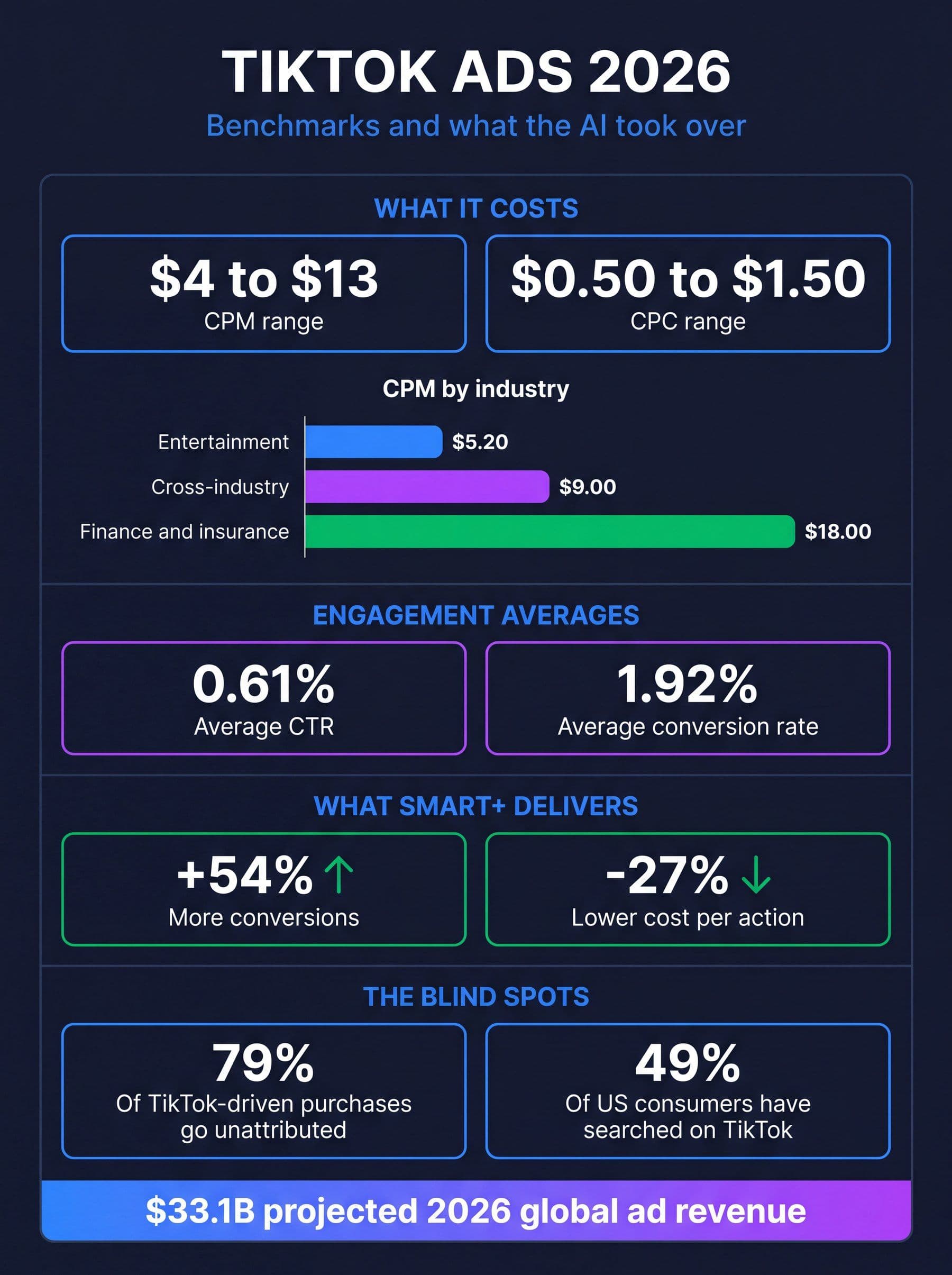
TikTok advertising costs get quoted as a single range constantly, and the single range is close to useless. Across all industries you will see CPMs between roughly $4 and $13 and CPCs between $0.50 and $1.50, with cross-industry CPC averaging around $1.02. Cost per acquisition runs anywhere from $15 to $80 and above.
The spread inside those averages is what should drive your planning. Industry CPM varies by roughly 3.5x, from about $5.20 in entertainment and media to $18.00 in finance and insurance. CPC ranges from $0.74 in beauty to $1.92 in legal services. A beauty brand and an insurance brand running identical creative on identical budgets are not playing the same game.
| Metric | Typical 2026 range | What moves it most |
|---|---|---|
| CPM | $4 to $13 (avg near $4.80 to $12) | Industry, from $5.20 entertainment to $18.00 finance |
| CPC | $0.50 to $1.50 (avg $1.02) | Vertical, from $0.74 beauty to $1.92 legal |
| CTR | Around 0.61% average | Creative quality and hook length |
| Conversion rate | Around 1.92% average | Offer, landing experience, consideration length |
| CPA | $15 to $80+ | Price point and purchase consideration |
TikTok ad formats and specs
TikTok's format list has grown, but the technical requirements have consolidated around a single shape. Vertical 9:16 is effectively mandatory. Horizontal and square assets are either rejected or cropped into irrelevance.
The working spec sheet for 2026:
- Aspect ratio: 9:16 vertical. Plan for it at the storyboard stage rather than reformatting later.
- Resolution: 540x960 minimum, 1080p strongly recommended, particularly for premium placements.
- Duration: 5 to 60 seconds supported. Nine to fifteen seconds performs best for most objectives.
- Bitrate: at least 2,500 kbps. Compression artifacts read as low effort and depress completion rates.
- File: .mp4, .mov, .mpeg, .3gp or .avi, up to 500 MB.
Format choice matters more than spec compliance. In-Feed ads are the workhorse and where most performance budget lands. TopView takes over the screen on app open and is priced for brand moments rather than efficiency. Spark Ads are the format worth understanding properly, because they behave differently from everything else.
A Spark Ad promotes an existing organic post rather than an upload. It inherits the original caption, the creator's profile image, and the engagement the post already accumulated. That inheritance is the point. The ad looks like content because it is content, and the social proof carries into the paid placement. For teams already investing in user-generated content marketing or creator partnerships, Spark Ads are the mechanism that turns organic performance into paid reach without rebuilding the asset.
TikTok advertising benchmarks and platform changes in 2026 at a glance
Smart+, GMV Max and Symphony: the AI stack
TikTok's automation now covers the three things a media buyer used to do manually: decide who sees the ad, decide what to pay, and make the ad.
Smart+ is the campaign layer. It automates targeting, bidding and creative combination, and the 2025 rebuild added module-level control so you can automate audience while keeping manual creative, or the reverse. TikTok reports that advertisers in third-party measured tests saw an average 54% increase in conversions and a 27% decrease in cost per action. Independent advertiser reports cluster around a 36% CPA reduction, and early tests suggested 20% to 30% improvement over manual optimization. Treat the vendor number as the ceiling and the independent number as the planning assumption.
GMV Max is the TikTok Shop equivalent. It optimizes toward gross merchandise value and, usefully, factors in affiliate commissions, coupons and seller fees rather than optimizing to a revenue figure that ignores your actual margin. If you sell through TikTok Shop, this is where the spend goes.
Symphony is the creative layer inside TikTok One. It generates scripts, produces AI avatars, translates existing videos and remixes assets into variants. It solves a real problem, because TikTok burns creative faster than any other paid channel, and the volume required to feed Smart+ is beyond what most in-house teams can shoot.
The catch with platform-native creative generation is brand consistency. Symphony will happily produce fifty variants that are technically on-message and visually off-brand, and nobody is reviewing all fifty. This is exactly the problem creative automation systems exist to solve, and it is why MarqOps builds Brand Intelligence DNA into generation rather than checking output afterward. Getting brand-correct assets from the first generation is cheaper than reviewing your way to them.
TikTok search ads and the discovery shift
TikTok has pushed hard on search, adding Search Hubs, Keyword Amplifier and Branded Buzz on the logic that social discovery increasingly triggers a search query. The data behind that logic deserves a closer look than it usually gets.
Adobe Express research in 2026 found that 49% of American consumers have used TikTok as a search engine, up from 41% in 2024. Among Gen Z the figure is 65%. Those numbers are real and they support building a TikTok search presence.
The number that gets left out is the one that matters more. Only 4% of Gen Z respondents said they are more likely to rely on TikTok over Google, and that figure fell from 8% in 2024. The share of Gen Z that has searched on TikTok went up while the share that prefers it over Google was cut in half. Separate analysis found roughly even usage across platforms, with about 67% of Gen Z searching on Instagram, 62% on TikTok and 61% on Google.
That split is why single-channel search strategy no longer works. The same buyer discovers a product on TikTok, checks reviews on Reddit, asks an AI assistant to compare options and finally converts through Google. If you are building for that path, our guides to AI visibility and zero-click search cover the surfaces TikTok hands off to.
The attribution problem nobody solves in the dashboard
TikTok's biggest measurement problem is that it works in ways its own reporting cannot see. TikTok research claims that 79% of purchases the platform drives are never attributed to it, and that simple click-and-buy measurement undervalues TikTok conversions by around 73%.
Those are platform-published figures and they benefit the platform, so treat them as directional rather than precise. The underlying mechanism, though, is well documented and not controversial: TikTok drives view-through demand that surfaces later as branded search, direct traffic or a marketplace purchase. Last-click models credit whatever came last.
Independent testing supports the direction. In one documented case, Liquid I.V. ran automated incrementality testing and found its TikTok automation was driving a 62% increase in incremental Amazon sales that last-click attribution had entirely missed. The sales existed. The attribution did not.
The practical response is to stop arbitrating this in the platform dashboard:
- Run geo holdout or conversion lift tests rather than comparing platform-reported ROAS across channels. Incrementality testing answers the question attribution cannot.
- Track branded search volume as a TikTok output. A spend increase that lifts branded queries two weeks later is doing its job even if the dashboard is quiet.
- Use media mix modeling for budget allocation and multi-touch attribution for tactical optimization. They answer different questions and swapping them causes most cross-channel budget arguments.
- Report TikTok next to every other channel in one view. Comparing a TikTok dashboard against a Google dashboard against a spreadsheet is how measurement disputes become unresolvable. A unified marketing dashboard at least makes the numbers arguable on the same basis.
A 90 day TikTok ads operating plan
If you are starting or restarting TikTok in 2026, the sequence below reflects how the channel actually behaves rather than how a platform onboarding flow presents it.
Days 1 to 30: build the creative engine before the campaign. The most common failure is launching with three assets and expecting Smart+ to optimize its way out of a supply problem. Target fifteen to twenty distinct creative concepts before meaningful spend, built as vertical-native video rather than repurposed horizontal cutdowns. Set up Spark Ad permissions with any creators you work with now, because retrofitting that authorization mid-flight wastes a week. Install conversion tracking properly and define the one event that matters.
Days 31 to 60: let Smart+ run and resist the urge to intervene. Automated campaigns need a learning window and most teams kill them inside it. Run Smart+ with module-level control if you want creative oversight, hold budget steady, and judge on cost per action rather than daily ROAS noise. Start a geo holdout in parallel so you have an incrementality read forming by the time anyone asks whether the channel works.
Days 61 to 90: scale on creative, not on budget. TikTok fatigue curves are short. Scaling usually means feeding new concepts, not raising bids on tired ones. Establish a weekly cadence of new variants, retire assets on frequency and completion decay rather than on gut feel, and use creative analytics to identify which hooks and formats are carrying performance so the next batch inherits what worked.
Where TikTok fits in the 2026 paid mix
TikTok is projected to capture about 4.2% of the total US digital ad market and 13.9% of US social advertising in 2026. That makes it a significant channel and not a dominant one, which is roughly where most media plans should place it.
It earns budget when your product is visually demonstrable, your price point supports impulse or short consideration, and you can sustain creative volume. It struggles when the purchase requires long research, when your creative pipeline produces one asset a month, or when your measurement stack cannot see past last click.
The comparison worth running is not TikTok against Meta. It is TikTok against every video surface competing for the same production budget, including connected TV and Google Demand Gen. All three now want vertical video, all three run on AI-managed delivery, and all three reward whoever can produce the most on-brand variants per week. The winning constraint across the entire modern paid stack is creative throughput.
That is the operational reality behind the channel-by-channel tactics. Teams running TikTok, Meta, Google and CTV from four separate tools with four separate creative pipelines lose most of their leverage to coordination overhead. MarqOps consolidates creative production, campaign analytics and brand governance into one system, which is what makes weekly creative velocity across every channel achievable without adding headcount. Our broader guide to AI advertising covers how that stack fits together.
Frequently asked questions
How much do TikTok ads cost in 2026?
Expect CPMs between roughly $4 and $13 and CPCs between $0.50 and $1.50, with cross-industry CPC averaging around $1.02. Industry is the biggest driver: CPM runs about $5.20 in entertainment and media versus $18.00 in finance and insurance, and CPC ranges from $0.74 in beauty to $1.92 in legal services. Cost per acquisition typically falls between $15 and $80 depending on price point and consideration length.
Did the US joint venture change anything for advertisers?
Operationally, very little. The TikTok USDS Joint Venture closed on 22 January 2026 with Oracle, Silver Lake and MGX each holding about 15% and ByteDance retaining just under 20%. Ad accounts, campaign history, TikTok Shop and Ads Manager continued running through the transition. The main change is that regulatory uncertainty is no longer a defensible reason to withhold budget.
What is the difference between Spark Ads and regular TikTok ads?
Spark Ads promote an existing organic post rather than a fresh upload. They inherit the original caption, the creator's profile image and the engagement the post already earned, so the social proof carries into the paid placement. Standard In-Feed ads are new creative uploaded directly into Ads Manager. Spark Ads generally perform better when you have organic or creator content that already resonated.
Is Smart+ better than manual TikTok campaigns?
For most advertisers, yes, provided you can feed it enough creative. TikTok reports 54% more conversions and 27% lower cost per action in third-party measured tests, and independent advertisers commonly report CPA reductions near 36%. The 2025 rebuild added module-level control, so you can automate targeting and bidding while retaining manual creative selection. Smart+ cannot compensate for a thin creative library.
Is TikTok really replacing Google as a search engine?
No, and the 2026 data actively contradicts that claim. While 49% of US consumers and 65% of Gen Z have searched on TikTok, only 4% of Gen Z say they are more likely to rely on TikTok over Google, down from 8% in 2024. TikTok search is additive for discovery and lifestyle queries. Transactional search still resolves on Google and increasingly on AI assistants.
Why does TikTok under-report conversions?
TikTok drives a large share of view-through demand that resurfaces later as branded search, direct traffic or a marketplace purchase, and last-click models credit whichever channel came last. TikTok's own research claims 79% of purchases it influences go unattributed. Those figures are platform-published, so verify with your own geo holdout or conversion lift testing rather than accepting either the platform number or the last-click number.
How much creative do I need to run TikTok ads properly?
Plan for fifteen to twenty distinct concepts before meaningful spend, then a sustained weekly cadence of new variants. TikTok's fatigue curves are shorter than any other major paid channel, and automated campaigns consume creative faster than manual ones. Teams that cannot sustain weekly output will see performance decay regardless of budget or bidding strategy.
The bottom line
TikTok in 2026 is a normal media channel with an unusual creative appetite. The ownership question is settled, the automation is competent, and the costs are predictable within your vertical. What has not changed is that the platform rewards volume and punishes reuse, and that its contribution is systematically invisible to last-click reporting.
The teams doing well on TikTok are not the ones with the best targeting instincts, because targeting is no longer theirs to control. They are the ones who can produce brand-correct vertical video every week and who measure the channel with holdout tests instead of dashboard ROAS. Solve those two problems and the rest of the platform mostly runs itself.
Keep following the signal