Zero-Click Search in 2026: The Complete Guide to Winning Visibility When Nobody Clicks
Zero-click search now accounts for about 68% of Google queries. Learn what it means, why AI Overviews drive it, and how to win visibility, citations, and pipeline in 2026.
TL;DR
- Zero-click search is when Google answers the query directly on the results page, so the searcher never visits a website. In early 2026, roughly 68% of Google searches ended without a click, up from about 60% in 2024.
- AI Overviews are the accelerant. They appear on more than 20% of searches, and when one shows, the zero-click rate jumps to about 83%. In Google AI Mode, 93% of searches end with no click at all.
- Clicks are shrinking, but the traffic that does come through is higher intent. AI-referred visitors have been shown to convert far better than traditional organic, so the game shifts from volume to qualified visibility.
- Winning in a zero-click world means optimizing for citation and presence: entity clarity, topical authority, extractable answers, schema markup, and strong branded demand, not just blue-link rankings.
- You need new KPIs (impressions, citation frequency, share of AI answers, branded search lift) and a unified way to track them. MarqOps brings SEO, content, analytics, and brand visibility into one dashboard so you can see the full search surface, not just sessions.
Table of Contents
- What Is Zero-Click Search?
- The 2026 Data: How Big Is Zero-Click Really?
- Why Zero-Click Search Is Happening Now
- What Zero-Click Means for Your Marketing
- How to Win in a Zero-Click Search World
- The New KPIs: Measuring Visibility, Not Just Clicks
- Your 90-Day Zero-Click Action Plan
- Frequently Asked Questions
What Is Zero-Click Search?
A zero-click search is any query that a searcher resolves without clicking through to a website. The answer is served right on the search engine results page, through a featured snippet, a knowledge panel, a local pack, a weather box, or, increasingly, an AI Overview that summarizes multiple sources in a few sentences. The person gets what they need and moves on. No session, no pageview, no line in your analytics.
This is not new in principle. Google has been answering simple questions like currency conversions and sports scores for years. What changed is scale and scope. Generative AI now composes answers to complex, multi-part questions that used to require reading two or three articles. That shift has pulled a huge share of informational demand off publisher sites and onto the SERP itself. If you have been following our coverage of AI Overviews and answer engine optimization, you already know the direction of travel. Zero-click is the outcome those forces produce.
Quick definition: Zero-click search describes a behavior (the SERP answers the query directly). Zero-click marketing describes the strategic response: treating that search surface as the placement itself, not just a stepping stone to your site.
Common types of zero-click results
Zero-click is not a single feature. It is a family of SERP elements that each intercept a click in a slightly different way. Knowing which ones affect your queries tells you where to compete.
- AI Overviews: AI-generated summaries that answer the query by synthesizing several sources, usually with a handful of citations. The fastest-growing and most disruptive format.
- Featured snippets: The classic “position zero” box that lifts a paragraph, list, or table straight from a ranking page.
- Knowledge panels: Structured facts about a brand, person, or entity pulled from the knowledge graph and trusted sources.
- People Also Ask: Expandable question boxes that answer related queries inline, often deep enough that the searcher never needs a link.
- Local packs, weather, sports, and calculators: Instant-answer widgets that have quietly resolved millions of queries for years.
The strategic takeaway is that each format is won differently. Featured snippets reward clean formatting, knowledge panels reward strong entity signals, and AI Overviews reward trusted, extractable content across a topic. A modern search strategy plans for all of them at once rather than chasing blue-link rank alone.
The 2026 Data: How Big Is Zero-Click Really?
The numbers have moved fast, and they are hard to ignore. In the first four months of 2026, about 68% of Google searches ended without a click to an external site. That is up from roughly 60% in 2024, a jump of nearly eight percentage points in two years. Zoom out further and the trend is stark: a decade ago around 45% of searches were zero-click, so the clickless share has climbed more than 20 points in ten years.
68%
of Google searches ended without a click in early 2026
The single biggest driver is the AI Overview. These AI-generated summaries now appear on more than one in five searches, and when they show up they cut click-through rates by roughly 60%. Put differently, searches that trigger an AI Overview carry an average zero-click rate near 83%, while searches without one sit closer to 60%. One study found that when an AI summary is present, only about 8% of users click through to a website, versus 15% when no summary appears.
Then there is Google AI Mode, the conversational search experience. It is still a small slice of total query volume, but Google said at its 2026 developer conference that AI Mode had passed a billion monthly users and that query volume was more than doubling each quarter. Inside AI Mode, roughly 93% of searches end without a click. As that experience grows, the zero-click share of the whole ecosystem grows with it.
| Search context | Approx. zero-click rate | What it tells you |
|---|---|---|
| All Google searches (2026) | ~68% | The baseline. Most searches never leave Google. |
| Searches with an AI Overview | ~83% | Informational queries lose the most clicks. |
| Searches without an AI Overview | ~60% | Still high, driven by snippets and panels. |
| Google AI Mode | ~93% | The most extreme surface, and it is growing fast. |
One important nuance keeps the picture balanced. Transactional queries, the ones with clear buying intent like “buy,” “price,” or “best tool for X,” are largely spared. Google has deliberately limited AI Overview coverage on commercial searches because people still need to reach a store or a signup page to finish the job. The practical read: informational demand is being absorbed by the SERP, while high-intent commercial demand still flows to sites. That split should shape where you fight for clicks and where you fight for citations.
Why Zero-Click Search Is Happening Now
Three forces converged. First, generative AI made it cheap for Google to synthesize an answer from many sources on the fly. Second, user behavior rewarded it, because most people prefer a fast answer over a hunt through ten links. Third, Google has a business incentive to keep users inside its ecosystem where it controls the experience and the ad inventory.
For marketers, this is the same tectonic shift we described in GEO vs SEO and LLM SEO. Search is no longer a directory that routes people to pages. It is becoming an answer layer that reads your content, extracts what it needs, and presents a synthesized response. Ranking number one still matters, but being the source the AI trusts and cites matters just as much. That is why entity SEO and topical authority have become foundational rather than optional.
What Zero-Click Means for Your Marketing
The instinct is to panic about lost traffic. That instinct is only half right. Yes, informational pages will see fewer sessions, and a click-only dashboard will make a well-performing brand and a failing one look identical, because both show flat or falling traffic. But the story underneath is more interesting.
When your brand is the source an AI Overview cites, you become part of the answer your audience is already receiving. That exposure compounds. Cited brands have been shown to see meaningfully higher direct traffic and branded search volume within about a month of consistent AI citation. In other words, the SERP becomes a branding surface, and the demand shows up later through channels you can still measure.
The clicks that survive are worth more. AI-referred visitors have been reported to convert dramatically better than traditional organic traffic, because the AI has already pre-qualified intent before the person ever reaches your site.
So the real impact is not “traffic is dead.” It is a reallocation. Volume drops on informational queries, quality rises on the clicks that remain, and brand presence on the SERP becomes a leading indicator of future revenue. Teams that keep score only on sessions will misread all three. This is exactly why tracking your AI visibility and monitoring where your brand appears through AI brand monitoring has moved to the center of the modern marketing stack.
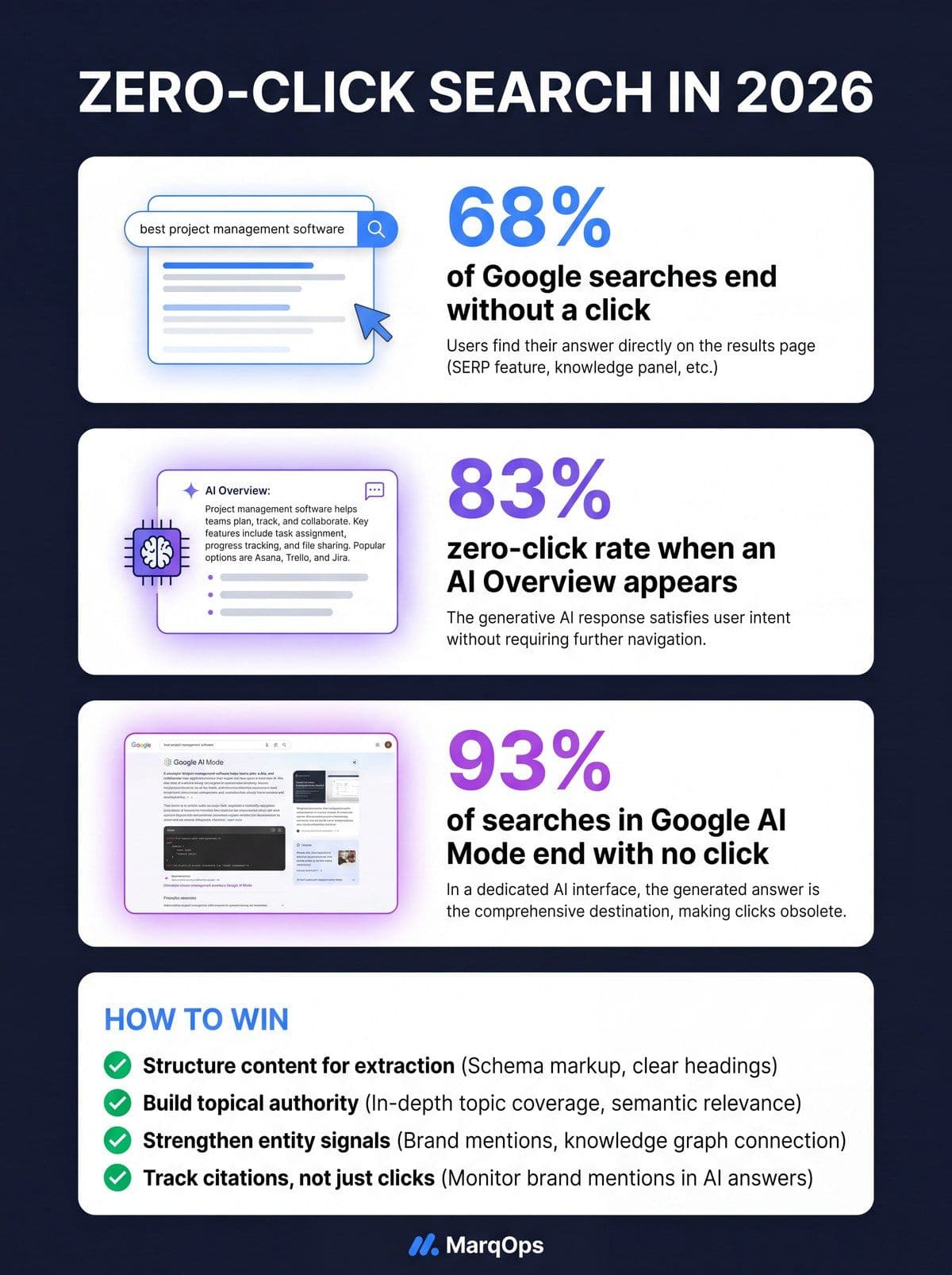
The zero-click search landscape in 2026: the numbers, the drivers, and the response.
How to Win in a Zero-Click Search World
Winning is less about clawing back clicks and more about owning presence. Here is where to focus.
1. Structure content for extraction and citation
AI systems and featured snippets reward content they can lift cleanly. Lead each section with a question-style heading, then answer it in the first 40 to 60 words before you expand. Use ordered lists for steps, tables for comparisons, and clear definitions for key terms. The easier it is for a machine to quote you accurately, the more often you become the cited source. Our guide to AI content optimization walks through this format in detail.
2. Build topical authority, not one-off posts
Google’s AI layer favors sources that demonstrate depth across a subject. A hub-and-spoke model, one comprehensive pillar page supported by focused cluster articles that link back with descriptive anchor text, signals genuine expertise. This is the same architecture that powers durable rankings and, increasingly, AI citations.
3. Strengthen your entity footprint
AI answers are built on entities, the people, products, and organizations a model can recognize and trust. Consistent naming, structured data, an accurate knowledge panel, and third-party corroboration all make your brand easier to identify and cite. When the model understands who you are, it is far more likely to name you in an answer.
4. Add schema markup everywhere it fits
FAQ, HowTo, Article, Product, and Organization schema help engines parse your content and qualify it for rich results and AI extraction. Schema will not guarantee a citation, but its absence makes you harder to read, and in a zero-click world readability is leverage.
5. Optimize hard for clicks where clicks still exist
Since commercial and transactional queries keep sending traffic, treat them differently. Sharpen your titles, meta descriptions, product pages, and comparison content for those searches. Split your strategy: pursue citation and visibility on informational queries, and pursue the click on high-intent commercial ones.
6. Invest in demand you own
The most durable asset in a zero-click era is an audience you can reach without a search engine in the middle. Email lists, communities, branded apps, and social followings all convert search exposure into a relationship. When the SERP builds your awareness, owned channels capture the intent it creates. Rising share of search for your brand is one of the clearest early signals that this flywheel is turning.
The MarqOps angle: Most teams juggle a separate tool for SEO, one for content, one for analytics, and another for AI visibility, then lose hours stitching the data together. MarqOps replaces 7+ disconnected tools with one brand-intelligent platform, so your zero-click strategy, from extractable content to citation tracking, runs from a single unified dashboard.
The New KPIs: Measuring Visibility, Not Just Clicks
If most searches never reach your site, a traffic-only report captures less than half the picture. Forward-thinking teams are rebuilding their scorecards around presence, not just sessions. The metrics that matter now include:
- Impressions and pixel depth: How often you appear and how much of the visible SERP you own, including AI Overview impressions, which Google Search Console now reports alongside standard impressions.
- AI citation frequency: How often AI Overviews and assistants like ChatGPT, Perplexity, and Gemini name your brand or link your content.
- Share of answers: For your priority queries, what percentage of AI responses and featured snippets you hold versus competitors.
- Branded search lift: Growth in people searching your brand directly, a reliable downstream proxy for zero-click exposure working.
- Assisted conversions: The revenue that visibility influences even when the first touch never registered as a click.
Tracking all of this by hand across separate tools is where most teams stall. Purpose-built AI search visibility tools and a unified marketing dashboard pull impressions, citations, and branded demand into one view, so you can prove that visibility is translating into pipeline. If your reporting still lives in disconnected spreadsheets, start with our guide to AI marketing analytics.
Your 90-Day Zero-Click Action Plan
You do not need to rebuild everything at once. Here is a practical sequence.
Days 1 to 30, audit and baseline. Identify which of your top queries now trigger AI Overviews and where your brand does or does not appear. Set a baseline for impressions, citation frequency, and branded search so you can measure progress. Separate your informational queries from your commercial ones.
Days 31 to 60, restructure for extraction. Rewrite your highest-value informational pages with question-led headings, concise lead answers, tables, and complete schema markup. Tighten entity signals: consistent naming, an accurate Organization profile, and structured data across the site. With a brand-intelligent platform, this is where 6x faster content output pays off, because you can reformat and expand at scale without losing brand voice.
Days 61 to 90, build the flywheel and measure it. Launch or strengthen an owned channel to capture the demand your SERP presence creates. Stand up a visibility dashboard that reports citations, share of answers, and branded search lift next to pipeline. Review, double down on the queries where you are winning citations, and repeat.
Frequently Asked Questions
What is a zero-click search?
A zero-click search is a query that gets answered directly on the search results page, so the person never clicks through to a website. The answer comes from a featured snippet, knowledge panel, local pack, or an AI Overview. In early 2026, about 68% of Google searches ended this way.
Are AI Overviews causing zero-click search?
They are the biggest accelerant. AI Overviews appear on more than 20% of searches and cut click-through rates by roughly 60%. When an AI Overview is present, the zero-click rate climbs to about 83%, compared with around 60% when one is not.
Is zero-click search bad for my business?
Not necessarily. Informational traffic drops, but brand presence on the SERP builds awareness that shows up later as direct and branded search. The clicks that remain tend to convert better because intent is pre-qualified. The risk is only real if you measure success by sessions alone.
How do I optimize for zero-click search?
Structure content for extraction with question-led headings and concise answers, build topical authority through pillar and cluster pages, strengthen your entity signals, add schema markup, and keep optimizing hard for clicks on commercial queries. Then invest in owned channels to capture the demand your visibility creates.
What KPIs replace clicks in a zero-click world?
Track impressions and SERP pixel depth, AI citation frequency, share of AI answers for priority queries, branded search lift, and assisted conversions. Google Search Console now reports AI Overview impressions, and a unified dashboard ties these visibility signals to pipeline.
Keep following the signal
Related field notes
Marketing
Brand Asset Management in 2026: How to Run It Without Adding Another Tool
14 min readMarketing Operations
Marketing Project Management Software in 2026: How to Choose Without Adding Tool #122
11 min readMarketing Analytics