AI Agent Governance for Marketing Teams: The 2026 Framework
Gartner expects 40% of enterprises to demote or decommission AI agents by 2027 over governance gaps. Here is a four-level framework built for marketing teams.
Ask a marketing team how many AI agents are running in their stack and you will usually get a confident number. Ask who owns each one, what credentials it holds, and what happens if it starts writing something wrong at three in the morning, and the confidence drops.
That gap is now measurable. Deloitte's State of AI in the Enterprise research puts mature agentic governance at roughly one in five organisations, while adoption keeps climbing. Gartner, polling more than 3,400 organisations investing in the technology, expects over 40% of agentic AI projects to be cancelled by the end of 2027, and pins the cause on cost, unclear value, and inadequate risk controls rather than on the models themselves. In a separate May 2026 forecast, Gartner predicted that 40% of enterprises would demote or decommission autonomous agents because governance gaps only became visible after something went wrong in production.
Marketing is a good place for those gaps to hide. The output looks finished. A generated brief reads like a brief, a drafted report reads like a report, and nothing in the interface tells you whether the number in paragraph three came from Search Console or from the model's imagination. This guide covers what AI agent governance actually means, the autonomy model worth stealing from enterprise IT, the seven controls that matter for marketing specifically, and a rollout that does not require a committee.
Contents
- What AI agent governance actually means
- Why 2026 is the year marketing cannot defer this
- The governance gap, in numbers
- Classify agents by autonomy, not by tool
- Mapping your marketing agents to a level
- Seven controls that make the framework real
- Disclosure, labelling, and what goes in the client contract
- A 30 day rollout for a team that does not have a governance function
- Five mistakes that keep showing up
- Where MarqOps fits
- Frequently asked questions
- The bottom line
What AI agent governance actually means
Most definitions of AI agent governance are written for a CISO. They talk about policy frameworks, risk registers, and model cards. All useful, none of it answers the question a marketing lead is actually asking, which is: what stops this thing from doing something I will have to explain to a client.
Strip it back and governance is four decisions, made once per agent and written down.
- Scope. Which systems and which accounts can this agent reach, and with which permission level on each.
- Autonomy. What it may do without asking, what it must propose and wait on, and what it must never do at all.
- Accountability. The named human who owns its behaviour, and the review that happens before its output becomes a claim.
- Evidence. The record that lets you reconstruct, after the fact, what it did and on what basis.
The reason those four and not forty is that both major standards land in the same place. NIST's AI Risk Management Framework and ISO/IEC 42001 converge on lifecycle accountability: every agent needs a defined owner, a clear intent, a bounded scope of access, and an explicit end. ISO 42001 in particular pushes the discipline further, treating agents the way a security team treats service accounts, which means formal onboarding, periodic review, and decommissioning when the agent is no longer needed. Identity practitioners have started describing this as giving each agent a digital birth certificate, which is a slightly dramatic phrase for a genuinely sensible idea.
Why 2026 is the year marketing cannot defer this
Two things changed this year, and they pull in the same direction.
The first is regulatory. The EU AI Act's transparency obligations under Article 50 took effect on 2 August 2026, and they apply immediately to in-scope systems regardless of when those systems came to market. Providers of systems that generate synthetic text, image, audio or video have to mark outputs in a machine-readable format and make them detectable as AI-generated. Generative systems already on the market before that date have until 2 December 2026 to meet the machine-readable marking requirement. Penalties run up to EUR 15 million or 3% of worldwide annual turnover, whichever is higher.
The part marketing teams tend to skim is the deepfake definition. Under the final Commission guidance, AI-generated marketing content that makes a product appear different from reality, digital replicas of real people, and de-aging effects applied to actors all count as deepfakes requiring disclosure. The guidelines also classify most advertising examples as not qualifying for the reduced disclosure regime. If your creative pipeline is generating product imagery at volume, that is a labelling obligation, not a footnote.
The second is commercial. The US FTC's position through 2026 has been that a brand stays liable for advertising produced on its behalf, including by an agency or an AI tool, and that AI-involved sponsored content needs disclosure of both the sponsorship and the AI involvement. The IAB published its first AI Transparency and Disclosure Framework on 15 January 2026, built around flagging by real effect rather than by tooling, which is a more workable standard than labelling anything an AI touched.
Put those together and the governance question stops being internal hygiene. It becomes a question about what you can defend in front of a client, a regulator, or a platform review.
The governance gap, in numbers
The adoption figures and the readiness figures do not agree, which is the whole story.
| Signal | Figure | Source |
|---|---|---|
| Organisations adopting AI agents | 79% | PwC |
| Enterprises with at least one agent in production | 31% | S&P Global Market Intelligence |
| Organisations reporting mature agentic AI governance | 21% | Deloitte |
| Organisations with no formal plan for deploying agents | 36% | Survey aggregate, 2026 |
| Organisations that say they could not shut down a rogue agent | 35% | Survey aggregate, 2026 |
| Agentic AI projects Gartner expects to be cancelled by end of 2027 | Over 40% | Gartner |
| Enterprises expected to demote or decommission agents over governance gaps by 2027 | 40% | Gartner |
The line worth sitting with is the shutdown one. A third of organisations running agents say they could not reliably stop one. That is not a sophisticated governance failure. That is a missing off switch.
That last number is the argument against treating governance as drag. The same body of research that reports an average 171% return on agent deployments also reports that 19% never reach payback at all, and that the teams who set baseline metrics, ownership, and controls before deployment get to positive return meaningfully sooner. Governance is not what slows the project down. Rework after an incident is.
Classify agents by autonomy, not by tool
Gartner's most useful contribution here is a warning about how teams get this wrong. Writing in May 2026, Senior Director Analyst Shiva Varma described enterprises treating agent governance as binary, either locked down or fully trusted, and called that the root cause of failure. Apply the same controls to everything and you get one of two outcomes: over-restriction of simple agents, which slows delivery and pushes people toward shadow tools, or under-restriction of the autonomous ones, which is where the operational and compliance risk lives.
The fix is proportional governance built on four autonomy levels. Each level is a different trust boundary with different requirements.
| Level | What the agent does | Access | Governance focus |
|---|---|---|---|
| 1. Observe | Reads and summarises. Output visible only to the person who asked. | Read-only, scoped sources | Scoped data access, authentication, usage logging, basic testing |
| 2. Advise | Generates recommendations and drafts. A human executes everything. | Read-only, no write anywhere | Everything in Level 1, plus accuracy and hallucination testing, and training on how much to rely on it |
| 3. Act with approval | Writes data, sends messages, changes configuration, but only after explicit approval per action. | Write, gated | Approval workflows with audit trails, security testing, agent-specific incident response |
| 4. Act autonomously | Executes inside guardrails. Humans review exceptions and aggregate outcomes, not individual decisions. | Write, bounded | Continuous monitoring, enforced guardrails, rollback, circuit breakers, named owner |
Two details in that model deserve attention because marketing teams trip on both.
The first is Level 2. An agent that only advises still carries risk, because people trust confident output. Gartner calls this automation bias, and the practical consequence is that a wrong recommendation gets executed by a human who assumed the agent had checked. Advisory agents need accuracy testing precisely because nobody is watching them write.
The second is Level 3 and approval fatigue. Human review is only a control while it stays meaningful. Route every routine action through an approval queue and reviewers start clicking through without reading, which produces the paperwork of oversight and none of the substance. The design principle is risk tiering: let low-risk reversible actions run, and reserve the named approver for the actions that are expensive to undo.
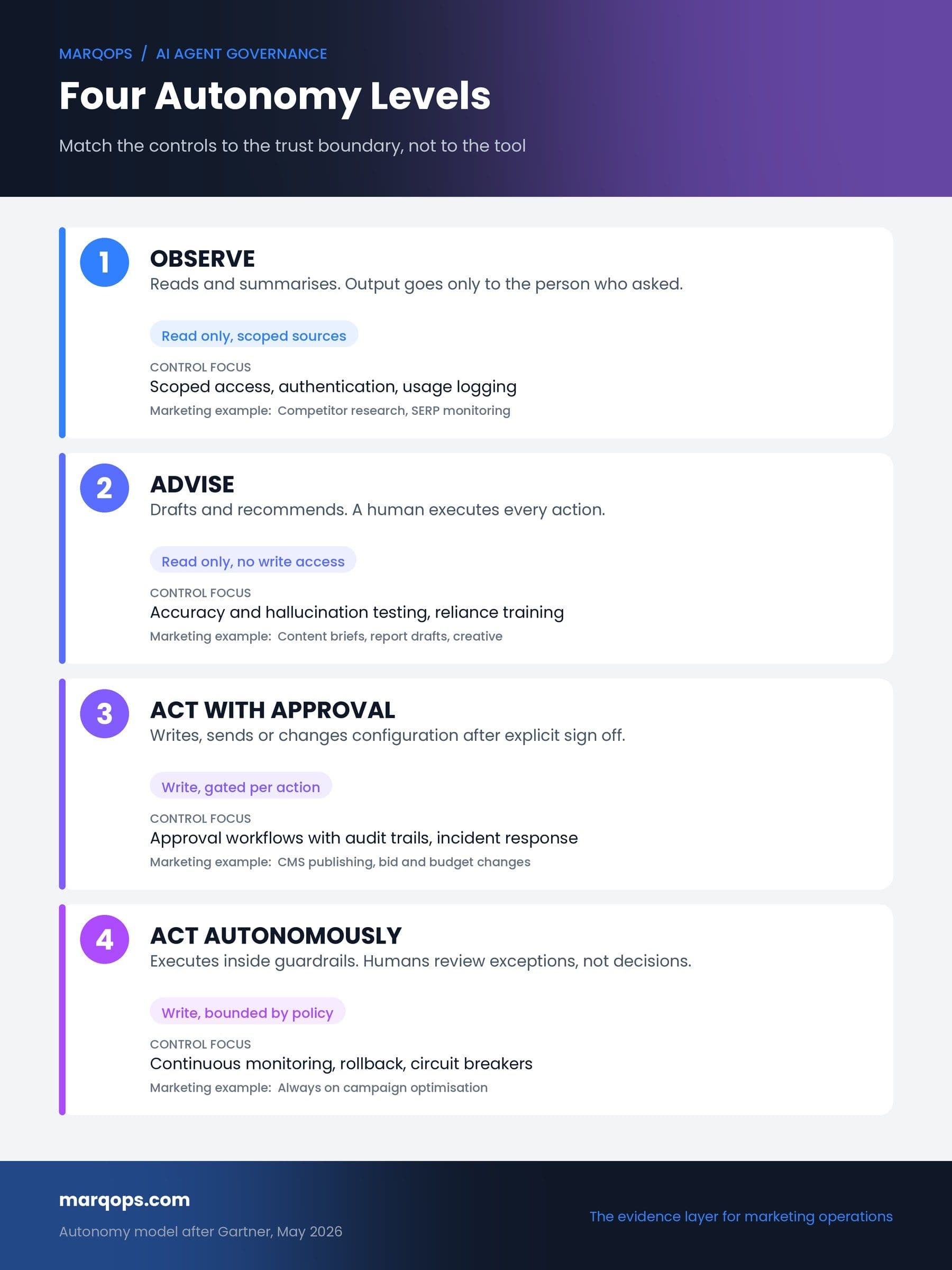
Proportional governance: each autonomy level is a different trust boundary with its own controls.
Mapping your marketing agents to a level
The model is abstract until you run your own stack through it. Here is how the common marketing cases usually land.
| Marketing agent | Typical level | The control that matters most |
|---|---|---|
| Competitor and SERP research | 1. Observe | Source logging, so conclusions can be traced back |
| Analytics question answering over GA4 and Search Console | 1 or 2 | Read-only credentials, one property per connection |
| Content brief and draft generation | 2. Advise | Approved source material and a brand voice standard |
| Creative and product image generation | 2. Advise | Disclosure and labelling, plus a rights check on inputs |
| Client report drafting | 2 or 3 | Claim verification before anything is sent |
| Publishing to a CMS | 3. Act with approval | Per-action approval with an audit trail |
| Bid, budget, or negative keyword changes in a live ad account | 3 or 4 | Spend ceilings, rollback, and a circuit breaker on thresholds |
| Outbound email or social posting | 3. Act with approval | Named approver, no exceptions, because it is not reversible |
Notice how much of marketing sits at Level 2. That is the honest picture for most teams in 2026, and it is fine. The mistake is not being at Level 2. The mistake is running a Level 3 workflow, such as an agent that pushes negative keyword changes straight into a live account, while governing it like Level 1 because it started life as a research helper. Agents drift upward in capability quietly. The registry is what catches that.
Seven controls that make the framework real
1. An agent registry with a named owner
One spreadsheet or one page. Every agent gets a row: what it does, which level it sits at, which systems and accounts it can reach, which credential it uses, who owns it, and when it was last reviewed. This is the control that makes the other six possible, and it is the one most teams skip because it feels like admin rather than safety. It is the thing that answers "how many agents do we have" with a number you can defend.
2. Scoped credentials, one client at a time
Keep the agent small by default. A research agent should not hold the same reach as a publishing agent, and a tool that reads data should never inherit write access because it was convenient at setup. For agency work the additional rule is separation by client: one property or one account per credential, so a prompt that wanders cannot pull one client's data into another client's report. We went through the specifics of this for search data in the guide to Google Search Console MCP setup, and the same shape applies to ad accounts and analytics properties.
3. Approval gates matched to risk
Tier the gates. Reversible, low-impact actions run without interruption. Actions that spend money, send something to a third party, or change a published asset route to a named approver with a response window. Anything that cannot be undone gets a hard stop. If an approval times out, the safe default is denied, with the context captured for review rather than silently dropped.
4. Claim verification before anything reaches a client
This is the control marketing needs most and standard agent governance guidance covers least, because most of it was written for engineering workflows. When an agent drafts a report or a case study, the risk is not that it breaks a system. The risk is that it states something as fact which the underlying data does not support, and a human ships it because it read well.
A workable review has three outcomes rather than two. Verified means the claim matches source data you can point at. Needs context means the relationship is real but the framing overstates it, which is where most correlation-as-causation language lives. Unsupported means there is no evidence behind it and it does not ship. Applying that grading to client-facing language is the same discipline behind a defensible white label SEO report, and it catches the failure mode that policy documents never do.
5. A brand voice and source standard the agent is held to
Governance is not only about risk to the business. It is also about output that quietly stops sounding like the brand. Teams that do this well maintain an approved source set, a message hierarchy, and explicit rules for when a draft needs an editorial rewrite rather than a light edit. That is a governance artefact, not a style guide, and it belongs alongside the registry. Our notes on AI brand voice and the three-layer approach in brand compliance go deeper on how to write those rules so a model can actually follow them.
6. An audit trail you could hand to someone else
The test is reconstruction. Six weeks after a report goes out, could you show which agent produced a given paragraph, which data it queried, who approved it, and when. Prose policies do not survive that test. Versioned, machine-readable configuration does, because it can be diffed, tested against sample decisions, and enforced rather than remembered. Both the EU AI Act's human oversight requirement in Article 14 and NIST's framework point at demonstrable oversight, and demonstrable means there is a record.
7. A kill switch someone has tested
Given that roughly a third of organisations say they could not stop a rogue agent, this is worth an afternoon. For each agent: what revokes its credential, who can do it, how long it takes, and what state it leaves behind. Then actually do it once in a non-production context. A circuit breaker that halts an agent when it crosses a spend or volume threshold belongs here too, and it is the difference between an incident and an outage. Anomaly detection on ad accounts is one practical trigger for that breaker.
Disclosure, labelling, and what goes in the client contract
Agencies have a second layer of exposure that in-house teams do not, because the work is delivered under someone else's brand. The advice converging across 2026 is that blanket disclosure everywhere is not the right posture, and neither is silence. What matters is written alignment on what AI assistance means in that specific relationship.
Four clauses cover most of it:
- Disclosure of AI use, defined by category of work rather than by tool, so it does not need renegotiating every time you change vendors.
- An IP warranty carve-out for AI-generated portions of a deliverable, which protects you from warranting originality you cannot verify.
- Training-data exclusion of client materials, stating that the client's data is not used to train third-party models.
- A liability cap tied to fees paid, which is standard practice and unusually relevant here.
On the labelling side, the IAB's flag-by-real-effect standard is the more usable rule: label work where AI has shifted who or what the content appears to show in a way that could mislead. An AI-assisted first draft of a blog post is not that. A generated product image that shows the product in a state it has never been in is.
A 30 day rollout for a team that does not have a governance function
Nobody in a small marketing team is going to stand up an AI governance board. The version that actually gets done looks like this.
| Window | What you do | What you end up with |
|---|---|---|
| Days 1 to 5 | Inventory. List every agent, assistant, connector and automation touching marketing work, including the ones an individual set up alone. | A registry, probably longer than expected |
| Days 6 to 10 | Classify each entry against the four autonomy levels and assign a named owner. | A level and an owner per agent |
| Days 11 to 15 | Audit credentials. Revoke write access nothing needs, split shared credentials by client, rotate anything stale. | Scoped access matching the level |
| Days 16 to 20 | Define approval gates for everything at Level 3 or above, and write the claim review rule for anything client-facing. | Gates and a review standard |
| Days 21 to 25 | Test the kill switch on every Level 3 and 4 agent. Set spend and volume thresholds where they apply. | A tested stop procedure |
| Days 26 to 30 | Write the one-page policy from what you actually did, and set a review cadence. | A policy that describes reality |
The ordering matters. Most governance efforts start at day 26, write a policy first, and then discover the inventory does not match it. Doing the policy last means it documents the system you have rather than the one you intended. That sequencing is the same reason a marketing operations function that starts with process mapping outperforms one that starts with a tool purchase.
Five mistakes that keep showing up
Governing by tool rather than by action. The question is never whether the team may use a particular assistant. It is what any agent may do to a live account. Vendor-level policies go stale the week someone tries a new product.
Treating every agent identically. Covered above, and it is the failure Gartner singles out. Uniform controls produce shadow tooling at one end and unreviewed writes at the other.
Confusing capability with access. An agent's ability to act and the scope it has been granted are separate things, and conflating them is where the incidents come from. A capable agent with narrow access is safe. A limited agent with broad credentials is not.
Approval theatre. If reviewers approve 200 items a week, they are not reviewing. Cut the queue to what genuinely needs a decision, or the gate becomes a record that nobody looked.
Measuring adoption instead of outcomes. Counting agents deployed tells you nothing about whether they work. Track the things governance is supposed to protect: claims corrected before delivery, incidents, rework, and the actual return on AI marketing investment.
Where MarqOps fits
MarqOps is built as the evidence layer for marketing operations, which is a specific claim about where the governance work happens. Rather than replacing the dashboards and ad platforms a team already runs, it sits above them and holds the review step: material claims are traced to a source and held for human approval before they reach a client.
In the terms of this article, that is controls four, six, and part of three. Claims move through a three-state review of verified, needs context, or unsupported, with the evidence receipt attached. Source context, human approval, account scope and an activity trail stay attached to consequential decisions, which is the audit trail requirement in a form that does not depend on anyone remembering to log something. Connections run to Search Console, GA4, and Google Ads, so the data behind a claim is the data the platform actually returned.
The four modules line up with the same map. Analytics Ops answers plain-language questions over connected data and keeps the source view one click away, which is Level 1 and 2 work done with the logging already in place. Ad Ops surfaces campaign risk through traffic-light analysis and search-term review and turns it into a governed next action rather than an automatic one, which is the Level 3 pattern. SEO agents and creative generation run against a brand-aware system rather than a blank prompt.
None of that removes the need for a registry, scoped credentials, or a tested kill switch. Those stay your job. What it does remove is the part where the audit trail depends on discipline.
Frequently asked questions
What is AI agent governance?
AI agent governance is the set of decisions that define what an autonomous or semi-autonomous AI agent may access, what it may do without human approval, who is accountable for its behaviour, and what record it leaves behind. In practice it is a registry, scoped credentials, approval gates, a review standard, an audit trail, and a way to stop the agent.
What are the four levels of AI agent autonomy?
Gartner's model describes four: observe, where the agent reads and summarises with no write access; advise, where it drafts and recommends but a human executes; act with approval, where it can write or send but only after explicit sign-off per action; and act autonomously, where it executes inside guardrails and humans review exceptions rather than individual decisions. Each level carries a different set of controls.
Do marketing teams have to disclose AI-generated content in 2026?
In the EU, yes for content covered by the AI Act's Article 50 transparency rules, which took effect on 2 August 2026 and require machine-readable marking plus clear labelling for synthetic content including most advertising examples. In the US, the FTC requires disclosure of both sponsorship and AI involvement for AI-involved sponsored content, and holds the brand responsible for work produced on its behalf. The IAB's January 2026 framework offers a practical middle standard: label where AI has shifted what the content appears to show.
Should every AI agent be governed the same way?
No, and Gartner identifies uniform governance as a leading cause of enterprise agent failure. Applying heavy controls to a read-only research agent slows delivery and pushes people toward unmanaged tools, while applying light controls to an agent that can change a live ad account creates real operational and compliance risk. Classify by autonomy level and match the controls to the trust boundary.
How do you stop an AI agent from publishing something factually wrong?
Verification has to happen against source data, not against how confident the output sounds. The workable pattern is a three-state review applied to every material claim before delivery: verified where the claim matches evidence you can point to, needs context where the relationship is real but the framing overstates it, and unsupported where there is no evidence behind it. Unsupported claims are blocked rather than edited.
Does AI agent governance slow marketing teams down?
Not when it is proportional. Research on agent deployments suggests teams that establish ownership, baseline metrics and controls before launch reach positive ROI considerably faster than teams that add governance after an incident, largely because they avoid the rework. What does slow teams down is uniform restriction applied to low-risk agents, which is a design problem rather than an argument against governance.
The bottom line
The interesting thing about the 2026 data is that the failures are not exotic. Agents are not going rogue in clever ways. They are running with credentials nobody scoped, producing output nobody verified, owned by nobody in particular, with no record of what they did and no reliable way to stop them. Every one of those is a decision that was never made rather than a decision that was made badly.
Which is the encouraging part. Six controls and a registry is a week of work for a marketing team, not a programme. Inventory what you have, classify it by what it can actually do, scope the credentials to match, gate the actions you cannot undo, verify claims against evidence before they reach a client, keep the trail, and test the stop.
Do that and the agents get more useful rather than less, because you can finally let the safe ones run without wondering what else they are touching.
Keep following the signal