User-Generated Content Marketing in 2026: Performance Data, AI, and the New Disclosure Rules
UGC-style creative now earns 4.7x the click-through rate of studio ads at 56% lower CPC, yet only 16% of brands run a dedicated strategy. Here is what user-generated content marketing delivers in 2026, what creators charge, how AI rewrote the supply side, and the disclosure rules that landed this summer.

A customer's shaky phone video, filmed in bad kitchen lighting, will usually outperform the ad you paid an agency $40,000 to produce. Marketers have known this for a decade. What changed in 2026 is that the gap stopped being a curiosity and became the entire economics of paid social: UGC-style creative on Meta now delivers click-through rates roughly 4.7 times higher than studio-produced brand ads, at a cost per click 56% lower.
And yet only 16% of brands run a dedicated user-generated content strategy. Most treat UGC as something that happens to them rather than something they operate. That gap is where this guide lives. Below is what user-generated content marketing actually delivers in 2026, what it costs, how AI rewrote the supply side, and the disclosure rules that landed this summer and can now cost you $53,088 per violation.
Table of Contents
- What Is User-Generated Content Marketing?
- The Numbers: What UGC Actually Delivers in 2026
- The Five Types of UGC, Ranked by Effort and Payoff
- The Volume Problem: Why Most UGC Programs Stall
- What UGC Costs in 2026
- AI-Generated UGC: What Actually Changed
- The 2026 Disclosure Rules You Cannot Ignore
- Usage Rights, Whitelisting, and Spark Ads
- UGC Is Now an AI Search Asset
- How to Source UGC Without Paying for All of It
- Measuring UGC Without Fooling Yourself
- Building a UGC Program in 90 Days
- Seven Mistakes That Kill UGC Programs
- Frequently Asked Questions
What Is User-Generated Content Marketing?
User-generated content marketing is the practice of sourcing, licensing, and distributing content created by customers, creators, and employees rather than by the brand's own studio. Reviews, unboxing videos, testimonial clips, before-and-after photos, Reddit threads, TikToks filmed on a phone: all of it counts, and all of it can be put to work in paid media, on product pages, in email, and in retail listings.
The definition matters less than the distinction underneath it. UGC is not free content. It is content whose credibility comes from not being made by you. The moment it looks brand-produced, the advantage evaporates. That single constraint explains most of what follows, including why AI-generated UGC is such a complicated proposition.
It is also worth separating UGC from influencer marketing, because the two get conflated constantly. Influencer marketing buys an audience. UGC buys an asset. A creator with 400 followers can produce UGC that outperforms a creator with 400,000, because you are not paying for their distribution, you are paying for footage you will distribute yourself. The rates, the briefs, and the success metrics are all different. Our breakdown of AI-driven influencer marketing covers the audience-buying side in detail.
The Numbers: What UGC Actually Delivers in 2026
The performance case for UGC is unusually well documented, which is rare in marketing. The consistent finding across studies is that it wins on both sides of the equation: higher response, lower cost.
On-site, shoppers who interact with a UGC gallery convert at a 140% higher rate, and featuring UGC across marketing touchpoints raises revenue per visitor by 154%. In paid social, the 4.7x CTR advantage and 56% lower CPC compound into meaningfully cheaper acquisition, which is the number that actually moves a budget conversation. If you are tracking blended efficiency, this is one of the few creative decisions that reliably shows up in customer acquisition cost.
The trust data explains why. 92% of consumers say they trust UGC more than any form of brand advertising, 79% say it materially affects their purchase decisions, and 93% would rather engage with authentic user posts than branded ads. Engagement rates run about 28% higher than branded equivalents. Meanwhile 93% of marketers report that UGC outperforms their branded content, which makes the 16% adoption figure genuinely strange.
The category is growing to match. The global UGC platform market was worth $7.1 billion in 2025, reaches roughly $8.48 billion in 2026, and is projected at $64.31 billion by 2034. That trajectory is not about consumers posting more. It is about brands finally building operational systems to capture, license, and deploy what consumers already post.
The Five Types of UGC, Ranked by Effort and Payoff
Not all UGC does the same job. Treating it as one bucket is the most common planning error, because the sourcing cost and the conversion mechanism differ enormously across formats.
| Type | Typical cost | Best used for | Time to first asset |
|---|---|---|---|
| Reviews and ratings | Near zero, plus request automation | Product pages, retail listings, AI search visibility | Days |
| Organic social posts and mentions | Rights request only | Social proof modules, community content | 1 to 2 weeks |
| Commissioned creator video | $150 to $300 per video | Paid social performance creative | 2 to 3 weeks |
| Customer testimonial and case content | Incentive or gifting | Mid-funnel, sales enablement, landing pages | 3 to 6 weeks |
| Employee-generated content | Internal time | Employer brand, B2B credibility, LinkedIn | Ongoing |
The pattern most teams miss: reviews are the cheapest and highest-leverage asset on the list, and almost nobody operates them deliberately. Commissioned creator video gets all the attention because it is the format that feeds paid social, but a systematic review-generation program costs a fraction as much and now pays off twice, once on the product page and once in AI-generated answers.
The Volume Problem: Why Most UGC Programs Stall
Here is the failure mode. A brand runs a UGC test, sees a 3x improvement on a single creative, declares victory, and then watches performance decay over six weeks with nothing queued behind it. The problem was never whether UGC works. It is that UGC works and then burns out, faster than any other format.
In 2026 a high-performing paid social creative burns out in days rather than weeks. Once ad frequency passes roughly 2.5x on TikTok, conversion rates typically drop 30% to 40%, and on high-spend accounts that decay begins almost immediately. A brand spending $10,000 a month on TikTok needs 10 to 20 new creatives every month simply to hold position. Brands refreshing at 15 to 50-plus variants monthly extend campaign life by 3x to 5x, and that high-volume refresh is now the dominant strategy above $10,000 in monthly paid social spend.
That reframing is what separates a UGC campaign from a UGC program, and it is a supply chain problem more than a creative one. Our guide to building a content supply chain covers the operating model, and creative automation covers how the variant layer gets built without a proportional increase in headcount.
What UGC Costs in 2026
Creator pricing has stabilized enough to plan against. Most UGC creators charge $150 to $300 per video depending on experience, format, and rights. Beginners start near $100 and experienced creators charge $500 or more. Reaction-format video runs $200 to $400 for established creators and $75 to $150 for newer ones.
| Line item | 2026 range | Notes |
|---|---|---|
| Standard UGC video, no paid rights | $100 to $500 | $150 to $300 covers most briefs |
| Whitelisting or Spark Ads rights | +50% to +100% of base | Negotiate at brief stage, not after |
| Raw footage delivery | Usually included if requested upfront | Essential for editing variants |
| Exclusivity or category lockout | Significant premium | Rarely worth it below enterprise scale |
| Monthly library at $10k paid social spend | $1,500 to $6,000 | 10 to 20 assets at typical rates |
Two costs get missed in almost every first budget. The first is editing: a raw creator video is an input, not an ad, and each one should yield three to six cut-downs, hook variants, and aspect ratios. The second is rights administration, which is a real operational cost once you are managing dozens of creators with different terms and expiry dates.
AI-Generated UGC: What Actually Changed
Synthetic UGC arrived properly in 2026. AI-generated presenters delivering testimonial-style scripts are now cheap enough and convincing enough that a whole category of managed agencies has grown around producing them at volume. The appeal is obvious against the numbers above: if your constraint is 20 assets a month and creator sourcing takes three weeks per cycle, generation solves the throughput problem outright.
The findings are uncomfortable, though. A live study across roughly 300,000 ads found AI creative performs best specifically when viewers cannot tell it is AI. The same research indicates that a mandated "AI Generated" label depresses conversion in high-consideration categories. Read those two results together and the strategic position is awkward: the performance depends on an ambiguity that regulation is actively closing.
The defensible use of AI here is not counterfeiting a customer. It is compressing everything around the human footage. Use generation for hook variants, localization, aspect-ratio versioning, script iteration, and B-roll, and keep a real person in the parts of the asset where credibility is doing the work. That is also where dynamic creative optimization earns its keep, because the variant explosion only pays off if something is systematically deciding which combination to serve.
The 2026 Disclosure Rules You Cannot Ignore
Three regulatory deadlines converged in mid-2026, and they all target the same thing: AI-generated people in advertising. If your creative pipeline touches synthetic humans, this is now a compliance workflow rather than a legal footnote.
| Rule | Status | Exposure |
|---|---|---|
| FTC ban on fake and AI-generated testimonials | In force since October 2024, endorsement guidance updated May 2026 | Up to $53,088 per knowing violation, and each post can count separately |
| New York synthetic performer disclosure law | Effective June 9, 2026 | $1,000 first violation, $5,000 thereafter |
| EU AI Act Article 50 transparency | Enforceable August 2, 2026 | Applies to EU-facing creative |
| California AI metadata mandate | Effective August 2, 2026 | Provenance metadata requirements |
The common thread is straightforward: if AI generated or substantially modified a human likeness, meaning a face, a voice, or a body, disclosure is required. And for sponsored AI creative the disclosure is layered. You need one disclosure that the content is an ad or paid partnership, and a separate one that AI was involved. A "#ad" tag does not satisfy the AI requirement, and an "AI-generated" tag does not satisfy the sponsorship requirement.
None of this makes AI-assisted creative unusable. It makes undisclosed synthetic testimonials a bad bet, which is a narrower and much more manageable constraint than the headlines suggest. Teams already running structured brand guidelines and approval workflows will absorb the change with minimal disruption.
Usage Rights, Whitelisting, and Spark Ads
The single most expensive mistake in UGC operations is discovering, after a video performs, that you do not have the rights to run it as an ad. Renegotiating from a position of demonstrated success is the worst possible time to buy rights.
Whitelisting is one specific right: permission to run paid ads from the creator's own handle. On TikTok this is Spark Ads, on Instagram it is Partnership Ads, and both require creator-side authorization inside the platform that is entirely separate from your contract. Your brief should make completing that authorization a deliverable with a defined window, and 48 hours after posting is a reasonable standard.
Three things to write into the brief before anyone films:
- Paid usage upfront. Say plainly that top performers will run as Spark or Partnership Ads and that the rate reflects those rights. Professional creators will either accept or quote a transparent line item. Both outcomes are better than a surprise later.
- Raw video delivery. A large share of organic creator posts contain licensed music that blocks paid usage entirely. Request raw files, or plan on Meta's music replacement option.
- Term and territory. Rights that expire silently mid-flight cause takedowns during your best-performing week. Track expiry alongside the asset, not in a separate contract folder nobody opens.
Expect whitelisting to add 50% to 100% on top of the base rate. That is not a markup to resist. Running a proven asset from a creator's handle typically outperforms the same footage run from the brand account, so the incremental cost is usually the cheapest performance lift available in the whole program.
UGC Is Now an AI Search Asset
This is the part most UGC strategies have not caught up to. AI answers now resolve around 60% of search queries with no click to any website, and when a Google AI Overview appears, organic click-through rates fall 61%, from 1.76% down to 0.61%. AI Overviews reach roughly 2 billion monthly users and ChatGPT sits near 910 million weekly actives. A large share of discovery now happens inside a generated answer rather than on a results page.
Which means the question is no longer only whether you rank. It is whether the model recommends you. And the strongest available predictor of that is off-site brand mentions. Ahrefs found branded web mentions predicted AI visibility more reliably than backlinks, domain rating, or any other technical SEO signal. Reviews function the same way: they are the corpus models draw on to decide what you are good at and whether to name you at all.
The practical consequence is that a review-generation program is now an AI visibility program. A review that names the product, the use case, and the outcome is training data describing what you do well. Reviews that say "great service, five stars" are worth almost nothing to a model. Ask for specifics and the same volume of reviews produces far more usable signal. Our guides to AI visibility and Google AI Overviews go deeper on the mechanics, and brand tracking covers how to monitor mention share over time.
How to Source UGC Without Paying for All of It
Paid creators are the fastest path to volume, but a program that only buys content is more expensive and more fragile than it needs to be. The strongest programs run four supply lines at once.
- Post-purchase review capture. Automate the request, time it to the moment of first successful use rather than delivery, and ask a specific question instead of a star rating. This is the cheapest asset in marketing and most teams still run it on defaults.
- Rights requests on organic mentions. People already post about you. A simple monitoring and permission workflow converts existing mentions into licensed assets at effectively zero production cost.
- A gifting tier below the paid tier. Product-for-content works well with micro-creators and community members, and it fills the middle of your library so paid budget can concentrate on formats that consistently convert.
- Employee-generated content. Underused outside B2B, and in B2B it is often the highest-credibility content available. It also sidesteps the rights problem entirely.
Then repurpose aggressively. One strong customer video should become a paid social asset, a product page module, an email block, a landing page proof point, and a sales deck slide. Most teams extract maybe 20% of the value from each asset they license. AI content repurposing is where that ratio improves quickly.
Measuring UGC Without Fooling Yourself
UGC measurement fails in a specific way: the format is so obviously better in a head-to-head test that teams stop testing, then attribute everything good that follows to the format rather than to the specific assets. Six months later nobody can say which creator, hook, or format is actually carrying the account.
Three things worth measuring properly:
- Creative-level performance, not format-level. "UGC works" is not a finding you can act on. "Unboxing hooks from creators in the 25 to 34 bracket hold CPA under target through 3.0x frequency" is. Consistent tagging at upload time is what makes this possible, and creative analytics covers the tagging taxonomy in detail.
- Decay curves per asset. Track the frequency at which each creative starts to degrade. This is what tells you your true monthly replacement rate rather than a guessed one.
- Incremental lift, not last-click. UGC often improves upper-funnel efficiency in ways platform reporting overstates. Incrementality testing keeps the case honest when the CFO asks.
And run the on-site test separately from the paid test. The 161% product-page lift and the 4.7x ad CTR are different mechanisms operating on different audiences. Programs that measure them as one number end up optimizing neither. Structured A/B testing on the page module is a quick win most teams skip.
Building a UGC Program in 90 Days
A realistic sequence for a team starting close to zero.
Days 1 to 30: instrument and harvest. Turn on review request automation with a specific-question prompt. Set up mention monitoring and a rights request template. Audit what you already have permission to use, which is usually more than expected. Define your creative tagging taxonomy before the library grows, because retrofitting tags across 200 assets is how this stalls.
Days 31 to 60: commission and test. Brief 5 to 8 creators across two or three distinct formats. Buy paid usage rights upfront. Cut each raw video into at least three variants. Launch against your current best-performing branded creative as the control, and hold that control long enough to read.
Days 61 to 90: systematize. Calculate your actual monthly replacement rate from the decay data. Build the sourcing pipeline to match it. Add the winning assets to product pages and email. Write down the rights, provenance, and disclosure workflow so it survives the next hire.
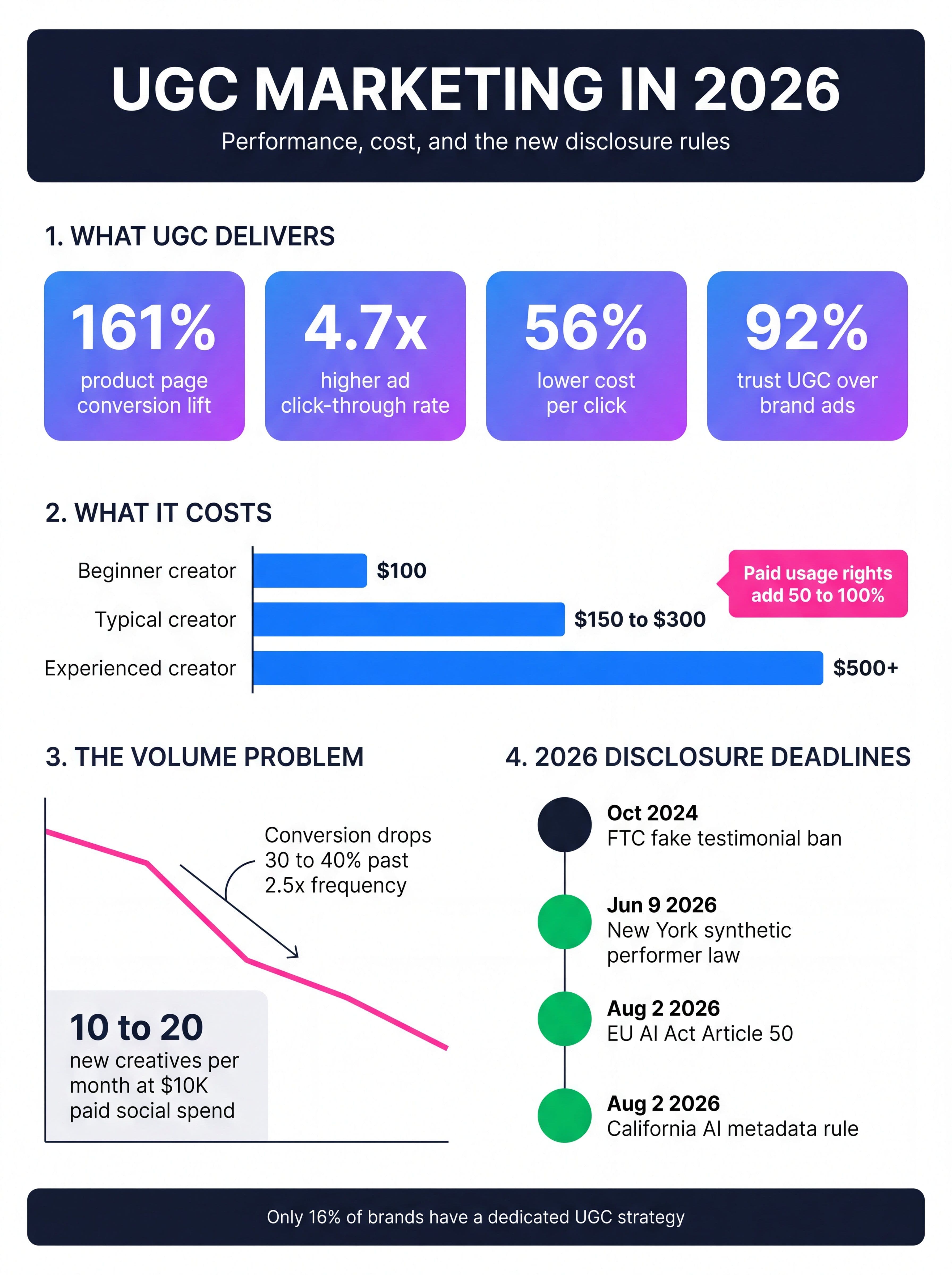
UGC marketing in 2026: what it delivers, what it costs, and what the new disclosure rules require.
Seven Mistakes That Kill UGC Programs
- Buying content without buying rights. The cheapest video you cannot run as an ad costs more than the expensive one you can.
- Polishing it into an ad. Color grading, brand overlays, and a scripted voiceover remove the exact quality you paid for. If it stops looking user-made, it stops performing like it.
- Treating it as a campaign. Without a replacement rate matched to decay, every UGC win is temporary by construction.
- Ignoring reviews. The highest-leverage, lowest-cost UGC asset, and now doubly valuable because AI answers are built on it.
- Undisclosed synthetic humans. Up to $53,088 per violation under FTC endorsement rules, with each post potentially counting separately.
- One creator, one format. Concentration risk in creative works exactly like concentration risk in channels.
- No tagging taxonomy. A library you cannot query is a folder, not an asset. Decide the tags before the library exists.
Frequently Asked Questions
What is user-generated content in marketing?
It is content created by customers, creators, or employees rather than by the brand, then licensed and distributed by the brand across paid media, product pages, email, and retail listings. Reviews, testimonial video, unboxing clips, social posts, and photos all qualify. Its advantage comes from being visibly not brand-produced, which is why it outperforms studio creative in both trust and conversion.
How much does UGC cost in 2026?
Most UGC creators charge $150 to $300 per video, with beginners near $100 and experienced creators at $500 or more. Whitelisting or Spark Ads rights add another 50% to 100% on top of the base rate. A brand spending $10,000 a month on paid social typically needs 10 to 20 fresh assets monthly, putting a realistic content budget at $1,500 to $6,000 before editing.
Does user-generated content actually increase conversions?
Consistently, yes. UGC on ecommerce product pages lifts conversions by 161%, shoppers who interact with a UGC gallery convert at a 140% higher rate, and revenue per visitor rises 154% when UGC appears across touchpoints. In paid social, UGC-style creative delivers roughly 4.7 times the click-through rate of studio ads at 56% lower cost per click.
What is the difference between UGC and influencer marketing?
Influencer marketing buys access to someone's audience. UGC buys an asset you distribute through your own media. A creator with a small following can produce excellent UGC because you are paying for footage rather than reach. The rates, briefs, deliverables, and success metrics differ, and conflating them is a common reason UGC budgets get misallocated.
Do I have to disclose AI-generated UGC?
If AI generated or substantially modified a human likeness such as a face, voice, or body, disclosure is required. Sponsored AI creative needs layered disclosure: one indicating it is an ad or paid partnership, and a separate one indicating AI involvement. A "#ad" tag does not cover the AI requirement and an "AI-generated" tag does not cover the sponsorship requirement. FTC penalties reach $53,088 per knowing violation.
How much UGC do I need each month?
Match your replacement rate to your decay rate rather than guessing. As a benchmark, $10,000 in monthly TikTok spend consumes 10 to 20 new creatives, and brands refreshing at 15 to 50-plus variants monthly extend campaign life 3x to 5x. Once frequency passes about 2.5x, conversion rates typically fall 30% to 40%, so track the frequency at which each asset degrades and size the pipeline from that.
Does UGC help with AI search visibility?
Substantially. Off-site brand mentions predict AI visibility more reliably than backlinks or domain rating, and reviews are a primary corpus AI systems use to decide whether to recommend a brand. With roughly 60% of queries now resolved without a click and organic CTR dropping 61% when an AI Overview appears, a specific, outcome-focused review program has become one of the more effective AI visibility tactics available.
How do I get usage rights for customer content?
Request permission in writing before use, specifying the channels, term, and territory. For paid social, whitelisting requires creator-side authorization inside TikTok or Meta that is separate from your contract, so make that authorization a brief deliverable with a 48-hour window. Also request raw video files, since licensed music in organic posts frequently blocks paid usage.
The Bottom Line
UGC stopped being a tactic somewhere around the point where a phone video started beating a production budget by 4.7x on click-through. What it became instead is an operating requirement, and operating requirements need pipelines, not campaigns.
The teams that win here are not the ones with the best single creator. They are the ones who size the library to the decay rate, buy rights before they need them, treat reviews as the AI-era asset they now are, and keep a clean provenance record so the 2026 disclosure rules are a checkbox rather than a fire drill. Do that and UGC compounds. Skip it and you get one great quarter followed by a slow, unexplained decline in return on ad spend.
Keep following the signal