Google Demand Gen Campaigns in 2026: Specs, Placements, and the Playbook That Beats Display
A complete 2026 guide to Google Demand Gen: every placement, the full ad specs cheat sheet, channel controls, how it compares to Performance Max, bidding, creative requirements and honest measurement.
TL;DR
- Google Demand Gen is Google’s visual, AI-driven campaign type that serves across YouTube, Shorts, Discover, Gmail and the Google Display Network, reaching more than 3 billion monthly active users.
- It is a top and mid-funnel engine, not a bottom-funnel one. Performance Max harvests existing demand. Demand Gen creates it. Teams running both report 20 to 30 percent ROAS lifts versus PMax alone.
- 2026 brought channel controls at the ad group level, Shoppable CTV, Attributed Branded Searches, view-through conversion optimization, and the March 15 shift from strict Lookalike targeting to AI-powered audience signals.
- Creative volume is the single biggest lever: 3 video aspect ratios plus 10 or more images. Advertisers who upload video and image assets together see 20 percent more conversions at the same CPA versus video alone.
- The bottleneck is no longer targeting, it is creative production. This is exactly where a unified system like MarqOps replaces the 7-plus tool stack most teams stitch together.
Table of Contents
- What Google Demand Gen Actually Is
- Where Your Ads Show Up: Every Demand Gen Placement
- Google Demand Gen vs Performance Max
- What Changed in 2026
- Demand Gen Ad Specs Cheat Sheet
- The 7-Step Demand Gen Build Playbook
- The Real Bottleneck Is Creative Volume
- How to Measure Demand Gen Honestly
- Five Mistakes That Kill Demand Gen Performance
- Frequently Asked Questions
What Google Demand Gen Actually Is
Most paid media teams have a bottom-funnel problem disguised as a budget problem. Search is capped. Shopping is capped. Performance Max keeps eating the same branded and high-intent traffic you were already going to win. Spend goes up, incremental revenue does not. The pipeline is not broken, it is just empty at the top.
Google Demand Gen is the campaign type built for that gap. It replaced Discovery campaigns entirely and now serves visually rich image and video ads across YouTube in-stream, YouTube Shorts, YouTube in-feed, the Google Discover feed, Gmail’s Promotions and Social tabs, and the Google Display Network. Google puts the combined reach at more than 3 billion monthly active users, with Shorts alone driving over 50 billion daily views globally.
The strategic difference matters more than the surface list. Search intercepts a person who has already decided they want something. Demand Gen reaches a person mid-scroll who has not decided anything yet, and gives Google’s AI the job of predicting which of those people are close enough to a decision to be worth a bid. Google’s own research found that 91 percent of consumers took action immediately after discovering a new product or brand on a Google feed like Discover or Gmail, and that one in three consumers bought something on a Google feed they were not originally shopping for.
If you have already read our breakdown of Performance Max campaigns or our guide to using AI inside Google Ads, treat Demand Gen as the missing upper-funnel half of that system rather than a competitor to it.
Where Your Ads Show Up: Every Demand Gen Placement
Understanding placements is not trivia. It determines which creative dimensions you need, how long your video should be, and what a realistic view-through window looks like.
YouTube
Demand Gen serves in-stream (before and during videos), in-feed (in search results and the watch-next rail), on the YouTube Home feed, and in Shorts. Shorts is the highest-volume surface and demands vertical 9:16 video kept under 60 seconds. As of 2026, Demand Gen also powers Shoppable CTV, letting viewers browse and buy products while watching YouTube on a connected TV. Google reports campaigns that include TV screens drive an average of 7 percent additional conversions at the same ROI.
Google Discover
Discover is the personalized feed inside the Google app and on Android home screens. It is a pure discovery surface with no query attached, which makes it the closest thing Google has to a social feed. Creative that looks like an ad underperforms here. Creative that looks like editorial content earns the tap.
Gmail
Ads appear at the top of the Promotions and Social tabs. Gmail placements are cheap and can look impressive on a raw CPC basis, which is exactly why they deserve scrutiny. Accidental taps are common. Check post-click engagement before you let Gmail absorb budget.
Google Display Network and Maps
Google folded Display Network inventory into Demand Gen, and 2026 added promoted pins on Google Maps for eligible advertisers. Eligible accounts can voluntarily migrate legacy Display campaigns using the in-account migration tool that opened in June 2026.
Channel controls changed the game. Since March 2025 Google has offered channel controls at the ad group level with three configurations: all channels, all channels owned and operated by Google, or individual channel selection. Channel-level reporting is now available at campaign, ad group and ad level. That means you can finally isolate Shorts from Gmail and see which surface is actually producing revenue instead of guessing.
Google Demand Gen vs Performance Max
This is the most searched question about Demand Gen, and most answers get it wrong by framing it as a choice. It is not. They solve different problems in different parts of the funnel.
| Dimension | Demand Gen | Performance Max |
|---|---|---|
| Funnel role | Creates demand, top and mid funnel | Captures demand, mid and bottom funnel |
| Surfaces | YouTube, Shorts, Discover, Gmail, Display, Maps | All of the above plus Search and Shopping |
| Control | Ad group level channel controls, audience layering, creative per placement | Asset groups and audience signals only, limited channel visibility |
| Creative demand | High. Video plus image in 3 to 4 aspect ratios | Moderate. Feed can carry the campaign |
| Typical use | New product launch, category education, cold prospecting | Ecommerce catalog scale, lead capture at known intent |
| Attribution risk | Under-credited by last-click | Over-credited by last-click |
20-30%
ROAS lift reported by advertisers running Demand Gen and Performance Max together versus PMax alone
The mechanism is simple. Demand Gen fills the top of the funnel with qualified prospects who now recognize your brand. Performance Max converts them at the moment of intent, often through branded search, at a much lower cost per acquisition than cold traffic. One apparel ecommerce case study hit 4.2 ROAS running both in Q4 2025 versus 2.8 on PMax alone. If you are still deciding how these fit next to Search, our comparison of Performance Max vs Search campaigns covers the overlap question in detail, and our AI Max for Search guide explains what Google is doing to the query side.
What Changed in 2026
Google shipped Demand Gen updates on a near-monthly cadence through what it calls Demand Gen Drops. Four changes matter enough to rewrite your setup.
1. Lookalike segments became AI audience signals
Starting March 15, 2026, Lookalike segments in Demand Gen stopped functioning as strict audience targeting and became AI-powered audience signals. Practically, this means Google treats your seed list as a hint rather than a fence. Campaigns that were quietly running on tightly capped lookalike audiences suddenly had far more room to spend, and some accounts saw CPA drift before anyone noticed. Audit any ad group that relied on narrow lookalikes and re-baseline your targets. Our piece on audience signals in Google Ads explains how signal-based targeting behaves differently from list-based targeting.
2. Shoppable CTV and Travel Feeds
January’s Drop made Demand Gen the engine behind YouTube’s connected TV shopping experience and introduced Travel Feeds so that browsing converts into booking inside the ad unit. For retail and travel advertisers this is the first genuinely transactional big-screen format Google has shipped.
3. View-through conversion optimization and Commerce Media Suite
April added Demand Gen support inside Commerce Media Suite and, more importantly, view-through conversion optimization for YouTube traffic. Bidding can now optimize toward conversions that never involved a click, which is closer to how upper-funnel video actually works. It also makes reported conversion counts look better than click-based systems will confirm, so hold the line on incrementality testing before you scale on view-through numbers alone.
4. AI creative production moved inside Google Ads
March enabled Veo-based video generation from static images directly in Google Ads, and May added multimodal video creation in Asset Studio, letting advertisers build YouTube ads from a few prompts. The same Drop made it possible to boost authentic creator partnership videos from the asset picker during Demand Gen setup, with a YouTube Creator Partnerships surface that recommends relevant creators for your brand.
That last change is the strategically interesting one. Google is removing the excuse that creative production is too slow, because Google now produces the creative. The catch is that Google-generated assets are generic by default. They have no memory of your brand’s voice, palette, product truths or claim restrictions, which is precisely the problem brand voice systems exist to solve.
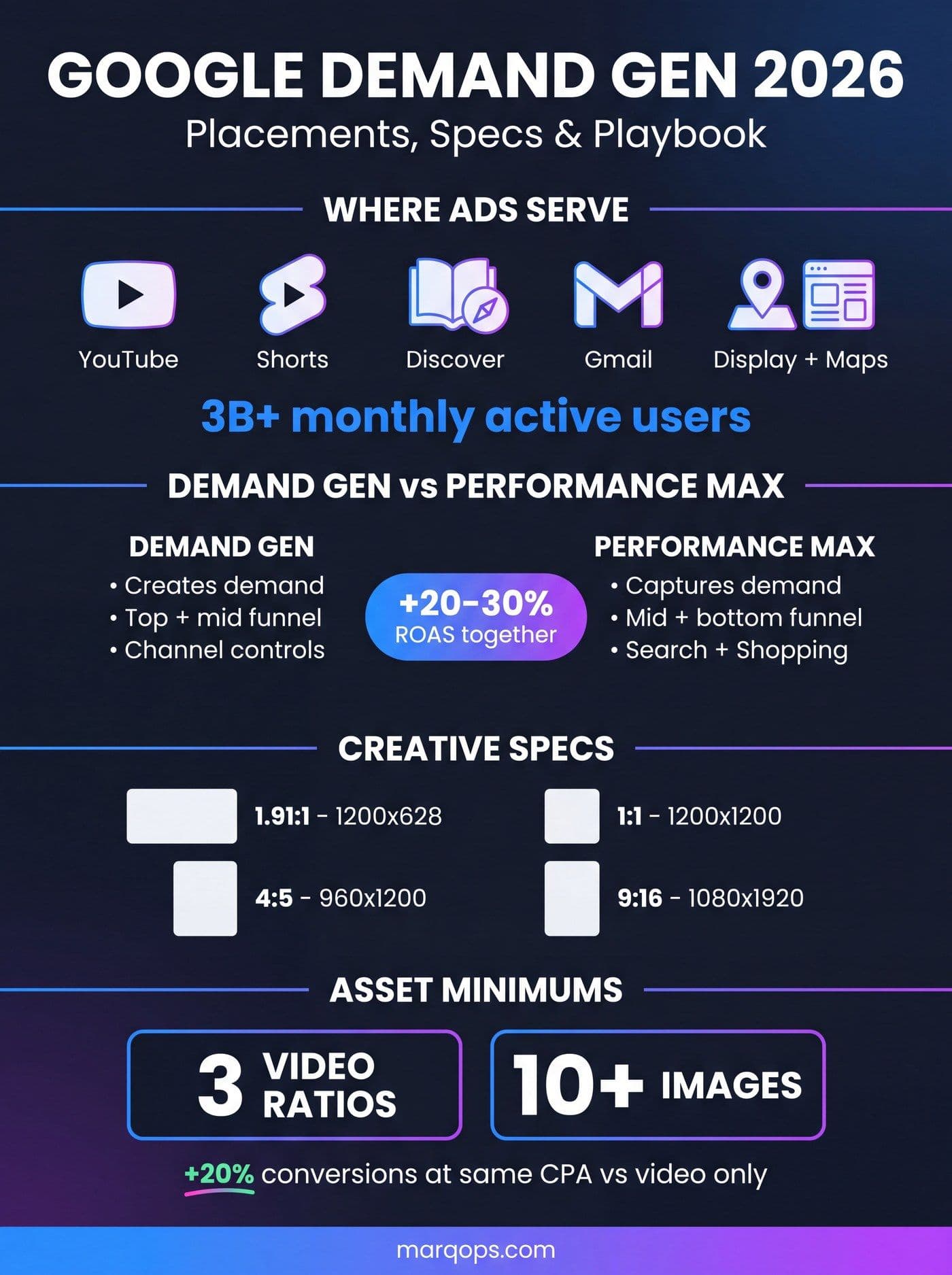
Google Demand Gen in 2026: placements, specs, and how it pairs with Performance Max.
Demand Gen Ad Specs Cheat Sheet
Missing a single aspect ratio means Google simply cannot serve you on that surface. Build all four image ratios and at least three video ratios before launch.
| Asset | Ratio | Recommended size | Primary surface |
|---|---|---|---|
| Landscape image | 1.91:1 | 1200 x 628 px | Gmail, Discover, Display |
| Square image | 1:1 | 1200 x 1200 px | Discover, YouTube in-feed |
| Vertical image | 4:5 | 960 x 1200 px | Discover mobile |
| Portrait image | 9:16 | 1080 x 1920 px | YouTube Shorts |
| Video, vertical | 9:16 | 720p or higher, under 60 seconds | Shorts |
| Video, landscape | 16:9 | 720p or higher, MP4 H.264 | YouTube in-stream, in-feed, CTV |
| Video, square | 1:1 | 720p or higher | In-feed, Discover |
Images accept JPG, PNG or static GIF up to 5120 KB. Video should be MP4 with H.264 compression. The most common avoidable error is safe-area violation: never place logos, headlines or price callouts in the top or bottom 20 percent of a portrait asset, because device UI overlays will cover them.
The 7-Step Demand Gen Build Playbook
Google reports that advertisers who adopt at least three of its four core Demand Gen best practices see, on average, more than 40 percent more conversions. Here is the sequence that consistently works.
Step 1: Fix conversion tracking before you spend a rupee or a dollar
Demand Gen bidding is entirely dependent on conversion signal quality. Confirm enhanced conversions are firing, offline conversion imports are current if you sell through a sales team, and that your primary conversion action is a real business outcome rather than a page view. Weak signal is the single most common reason a Demand Gen campaign never exits learning.
Step 2: Structure ad groups by audience intent, not by product
The best-performing 2026 structures use a layered approach with separate ad groups for lookalike prospecting, custom intent segments, and remarketing. Keeping them separate is what lets you read channel-level and audience-level performance instead of a blended average that hides everything.
Step 3: Start on Maximize Conversions, not Target CPA
Demand Gen supports Maximize Conversions, Maximize Conversion Value and Target CPA. Launch on Maximize Conversions and run it for two to three weeks until you have accumulated at least 50 conversions. Only then switch to a target-based strategy. Setting a tCPA on day one starves the algorithm of the exploration it needs. Our guide to Google Smart Bidding covers the learning-period mechanics in more depth.
Step 4: Upload 3 video variations and 10-plus images
Google’s global best practice is a minimum of three video variations covering horizontal, square and vertical, plus at least 10 images. This is not padding. Advertisers who uploaded both video and image assets to Demand Gen campaigns saw 20 percent more conversions at the same CPA compared with those using video alone. Aim for Excellent Ad Strength before you launch.
Step 5: Set channel controls deliberately
Default to all Google-owned and operated channels for the first two weeks so you gather clean surface-level data. Then read channel reporting and either exclude the surfaces that are producing traffic without engagement, or split them into their own ad groups with creative built for that surface.
Step 6: Build the landing experience for a cold visitor
Demand Gen traffic did not search for you. Sending it to a product detail page written for someone already comparing options wastes the click. Use a page that explains the category problem before the product, and make sure the visual language matches the ad. Mismatched creative and landing page is the fastest way to burn a Demand Gen budget.
Step 7: Refresh creative on a fixed cadence
Demand Gen creative fatigues faster than Search copy because the same users see it repeatedly in feeds. Plan a refresh every three to four weeks for high-spend ad groups. This is the operational commitment most teams underestimate, and it is the reason so many Demand Gen campaigns decay after month two.
The Real Bottleneck Is Creative Volume
Add up what step 4 and step 7 actually require. Three video ratios and ten images per ad group, refreshed monthly, across three audience layers. For a single product line that is roughly forty assets a month. For an agency running eight clients it is several hundred, every month, all of which must be on brand, legally reviewed and correctly sized.
This is why most Demand Gen accounts underperform. It is not a targeting failure or a bidding failure. It is a production failure. The campaign type is starved of the fuel it needs, so Google serves the same two assets to the same audiences until performance flattens.
The typical response is to buy more tools: one for image generation, one for video, one for resizing, one for brand asset storage, one for ad copy, one for reporting, one for approvals. Seven tools, seven logins, seven places for brand consistency to break, and a marketing ops manager spending most of the week moving files between them.
MarqOps was built for exactly this shape of problem. One platform replaces that 7-plus tool stack, and its Brand Intelligence DNA layer means generated creative comes out on brand from the first pass rather than after three rounds of revisions. Teams running creative through it report roughly 6x faster content output, which is the difference between refreshing Demand Gen creative monthly and refreshing it never. Analytics, ads, SEO and creative sit in one dashboard, so the channel-level Demand Gen data Google now exposes actually lands somewhere your team will look at it.
If you are earlier in that journey, our guides to creative automation, AI dynamic creative optimization and AI ad generators cover the component pieces.
How to Measure Demand Gen Honestly
Demand Gen is systematically under-credited by last-click attribution and systematically over-credited by view-through reporting. Both distortions are large enough to cause bad budget decisions, so measure on three layers.
Layer 1: Attributed Branded Searches
Google made Attributed Branded Searches available for Demand Gen in the January 2026 Drop. It reports the volume of branded searches on Google and YouTube that followed exposure to your campaign. This is the cleanest available proxy for demand actually created, and it is the metric to lead with when a CFO asks what upper-funnel spend bought.
Layer 2: Cross-campaign effects
Watch what happens to branded Search impression volume, Performance Max CPA and direct traffic in the four weeks after a Demand Gen launch. If Demand Gen is working, your bottom-funnel campaigns get cheaper. That downstream efficiency gain is real revenue that will never appear in the Demand Gen row of your report. A unified marketing dashboard makes this visible; siloed channel reports never will.
Layer 3: Geo holdout tests
The only way to settle the argument is a geo-based incrementality test. Hold Demand Gen out of matched markets for four to six weeks and compare total revenue, not platform-reported conversions. It is the discipline behind incrementality testing and it is worth the effort before you commit a large annual budget. Pair it with multi-touch attribution for a fuller picture of assisted conversions.
Five Mistakes That Kill Demand Gen Performance
Judging it on last-click ROAS in week two. Demand Gen builds recognition that converts weeks later through other campaigns. Give it a full purchase cycle plus two weeks before you make a scale-or-kill call.
Running one ad group for everything. Blending cold prospecting with remarketing hands Google a shortcut. It will spend most of the budget re-serving people who were already going to convert, and your CPA will look great while incremental revenue stays flat.
Repurposing 16:9 hero videos into Shorts. Cropping a landscape brand film to vertical produces an ad with the subject half out of frame and the message in the safe-area dead zone. Shorts needs creative built for Shorts.
Letting Gmail quietly absorb budget. Gmail’s cheap clicks can dominate a blended CPC while producing minimal engagement. Now that channel reporting exists at ad group level, there is no excuse for not checking.
Setting it and forgetting it. Demand Gen is not a set-and-forget campaign type. Without a creative refresh cadence and a monthly channel review, performance reliably decays after the second month. Our overview of AI PPC management covers how to automate that review loop rather than skip it.
Where This Leaves You
Demand Gen in 2026 is the most capable upper-funnel format Google has ever offered advertisers, and it is still underused because it demands something most paid media teams are not structured to deliver: continuous, on-brand, multi-format creative. The targeting is handled. The bidding is handled. Google will even generate the video for you now. What Google will not do is make that creative sound like your brand, keep it consistent across surfaces, or tie its performance back to the rest of your marketing system.
That is the operational gap. Teams that close it by unifying creative production, ad management and analytics in one place will run Demand Gen at a scale their competitors cannot match with a stack of disconnected tools. Teams that do not will keep launching Demand Gen campaigns, watching them fade after six weeks, and concluding the channel does not work.
Frequently Asked Questions
What is the difference between Google Demand Gen and Performance Max?
Demand Gen creates demand at the top and middle of the funnel using visual and video ads on YouTube, Shorts, Discover, Gmail and Display. Performance Max captures existing demand across all Google surfaces including Search and Shopping. Demand Gen gives you ad group level channel controls and audience layering; Performance Max is more automated with less surface visibility. Most advertisers get the best results running both, with reported ROAS lifts of 20 to 30 percent versus Performance Max alone.
What are the Google Demand Gen ad specs?
Images come in four ratios: landscape 1.91:1 at 1200 x 628 px, square 1:1 at 1200 x 1200 px, vertical 4:5 at 960 x 1200 px, and portrait 9:16 at 1080 x 1920 px. Accepted formats are JPG, PNG or static GIF up to 5120 KB. Video should be MP4 with H.264 compression at 720p or higher, with vertical 9:16 clips kept under 60 seconds for Shorts. Keep critical content out of the top and bottom 20 percent of portrait assets to avoid device UI overlays.
How many assets do I need for a Demand Gen campaign?
Google’s global best practice is a minimum of three video variations covering horizontal, square and vertical, plus at least 10 images. Advertisers who upload both video and image assets see roughly 20 percent more conversions at the same CPA compared with video alone. Aim for Excellent Ad Strength before launch and plan a creative refresh every three to four weeks on high-spend ad groups.
Which bidding strategy should I use for Demand Gen?
Demand Gen supports Maximize Conversions, Maximize Conversion Value and Target CPA. Launch new campaigns on Maximize Conversions and run for two to three weeks until you have at least 50 conversions, then switch to a target-based strategy. Applying a Target CPA on day one restricts the exploration the algorithm needs and usually results in low delivery.
What changed for Demand Gen Lookalike segments in 2026?
From March 15, 2026, Lookalike segments in Demand Gen transitioned from strict audience targeting to AI-powered audience signals. Google now treats your seed audience as a directional hint rather than a hard boundary, which typically widens reach and can shift CPA. If your campaigns depended on narrow lookalike targeting, audit those ad groups and re-baseline your targets against the new delivery pattern.
Keep following the signal
Related field notes
Marketing
Marketing Automation for Agencies in 2026: What to Automate, What to Keep Human
11 min readMarketing
Brand Asset Management in 2026: How to Run It Without Adding Another Tool
14 min readMarketing Operations