Connected TV Advertising in 2026: Costs, Platforms, and How to Actually Measure It
CTV upfront commitments now exceed primetime linear for the first time. Here is what connected TV advertising costs in 2026, how the platform landscape breaks down, and the three measurement approaches that separate a defensible CTV program from an expensive line item nobody can explain.

For the first time in the history of television, advertisers committed more money to streaming than to primetime linear in the upfronts. CTV upfront commitments landed at $17.73 billion against $16.98 billion for primetime linear TV. That is not a trend line anymore. That is a handover.
Connected TV advertising has spent a decade being described as "the future of TV." In 2026 it is simply where the audience is, where the budget is going, and where a growing share of performance marketing now competes. The harder question is no longer whether to buy CTV. It is how to buy it without overpaying, and how to prove it worked.
Table of Contents
- What Is Connected TV Advertising?
- CTV vs OTT vs Streaming vs Linear: Sorting the Terms
- Why 2026 Is the Year CTV Stopped Being Experimental
- How Connected TV Advertising Actually Works
- The CTV Platform Landscape
- What Connected TV Advertising Costs in 2026
- Targeting: What CTV Can and Cannot Do
- Creative: Why AI Changed the Economics
- Shoppable CTV and the Retail Media Collision
- The Measurement Problem, and Three Ways to Solve It
- How to Launch Your First CTV Campaign
- Six Mistakes That Waste CTV Budget
- Frequently Asked Questions
What Is Connected TV Advertising?
Connected TV advertising is the practice of buying video ad placements that run on internet-connected television sets. That includes smart TVs from Samsung, LG, and Vizio, streaming sticks and boxes like Roku, Amazon Fire TV, and Apple TV, and gaming consoles used as streaming devices.
The defining characteristic is not the screen size. It is the delivery pipe. A CTV ad is served over the internet, which means it can be targeted at a specific household, bought in real time through an auction, capped for frequency, and tied back to a conversion. A linear TV ad is broadcast to everyone watching a channel at a given moment, bought weeks in advance against demographic estimates, and measured by panel.
Practically, that means CTV inherits the buying logic of digital advertising and the attention profile of television. Ads are typically 15 or 30 seconds, non-skippable, and delivered full screen with sound on. Completion rates routinely clear 90%, which is a number no other video environment reliably produces.
CTV vs OTT vs Streaming vs Linear: Sorting the Terms
The vocabulary in this channel is genuinely confusing, and vendors do not help by using the terms interchangeably. Here is the distinction that matters when you are reading a media plan.
| Term | What it actually means | Why it matters to a buyer |
|---|---|---|
| CTV | Ads delivered to an internet-connected television screen | Highest attention, highest completion, highest CPM |
| OTT | Any content delivered "over the top" of cable, including phones and laptops | Broader and cheaper, but includes small screens you may not want |
| AVOD | Ad-supported video on demand, such as Hulu or Peacock's ad tier | On-demand library content, viewer chose the show |
| FAST | Free ad-supported streaming TV, such as Pluto TV or Tubi | Channel-style lean-back viewing, lowest CPMs |
| Linear | Traditional broadcast and cable | Mass reach, no household targeting, upfront commitments |
If a vendor quotes you an "OTT CPM" that looks suspiciously cheap, ask what percentage of impressions actually land on a television. Mobile-heavy OTT inventory is a different product priced like the same one.
Why 2026 Is the Year CTV Stopped Being Experimental
Four data points explain the shift better than any argument.
Reach stopped being a limitation. 89.5% of US households now own at least one internet-connected TV device, and eMarketer projects 243.6 million US CTV viewers in 2026. Whatever audience you were reaching on linear, you can reach on streaming.
Budgets moved, not just tests. The IAB found that marketers reallocated an average of 36% of their linear TV spend to CTV during 2025. A Premion survey found 70% of advertisers plan to increase CTV investment in 2026, by an average of 17%.
The upfront flipped. CTV upfront commitments of $17.73 billion now exceed primetime linear upfronts of $16.98 billion. Upfront money is the most conservative money in television. When it moves, the structural shift is already complete.
The crossover is dated. eMarketer projects CTV ad spending overtakes all traditional TV advertising in 2028, at roughly $46.89 billion against $45 billion, on the way past $52.5 billion by 2029. Globally, CTV ad revenue is forecast to run from $44 billion in 2025 to $81 billion by 2030.
This is not a US-only story. UK CTV spend reaches $3.25 billion in 2026, up 16.9%. Canada hits $1.29 billion, up 16%. China reaches $3.47 billion, up 11.5%.
How Connected TV Advertising Actually Works
The mechanics are closer to a programmatic display buy than to anything a TV buyer would recognize. Five steps, roughly.
1. You define an audience, not a daypart. Instead of buying "Thursday primetime on a sports network," you build a household-level audience from first-party CRM data, purchase data, demographic data, or behavioral segments. This is why first-party data quality now determines CTV performance more than media planning skill does.
2. Inventory is auctioned in real time. A viewer starts a show, an ad break opens, and a bid request goes out with the device ID, IP address, content genre, and available slot. Your demand-side platform decides in milliseconds whether to bid.
3. The ad is stitched in server-side. Server-side ad insertion splices your spot into the content stream so it plays like part of the show. No buffering, no skip button, no ad blocker.
4. Frequency is capped across the household. This is the single biggest practical advantage over linear. On broadcast you cannot stop showing the same person the same ad eleven times. On CTV you can set a cap and enforce it.
5. Exposure is matched back to outcomes. The household IP that saw the ad is matched against site visits, app opens, or purchases from devices on the same network. This works, but it is probabilistic, and it is where most CTV programs quietly fall apart. More on that below.
The CTV Platform Landscape
There are four distinct ways to buy, and the right one depends far more on your budget than on your industry.
Publisher direct. Buying straight from Netflix, Hulu, Disney+, Max, or Paramount+. Best inventory, tightest brand safety, highest CPMs, and usually a spend minimum that rules out smaller advertisers. Netflix's ad tier alone cleared $1.5 billion in revenue during 2025 and is expected to roughly double in 2026.
Device and OS platforms. Roku, Amazon Fire TV, Samsung TV Plus, LG Ads. These own the operating system, which means they see everything the household watches across apps. That cross-app view is a targeting advantage nobody else has. Amazon, Netflix, and Google are collectively projected to hold about half the CTV ad market by 2030.
Demand-side platforms. The Trade Desk, Viant, StackAdapt, MadHive, Yahoo DSP. You get supply across many publishers in one auction, with your own audience data applied. This is where most mid-market CTV budget lands, and where the tooling for frequency capping and cross-publisher measurement is strongest.
Self-serve platforms. The category that opened CTV to companies without a media agency. Lower minimums, simplified targeting, built-in creative tools, and increasingly a generative AI layer that produces the spot for you. Quality of inventory varies enormously here, so ask for a publisher-level delivery report before you scale.
What Connected TV Advertising Costs in 2026
CTV pricing has finally stabilized after several years of volatility, and it has segmented cleanly by inventory tier.
| Inventory tier | Typical CPM | What you are buying |
|---|---|---|
| FAST and broad AVOD | $15 to $25 | Free streaming channels, wide reach, light targeting |
| Standard programmatic | $20 to $40 | Mainstream ad-supported apps, audience targeting applied |
| Premium and curated | $40 to $60 | Top-tier publishers, live sports, tight audience segments |
| Blended market average | Around $26 | What most mixed campaigns actually pay |
Most campaigns land in the $25 to $35 range, with the full market spanning roughly $15 to $45. On a completed-view basis, $2 to $4 per completed view is a healthy benchmark.
The number that matters more than CPM is effective cost per outcome. A $45 premium CPM that reaches an in-market household with a 94% completion rate can be cheaper per conversion than an $18 FAST CPM delivered to a television playing to an empty room. This is the same discipline that governs customer acquisition cost in every other channel, and CTV does not get an exemption from it just because it feels like brand advertising.
For budget planning, a realistic floor for a meaningful test is $10,000 to $15,000 over four to six weeks. Below that you cannot reach enough unique households to read a result, and you will spend the whole budget learning that you underspent.
Targeting: What CTV Can and Cannot Do
What works well. Household demographic and income targeting. Geographic targeting down to the ZIP code, which makes CTV genuinely viable for multi-location and regional businesses. First-party CRM matching for retargeting and suppression. Contextual targeting by content genre. Lookalike modeling from converter lists.
What is weaker than the pitch suggests. Individual-level targeting is mostly household-level targeting wearing a costume, because four people share one TV. Behavioral segments sourced from third-party data have degraded in accuracy. Sequential storytelling across screens works in decks more often than in delivery logs.
What to do about it. Treat CTV as a household channel and build your audience strategy accordingly. Suppression lists matter more than lookalikes here, because the fastest way to waste CTV budget is showing acquisition creative to existing customers. If you have invested in data clean rooms or a unified customer view, CTV is one of the highest-leverage places to deploy it.
Creative: Why AI Changed the Economics
For most of CTV's history the barrier was not media cost. It was creative. A brand could afford a $20,000 test budget but not the $80,000 production it took to make a spot worth running next to network content. That gate is coming down fast.
By 2026, AI-generated creative is projected to account for 40% of all digital video ads. 44.7% of marketers already use AI to produce multiple variants of campaign assets, which makes creative diversification a standard workflow rather than an experiment.
The more interesting change is that dynamic creative optimization has finally reached television. DCO has been routine in display and social for a decade. Server-side ad insertion now makes it possible on CTV, so a single campaign can run dozens of variants that adjust by household demographic, content genre, geography, or even weather, and reinforcement learning systems shift weight toward whatever produces completed views and conversions. Advertisers running adaptive AI audience modeling report conversion rate lifts of up to 40% with cost per acquisition falling by close to a third.
The practical implication for most teams is a production strategy, not a technology purchase. Build one hero spot and eight to twelve variants that change the opening three seconds, the offer, and the end card. Then let creative analytics tell you which combinations earn their CPM. This is precisely the kind of volume problem that platforms with brand-locked generation solve well: MarqOps generates on-brand variants from a single Brand Intelligence DNA profile, so the twelfth version looks as correct as the first without a round of brand review on each one.
Shoppable CTV and the Retail Media Collision
The most consequential thing happening in CTV right now is not the spend growth. It is retail media networks buying their way into the living room.
Walmart agreed to acquire the self-serve CTV platform Vibe.co. Target's Roundel launched a shoppable video pilot with DirecTV that includes closed-loop measurement. Amazon Ads and Samsung went live with remote-enabled "add to cart" advertising inside Samsung TV Plus. Each of these connects a television impression to a verified purchase in a retailer's own transaction data.
That matters because it solves the measurement problem by sidestepping it. If the retailer sees both the ad exposure and the basket, no probabilistic matching is required. For brands that sell through those retailers, shoppable CTV inside a retail media network is currently the cleanest attribution available anywhere in television.
Interactive formats are growing from a small base but growing fast. QR code usage in CTV ads is up more than 3x year over year, and shoppable units convert at meaningfully higher rates than standard video. If you are testing CTV in 2026 and your creative has no interactive element and no on-screen code, you are leaving the most measurable part of the channel on the table.
The Measurement Problem, and Three Ways to Solve It
Here is the honest state of CTV measurement: it is the reason budgets are not growing faster.
53% of marketing decision-makers say they would increase CTV investment if they could prove it was working. 72% of ad buyers now rank cross-platform measurement as a top priority for 2026, up from 64% a year earlier, and 52% of senior marketers name the lack of unified measurement as the single biggest barrier to omnichannel success.
The root cause is the identity gap. A CTV impression happens inside a walled garden on a device with no persistent cookie, and the streaming platform controls the authentication data. To connect that exposure to a conversion you either match the household IP to later web sessions from phones and laptops on the same network, which is probabilistic, or you rely on a logged-in publisher sharing a conversion pixel, which is deterministic but limited to that publisher.
Three approaches actually work, and mature programs use all three.
Geo-based incrementality testing. Hold out matched markets, run CTV in the test markets only, and measure the difference in conversions. This is the closest thing to a clean causal read that exists in the channel. The limitation is that incrementality testing evaluates CTV in isolation, so it tells you what the campaign contributed in those geographies during that window, not how CTV interacts with your other channels.
Media mix modeling. Statistical modeling across all channels and time, which captures the interaction effects incrementality misses and does not depend on user-level identity at all. Marketing mix modeling has become far more accessible as open-source implementations matured, and it is the right backbone for any brand spending seven figures across channels.
Exposure-matched attribution, used carefully. Household-level matching from your DSP or publisher, reported as a directional signal rather than truth. It is useful for optimization inside a campaign. It should never be the number you report to the CFO, because it will disagree with multi-touch attribution and both will overstate.
The operational problem underneath all of this is that these three views usually live in three different tools, so nobody reconciles them and the CTV line item stays unproven by default. Pulling CTV delivery, site behavior, and pipeline into one reporting layer is the unglamorous work that decides whether the channel survives your next budget review. A unified marketing dashboard that reads ad platform, analytics, and conversion data together is worth more to a CTV program than any single measurement vendor, which is the gap MarqOps was built to close.
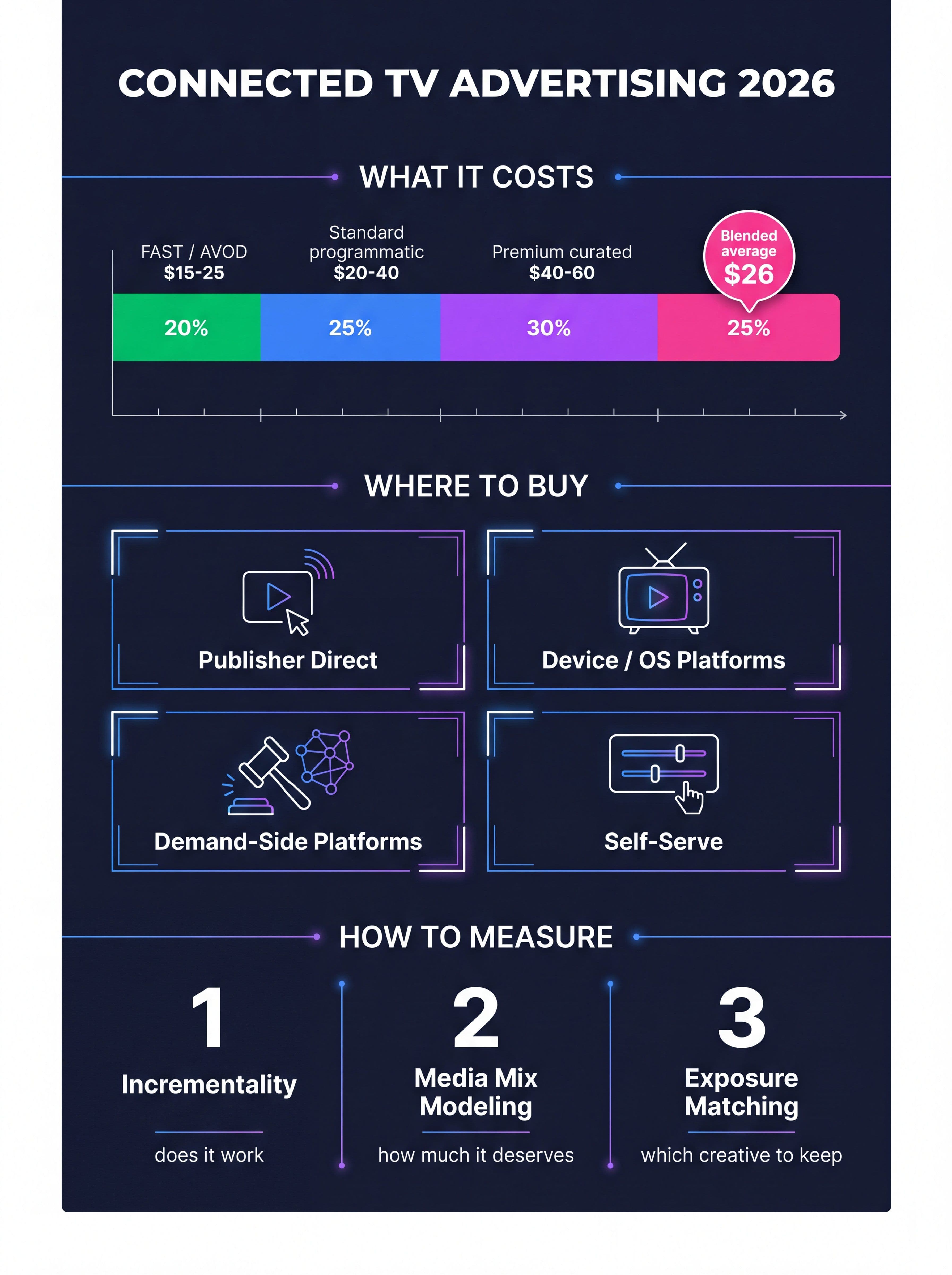
CTV advertising in 2026: what it costs, where to buy it, and how to measure it.
How to Launch Your First CTV Campaign
A workable first test, in order.
Set the budget floor. $10,000 to $15,000 over four to six weeks in a defined geography. Concentrate rather than spread. Reaching 40% of households in three metros beats reaching 4% nationally.
Pick a measurable objective. Not "awareness." Choose branded search lift, site visits from the target geography, or incremental conversions against a holdout. Write the success threshold down before launch, because after launch you will negotiate with yourself.
Build the audience from your own data first. Upload your customer list for suppression and your best-converting segments for lookalike modeling. Third-party segments are a supplement, not a foundation.
Produce one hero spot plus variants. Fifteen seconds is usually the efficient length for performance objectives, thirty for brand. Front-load the brand in the first three seconds. Include a QR code or an on-screen URL that is short enough to remember.
Cap frequency at three to five per household per week. Above that you buy irritation. Below that you do not build recall.
Run a geo holdout from day one. Match your test markets to control markets on population, income, and baseline conversion. This is the single highest-return decision in the entire plan and it costs nothing except discipline.
Read the result at four weeks, not four days. CTV response curves lag. Reading week one and killing the campaign is the most common way teams conclude that CTV does not work for them.
Six Mistakes That Waste CTV Budget
Buying OTT and calling it CTV. If half your impressions serve on phones, you bought mobile video at a television price. Demand a device-type breakdown.
Spreading a small budget nationally. A $12,000 national CTV campaign reaches almost nobody enough times to matter. Concentrate geographically.
Repurposing a social video. Vertical crops, text-dependent creative, and sound-off editing all fail on a television. CTV creative is watched, not scrolled past.
Skipping the holdout. Without a control group you will attribute organic baseline to CTV, scale on a false signal, and then be unable to explain the flat revenue.
Ignoring frequency across publishers. Capping within each platform separately still lets a household see your ad twenty times. Cap at the DSP level across supply.
Treating CTV as a standalone channel. Its main effect is often lifting the performance of search and social rather than converting directly. If you evaluate it in a silo it will underperform its actual contribution, which is why an omnichannel measurement view matters more here than in most channels.
Frequently Asked Questions
How much does connected TV advertising cost?
Blended CTV CPMs average around $26 in 2026, with most campaigns paying $25 to $35. Budget FAST and AVOD inventory runs $15 to $25, standard programmatic $20 to $40, and premium or tightly targeted placements $40 to $60. Plan on a minimum of $10,000 to $15,000 for a readable first test.
How does connected TV advertising work?
You define a household audience, bid on inventory through a demand-side platform in a real-time auction, and your spot is stitched into the content stream server-side so it plays non-skippable and full screen. Frequency is capped across the household, and exposure is later matched to site visits or purchases through the household IP address or a publisher conversion pixel.
What is the difference between CTV and OTT advertising?
CTV means the ad served on an internet-connected television screen. OTT means any content delivered over the internet instead of cable, including phones, tablets, and laptops. All CTV is OTT, but plenty of OTT is not CTV. Since CTV commands higher CPMs, always ask for a device-type breakdown before accepting an OTT quote.
What are examples of connected TV advertising?
A 30-second spot in a Hulu ad break, a 15-second pre-roll on a Pluto TV channel, a shoppable ad with a QR code inside Samsung TV Plus, a sponsored placement on the Roku home screen, and an ad served against live sports on a streaming platform. All are bought programmatically with household-level targeting.
Where do connected TV ads reach their audience?
On smart TVs from Samsung, LG, and Vizio, on streaming devices such as Roku, Amazon Fire TV, and Apple TV, and on gaming consoles used for streaming. 89.5% of US households own at least one of these, and eMarketer projects 243.6 million US CTV viewers in 2026.
Can small businesses advertise on connected TV?
Yes, and the barrier has dropped sharply. Self-serve CTV platforms now accept budgets in the low thousands, ZIP-code targeting makes local campaigns viable, and AI creative tools have removed most of the production cost that used to gate the channel. The practical constraint is geographic concentration: a small budget works locally and fails nationally.
How do you measure connected TV advertising effectively?
Use geo-based incrementality testing to establish whether CTV causes lift, media mix modeling to decide how much budget it deserves relative to other channels, and exposure-matched attribution only as a directional signal for optimizing creative and audiences. Relying on exposure matching alone will overstate CTV's contribution.
Is CTV replacing linear TV advertising?
It is on track to. CTV upfront commitments already exceed primetime linear upfronts, and eMarketer projects CTV ad spending overtakes all traditional TV in 2028 at roughly $46.89 billion. Most large advertisers now run both, with linear covering mass simultaneous reach and CTV handling targeting, frequency control, and measurement.
The Bottom Line
CTV in 2026 is no longer a channel you test to look modern. It is where television advertising now happens, priced at a level most mid-market brands can afford, with AI having removed the creative production barrier that kept it enterprise-only.
The teams that win it are not the ones with the biggest budgets. They are the ones who concentrate spend geographically, build audiences from their own customer data, run a holdout from day one, and refuse to report exposure-matched conversions as though they were causal. Do those four things and CTV becomes a channel you can defend in a budget meeting. Skip them and it becomes an expensive line item nobody can explain.
Keep following the signal