AI Visibility in 2026: The Complete Guide to Getting Your Brand Seen in AI Search
AI visibility is how often AI answer engines surface and cite your brand. Learn what it is, why it matters, the 6 metrics to track it, and how to improve it in 2026.
TL;DR
- AI visibility is how often and how favorably your brand is surfaced, mentioned, and cited inside AI answer engines like ChatGPT, Google AI Overviews, Perplexity, and Gemini, and it is becoming the new front page of search. [Primary source: Google Search: optimizing for generative AI features] [Primary source: OpenAI: web search tool documentation]
- The stakes are real: Google AI Overviews reach roughly 1.5 billion monthly users, ChatGPT serves around 810 million daily users, and AI referral traffic converts at about 5.4% versus 2.6% for organic search.
- You measure AI visibility with six core metrics: mention rate, citation share, share of voice, sentiment, recommendation rate, and prompt coverage, tracked across every major engine.
- You improve it by publishing clear, well-structured, frequently refreshed content, adding schema markup, building authority, and monitoring answers continuously.
- MarqOps unifies brand monitoring, GEO content, and analytics in one Brand Intelligence platform so AI visibility becomes a repeatable operation instead of a scramble.
Table of Contents
- What Is AI Visibility?
- Why AI Visibility Matters Now
- How AI Engines Decide Who Gets Cited
- How to Measure AI Visibility: The 6 Core Metrics
- How to Improve Your AI Visibility: A Practical Roadmap
- AI Visibility Tools: What to Look For
- Where MarqOps Fits
- Frequently Asked Questions
What Is AI Visibility?
AI visibility is the degree to which your brand, products, and content appear inside the answers generated by AI assistants and AI-powered search. When a buyer asks ChatGPT for “the best marketing operations platform,” or types a question into Google and reads the AI Overview before scrolling, the question that decides your fate is simple: does your brand show up in that answer, and does it show up well?
For two decades, marketers optimized for a ranked list of blue links. That world is shrinking fast. AI Overviews now appear in roughly 25% of Google searches, up from about 13% a year earlier, and they reduce clicks to the top-ranking page by more than half. The search box is quietly turning into an answer box, and the answer box does not show ten options. It shows a short, synthesized response that names a handful of brands. If you are not one of them, you are effectively invisible, no matter how well you rank in the classic sense.
This is why AI visibility has become the headline metric for modern search teams. It sits at the intersection of GEO and SEO and extends the older discipline of answer engine optimization into a measurable, trackable practice. Think of it as market share, but for answers.
Quick definition: AI visibility measures how frequently and how favorably an AI answer engine surfaces your brand for the questions your customers actually ask. High traditional rankings no longer guarantee it, because AI systems synthesize and cite selectively rather than listing everything.
Why AI Visibility Matters Now
The shift is not theoretical, and it is not five years out. The audience has already moved. Google AI Overviews reach an estimated 1.5 billion monthly users, and ChatGPT has grown to roughly 810 million daily users, with web visits up about 84% between late 2024 and early 2026. Gemini grew nearly ninefold over the same window. Buyers are forming opinions, shortlisting vendors, and making decisions inside these tools before they ever land on your website.
5.4% vs 2.6%
Conversion rate of AI referral traffic versus organic search
Here is the part that should reframe how you think about this channel: AI traffic is small but exceptionally high quality. AI referral traffic accounts for just over 1% of total website traffic today, but it converts at roughly 5.4% compared with 2.6% for organic search, and ChatGPT referrals convert at about 7.1%, second only to paid search. People who arrive from an AI answer have already had their questions answered and their options narrowed. They show up ready to act.
There is a compounding effect too. Brands that are consistently cited in AI responses see an average 23% lift in branded search volume over the following 30 days. In other words, being named in AI answers does not just capture demand, it creates it. The AI mention plants the brand, and the branded search follows. Ignore AI visibility and you are not just missing a channel, you are letting competitors define the shortlist that buyers carry into every other channel you spend on.
Gartner has forecast a meaningful decline in traditional search volume as users shift to AI chat answers. Whether the exact number lands as predicted, the direction is unmistakable. The teams that treat AI visibility as a first-class metric now will own the answer box while everyone else is still optimizing for a page that fewer people click.
How AI Engines Decide Who Gets Cited
To influence AI visibility, you need a working mental model of how these systems choose sources. The engines differ, but the underlying logic rhymes across ChatGPT, Perplexity, Gemini, and Google AI Overviews.
They retrieve, then synthesize
Most answer engines run a retrieval step (pulling candidate sources from a search index or the live web) and then a synthesis step (composing an answer and choosing which sources to cite). Your content has to survive both. Winning retrieval is about classic relevance and authority. Winning the citation is about being the clearest, most quotable, most trustworthy expression of the answer.
They reward structure and clarity
AI systems favor content that states answers plainly and early. Pages with clear H2 and H3 headings, short paragraphs, and an explicit answer near the top of each section consistently outperform equivalent pages that bury the point. Structured data amplifies this: proper schema markup shows a 73% improvement in AI Overview selection rates, and FAQ schema, author credentials, and explicit expertise signals repeatedly tip marginal queries into inclusion. This is the same discipline that powers strong AI content optimization.
They trust recognized authority
Perplexity does not cite just any blog, and neither do the others. Domain authority, quality backlinks from recognized sites, and a track record of accurate, well-sourced content all raise your odds. Freshness matters as much as authority: content updated within the last 30 days, with a refreshed dateModified timestamp and current statistics, gets picked up far more reliably than stale pages.
They cite differently from one another
Each platform has its own personality. Perplexity cites nearly three times as many sources per response as ChatGPT, which means the competition for any single citation slot is lower there and it is often the fastest place to earn visibility. Structural fixes like FAQ schema and rewritten opening paragraphs tend to show up in Perplexity within 2 to 7 days, and in ChatGPT within 7 to 21 days. Limiting your measurement to just ChatGPT or just Google hides an estimated 60 to 70% of your true visibility footprint, which is exactly why you have to watch all of them.
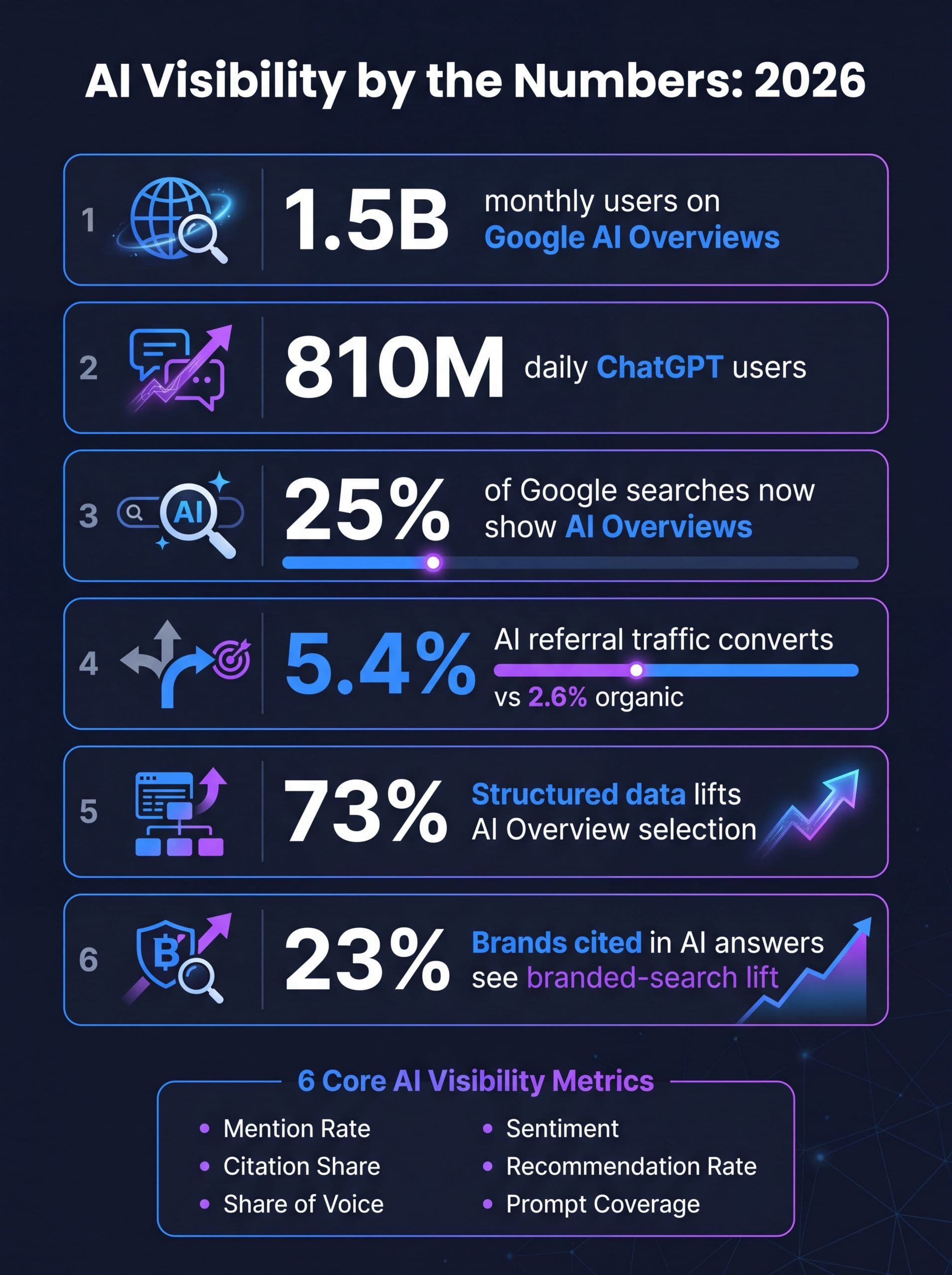
The AI visibility landscape in 2026: adoption, conversion quality, and the metrics that matter.
How to Measure AI Visibility: The 6 Core Metrics
You cannot manage what you cannot measure, and AI visibility does not show up in your standard rank tracker or Google Analytics view. It needs its own measurement framework. Six metrics, tracked across every major engine, give you a complete picture.
1. Mention rate
The percentage of relevant prompts where your brand is named at all, cited or not. This is your baseline presence signal. If your mention rate is low, nothing else matters yet, because you are not in the conversation.
2. Citation share
How often your domain is the linked, attributed source behind a claim, versus competitors. Citations drive the high-converting referral traffic and signal that the engine trusts your page as the authority on that point.
3. Share of voice (Answer Share of Voice)
Your percentage of inclusion across a defined prompt set, benchmarked against competitors. Think of this as market share of answers. It answers the strategic question: for the topics that matter to our business, whose brand does AI recommend most often?
4. Sentiment
How the AI describes you when it mentions you. Being named as “a budget option with limited support” is very different from “a leading unified platform trusted by enterprise teams.” Sentiment tracking catches reputation problems that a simple mention count would miss, and connects directly to AI brand monitoring.
5. Recommendation rate
When a user asks for a recommendation or a “best X” list, how often are you on it, and in what position? This is the metric most tightly correlated with pipeline, because it captures high-intent, decision-stage moments.
6. Prompt coverage
The breadth of relevant questions where you appear. You want to be visible across the full buyer journey, from broad “what is” questions to narrow comparison and pricing prompts, not just one lucky query.
A more advanced metric worth adding: Question-to-Quote velocity, the time from a buyer’s first AI-discovery touch to a sales quote or demo request. It ties AI visibility directly to revenue and helps you prove the channel to finance, the same way pipeline marketing ties activity to outcomes.
How to Improve Your AI Visibility: A Practical Roadmap
Measurement tells you where you stand. This is how you climb. The tactics below are ordered roughly by impact and speed to result.
Step 1: Structure content for extraction
Rewrite key pages so each section leads with a direct, quotable answer, then supports it. Use descriptive H2 and H3 headings phrased the way people ask questions. Keep paragraphs short. Add comparison tables and clearly labeled statistics. This single reformatting is often enough to move marginal queries into inclusion, and it improves the experience for human readers too.
Step 2: Deploy schema markup everywhere it fits
Add Article, FAQPage, Organization, and author schema to your important content. Given the 73% lift in AI Overview selection from structured data, this is among the highest-return work you can do. Mark up your expertise explicitly so engines can verify who is behind the content.
Step 3: Refresh relentlessly
Set a cadence to update cornerstone content with new statistics, current examples, and a fresh dateModified timestamp. Include visible year signals like “2026” in titles and headings, which have been shown to lift citation rates by roughly 30%. Stale content older than 30 days is a liability in an AI-first index.
Step 4: Build topical authority and links
AI engines lean on recognized sources. Earn quality backlinks, publish consistently within your core topics, and develop content clusters so the engines see you as a subject authority rather than a one-off page. This is where a disciplined content supply chain and SEO automation pay off, because volume and consistency compound.
Step 5: Optimize for the fastest engine first
Because Perplexity cites more sources and updates faster, it is often the quickest place to see wins and validate that your changes are working. Use it as your early-signal channel, then expect ChatGPT and Google AI Overviews to follow over the next few weeks.
Step 6: Monitor, benchmark, and iterate
Stand up continuous tracking across all major engines, benchmark share of voice against named competitors, and feed what you learn back into content. AI visibility is not a project you finish, it is an operating loop, and it works best when it plugs into your broader marketing orchestration and AI marketing analytics.
AI Visibility Tools: What to Look For
A category of AI visibility tools has emerged fast, with offerings from established SEO players and a wave of specialists focused on tracking brands inside AI answers. When you evaluate AI visibility tracking tools, the differences that matter are practical.
Coverage comes first. A tool that only checks ChatGPT and Google leaves most of your footprint unmeasured, so insist on ChatGPT, Google AI Overviews, Gemini, Perplexity, and Bing Copilot at minimum. Next is metric depth: a basic AI visibility checker tells you whether you appear, but a real platform reports citation share, sentiment, share of voice, and prompt coverage against competitors. Then comes actionability. The point is not a dashboard, it is knowing which page to fix and what to change, so the best tools connect measurement to a content workflow.
This is exactly where a fragmented stack breaks down. Stitching together a standalone AI brand visibility tracker, a separate content platform, an analytics suite, and a rank tracker recreates the tool sprawl marketers are trying to escape. The teams pulling ahead are consolidating. If you want a deeper comparison of the tracking category, our guide to AI search visibility tools and the broader generative engine optimization services landscape breaks down the options.
The consolidation advantage: When brand monitoring, GEO content production, and analytics live in one system, an AI visibility gap becomes an instant, fixable task instead of a finding that gets lost between four tools and three teams.
Where MarqOps Fits
Most AI visibility problems are really operations problems. Teams can see they are losing the answer box, but the work to fix it is scattered across disconnected tools, so nothing compounds. MarqOps was built to close that gap by putting brand monitoring, content generation, SEO, analytics, and paid advertising under one Brand Intelligence system.
Because MarqOps replaces 7 or more disconnected tools with a single unified dashboard, the loop from “we are under-cited for this topic” to “here is refreshed, schema-marked, brand-perfect content published and tracked” happens in one place. The Brand Intelligence DNA at the core means every asset comes out on-brand from the start, and the multi-model AI pipeline produces content roughly 6x faster than manual workflows, so you can sustain the refresh cadence AI engines reward. Visibility monitoring feeds content production, content production feeds analytics, and analytics feeds the next round of priorities, without a single tab switch or CSV export.
That is the difference between chasing AI visibility as a series of one-off fixes and running it as a repeatable operation. If you are already building toward an AI-native stack, it connects naturally with your marketing intelligence platform strategy and your team of AI agents for marketing.
Frequently Asked Questions
What is AI visibility?
AI visibility is how often and how favorably your brand is surfaced, mentioned, and cited inside AI answer engines like ChatGPT, Google AI Overviews, Perplexity, and Gemini. It measures whether AI recommends your brand for the questions your customers ask, which is increasingly where buying decisions are formed before anyone visits your website.
How is AI visibility different from SEO?
Traditional SEO optimizes for ranked positions in a list of links. AI visibility optimizes for inclusion and citation inside a synthesized answer that names only a handful of brands. You can rank well in classic search and still be absent from AI answers, which is why AI visibility needs its own metrics and its own optimization tactics like schema markup, extractable content structure, and continuous monitoring.
How do you measure AI visibility?
Track six core metrics across every major engine: mention rate, citation share, share of voice, sentiment, recommendation rate, and prompt coverage. Measuring only ChatGPT or only Google hides an estimated 60 to 70% of your true footprint, so monitor ChatGPT, Google AI Overviews, Gemini, Perplexity, and Bing Copilot together.
How long does it take to improve AI visibility?
Structural fixes such as FAQ schema and rewritten opening paragraphs tend to appear in Perplexity within 2 to 7 days and in ChatGPT within 7 to 21 days. Authority-based gains from links and topical depth take longer to compound, so treat AI visibility as an ongoing operating loop rather than a one-time project.
Are AI visibility tools worth it?
Yes, because AI referral traffic converts at roughly 5.4% versus 2.6% for organic, and brands consistently cited in AI answers see about a 23% lift in branded search. The best tools cover all major engines, report competitive share of voice and sentiment rather than a simple yes-or-no check, and connect measurement to a content workflow so you can act on gaps. A unified platform like MarqOps folds this into your wider marketing operation instead of adding another silo.
Keep following the signal
Related field notes
Marketing Operations
Marketing Project Management Software in 2026: How to Choose Without Adding Tool #122
11 min readMarketing Analytics
Marketing Attribution Software in 2026: The Buyer's Guide for a Stack That Won't Stop Growing
11 min readMarketing Operations