Creative Automation in 2026: The Complete Guide to Scaling Brand-Perfect Creative Without Breaking Your Team
Creative automation turns one master asset into thousands of on-brand variations. See how 2026 marketing teams ship 6x faster, lift ROAS, and stay on-brand.
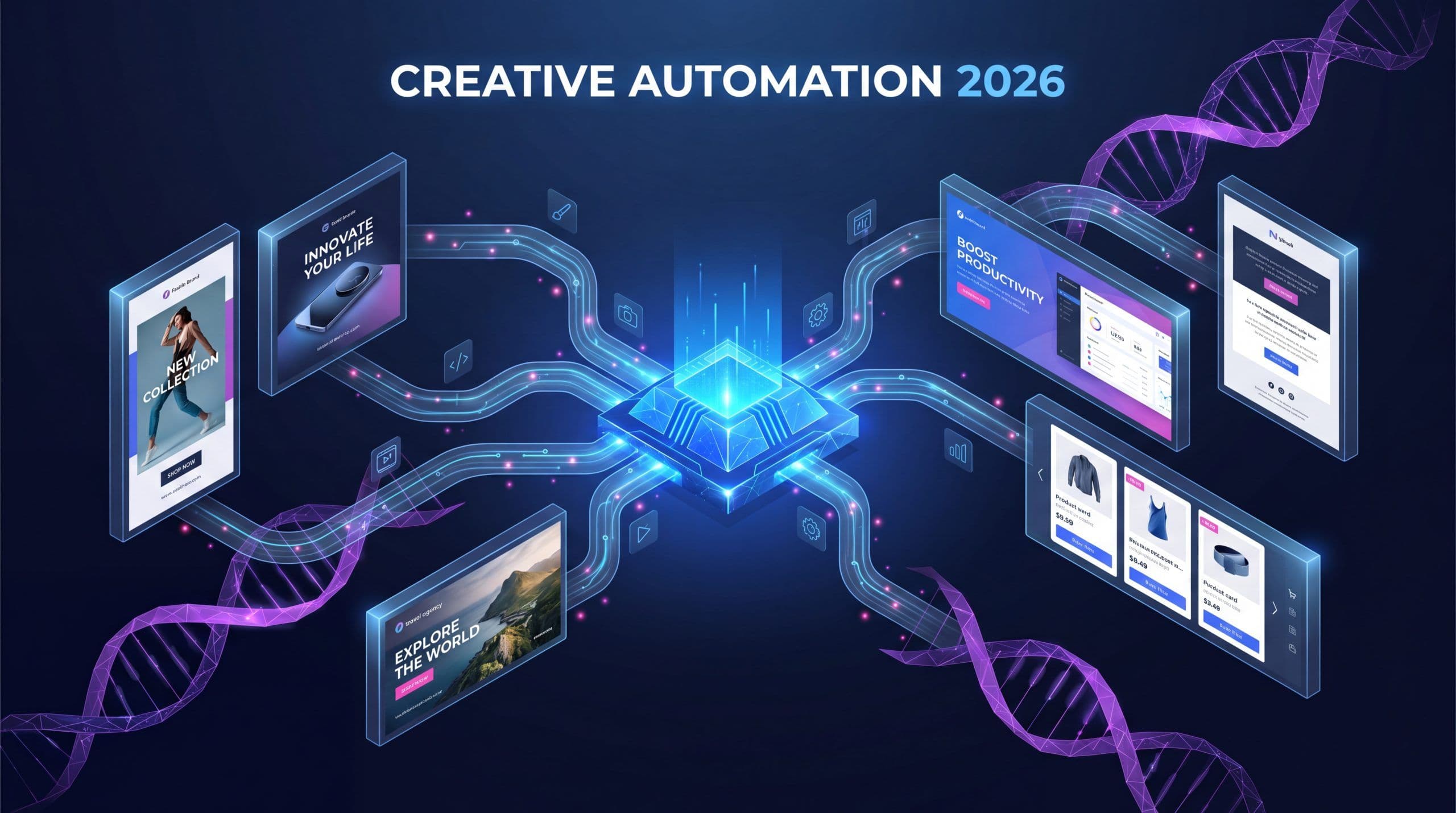
Creative automation workflow connecting brand DNA to multi-channel ad variants
TL;DR: Creative Automation in 2026
- What it is: Creative automation is the software-driven process of generating, adapting, and deploying thousands of on-brand ad variations from a single master template, without a human touching every file.
- Why now: Creative is 49% of a campaign’s sales contribution (NCS), yet most teams ship just 3-5 new ads per week. Automation closes that gap 10x to 80x.
- The business impact: DCO-powered creative automation drives up to 30% higher CTR and 20% stronger conversion lift compared to static ads, with some brands reporting 58% ROAS increases.
- The catch: 70% of marketers have already hit AI-related brand issues. Automation without brand guardrails creates volume, not value.
- Who wins in 2026: Teams that combine a unified creative automation platform, brand intelligence DNA, and AI agents instead of stitching 7+ point tools together.
Table of Contents
- 1. What Is Creative Automation?
- 2. Why 2026 Is the Tipping Point for Creative Automation
- 3. How Creative Automation Actually Works
- 4. Five Use Cases That Pay Back Immediately
- 5. Brand Intelligence: The Missing Layer in Most Creative Automation Tools
- 6. Creative Automation Platforms vs. Creative Automation Services
- 7. A 90-Day Creative Automation Implementation Plan
- 8. Metrics That Prove Creative Automation Is Working
- 9. Creative Automation Mistakes That Kill ROI
- 10. How MarqOps Delivers Creative Automation Differently
- 11. Frequently Asked Questions
1. What Is Creative Automation?
Creative automation is the use of software, templates, and AI to generate, adapt, and deploy marketing creative at scale without a designer manually producing every asset. In practical terms, one master layout becomes hundreds or thousands of variations, resized for every channel, personalized for every audience, localized for every market, and assembled in minutes instead of weeks.
Ask five CMOs what is creative automation and you’ll get five answers. The useful definition in 2026 is this: creative automation is the production layer between your brand system and your media channels. It takes structured inputs (brand guidelines, product data, audience signals) and produces output ready to ship (ads, emails, landing pages, social posts) without manual copy-paste work in between.
For marketing teams living inside a fragmented stack, this is a relief. Instead of a designer building three Facebook ads, a copywriter rewriting the headline four times, and an ops manager chasing approvals in Slack, AI-powered marketing automation inside a creative automation platform handles the mechanical work so humans stay on the strategy, the concept, and the brand.
The core promise of creative automation: you describe the brand once, and every future asset inherits it automatically. No more “off-brand” fire drills on launch day.
2. Why 2026 Is the Tipping Point for Creative Automation
Three forces are colliding in 2026 that make creative automation less of a nice-to-have and more of a survival tool.
2.1 Channel fragmentation exploded
A single B2B campaign now needs assets in 1:1, 4:5, 9:16, and 16:9 aspect ratios, in four copy variants, in three languages, and often with separate visual treatments per platform. Meta, TikTok, YouTube, Google Display, LinkedIn, CTV, and retail media networks each have their own spec sheet. Manual resizing is dead.
2.2 Creative is 49% of campaign performance
NCS research consistently shows creative accounts for roughly 49% of a campaign’s sales contribution, more than targeting, more than placement, more than bid strategy. Yet most teams still treat creative as the slow tail of the workflow. The bottleneck is not budget or targeting. It’s creative output.
2.3 AI agents finally shipped
Gartner’s 2025 survey of 413 marketing tech leaders found 81% are piloting or already running AI agents for marketing. These agents don’t just generate a single asset. They complete multi-step creative jobs: pull product data, write copy, generate visuals, localize, QA, and push to ad platforms. That’s what made real-time creative marketing automation production-viable.
The numbers to remember:
- Manual teams ship roughly 8 ad variants per month. Automated teams ship 80+.
- AI creator campaigns are projected to scale 24x to 80x by 2026 (Humanz).
- Marketing automation market: $15.62B by 2030, growing 15.3% annually.
- By 2026, 80%+ of enterprises will embed generative AI in applications (Gartner).
- A single DCO campaign testing 2,000+ variations drove 58% ROAS lift and 30% CPA drop.
3. How Creative Automation Actually Works
A creative automation platform turns brand and product inputs into deployable creative through four layers. Understanding these layers helps you evaluate tools, brief your team, and avoid the “automation in name only” trap.
Layer 1: Brand system
The brand system encodes your colors, typography, logos, tone of voice, legal copy, and visual rules. This becomes the constraint engine. Everything the platform produces must pass through these rules before shipping. Without this layer, you’re just generating content, not brand-safe creative.
Layer 2: Templates and dynamic modules
Templates define the structure of each asset (headline block, product shot, CTA button, disclaimer line). Dynamic modules inside the template swap based on inputs: audience segment, product in stock, location, or live performance data. A good creative automation platform treats templates as code, versioned, reusable, and testable.
Layer 3: Data feeds and AI generation
Inputs arrive from product catalogs, CRM data, live pricing, weather APIs, or audience signals. AI fills the gaps: generating headline variants, translating copy, creating product backgrounds, or producing short video clips. This is where modern creative automation tools add the most leverage compared to older template engines.
Layer 4: Distribution and optimization
The final layer pushes finished assets to ad platforms, CMS, email tools, and paid social. Mature creative automation platforms close the loop: they pull performance data back and use it to retire losing creative and reweight winning variants automatically. This is where creative automation overlaps with dynamic creative optimization (DCO).
4. Five Use Cases That Pay Back Immediately
Not every team needs every feature. These five use cases are the fastest to prove value and the easiest to pitch internally.
1. Paid social ad production
A performance team testing 5 variations per campaign upgrades to 50 without hiring. Aspect ratios auto-resize, copy variants generate from product data, and creative fatigue becomes a non-issue. Pair this with our guide to AI ad generators to see the tool landscape.
2. Product catalog personalization
E-commerce teams connect their product feed and generate thousands of product ads automatically. A fashion retailer using DCO reported 25% higher conversions by swapping product images based on browse history (AppsFlyer, 2025). This overlaps with AI personalization in marketing.
3. Global localization at speed
One master campaign becomes 40 market-ready versions with localized copy, legal footers, and currency. What used to take three weeks and a translation agency is now same-day. Compliance is baked in by the brand system.
4. Always-on creative refresh
Creative fatigue kills paid media performance within 7 to 14 days on Meta. Automated refresh pipelines generate a weekly batch of net-new variants, so your campaigns never run stale creative. This ties directly to your marketing automation toolset.
5. Sales enablement and lifecycle content
Beyond paid, creative automation quietly transforms sales decks, nurture emails, landing pages, and retention content. Connect it to your AI content strategy and the entire content engine speeds up together.
5. Brand Intelligence: The Missing Layer in Most Creative Automation Tools
Here’s the honest problem most vendors don’t advertise: over 70% of marketers have run into AI-related issues (hallucinations, bias, off-brand output), yet fewer than 35% plan to increase investment in brand governance next year. That mismatch explains why so many creative automation rollouts stall six months in. Volume goes up. Quality slides. Legal starts flagging assets. Trust dies.
The fix is a brand intelligence layer, a structured representation of your brand that every AI model must honor. Coca-Cola’s internal brand asset management system, which handles 50,000 assets per month, reportedly cut guideline violations by 60% and saved around $2 million once this layer was added. The generative power was the same. The governance was different.
What a brand intelligence layer actually contains
- Typography rules (allowed fonts, weights, kerning constraints)
- Color system with context (primary for CTAs, accent for highlights, warnings, success states)
- Logo clear space, minimum sizes, forbidden backgrounds
- Tone of voice instructions converted to prompt constraints
- Legal and compliance copy, always appended by default
- Visual style references (not just images, but the rules behind them)
- Reviewer escalation triggers for sensitive categories
This is the layer that turns creative automation from a productivity hack into a system your legal team will actually sign off on. Without it, you’re just producing off-brand content faster.
6. Creative Automation Platforms vs. Creative Automation Services
A search for creative automation services returns both software platforms and agencies that run creative automation on your behalf. Both have a place. The choice depends on your team.
| Dimension | Creative Automation Platform | Creative Automation Services (Agency) |
|---|---|---|
| Best fit | In-house marketing team with ops capacity | Teams with more budget than headcount |
| Control | Full. You own the templates and the data. | Partial. The agency holds the templates. |
| Time to first output | 4-8 weeks (setup, template building) | 1-2 weeks (agency runs it) |
| Cost curve | Fixed SaaS + staff. Scales well. | Variable retainer. Scales painfully. |
| Knowledge lock-in | Stays in-house | Leaves when the contract ends |
Most maturing marketing teams start with a service to learn, then migrate to a platform once they understand the template logic. Unified platforms like MarqOps reduce that migration risk because the entire workflow lives in one system. See our marketing operations guide for the organizational side of this shift.
7. A 90-Day Creative Automation Implementation Plan
Most failed creative automation rollouts share one pattern: they try to automate everything in quarter one. Don’t. The plan below is built from working implementations at mid-market and enterprise teams.
Days 1 to 30: Brand intelligence and audit
- Document your brand system in machine-readable form (tokens, not PDFs)
- Audit the last 90 days of creative output: volume, channels, time-to-ship
- Identify the top 3 formats that consume 80% of designer time
- Pick one channel to pilot (paid social is usually the fastest payback)
- Build a small internal task force: marketing ops, design, legal, paid media
Days 31 to 60: Pilot on one channel
- Build 3 to 5 master templates for the pilot channel
- Connect your product or audience data feed
- Run a parallel test: human-made creative vs automated output, same campaign
- Measure CTR, conversion rate, and cost per outcome, not just volume
- Capture what the AI gets wrong, iterate the brand prompts
Days 61 to 90: Scale and connect
- Add the next 2 channels using proven templates
- Integrate with your multi-touch attribution stack so you can see which variants actually drive ROI
- Stand up an always-on creative refresh rhythm (weekly batch)
- Train the team on template ownership, so designers shift from production to creative direction
- Formalize governance: who approves templates, who audits output, escalation rules
By day 90 you should be shipping 3x to 6x more creative with the same headcount and seeing measurable lift on the pilot channel. If you’re not, the issue is almost always template quality or data wiring, not the underlying creative automation tools.
8. Metrics That Prove Creative Automation Is Working
Volume alone is vanity. If your creative automation program is working, four numbers should move together:
Time-to-ship per asset
Target: from days to minutes. A mature setup ships a new variant in under 10 minutes including review.
Variants per campaign
Target: 5x to 10x growth in 90 days. This is your test surface area.
CTR and conversion lift
Target: 15% to 30% lift, matching published DCO benchmarks. If automation produces volume without lift, your templates are the problem.
Brand compliance rate
Target: 95%+ auto-approved on first pass. This is the signal that your brand intelligence layer is working.
Pair these with predictive marketing analytics to understand which creative patterns drive longer-term customer value, not just first-touch conversion.
9. Creative Automation Mistakes That Kill ROI
Every team we talk to hits at least two of these. Avoid them and your first quarter of creative workflow automation looks dramatically better.
- Automating bad creative. Automation amplifies whatever you feed it. If your master template has weak hierarchy or off-brand copy, you’ll ship 500 off-brand assets instead of 5. Audit the source first.
- Ignoring brand governance. Ship fast, break brand. That’s how you end up in a legal review spiral that pauses automation for a quarter.
- Stitching 7+ point tools. A creative automation platform stitched from a template tool, a copy tool, a DAM, a DCO engine, an ad API, and a workflow app is a maintenance job, not a marketing program. Unified platforms win on total cost of ownership.
- No performance loop. If you’re not pulling performance back into the creative system, you’re just producing variants without learning. Close the loop or you’re doing creative production automation without the ROI story.
- Wrong team incentives. If designers are rewarded for output count, they’ll protect the old workflow. Shift incentives toward ideas shipped and lift delivered.
- Skipping the pilot. Trying to automate everything at once is how most programs fail. Pick one channel, prove lift, then expand.
- Treating AI outputs as final. In 2026 the winning pattern is AI-generated, human-approved, not human-free. Build review into the workflow, not as an afterthought.
10. How MarqOps Delivers Creative Automation Differently
Most creative automation platforms solve one slice of the problem: an ad builder, a template engine, or a DCO layer. MarqOps unifies creative, SEO content, paid media, and analytics in one platform built around a Brand Intelligence DNA layer. That’s what the rest of this guide has been circling.
Three reasons marketing teams pick MarqOps for creative automation
- One platform replaces 7+ tools. Creative, content, ads, and analytics in a single dashboard means no more tab-switching and no integration rot.
- Brand Intelligence DNA. Your brand system becomes the constraint layer every AI model honors, so output is on-brand from the first draft.
- 6x faster content output. The multi-model AI pipeline picks the best engine per job instead of locking you into one vendor’s limits.
You don’t have to take our word for it. The fastest way to see how a unified creative automation platform changes your workflow is to run one campaign through it. No rip-and-replace. Start with a single channel, keep your existing tools, and measure lift.
Start Free – No Card Required
See How MarqOps Works
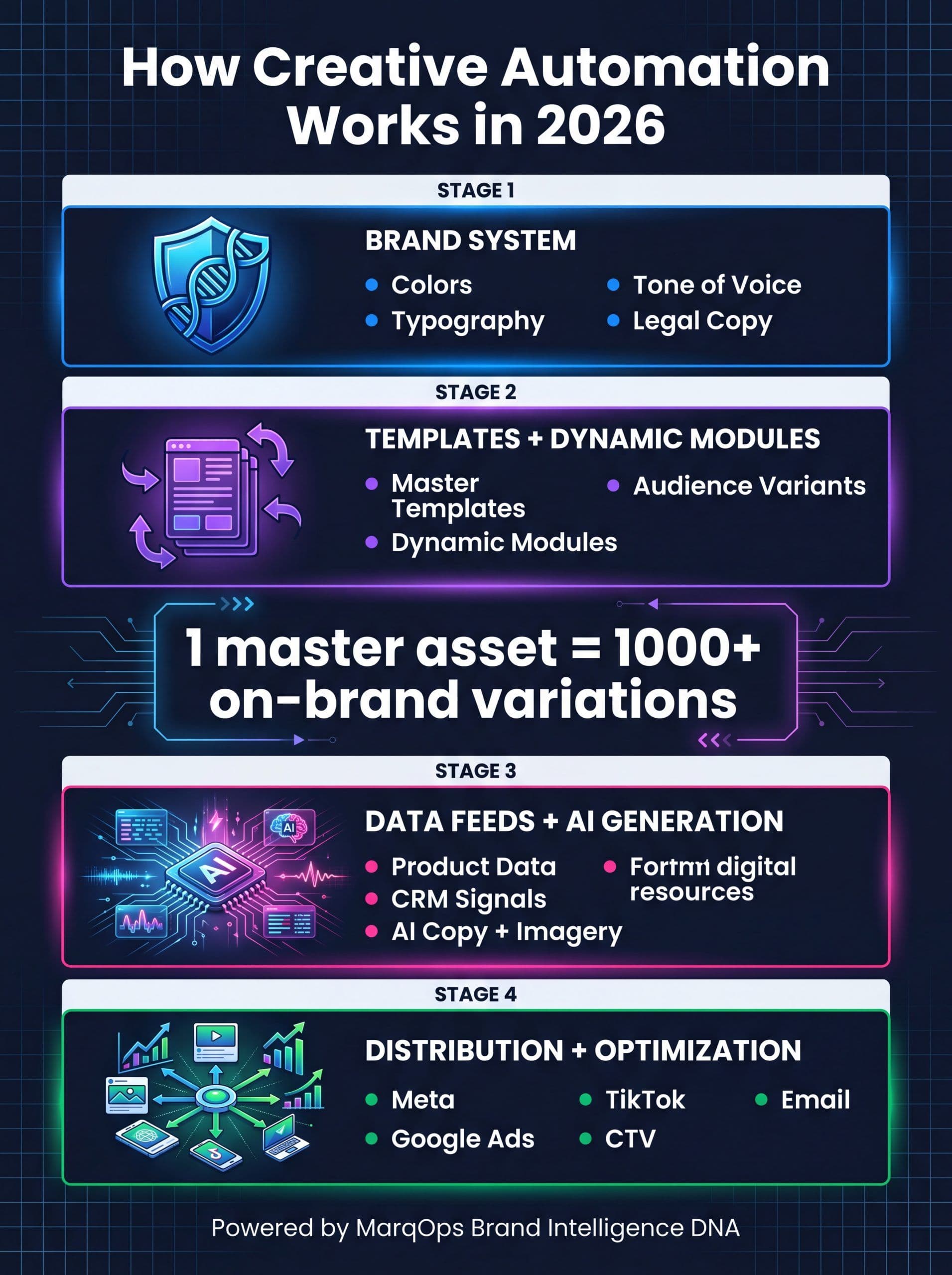
How creative automation turns one master asset into thousands of on-brand variations.
11. Frequently Asked Questions
What is creative automation in simple terms?
Creative automation is software that turns one master creative template into thousands of on-brand variations automatically. Instead of a designer making every ad by hand, you describe the brand and the inputs once, and the system produces every size, language, and audience version on demand. It’s how modern marketing teams test 80 variants a month instead of 8.
How is creative automation different from dynamic creative optimization (DCO)?
Creative automation is the production layer. It generates and assembles assets. DCO is the distribution layer. It decides which variant to serve to which user in real time based on signals and performance. In a mature stack, creative automation feeds variants into DCO. One without the other leaves money on the table.
Do I need a creative automation platform if my team already uses generative AI tools?
Generative AI tools give you one-off outputs. A creative automation platform gives you repeatable, on-brand, governed production at scale. If your team is spending hours cleaning up AI output or fixing brand drift, you need the platform layer. The biggest wins come from combining the two.
What are the best creative automation tools in 2026?
The leaders split into two camps. Point tools such as Celtra, Bynder, and Hunchads focus on ad creative production. Unified platforms such as MarqOps combine creative automation with SEO content, paid media, and analytics, which removes the cost of stitching multiple tools together. The right pick depends on whether you want best-of-breed or best-of-stack.
How much ROI can creative automation actually deliver?
Published benchmarks show 15% to 30% CTR lift, 20% higher conversion rates, and ROAS improvements between 18% and 58% depending on the vertical. The bigger impact is structural: teams ship 6x to 10x more creative with the same headcount, and brand compliance improves instead of degrading as volume scales.
Keep following the signal