Creative Analytics in 2026: The Complete Guide to Measuring and Scaling Winning Ad Creative
Creative quality drives 49% of advertising’s sales lift, yet only 3.6% of marketers actively optimize it. Learn the hook rate and hold rate framework, AI fatigue detection, and a 6-step creative analytics workflow.

TL;DR
- Creative analytics is the practice of measuring which specific creative elements (hooks, formats, messages, visuals) drive ad performance, then feeding those insights back into production.
- Creative quality drives 49% of the incremental sales lift from advertising, more than reach, targeting, and recency combined, yet only 3.6% of marketers say their creative effectiveness is well understood.
- The core diagnostic funnel: hook rate (are you stopping the scroll?), hold rate (does the body deliver?), and CTR/conversion rate (did viewers act?).
- AI now automates creative tagging, fatigue detection, and predictive scoring, catching performance drops in 24-48 hours instead of 7-14 days.
- Teams that connect creative analytics directly to production close the loop faster: insights become new variations in hours, not weeks.
Most marketing teams can tell you their ROAS down to the second decimal. Ask them why their best ad outperformed the rest, and the room goes quiet.
That gap is exactly what creative analytics solves. While media buying has been algorithmic for years, the creative side of advertising has remained a black box of gut feel and post-hoc rationalization. In 2026, that black box is finally opening up, and the numbers show why it matters: creative assets now account for over half of ad performance variance, making creative intelligence more valuable than audience segmentation.
This guide covers what creative analytics actually is, the metrics that matter, how AI has transformed the discipline, and how to build a creative analytics workflow that turns reporting into revenue.
Table of Contents
- What Is Creative Analytics?
- Why Creative Analytics Matters in 2026
- The Core Creative Metrics Every Team Should Track
- The 3-Stage Creative Diagnostic Framework
- Creative Fatigue: The Silent Budget Killer
- How AI Is Transforming Creative Analytics
- How to Build a Creative Analytics Workflow (6 Steps)
- 5 Creative Analytics Mistakes to Avoid
- Frequently Asked Questions
What Is Creative Analytics?
Creative analytics is the systematic measurement of how individual creative elements (hooks, visuals, copy, formats, talent, music, calls to action) influence advertising performance. Instead of evaluating an ad as a single unit, creative analytics breaks it into components, tags those components, and correlates them with outcomes like click-through rate, conversion rate, and return on ad spend.
Traditional ad reporting answers “which campaign performed?” Creative analytics answers “which creative decisions performed?” That distinction changes everything downstream:
- Traditional reporting: “Video A got a 2.1% CTR, Video B got 0.9%.”
- Creative analytics: “Videos opening with a customer testimonial in the first 3 seconds hold viewers 38% longer than product-first openings, and UGC-style framing beats studio polish on cold audiences.”
The first tells you what happened. The second tells you what to make next. That production feedback loop is the entire point, and it is why creative analytics sits at the intersection of AI marketing analytics and creative automation rather than living in either silo alone.
Why Creative Analytics Matters in 2026
The case for creative analytics rests on a simple imbalance: creative drives most of the result but gets a fraction of the measurement attention.
49%
of advertising’s incremental sales lift comes from creative quality, more than reach, brand, targeting, and recency combined (Nielsen Catalina Solutions)
Google’s own research goes further, attributing roughly 70% of campaign success in brand advertising to creative, with media accounting for only 30%. In CPG specifically, strong creative delivers sales lift 2.5x higher than weak creative.
Now contrast that with how teams actually measure it. According to MarketingProfs research on creative measurement, only 3.6% of marketers say the effectiveness of their ad creative is well understood and actively optimized, while 33.2% have no method at all for tracking creative effectiveness.
The math is brutal: the single biggest driver of ad performance is the variable the fewest teams measure. If creative is 49-70% of your outcome and you have zero visibility into it, you are flying blind on most of your ad budget.
Three forces made creative analytics urgent in 2026:
1. Algorithmic media buying removed the other levers
Platforms like Google’s Performance Max and Meta Advantage+ have automated targeting, bidding, and placements. Creative is the last meaningful input human marketers control. When the algorithm handles distribution, your creative is your strategy.
2. Creative volume exploded
AI generation tools mean teams ship 10x more variations than they did three years ago. Tools covered in our guide to free AI ad generators make production cheap, but volume without measurement just produces more unmeasured creative. Only about 5% of ads earn at least 10x their account’s median spend, so finding those outliers fast is the game.
3. AI made element-level analysis practical
Manual creative tagging consumes up to 20 hours per week and is error-prone. Multimodal AI now tags video, audio, image, and text automatically, which means element-level insight is available to teams without a dedicated analyst.
The Core Creative Metrics Every Team Should Track
Creative analytics has its own metric stack that sits upstream of conversions. These are the ones that matter most.
Hook Rate (Thumbstop Rate)
Hook rate measures the percentage of impressions where viewers watched at least the first 3 seconds of your video: 3-second video plays ÷ impressions × 100. It answers one question: are you stopping the scroll? A healthy hook rate on Meta typically lands in the 20-30% range, though it varies by vertical and placement.
Hold Rate
Hold rate measures how well your ad retains the people it hooked: 15-second views ÷ 3-second views × 100. A strong hook with a weak hold means your opening made a promise the body did not keep.
Click-Through Rate by Creative Concept
CTR at the individual ad level is noisy. CTR aggregated by creative concept (all UGC testimonial ads vs. all product demo ads) reveals which ideas work, not just which executions got lucky.
Creative-Attributed ROAS and CPA
Roll spend and revenue up to the concept and element level. This is where you learn that, say, ads featuring pricing in the first frame convert 22% cheaper even though their CTR is lower.
Creative Fatigue Indicators
Frequency, first-time impression ratio, and declining CTR over time signal that an audience has seen your ad too often. Meta now surfaces a native creative fatigue and similarity score in Ads Manager that flags overexposed and redundant creatives automatically.
Creative Production Velocity
Less discussed but critical: how many net-new concepts and variations you ship per week, and how fast an insight becomes a live ad. Analytics without production speed is a report; analytics with production speed is a flywheel. This is where platforms that unify measurement and creation, like MarqOps with its Brand Intelligence DNA, compress the loop from insight to brand-perfect new variation from weeks to hours.
The 3-Stage Creative Diagnostic Framework
The most practical way to use these metrics is as a sequential diagnostic funnel. When an ad underperforms, walk through three stages in order:
- Stage 1: Hook (0-3 seconds). Is your hook rate below benchmark? The problem is your opening frame, first line, or thumbnail. Nothing else matters until this is fixed, because nobody is seeing the rest.
- Stage 2: Hold (3-15 seconds). Hook rate is fine but hold rate sags? The body is not delivering on the hook’s promise. Tighten pacing, front-load proof, cut the slow build.
- Stage 3: Action (CTR and conversion rate). People watch but do not click, or click but do not convert? Your offer, CTA, or landing page congruence is the bottleneck, not the video.
This framework prevents the most common creative mistake: rebuilding an entire ad when only one stage is broken. Pair it with structured experimentation from our AI A/B testing guide to validate fixes instead of guessing.
Pro tip: Diagnose in order. A weak hook makes every downstream metric meaningless, because hold rate and CTR are only measured on the tiny audience that survived the first 3 seconds.
Creative Fatigue: The Silent Budget Killer
Every creative has a decay curve. Performance climbs during the learning phase, plateaus, then erodes as the audience sees the ad repeatedly. The erosion is gradual enough that most teams notice 7-14 days after it starts, which means a week or two of budget spent on a declining asset.
Modern fatigue detection works differently:
- Leading indicators over lagging ones. First-time impression ratio and frequency trends shift before CTR visibly drops.
- AI anomaly detection. AI-powered tools catch performance drops within 24-48 hours versus the typical 7-14 day manual lag, and the best systems detect fatigue 7-14 days earlier than manual review.
- Automated refresh triggers. When fatigue is detected, the system queues replacement variations automatically rather than waiting for the Monday meeting.
The strategic answer to fatigue is not just detection but a steady supply of fresh variations, which is why fatigue management ties directly into dynamic creative optimization. DCO alone boosts CTR by 32% on average, precisely because it rotates fresh combinations before audiences burn out.
How AI Is Transforming Creative Analytics
Creative analytics existed before AI, but it was a luxury reserved for teams with analysts to spare. Three AI capabilities changed that.
Multimodal auto-tagging
AI vision and language models now watch every ad and tag its elements automatically: opening shot type, talent demographics, music tempo, text overlay density, CTA placement, color palette. What took 20 hours of weekly manual work happens continuously in the background.
Predictive creative scoring
Trained on historical performance, models score new creative before a dollar is spent. AI-optimized creatives deliver up to 2x higher click-through rates than manually designed versions, and AI-generated ads have shown 12% higher CTR on Meta across datasets of 50,000+ variations. Pre-flight scoring means your media budget tests fewer duds.
Closed-loop generation
The frontier in 2026 is connecting insight directly to production. When analytics shows that testimonial hooks outperform, AI agents generate the next batch of testimonial-led variations automatically, on brand and ready for review. This is the difference between a dashboard and an operating system for creative.
That closed loop is hard to build from point solutions because the data lives in one tool, the insights in another, and production in a third. A unified platform approach, where one system replaces 7+ disconnected tools, means your creative analytics, design generation, and reporting dashboard share the same data spine. MarqOps takes this approach: performance data flows into Brand Intelligence DNA, so every new variation generated is informed by what already won and stays brand-perfect from the start, with teams reporting 6x faster content output.
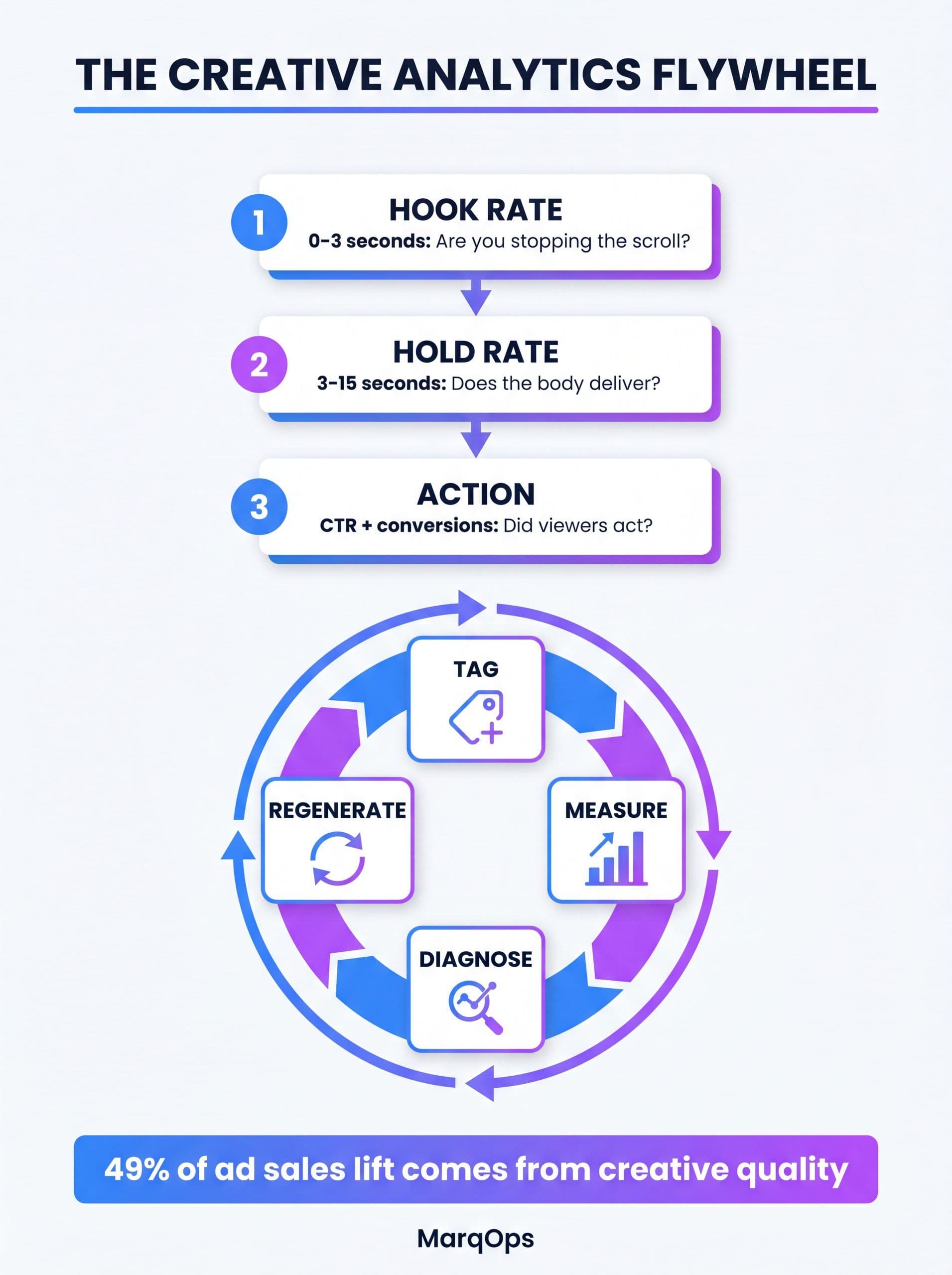
The creative analytics flywheel: tag, measure, diagnose, regenerate.
How to Build a Creative Analytics Workflow (6 Steps)
Step 1: Define your creative taxonomy
Decide what you will tag before you tag it: concept type (UGC, demo, testimonial, founder story), hook style, format, length, talent, offer framing, CTA type. Keep it to 8-12 dimensions. A taxonomy aligned with your brand guidelines ensures tags mean the same thing across teams.
Step 2: Instrument your platforms
Pull creative-level data from Meta, Google Ads, TikTok, and LinkedIn into one place. Native platform reporting is a start, but cross-channel comparison requires unified data.
Step 3: Tag everything, ideally with AI
Apply your taxonomy to every live and historical asset. If you are doing this manually, budget the hours honestly or use AI tagging to do it continuously.
Step 4: Set benchmarks and decision rules
Establish account-level baselines for hook rate, hold rate, CTR, and CPA. Then write the rules down: “If hook rate < 20% after 3,000 impressions, kill and replace the opening." Rules turn analytics into action without meetings.
Step 5: Run structured creative sprints
Each week or two, ship a batch of variations that tests one element deliberately. Volume matters, but structured volume compounds: every sprint adds rows to your dataset and sharpens the next prediction.
Step 6: Close the loop into production
Route insights directly to your creation workflow so the winning patterns shape the next batch. Whether through AI workflow automation or a unified platform, this step separates teams that report on creative from teams that compound it.
5 Creative Analytics Mistakes to Avoid
- 1. Judging concepts on single executions. One bad video does not kill a concept. Test at least 3 executions per concept before drawing conclusions.
- 2. Optimizing for hook rate alone. Shock-value hooks inflate 3-second views while attracting the wrong audience. Always pair hook rate with downstream conversion data.
- 3. Ignoring statistical significance. A 0.3% CTR difference on 2,000 impressions is noise. Set minimum impression thresholds before declaring winners.
- 4. Letting insights die in slides. If your monthly creative report does not change next month’s production brief, you have a reporting habit, not an analytics practice.
- 5. Measuring creative without brand consistency. Chasing pure performance can drift your creative off-brand. The best systems score both performance and brand fit so growth does not erode equity.
Frequently Asked Questions
What is creative analytics in marketing?
Creative analytics is the practice of measuring how individual creative elements such as hooks, visuals, copy, and formats affect ad performance. It breaks ads into tagged components and correlates them with metrics like CTR, conversion rate, and ROAS, so teams know what to produce next rather than just what happened.
What is the difference between creative analytics and regular ad reporting?
Ad reporting tells you which campaigns and ads performed. Creative analytics tells you why, by attributing performance to specific creative decisions like opening style, format, or message. Reporting is backward-looking; creative analytics feeds forward into the next production cycle.
What is a good hook rate for video ads?
On Meta, a hook rate (3-second plays divided by impressions) of 20-30% is generally considered healthy, though benchmarks vary by industry, placement, and audience temperature. Compare against your own account median rather than global averages, and diagnose hook rate before any downstream metric.
How does AI improve creative analytics?
AI automates the three slowest parts: tagging creative elements across video, image, audio, and text (replacing up to 20 hours of weekly manual work), detecting creative fatigue within 24-48 hours instead of 7-14 days, and predicting performance of new creative before spend. Advanced systems also generate new on-brand variations from winning patterns automatically.
How do I detect creative fatigue?
Watch leading indicators: rising frequency, falling first-time impression ratio, and CTR declining against the ad’s own trailing average. Meta Ads Manager now includes a native creative fatigue and similarity score, and AI analytics tools flag fatigue automatically so you can rotate fresh variations before performance craters.
Do small teams need creative analytics tools?
Yes, arguably more than large teams, because small teams cannot afford wasted spend on fatigued or weak creative. Start free with native platform metrics and a simple tagging spreadsheet, then graduate to an AI-powered platform when manual tagging starts consuming hours you do not have.
Turn Creative Data Into Your Next Winning Ad
Creative analytics in 2026 is no longer a nice-to-have report. With creative driving roughly half of advertising’s sales impact and platforms automating everything else, the teams that win are the ones that measure their creative at the element level, detect fatigue early, and close the loop from insight to new on-brand asset fastest.
MarqOps was built for exactly this loop: one unified dashboard for analytics, ads, SEO, and creative, with Brand Intelligence DNA ensuring every AI-generated variation stays brand-perfect from the start. No more exporting CSVs from one tool to brief another.
Keep following the signal
Related field notes
Marketing
Marketing Automation for Agencies in 2026: What to Automate, What to Keep Human
11 min readMarketing
Brand Asset Management in 2026: How to Run It Without Adding Another Tool
14 min readMarketing Operations