AI Advertising in 2026: The Complete Guide to Smarter Campaigns, Creative, and ROI
AI advertising explained for 2026: how AI targeting, bidding, and generative creative work, with market data, real brand examples, and a 6-step implementation roadmap.
TL;DR
- AI advertising uses machine learning to automate targeting, bidding, creative production, and optimization. US AI-powered ad spend is projected to hit $57 billion in 2026, up 63% year over year.
- Platform-native tools like Google Performance Max and Meta Advantage+ now run the majority of paid campaigns, while agentic AI systems plan, launch, and optimize with minimal human input.
- The results are measurable: up to 2x higher ROAS from AI-based targeting, 32% higher CTR from dynamic creative optimization, and 56% lower cost per click.
- The biggest risks are loss of transparency, setup complexity (cited by 62% of ad professionals), and consumer trust. Disclosure of AI use lifts overall company trust by 96%.
- Winning teams pair platform automation with unified data, brand-consistent creative, and human strategic oversight rather than handing everything to black-box algorithms.
Table of Contents
- What Is AI Advertising?
- The AI Advertising Market in 2026
- How AI Advertising Works: The Four Layers
- The Rise of Agentic Advertising
- AI Advertising Examples From Real Brands
- Benefits: What the Data Shows
- Challenges and the Consumer Trust Problem
- How to Implement AI Advertising: A 6-Step Roadmap
- Frequently Asked Questions
What Is AI Advertising?
AI advertising is the use of artificial intelligence, primarily machine learning and generative AI, to plan, create, buy, and optimize ad campaigns. Instead of a media buyer manually picking audiences, setting bids, and rotating creative, AI systems evaluate hundreds of campaign signals in real time and make those decisions automatically, usually faster and more accurately than any human team could.
In practice, AI now touches every stage of the advertising workflow: audience prediction and targeting, real-time bid management, dynamic creative optimization, budget pacing across channels, and post-campaign measurement. Generative AI adds a production layer on top, writing ad copy, generating images and video, and spinning up hundreds of creative variations from a single concept.
The shift matters because the platforms themselves have gone AI-first. Google pushes advertisers toward Performance Max and AI Max for Search. Meta makes Advantage+ the default starting point for new campaigns. If you buy digital ads in 2026, you are already using AI advertising whether you planned to or not. The real question is whether you are using it deliberately, with the right data, creative inputs, and guardrails, or just accepting whatever the black box decides. Teams that treat AI advertising as a strategy rather than a toggle are the ones seeing outsized returns, a theme we cover in depth in our guide to building an AI marketing strategy.
The AI Advertising Market in 2026
The numbers tell a story of rapid, uneven adoption. According to eMarketer, US AI-powered ad spend will reach $57 billion in 2026, a 63% jump year over year. That represents roughly 12% of the estimated $475 billion US ad market, and it is growing more than ten times faster than the non-AI remainder, which is expanding at about 5%.
$57 billion
Projected US AI-powered ad spend in 2026, up 63% year over year (eMarketer)
Zoom out and the momentum is global. The AI in advertising market is projected to grow from $11.17 billion in 2025 to $14.12 billion in 2026, a 26.4% compound annual growth rate. The IAB’s 2026 outlook study forecasts 9.5% growth in total US ad spend, explicitly naming accelerating adoption of agentic AI as a key driver. Meanwhile, Meta’s Advantage+ AI campaigns alone have exceeded a $20 billion annual revenue run rate.
Creative production is moving just as fast. An IAB report found that 86% of media buyers either currently use or plan to use AI to build AI-generated video ads in 2026. On the buying side, 66% of US ad buyers say they plan to pay closer attention to agentic ad buying this year, and 41% of US and UK marketers expect the biggest benefit of agentic AI to come from optimizing toward cost per acquisition and ROAS goals.
What this means for your team: the competitive gap is no longer between teams that use AI and teams that do not. It is between teams that feed AI systems clean first-party data and brand-consistent creative, and teams that let the algorithms guess.
How AI Advertising Works: The Four Layers
1. Targeting and audience prediction
AI targeting models analyze behavioral signals, purchase history, and contextual data to predict which users are most likely to convert, replacing static audience lists with continuously updated probability scores. With third-party cookies fading, AI-based contextual targeting paired with first-party data has become the highest-performing combination. Advertisers using it see up to 2x higher return on ad spend compared to third-party targeting.
2. Bidding and budget optimization
Smart bidding systems evaluate auction-time signals like device, location, time of day, and browsing behavior to set a unique bid for every single impression. Modern systems go further and reallocate budget across campaigns, channels, and dayparts automatically. This is the layer where platform tools like Google’s Smart Bidding and Performance Max campaigns have made manual bid management effectively obsolete.
3. Creative generation and optimization
Generative AI produces ad copy, images, and video at a speed no creative team can match, and dynamic creative optimization (DCO) transforms a single concept into hundreds or thousands of variations, adjusting messaging, imagery, and format in real time to match audience intent. The performance case is strong: campaigns using DCO deliver 32% higher CTR and 56% lower cost per click. The risk is brand drift. Generating volume is easy; generating on-brand volume is the hard part, which is why creative automation platforms with built-in brand controls are winning this layer.
4. Measurement and optimization loops
AI measurement systems detect which creative elements, audiences, and placements actually drive results, then feed those learnings back into targeting and bidding automatically. This closes the loop that used to take analysts weeks of manual reporting. Teams that pair this with creative analytics can see not just which ad won, but why it won, down to the hook, color, and call to action.
The Rise of Agentic Advertising
The biggest shift in 2026 is from AI as a feature to AI as an operator. Agentic advertising means AI systems that run advertising tasks, including targeting, bidding, creative selection, and budget pacing, with progressively less step-by-step human input. It spans three layers:
- Platform-native automation: Google AI Max and Performance Max, Meta Advantage+. You set goals and guardrails; the platform executes. Our guide to AI Max for Google Ads breaks down how this works in search.
- Cross-channel AI agents: standalone systems that operate entire ad accounts across platforms, handling planning, launch, and optimization from a single brief.
- Agent-to-agent buying: the frontier, where advertiser agents negotiate directly with publisher agents over open protocols, compressing the media buying process to seconds.
The role of the media buyer is shifting from hands-on campaign manager to strategic orchestrator: defining objectives, feeding the system quality inputs, and auditing outcomes. This mirrors the broader pattern we describe in our guide to agentic marketing, where AI agents execute and humans direct.
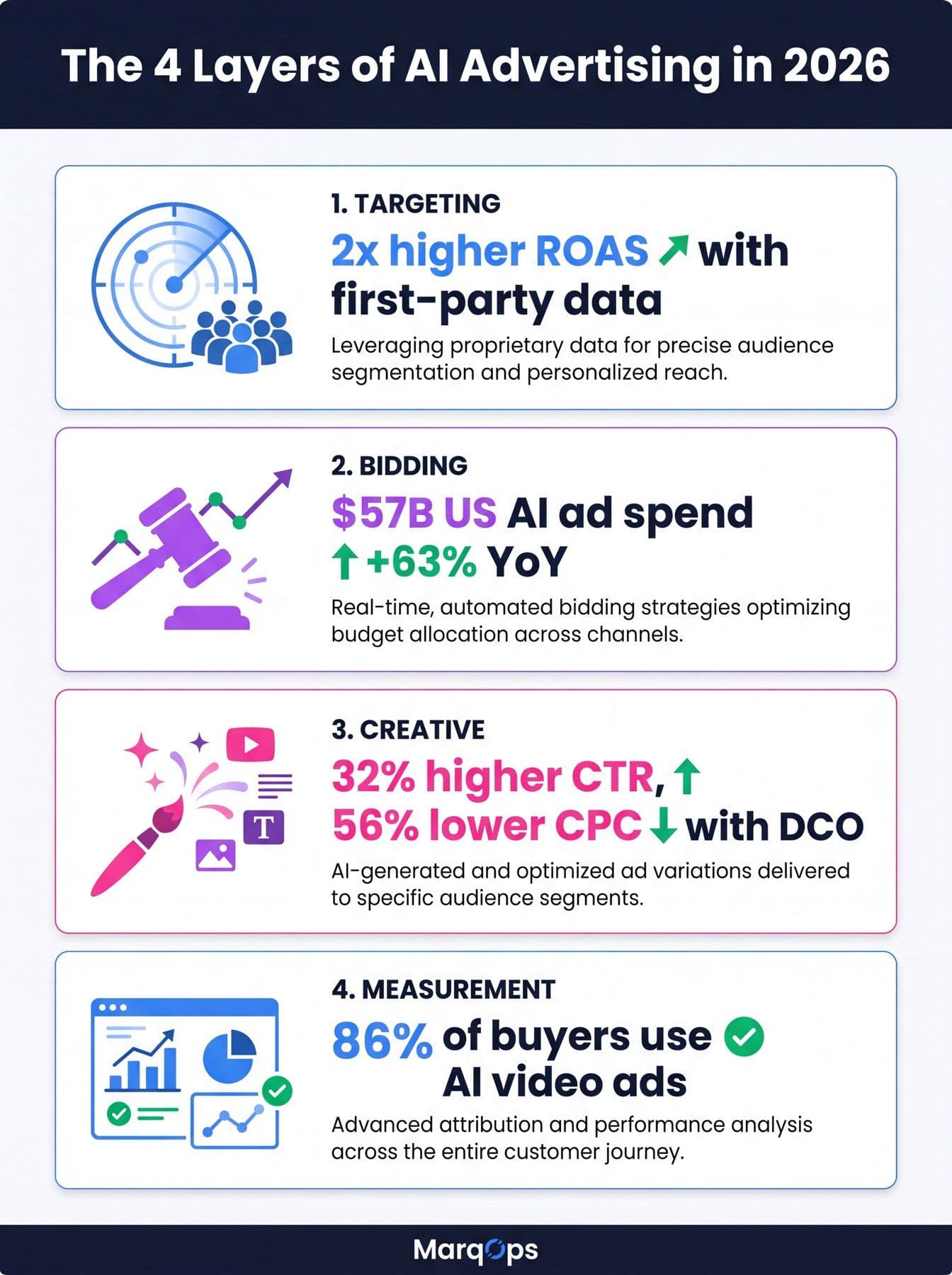
The four layers of AI advertising and the numbers behind each one in 2026.
AI Advertising Examples From Real Brands
Nike: “Never Done Evolving”
Nike used machine learning models trained on decades of match footage to simulate a match between Serena Williams’s rookie self and her 2022 self. The campaign earned over 1 billion impressions and generated earned media worth over 2,500% more than the media investment. The lesson: AI as a creative concept, not just a production shortcut.
Coca-Cola: AI-generated holiday campaigns
Coca-Cola’s agencies used tools like Runway, Luma, and Kling to generate scenes, environments, and motion for its holiday ads, testing multiple creative concepts at a speed traditional production could not match. Sentiment was mixed, but Coca-Cola positioned itself as the first global brand to run AI-generated ads at broadcast scale, and it kept iterating.
Kalshi: the $2,000 NBA Finals ad
Kalshi aired an AI-generated commercial during the NBA Finals that was created in roughly two days on an estimated $2,000 production budget, a tiny fraction of a typical national spot. Whatever you think of the creative, the economics are impossible to ignore.
Meta Advantage+: automation at scale
Less flashy but more consequential: Meta’s Advantage+ campaigns crossed a $20 billion annual revenue run rate because performance advertisers found that handing targeting and placement decisions to the algorithm, while controlling creative inputs, simply performed better. Similar dynamics are playing out in AI for Google Ads, where AI-led campaign types are now the default.
Benefits: What the Data Shows
Across studies and platform data, the performance benefits of AI advertising cluster into four areas:
- Higher returns: up to 2x higher ROAS from first-party data and AI-based contextual targeting versus third-party targeting.
- Better engagement at lower cost: 32% higher CTR and 56% lower CPC from dynamic creative optimization. One documented campaign cut cost per lead from $10.75 to under $3.
- Radical production efficiency: brands using custom AI image models report 10x faster image creation, 75% less time per image, and 85% lower cost per image.
- Speed to market: multi-platform campaign systems built in a day instead of weeks, and creative testing cycles that run continuously instead of quarterly.
The compounding effect is the real story: faster creative feeds better optimization, which generates better data, which improves the next round of creative. Teams running this loop on a unified platform move 6x faster than teams stitching together point solutions.
That last point deserves emphasis. Most teams run AI advertising through a patchwork of disconnected tools: one for copy, one for images, one for ads management, one for analytics. Every handoff loses brand context and campaign data. This is exactly the fragmentation problem MarqOps was built to solve: one platform that replaces 7+ disconnected tools, with Brand Intelligence DNA that keeps every AI-generated ad, image, and landing page on-brand from the start, and a unified dashboard that connects ad performance back to creative and SEO in one view.
Challenges and the Consumer Trust Problem
The transparency trade-off
Walled-garden tools like Performance Max and Advantage+ deliver results but limit visibility into targeting decisions and inventory selection. Advertisers consistently report frustration at how few learnings they can extract from AI-managed campaigns. The mitigation is disciplined measurement outside the platforms, using incrementality testing to verify that algorithmic performance is real rather than credited.
Complexity and skills
Among US ad industry professionals, 62% cite complexity of setup and maintenance as a key challenge when adopting AI in media campaigns. The tooling has outpaced the training. Teams need workflows and guardrails, not just licenses.
Consumer trust and disclosure
Consumers are skeptical of AI-generated advertising, and the data is nuanced. About half of consumers can correctly identify AI-generated content, and 52% report reduced engagement when they believe content is AI-made. Meanwhile, 70% believe it will eventually be impossible to tell without disclosure.
Here is the counterintuitive finding: disclosure helps. In a Yahoo and Publicis Media study, AI-generated ads with noticed disclosures produced a 47% lift in ad appeal, a 73% lift in ad trustworthiness, and a 96% lift in overall company trust. And 74% of consumers say they would feel more comfortable with AI in advertising if formal company policies governed its use. Transparency is not a legal checkbox; it is a performance lever.
How to Implement AI Advertising: A 6-Step Roadmap
- Audit your data foundation. AI systems are only as good as their inputs. Consolidate first-party data, fix conversion tracking, and define the events that matter before turning on automation.
- Start with platform-native AI. Run Performance Max or Advantage+ against your best manual campaigns and measure honestly. Learn how the systems respond to your data before adding third-party layers.
- Systematize creative production. AI campaign types are creative-hungry. Build a pipeline that produces on-brand variations at volume, with brand controls baked in rather than reviewed after the fact. Our guide to AI brand voice covers how to encode your brand so AI output stays consistent.
- Close the measurement loop. Connect ad platforms, analytics, and creative data in one place. If your ads live in three dashboards, your optimization decisions will always lag. This is where an AI marketing analytics layer pays for itself.
- Add agentic workflows gradually. Let AI agents handle budget pacing and bid management first, then expand to campaign creation as trust builds. Keep humans on strategy, brand, and final approval.
- Publish an AI use policy and disclose. Given the trust data above, a public policy and clear disclosure are both a risk shield and a measurable performance advantage.
Most teams get stuck between steps 3 and 4, where fragmented tools make brand-consistent creative and unified measurement nearly impossible. MarqOps handles both in one system: AI-powered ad creative generation with Brand Intelligence DNA, plus ads, analytics, SEO, and creative reporting in a single dashboard, so the optimization loop actually closes.
Frequently Asked Questions
What is AI advertising?
AI advertising is the use of artificial intelligence to plan, create, buy, and optimize ad campaigns. It includes AI-powered targeting, real-time bidding, generative creative production, dynamic creative optimization, and automated measurement across platforms like Google, Meta, and programmatic channels.
How big is the AI advertising market in 2026?
US AI-powered ad spend is projected to reach $57 billion in 2026, up 63% year over year, representing about 12% of the US ad market. The global AI in advertising market is expected to grow from $11.17 billion in 2025 to $14.12 billion in 2026, a 26.4% annual growth rate.
Does AI advertising actually improve performance?
Yes, when fed quality data and creative. Advertisers see up to 2x higher ROAS using first-party data with AI-based contextual targeting, while dynamic creative optimization delivers 32% higher click-through rates and 56% lower cost per click compared to static campaigns.
Should brands disclose when ads are AI-generated?
The data strongly favors disclosure. AI-generated ads with noticed disclosures produced a 47% lift in ad appeal, a 73% lift in trustworthiness, and a 96% lift in overall company trust in a Yahoo and Publicis Media study. 75% of consumers favor AI ad disclosures.
What is agentic advertising?
Agentic advertising uses AI systems that execute advertising tasks such as targeting, bidding, creative selection, and budget pacing with minimal human input. In 2026 it spans platform-native automation (Performance Max, Advantage+), cross-channel AI agents that operate accounts, and emerging agent-to-agent media buying.
The Bottom Line
AI advertising in 2026 is not an experiment; it is the operating system of paid media. The platforms have made automation the default, the performance data validates it, and the growth numbers show the market has already voted. What separates winners from the rest is not access to AI but the quality of what they feed it: unified first-party data, brand-consistent creative at volume, honest measurement, and transparent AI policies that consumers reward with trust.
If your team is running AI campaigns through seven disconnected tools, the algorithms are optimizing with one hand tied behind their back. Bring creative, ads, analytics, and SEO into one brand-intelligent system, and the loop finally closes.
Keep following the signal