AI Influencer Marketing in 2026: The Complete Playbook for Smarter Creator Campaigns
AI influencer marketing in 2026 explained: tools, workflows, brand safety, ROI measurement, virtual creators, and a 6-step launch playbook for modern marketing teams.
AI Influencer Marketing in 2026: The Complete Playbook for Smarter Creator Campaigns
Influencer marketing crossed $32.5 billion in 2025 and is on track to top $40 billion in 2026. The shift driving that growth is not more creators or more platforms. It is AI. From discovery to brand-safety vetting to performance attribution, AI has quietly become the engine room of every modern creator program. This guide breaks down what AI influencer marketing actually looks like in 2026, the tools marketing teams trust, the playbooks that work, and the pitfalls to avoid.
TL;DR
- AI influencer marketing uses machine learning to handle creator discovery, vetting, content briefing, fraud detection, and ROI measurement at a scale humans cannot match.
- 66.4% of marketers report better campaign outcomes after integrating AI, and creator vetting time drops by roughly 73% with AI agents in the loop.
- The biggest wins are in discovery (36.67% adoption), content generation (21.11%), and brief development (13.89%), where AI shortens cycle time and surfaces signal hidden in raw creator content.
- Brand safety has moved from optional to mandatory. 53% of US media experts call genAI-adjacent ad placement their top 2026 challenge, and synthetic creator detection now runs at four campaign stages.
- Virtual and AI-generated influencers, from Lil Miquela to Aitana López, are an $8.3 billion submarket with engagement rates around 5.67%, roughly 3x what human creators of the same size deliver.
- Brands using AI-driven platforms report 30-50% cost savings versus manual campaign management and 15-25% efficiency gains from predictive ROI modeling.
Table of Contents
- What is AI Influencer Marketing?
- The 2026 Market Snapshot: Numbers That Actually Matter
- 7 Use Cases Where AI Earns Its Keep
- Inside a Modern AI Influencer Workflow
- Best AI Influencer Marketing Tools and Platforms
- Virtual Influencers: The Other Half of the Story
- Brand Safety, Fraud, and Synthetic Detection
- Measuring ROI With AI Attribution
- A 6-Step Playbook for Launching AI Influencer Campaigns
- 5 Mistakes to Avoid
- Where MarqOps Fits
- FAQs
What is AI Influencer Marketing?
AI influencer marketing is the use of machine learning, natural language processing, and computer vision to run influencer programs end to end. That includes finding the right creators, vetting their audiences for fraud, generating campaign briefs, drafting content variants, predicting performance before launch, monitoring sentiment in real time, and tying every dollar spent to a measurable outcome.
The category is bigger than “use ChatGPT to write captions.” Modern AI tools analyze creator content frame by frame, score audience authenticity in seconds, and forecast ROI based on millions of historical campaign records. This is the layer of intelligence that lets a single marketing manager run programs that used to require an agency of 12 people.
One way to think about it: traditional influencer marketing was about who you knew. AI influencer marketing is about what the data shows. The creator with 2 million followers and the creator with 40,000 followers can both be the right pick. AI tells you which.
The 2026 Market Snapshot: Numbers That Actually Matter
Before getting tactical, look at the data shaping the category in 2026.
$40B+
Global influencer marketing spend projected for 2026
The headline numbers shape every conversation about creator marketing right now.
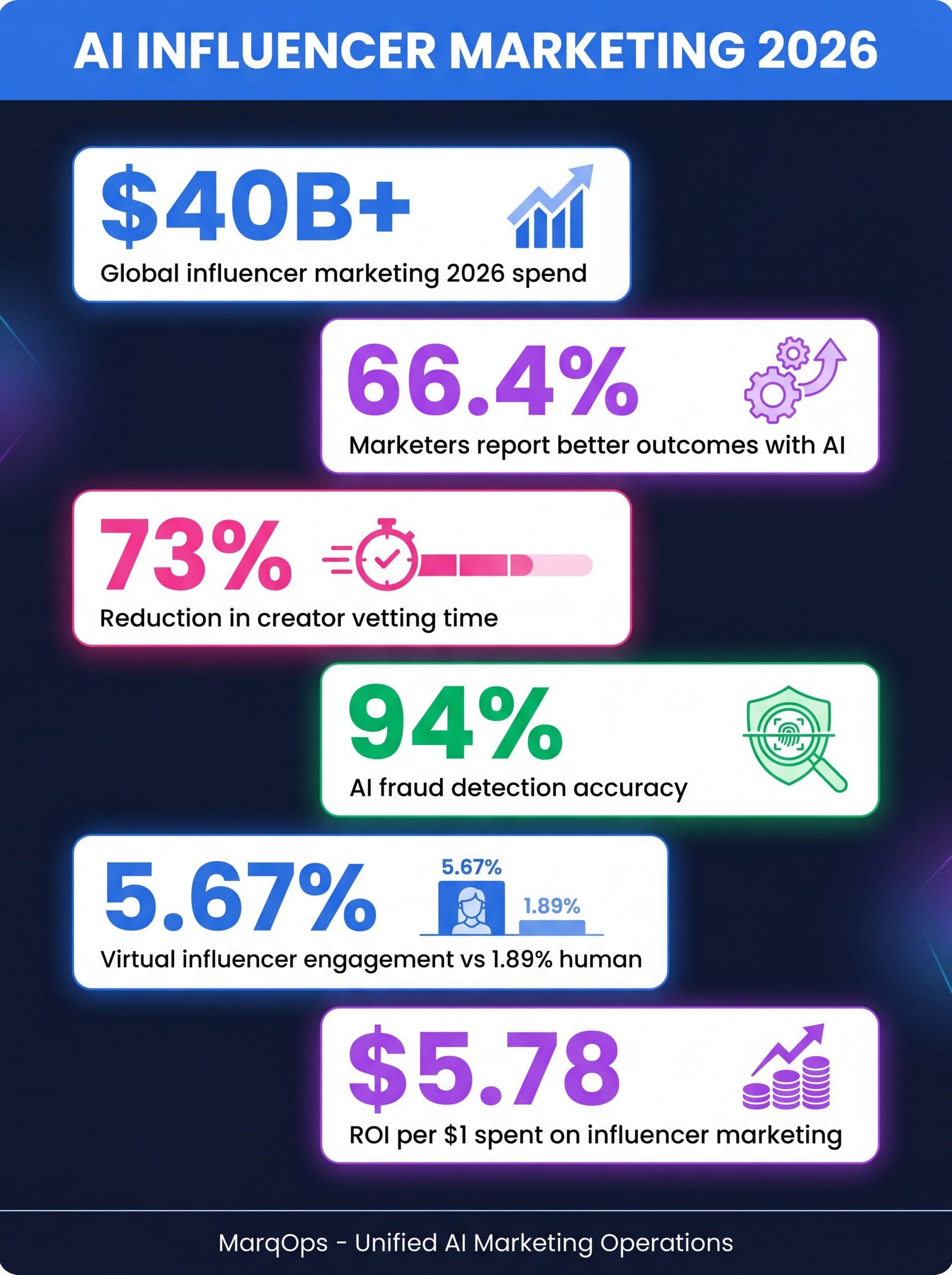
- Market size: The global influencer marketing industry hit $32.55 billion in 2025 and is projected to exceed $40 billion in 2026, with bullish forecasts reaching $38.7 billion.
- Budget intent: 74% of marketers plan to actively grow their influencer budgets this year.
- AI adoption: 66.4% of marketers report improved outcomes after adding AI to their influencer workflow.
- ROI benchmark: Brands earn an average of $5.78 for every $1 invested in influencer marketing.
- Where AI shows up first: Creator discovery (36.67%), content generation (21.11%), brief development (13.89%).
- Virtual influencer market: $8.30 billion in 2025, up 37% year over year, with AI-generated creators commanding 5.67% engagement vs 1.89% for similarly-sized human creators.
- Platform dominance: TikTok is included in 31% of influencer plans, with average engagement of 3.70% (roughly 7x Instagram).
Translation: the budgets are growing, the platforms are consolidating, and AI is no longer a nice-to-have. It is the cost of entry.
AI Influencer Marketing 2026: The data behind the shift
7 Use Cases Where AI Earns Its Keep
Not every part of an influencer program benefits equally from AI. These are the seven jobs where the ROI is clear today.
1. Creator Discovery and Matching
AI scans tens of millions of creator profiles, parses captions and visuals with semantic search, and matches creators to a brand brief in seconds. The Forbes coverage of AI in creator marketing notes that the best 2026 platforms use natural language queries like “fitness creators who discuss nutrition authentically without promoting fad diets” instead of clunky tag filters.
2. Audience Authenticity and Fraud Detection
Sprout Social reports AI fraud detection now catches 94% of fake engagement attempts in 2026. Models look at comment quality, save and share rates, follower growth curves, and bot signatures that humans miss.
3. Brief Development and Creative Variants
Marketing teams use AI to convert a campaign goal into a complete brief: tone, mandatory mentions, visual style, do-not-say list, and creator-specific calls to action. Some platforms then generate 5 to 10 creative variants automatically, which the creator edits rather than starts from scratch.
4. Performance Prediction
Before a creator is even contracted, AI models estimate expected reach, engagement, conversions, and ROI based on similar past campaigns. Marketing teams use these forecasts to allocate budget and pick the right creator mix.
5. Synthetic Creator Detection
With generative AI flooding feeds, brands need to know whether a “creator” is human, virtual, or somewhere in between. Detection should run at four stages: discovery shortlisting, pre-activation audit, in-flight monitoring, and post-campaign attribution.
6. Sentiment and Crisis Monitoring
AI tracks comments, mentions, and reposts in real time, flagging sentiment shifts or brand-risk moments while campaigns are live. This is the difference between a 24-hour response and a 24-day apology tour.
7. Attribution and ROI Reporting
Multi-touch attribution powered by AI ties influencer touchpoints to downstream conversions across the full customer journey. Brands using AI attribution report 15-25% improvements in campaign efficiency from automated budget reallocation alone.
Inside a Modern AI Influencer Workflow
Here is what a fully AI-augmented influencer workflow looks like in 2026:
- Brief intake: Marketing team drops campaign goal, audience, budget, and brand guardrails into an AI workspace.
- Discovery sweep: AI pulls 200 to 500 candidate creators from a multi-platform index, scored by content fit, audience authenticity, and performance prediction.
- Shortlist and vet: Top 25 creators get a deeper pass for synthetic content, fake followers, brand-safety risk, and historical engagement quality.
- Outreach automation: Personalized first-touch messages go out, with reply detection routing serious conversations to a human.
- Brief and creative: AI generates creator-specific briefs and 3-5 content variants per partner, which the creator approves or remixes.
- Launch and monitor: Posts go live, real-time analytics flow in, anomalies (drop in sentiment, fake-comment spikes) get escalated immediately.
- Attribute and learn: AI ties spend to revenue with multi-touch attribution, then writes the learnings back into the discovery model for the next campaign.
For a deeper look at how this connects to broader campaign infrastructure, read our guide on AI agents for marketing.
Best AI Influencer Marketing Tools and Platforms
The 2026 tooling landscape has split into three camps: legacy platforms that bolted AI onto existing influencer databases, AI-native platforms built from scratch, and unified marketing operations platforms that handle influencer work alongside content, ads, SEO, and analytics.
Legacy Platforms With AI Layers
- HypeAuditor: Long-standing analytics platform now positioned as 100% AI-powered, strong on audience verification.
- Upfluence: AI dashboards aggregate revenue, ROI, AOV, clicks, and commissions, with Amazon Attribution integration.
- Grin: Full lifecycle management, AI-assisted outreach, payment, and reporting.
- Sprinklr: Enterprise platform with creator marketing baked into a wider social suite.
AI-Native Platforms
- Kuli: AI agent that analyzes actual creator content frame by frame, scoring virality factors and brand-safety risk.
- Aria (Socially Powerful): 200M+ creator index, natural language and image recognition discovery, predictive performance forecasts.
- IQFluence: 375M+ profiles across TikTok, Instagram, YouTube with 16+ filters including AI semantic search.
- Ainfluencer: Marketplace-style discovery with 5M+ creators.
Unified Marketing Operations Platforms
The most underrated trend of 2026 is consolidation. Marketing teams running creator programs in one tool, paid ads in another, content production in a third, and analytics in a fourth lose more time to tool-switching than they save with any individual tool’s AI. Unified platforms like MarqOps fold influencer creative briefing, brand-safety guardrails, and performance attribution into the same workspace as creative production, SEO, and ads. We go deeper on this pattern in our marketing intelligence platform guide.
Virtual Influencers: The Other Half of the Story
AI influencer marketing splits into two distinct conversations. Using AI to run campaigns with human creators is one. Working with virtual or AI-generated creators is another. Both are growing fast.
The virtual influencer market hit $8.30 billion in 2025, up 37% year over year. AI-generated virtual influencers attract roughly $1.37 billion in annual brand spend and post engagement rates of 5.67% on average, well above the 1.89% you get from similarly sized human creators.
The Headline Acts
- Lil Miquela: 2.4M Instagram followers, brand deals with Prada, Calvin Klein, BMW, Red Bull. A 2026 promotional video for Liquid IV generated €75K in EMV.
- Aitana López: Built by Barcelona-based The Clueless, partnered with Olaplex, Intimissimi, and Brandy Melville Spain, signed two European fitness brands in 2026 worth €180K+ quarterly.
- Aisha Neo, Imma, Mia Zelu, and dozens more: A roster of virtual creators with genuine cultural traction, not just novelty value.
When to consider virtual creators: always-on always-available content needs, creative concepts a human can’t physically pull off, brand-controlled IP, and tightly regulated industries where compliance review of every post is brutal with human partners.
When to stay with human creators: trust-based categories like skincare, finance, and food, anything that needs lived experience, and audiences that have explicitly pushed back on synthetic content.
Brand Safety, Fraud, and Synthetic Detection
Brand safety used to be the legal team’s problem. In 2026 it is everyone’s. eMarketer’s 2026 outlook found 53% of US media experts call ad proximity to genAI content the top brand-safety challenge of the year.
What works: Run synthetic creator detection at four campaign stages: discovery shortlisting, pre-activation audit before contracts, continuous in-flight monitoring during the campaign, and post-campaign attribution. Most fraud surfaces between stages 2 and 3.
AI fraud detection now catches 94% of fake engagement attempts (Sprout Social 2026). Engagement authenticity scoring goes well beyond follower counts, parsing comment quality, share rates, save rates, and follower-growth curves to spot bot rings and inauthentic traffic.
Add to that creator-side risk: AI-generated content from human creators (their AI-edited photos, AI-rewritten captions) creates new gray zones for disclosure and authenticity. Brand guidelines for 2026 should explicitly cover what AI use is allowed in sponsored content. We cover this in detail in our brand guidelines template guide.
Measuring ROI With AI Attribution
Old influencer measurement was simple and wrong: count likes, multiply, hope. New measurement is harder and right.
The Three Layers of Influencer ROI in 2026
- Engagement quality: Saves, shares, completion rates, sentiment, comment depth, not just likes.
- Traffic and conversion: UTM parameters, promo codes, vanity URLs, and platform pixels tying influencer touches to site sessions, signups, and revenue.
- Attribution and lift: Multi-touch attribution and incrementality testing to isolate the actual influence the creator had on outcomes, controlling for everything else that ran at the same time.
AI plays in all three layers but earns its keep in the third. Multi-touch attribution is computationally heavy and impossible to do well manually once you have more than a handful of channels live. For a deeper walkthrough of how AI changes attribution, read our multi-touch attribution guide and our marketing mix modeling guide.
Brands using AI-driven platforms report 30-50% cost savings versus manual campaign management and 15-25% efficiency gains from predictive ROI modeling and automated budget reallocation.
A 6-Step Playbook for Launching AI Influencer Campaigns
If you are building or rebuilding your creator program with AI in 2026, run it in this order.
Step 1: Define the Outcome, Not the Output
“Get 5 creators to post” is an output. “Drive 1,200 qualified signups from a new audience segment at sub-$40 CAC” is an outcome. AI tools amplify whatever you tell them to optimize for. Make sure that target is actually tied to revenue.
Step 2: Codify Your Brand Guardrails
Before AI selects a single creator, encode your brand voice, do-not-say list, visual style, and disclosure requirements into a brand-intelligence layer the AI can reference. This is the single biggest predictor of campaign quality. See our piece on AI content strategy for how this connects to broader content systems.
Step 3: Run AI Discovery, Then Human Filter
Let AI pull a candidate pool of 200 to 500 creators. Have a human review the top 25 to 50. The human pass is where you catch things AI misses: tone shifts in their last few posts, public controversies, prior brand conflicts.
Step 4: Brief, Vet, and Predict in Parallel
Run brief development, fraud and synthetic detection, and performance prediction simultaneously instead of sequentially. Modern platforms support this. Old workflows do not.
Step 5: Launch With In-Flight Monitoring
Set up sentiment monitoring and fake-comment detection from minute zero. If something goes sideways, you want to know within hours, not weeks.
Step 6: Attribute, Learn, Re-Train
Post-campaign, run full multi-touch attribution. Feed the results back into your discovery model so the next campaign starts smarter. The teams that compound advantage are the ones who treat every campaign as training data.
5 Mistakes to Avoid
The category is young enough that most teams are still making the same handful of mistakes.
- Treating AI as a creator replacement. AI is a force multiplier for human creators, not a substitute for human creativity. Use it to filter, brief, and measure, not to write the soul of the content.
- Ignoring synthetic detection. If you don’t actively screen for AI-generated content in supposedly human campaigns, you will eventually run a campaign where 30% of “engagement” came from bot rings.
- Optimizing for vanity metrics. Likes and follower counts are easy to fake and easy to fall in love with. Tie every dollar to engagement quality and revenue.
- Underinvesting in brand guardrails. AI without strong brand context produces generic, off-tone work at scale. The brand layer is the multiplier, not the AI itself.
- Running creator programs in isolation. Influencer marketing produces compounding returns when it is wired into your content, ads, SEO, and analytics. Tool-by-tool fragmentation kills that effect.
Where MarqOps Fits
Most marketing teams in 2026 are running creator discovery in one platform, content briefing in a second, paid amplification in a third, analytics in a fourth, and SEO in a fifth. That fragmentation is the real reason AI-driven influencer programs underperform their potential.
MarqOps is built for this exact pain. One platform replaces 7+ disconnected marketing tools by bringing influencer creative briefing, brand-safety guardrails, paid amplification, content production, SEO operations, and unified analytics into a single workspace. Brand Intelligence DNA ensures every AI-generated brief, caption, and creative variant matches your tone of voice from the first draft. Marketing teams report 6x faster content output once creator programs are wired into the same engine that handles their ads and content.
For a deeper look at how this changes day-to-day marketing operations, read our guide on marketing operations or our breakdown of the modern marketing tech stack.
FAQs
What is AI influencer marketing in simple terms?
AI influencer marketing applies machine learning to every stage of a creator program: finding the right creators, vetting their audiences, generating briefs and content variants, predicting performance, monitoring sentiment, and attributing revenue. It scales work that would otherwise need a full agency team.
How big is the AI influencer marketing market in 2026?
The total influencer marketing industry is projected to exceed $40 billion in 2026. Inside that, the virtual influencer submarket alone reached $8.30 billion in 2025 (up 37% year over year), with AI-generated virtual creators commanding around $1.37 billion in annual brand spend.
Which AI influencer marketing tools are worth paying for?
It depends on your stack. For pure-play creator work: Kuli, Aria, IQFluence, HypeAuditor, Upfluence, and Grin lead the category. For teams running creators alongside content, ads, and analytics in one workflow, a unified platform like MarqOps is a better fit than stitching point tools together.
Are virtual AI influencers a good fit for my brand?
Virtual creators work well for always-on campaigns, tightly regulated industries, and concepts that need full brand-IP control. They are a poor fit for trust-heavy categories like finance, skincare, and food, where lived experience matters more than aesthetics.
How do I measure ROI from AI influencer campaigns?
Stack three layers: engagement quality (saves, shares, sentiment), traffic and conversion (UTMs, promo codes, pixel attribution), and multi-touch attribution that isolates influencer lift from everything else live at the same time. AI is essential for the third layer; manual tracking breaks down once you have more than two or three live channels.
What is the biggest brand-safety risk in AI influencer marketing?
Ad proximity to genAI content and undisclosed AI-generated content from human creators. 53% of US media experts named this the top 2026 brand-safety challenge. Run synthetic creator detection at four stages: shortlisting, pre-activation, in-flight, and post-campaign.
How much can AI actually save a marketing team?
Brands using AI-driven influencer platforms report 30-50% cost savings versus manual campaign management, 73% reductions in creator vetting time, and 15-25% efficiency gains from predictive ROI modeling and automated budget reallocation.
Final Thought
AI influencer marketing in 2026 is not a new channel. It is the upgrade path for an existing channel that finally has the tooling, data, and trust signals to scale. The teams pulling ahead are not the ones with the biggest budgets. They are the ones with the cleanest brand inputs, the tightest workflows, and the discipline to measure outcomes instead of outputs. Wire that into a unified marketing operations platform and creator marketing stops feeling like a one-off campaign sprint and starts behaving like a compounding growth lever.