Meta Advantage+ in 2026: What the AI Optimizes and What It Overstates
Meta made Advantage+ the default campaign type in February 2026 and is retiring manual controls outright. Platform data looks excellent: 22% higher ROAS, 17% lower CPA, 82% advertiser adoption. Then geo-lift testing across 640 experiments found 58% of brands got better incremental returns from manual campaigns, with Advantage+ over-reporting by about 12 percentage points. This guide covers what each Advantage+ layer actually does, why the reporting gap exists, how it compares to Performance Max, which controls still matter, and how to build a creative and measurement approach that works inside a platform you no longer fully steer.

For most of the last decade, running Meta ads well meant knowing which levers to pull. Audience stacking, placement exclusions, ad set budget splits, lookalike percentages. That skill set is being retired, and not gradually. In February 2026 Meta made Advantage+ the default for all new campaigns and merged the manual and automated build flows into a single interface. By the second quarter, large parts of the platform had moved to what advertisers have started calling goal-only setup: you supply a budget and an objective, and the system decides almost everything else.
The pitch is compelling and the platform numbers are good. Meta reports a 22% average lift in return on ad spend against manual campaigns, roughly 17% lower cost per acquisition, and adoption at 82% of advertisers. Advantage+ now accounts for something like 62% of ecommerce ad spend on the platform. If you only read the dashboard, the argument is settled.
Then geo-lift testing entered the picture, and the story got more complicated. In a dataset of 640 incrementality experiments run by measurement firm Haus, 58% of brands saw higher incremental return on manual campaigns than on Advantage+. The reported numbers and the causal numbers were not describing the same reality. This guide covers both: what Advantage+ genuinely does well in 2026, where the reporting flatters it, and which of the remaining controls are actually worth your attention.
Table of Contents
- What Meta Advantage+ Actually Is in 2026
- The Consolidation: Why Opting Out Stopped Working
- What the Platform Data Says
- What Incrementality Testing Says Instead
- Why the Gap Exists
- Advantage+ vs Performance Max
- The Controls You Still Have
- Creative Is the Real Lever Now
- A Practical Operating Playbook
- Where This Goes Next
- Frequently Asked Questions
- The Bottom Line
What Meta Advantage+ Actually Is in 2026
Advantage+ is not one product. It is a family of automation layers that can be switched on independently, and conflating them is the source of a lot of bad advice. Understanding which layer you are evaluating matters, because they do not perform equally.
Advantage+ Audience replaces manual interest and demographic targeting with a broad pool seeded by your conversion history and any audience suggestions you provide. You are giving up explicit targeting in exchange for a wider candidate set that the delivery system narrows in real time.
Advantage+ Placements distributes budget across Facebook, Instagram, Messenger, Threads, and the Audience Network automatically rather than letting you pick surfaces.
Advantage+ Creative applies automated enhancements to your assets: cropping, music, text variation, brightness adjustments, and increasingly full generative modification of the image itself.
Advantage+ Shopping and Advantage+ Sales campaigns are the campaign-level wrappers that bundle the above into a single simplified structure with consolidated budgets and minimal ad set configuration.
The Consolidation: Why Opting Out Stopped Working
Through 2024 and 2025, sophisticated advertisers treated Advantage+ as one option among several. That posture no longer maps to how the platform is built. The February 2026 merge of manual and automated flows means new campaigns start with AI optimization enabled across audience, placement, budget, and creative, and you toggle components off rather than on. Meta has also deprecated legacy campaign APIs built around the old structure, which pushed the change through every third-party tool and in-house script that touched campaign creation.
The practical consequence for teams is that the work moved. Time previously spent on audience architecture now goes to three places: feeding the system better conversion signal, producing more genuinely different creative, and building measurement that operates outside the platform. That last one is the piece most teams have not resourced, and it is the reason the incrementality findings below caught so many by surprise.
It is also worth noting what did not change. You still control budget, objective, geography, the conversion event you optimize toward, and the creative you supply. Those are not small. The mistake is assuming that because the interface got simpler, the job got simpler. It got narrower and more consequential.
What the Platform Data Says
Taken at face value, the case for Advantage+ is strong across every metric Meta and its partners publish.
| Metric | Reported result | Source basis |
|---|---|---|
| Return on ad spend | 22% lift vs manual setups | Meta internal benchmarks |
| Advantage+ Shopping ROAS | 4.52x vs 3.70x manual | Aggregated advertiser data |
| Cost per acquisition | Up to 32% lower in ecommerce and lead gen | Meta internal benchmarks |
| Click-through rate | 11% to 15% higher | Dynamic creative combinations |
| Cost per qualified lead | 10% lower on Advantage+ leads | Meta early testing |
| Advertiser adoption | 82% using Advantage+ automation | 2026 Facebook ad statistics reporting |
These are not fabricated numbers. They are accurate descriptions of what platform attribution records. The problem is a definitional one that has dogged digital advertising since the beginning: attributed conversions and incremental conversions are different quantities, and automated systems are unusually good at maximizing the first one.
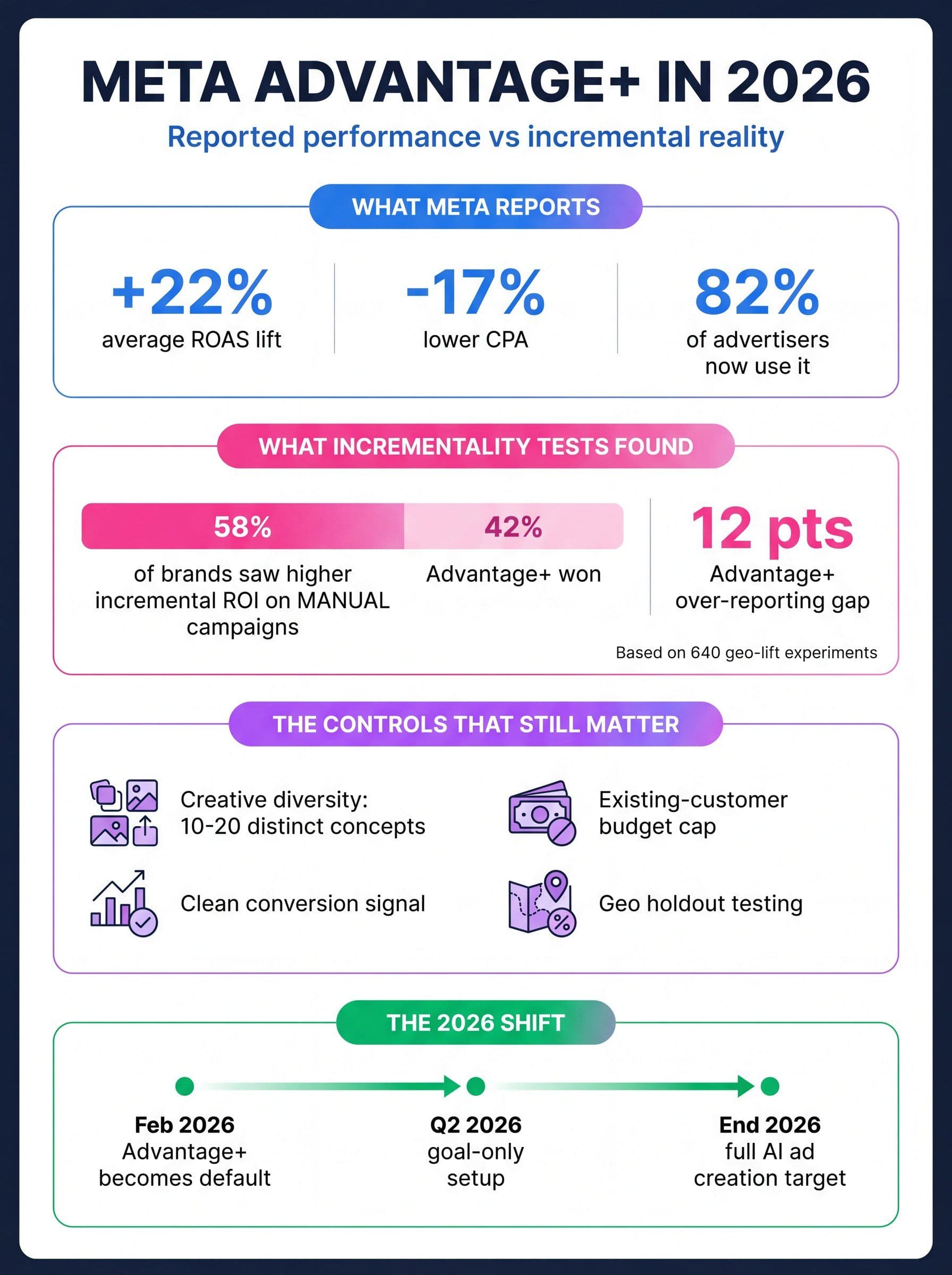
Platform-reported Advantage+ performance compared against geo-lift incrementality findings, plus the settings and timeline that matter most in 2026.
What Incrementality Testing Says Instead
Haus ran 640 geo-lift experiments over an 18-month window across mid-market DTC brands through to large enterprises. The average participant was spending just over $1 million per month on Meta, roughly $14 million a year, so this is not a sample of small accounts with thin data. Geo-lift works by switching ads off in matched regions and comparing aggregate sales, which sidesteps platform attribution entirely and captures offline and marketplace outcomes alongside direct site sales.
The headline findings are uncomfortable:
- Advantage+ outperformed manual campaigns in only 42% of tests. In the other 58%, manual delivered higher incremental return.
- Advantage+ over-reported its contribution by approximately 12 percentage points relative to measured incremental delivery.
- Where Advantage+ did win, the margin was modest rather than transformative. It produced 12% lower incremental ROAS at 18% lower daily spend, which is a scale trade rather than an efficiency breakthrough.
- In the post-test observation window, Advantage+ drove 17% less lift, suggesting weaker durable demand creation.
The right reading of this is not that Advantage+ is broken. A 42% win rate on a system that also reduces labor cost and daily spend is a legitimate result. The wrong reading is that a strong in-platform ROAS number tells you Advantage+ is working. Those two numbers have been shown to diverge systematically, in a consistent direction, at meaningful magnitude. If your entire evaluation runs through Ads Manager, you have no way to detect the difference. This is precisely why incrementality testing moved from a nice-to-have to a budget-defense requirement in 2026.
Why the Gap Exists
The mechanism is not mysterious, and understanding it tells you how to fix it.
When Advantage+ Audience builds a broad targeting pool, the delivery system optimizes toward the people most likely to complete your conversion event. Your existing customers and recent site visitors are, by a wide margin, the most likely people to convert. They are also the people most likely to have converted without seeing the ad. The system is not cheating. It is doing exactly what you asked, which is to maximize attributed conversions at the lowest cost. Harvesting demand is simply cheaper than creating it.
Meta does not expose where inside the broad pool conversions are coming from, so reported ROAS can look healthy while the audience mix quietly shifts from prospecting toward retargeting. You see a good number and no signal that the composition changed underneath it.
Two structural trends make this harder to catch. Continued signal loss from app tracking restrictions and cookie deprecation has degraded attribution accuracy generally. And the shift toward automated campaign types removes the granular breakdowns that once let analysts spot composition drift by hand. The result is that platform attribution in 2026 is less reliable than it was in 2022, at exactly the moment more decisions are being routed through it. Teams that have invested in multi-touch attribution alongside geo-based methods are considerably better positioned here than those relying on last-click inside a single ad platform.
Advantage+ vs Performance Max
The comparison comes up constantly, and it is one of the most common people-also-ask queries on this topic. The two systems rhyme but differ in ways that matter operationally.
| Dimension | Meta Advantage+ | Google Performance Max |
|---|---|---|
| Primary demand type | Demand creation on social feeds | Mixed, with strong existing search intent |
| Main input signal | Creative assets and conversion events | Asset groups, audience signals, product feed |
| Inventory span | Facebook, Instagram, Messenger, Threads, Audience Network | Search, Shopping, YouTube, Display, Discover, Gmail, Maps |
| Known incrementality risk | Drift toward existing customers | Cannibalizing branded search |
| Best available guardrail | Existing-customer budget cap | Brand exclusions and negative keywords |
Both platforms share the same core failure mode: the automation will absorb credit for demand that already existed unless you constrain it. On Google the classic symptom is Performance Max quietly eating branded search, which is why negative keyword lists and brand exclusions became standard practice. If you are running both, the parallel guidance in our Performance Max guide and the breakdown of Performance Max versus search campaigns maps closely onto the Advantage+ situation.
The Controls You Still Have
Automation removed a lot of dials. The ones that remain are disproportionately important, and most accounts underuse them.
The existing-customer budget cap. Inside Advantage+ Shopping you can cap the share of budget that goes to people already on your customer list. This is the most direct available lever against the exact failure mode the incrementality data exposes. Meta expanded these controls in its March 2026 update. If you set nothing else, set this.
The conversion event you optimize toward. Optimizing to a shallow event like add-to-cart gives the system an easy target it can satisfy with low-value users. Optimizing to purchase, or better, to a value-based or qualified-lead event, changes what it hunts for. Feed quality here dominates almost everything else, which is why first-party data hygiene is now a paid media concern rather than a CRM concern.
Learning phase economics. Meta still requires roughly 50 optimization events per week per ad set to exit the learning phase. That constraint has budget implications people ignore: at a $20 target CPA you need something close to $143 per day just to give the system enough signal to stabilize. Underfunded campaigns do not fail because the AI is bad. They fail because they never leave learning. Working backward from your customer acquisition cost targets before setting budgets avoids this entirely.
Geography. Retained in full, which is what makes geo holdout testing possible. This is your measurement instrument, not just a targeting setting.
Creative. Discussed next, because it deserves its own section.
Creative Is the Real Lever Now
As targeting control shrinks, creative becomes the main variable you can still move. The industry has largely converged on this, and the practical guidance is more specific than "make good ads."
Volume and diversity are not the same thing, and the distinction is the whole point. Uploading fifty near-identical product shots gives the system fifty redundant inputs. Five genuinely different approaches, a user-generated clip, a product demonstration, a testimonial, a text-forward explainer, and a lifestyle shot, give it real room to find winners. Current practice suggests ten to twenty distinct concepts as a working floor, refreshed with two or three new assets weekly to stay ahead of fatigue. Short-form vertical video under fifteen seconds continues to outperform on engagement by a wide margin.
Real diversity means varying the visual approach, the emotional register, the value proposition framing, and the format. Each distinct concept should then be executed across multiple format variants. That is a production volume problem more than a creative judgment problem, and it is where most teams hit a wall. Producing sixty on-brand assets a month through a traditional design queue is not realistic at mid-market headcount, which is a large part of why creative automation stopped being optional. It is also the specific gap MarqOps was built around: generating brand-consistent creative variants at volume from a single brand intelligence layer, so the asset pipeline can actually keep pace with what the algorithms consume.
Measuring which concepts work is its own discipline. With automated delivery you cannot cleanly read performance from placement or audience breakdowns, so concept-level tagging and analysis becomes the only reliable read. This is the core argument for treating creative analytics as a first-class reporting surface rather than a slide you build quarterly, and it pairs naturally with structured AI-driven testing to keep the learning loop tight.
A Practical Operating Playbook
Pulling the research together into something you can act on this quarter:
- Set the existing-customer cap before anything else. On Advantage+ Shopping, constrain the share of budget reaching your current customer list. This directly counteracts the documented drift toward harvested demand.
- Fund campaigns to clear the learning phase. Calculate 50 weekly conversion events against your real CPA and set daily budget from that number. If the math does not work, consolidate campaigns rather than running several underfunded ones.
- Clean the conversion signal. Optimize toward a deep, high-value event. Verify server-side event quality before blaming delivery for poor results.
- Build a creative library, not an ad set. Ten to twenty distinct concepts, refreshed weekly, with concept-level tagging so you can read results later.
- Run a geo holdout at least quarterly. Switch off a matched set of regions and measure aggregate sales difference. This is the only way to see what the platform cannot tell you.
- Reconcile platform numbers against an independent read. Whether that is marketing mix modeling, geo-lift, or both, assume a reporting gap in the 10 to 15 point range until you have measured your own.
- Keep a manual control cell where the platform still allows it. Given a 58% manual win rate on incrementality, maintaining a comparison arm is a reasonable hedge rather than nostalgia.
Where This Goes Next
Meta has signaled that it intends to fully automate ad creation by the end of 2026. In the described end state, a brand uploads a product image and a budget goal, and the system generates imagery, video, and copy, sets targeting, allocates budget, and personalizes the output per user in real time. The same car might appear on a mountain road for one viewer and an urban street for another.
Two caveats are worth holding onto. First, media buyers broadly consider that timeline optimistic, and early reviews of the generative tooling have been mixed at best. Brands have reported unauthorized creative alterations, anatomically implausible generated imagery, and copy that reads as though the writer had never encountered the product. Second, the more the platform generates, the more valuable a defensible brand layer becomes. If everyone's ads are produced by the same model from similar inputs, differentiation moves upstream into brand assets, positioning, and proprietary data.
The teams positioned well for this are the ones treating paid social as one output of a unified AI advertising operation rather than a standalone channel discipline. When creative production, brand governance, analytics, and campaign management sit in one system, feeding a platform that wants volume and consistency is straightforward. When they sit in seven disconnected tools, it is a permanent bottleneck. That consolidation, replacing a fragmented stack with a single brand-aware platform, is the shift MarqOps exists to make practical.
Frequently Asked Questions
What is Meta Advantage+?
Advantage+ is Meta's suite of AI-driven campaign automation covering audience selection, ad placements, creative enhancement, and budget allocation. Since February 2026 it has been the default setup for new campaigns, with manual configuration available as an opt-out on individual components rather than a separate campaign path.
Should I turn Advantage+ Audience on or off?
Test it rather than assuming. Advantage+ Audience is the layer most associated with the incrementality gap, since broad pools tend to drift toward existing customers. Run it with an existing-customer budget cap in place and validate with a geo holdout before committing significant budget. Advantage+ Placements is a much safer default to leave enabled.
Is Advantage+ actually better than manual campaigns?
By platform-reported metrics, yes, with roughly 22% higher ROAS. By measured incremental lift, it is closer to a coin flip that leans the other way. Across 640 geo-lift experiments Advantage+ won 42% of the time, meaning 58% of brands got better incremental return from manual campaigns. The honest answer is that it depends on your account and you need to measure it yourself.
What is the difference between Performance Max and Advantage+?
Performance Max is Google's automated campaign type spanning Search, Shopping, YouTube, Display, and Gmail, and it draws heavily on existing search intent. Advantage+ is Meta's equivalent across its social surfaces and is primarily a demand creation channel. Both carry the same core risk of absorbing credit for demand that already existed, though it shows up as branded search cannibalization on Google and existing-customer drift on Meta.
How many creatives should I upload to an Advantage+ campaign?
Aim for ten to twenty genuinely distinct concepts rather than a high count of minor variations, and refresh two or three assets weekly to counter fatigue. Diversity across format, tone, and value proposition matters far more than raw volume, because near-identical assets give the delivery system redundant options to choose between.
What budget does an Advantage+ campaign need?
Enough to generate roughly 50 optimization events per week so the campaign exits the learning phase. At a $20 cost per acquisition that works out to about $143 per day. Below that threshold campaigns tend to stay in learning indefinitely, which produces unstable results that get misattributed to the automation rather than to insufficient signal.
The Bottom Line
Advantage+ is no longer a choice you make, it is the environment you operate in. Meta made it the default in February 2026, has been steadily retiring manual controls since, and is targeting fully automated ad creation by year end. Resisting that is not a strategy.
What remains a choice is whether you accept the platform's account of its own performance. The evidence says you should not, at least not alone. A 22% reported ROAS lift and a 58% manual win rate on measured incrementality can both be true, because they measure different things. The teams doing this well in 2026 have stopped arguing about whether automation works and started building the two capabilities that determine whether it works for them: a creative pipeline that can supply genuinely diverse concepts at volume, and a measurement approach that sits outside the platform being measured.
Automation did not remove the skill from paid social. It relocated it, from audience construction into creative supply and causal measurement. Those are harder problems, and they are also considerably more durable ones.
Keep following the signal