AI Blog Writer: How to Choose One and Publish Posts That Rank in 2026
An AI blog writer can double your publishing speed, but only if you pair it with strong briefs, fact-checking, and brand voice. Here is how to choose one and build a workflow that ranks.
Table of Contents
- What Is an AI Blog Writer?
- The 2026 Numbers: Everyone Uses AI, Few Publish It Raw
- What Google Actually Says About AI Content
- Three Types of AI Blog Writer
- Six Criteria for Choosing an AI Blog Writer
- A Human-in-the-Loop Workflow That Ranks
- Writing for AI Search as Well as Google
- Mistakes That Make AI Blog Posts Fail
- How to Measure Whether It Is Working
- Frequently Asked Questions
Most marketing teams already have an AI blog writer in their workflow, whether they chose one on purpose or not. Someone on the team pastes a brief into a chatbot, gets 1,200 words back, and starts editing. The question is no longer whether to use AI for blog content. It is how to use it without publishing bland, inaccurate posts that never rank.
This guide covers what an AI blog writer really is, what the 2026 data says about adoption and quality, how Google treats AI-assisted content, and how to choose a tool and build a workflow that holds up. If you are comparing specific tools, our roundup of the best free AI writing tools and the deeper AI copywriting tool guide are good companions. Here we focus on the decision and the process.
What Is an AI Blog Writer?
An AI blog writer is software that uses a large language model to help produce blog posts. That can mean generating an outline, drafting sections, rewriting for tone, suggesting headlines, or optimizing a draft for search. Some tools do one of these jobs. Others try to cover the whole path from keyword to published post.
It helps to separate the writing from the work around the writing. A blog post that earns traffic usually needs keyword and competitor research, a clear angle, accurate sourcing, on-brand voice, internal links, images, metadata, and a publishing step. A general chatbot can draft text, but it does not know your keywords, your existing posts, or your brand rules. That gap is where most disappointing AI content comes from.
The 2026 Numbers: Everyone Uses AI, Few Publish It Raw
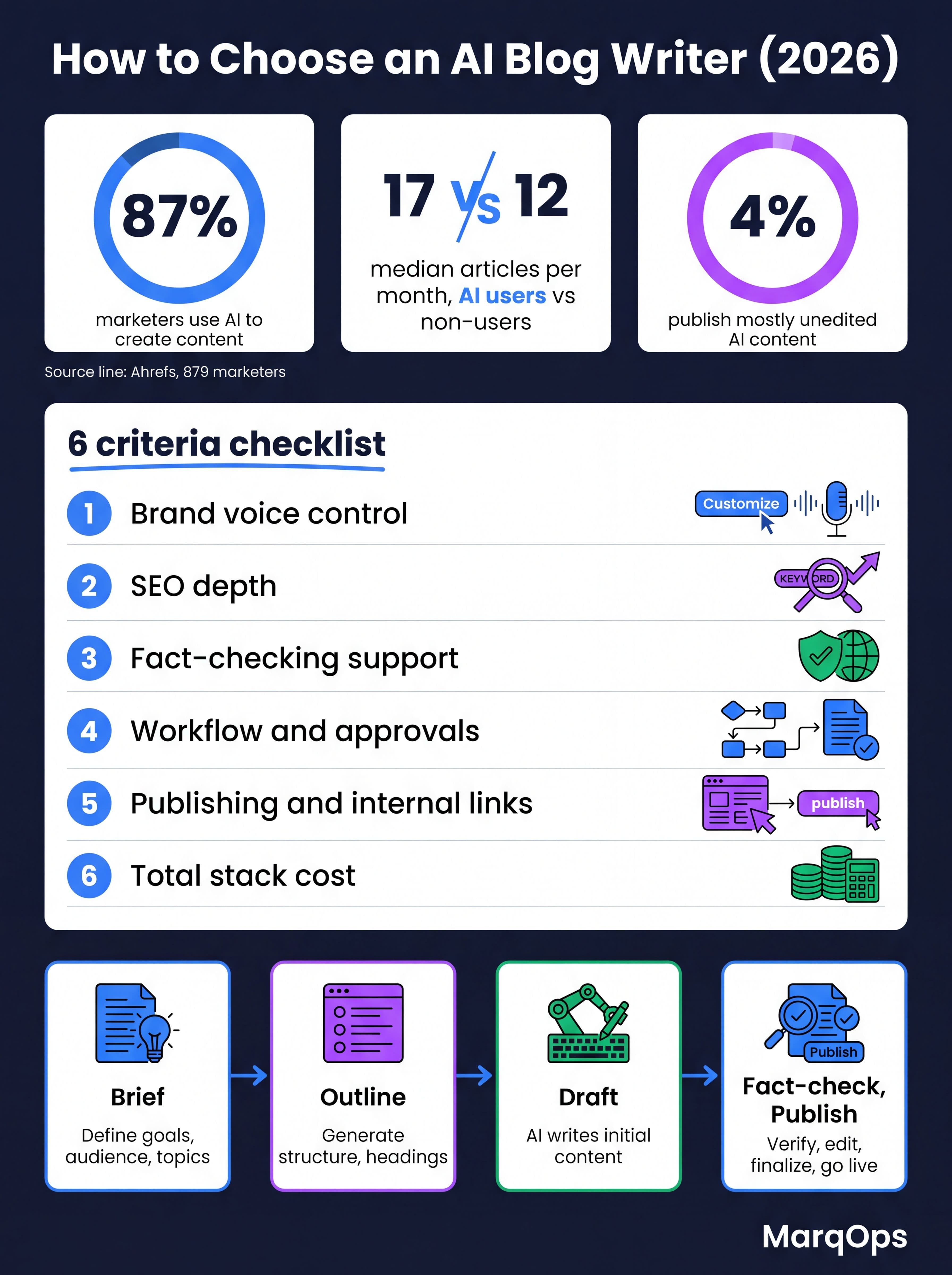
Adoption is nearly universal. In its State of AI in Content Marketing survey of 879 marketers, Ahrefs found that 87% use AI to create or help create content, and blog posts are the most common AI-assisted format at 87%. Siege Media and Wynter's 2026 research found 97% of content marketers plan to use AI for content marketing this year, up from 64.7% in 2023.
The speed gain is measurable. AI users in the Ahrefs survey published a median of 17 articles per month versus 12 for non-users. But the more interesting numbers are about restraint. Only 4% of respondents publish mostly unedited AI content, 80% manually review AI output for accuracy, and Siege Media and Wynter found just 1% of content marketers say all of their work is AI-generated.
| Metric | Figure | Source |
|---|---|---|
| Marketers using AI to create content | 87% | Ahrefs, 2025 survey |
| Blog posts as an AI-assisted content type | 87% | Ahrefs, 2025 survey |
| Manually review AI content for accuracy | 80% | Ahrefs, 2025 survey |
| Publish mostly unedited AI content | 4% | Ahrefs, 2025 survey |
| Content marketers using AI for drafting | 44% | Siege Media + Wynter, 2026 |
| Content marketers using AI for ideation | 74% | Siege Media + Wynter, 2026 |
Notice the pattern: teams lean on AI hardest for ideation and outlining, and less for the final draft. That matches what works. Semrush's analysis of 20,000 URLs, as summarized by Averi, found 57% of AI-written text appears in the top 10 results versus 58% of human-written text, which suggests search engines care about quality rather than authorship method. Treat that as a secondary-source figure, but it is consistent with Google's own position, covered next.
One more number should worry you. Averi, citing third-party research, reports that 81% of content teams have no framework for measuring whether AI is producing results. Speed without measurement is how teams end up publishing more and learning nothing. We return to measurement in a later section, and our guide to AI marketing ROI goes deeper on the math.
What Google Actually Says About AI Content
There is a persistent myth that Google penalizes AI-written posts. Its published guidance says something more specific. Google's page on generative AI content notes that AI can help with researching a topic and adding structure to original content. The warning is about volume without value: using AI to generate many pages that add nothing for users can violate the spam policy on scaled content abuse.
Google also tells publishers to manually fact-check and review all AI-generated content, because models predict likely word sequences rather than retrieve verified facts. That scrutiny extends to title elements, meta descriptions, structured data, and image alt text, since those can show up in search results. Google also encourages transparency about how content was created.
The practical takeaway is that the quality bar did not move because AI showed up. It was already about original insight, accuracy, and usefulness. If you want a structured way to hold that bar, our AI content optimization guide and content audit guide show how to score existing posts and fix weak ones before you publish more.
Three Types of AI Blog Writer
Tools that call themselves an AI blog writer fall into three groups. Knowing which you need prevents buying the wrong thing.
1. General-purpose chatbots
ChatGPT, Gemini, and Claude are the most used. Ahrefs found ChatGPT at 44%, Gemini at 15%, and Claude at 10% among respondents, and 77% of the tools people named were general LLMs. They are flexible and cheap, and they are excellent for brainstorming and outlining. Their weakness is context: they do not know your brand, your keywords, or what you have already published unless you paste it in every time.
2. Dedicated AI blog writing tools
These wrap a model in a blog-specific workflow: keyword input, outline, long-form draft, and sometimes an SEO score. They save setup time and often add templates and one-click publishing. The risk is sameness. If every competitor uses the same tool with default settings, the output starts to look alike, which is the opposite of an edge.
3. Platforms with content built into marketing operations
The third group connects writing to the rest of marketing: brand rules, SEO data, analytics, and ad performance in one place. The advantage is that the writer knows what your brand sounds like, what is already ranking, and what the data says to write next. This is the model behind SEO automation and the broader content supply chain approach, where drafting is one step in a managed process rather than a standalone trick.
Six Criteria for Choosing an AI Blog Writer
Use these six criteria to compare tools. Score each from 1 to 5 against a real brief from your own content calendar, not a demo prompt.
- Brand voice control. Can you load tone rules, banned phrases, and examples, and does the output follow them? Our guide to AI brand voice explains how to define rules a model can follow, and brand compliance covers how to enforce them at scale.
- SEO depth. Does it use real keyword data, competitor analysis, and search intent, or just stuff in a phrase? Look for support for keyword clustering and topic coverage that builds topical authority.
- Fact-checking support. Does it cite sources you can verify? A tool that invents statistics is a liability. Prefer tools that show where each claim came from.
- Workflow and approvals. Can an editor review, comment, and approve before anything goes live? Drafts without a review step are how embarrassing posts reach production.
- Publishing and internal linking. Does it push to your CMS and suggest links to your existing posts? Manual copy-paste and link hunting eat the time you were trying to save.
- Total stack cost. A cheap writer that needs a separate keyword tool, a separate image tool, a separate analytics tool, and a separate scheduler is not cheap. Count the whole stack, a theme we explore in marketing tech stack planning.
This last point is where an integrated platform earns its place. MarqOps combines creative, SEO, analytics, and ad operations in one workspace, with Brand Intelligence DNA keeping every draft on voice. Teams typically replace seven or more disconnected tools and report content output around six times faster, mainly because research, drafting, images, and publishing stop living in separate tabs.
A Human-in-the-Loop Workflow That Ranks
The data points to one workflow: let AI accelerate the mechanical steps and keep people on the judgment calls. Here is a seven-step version you can adopt this week.
Step 1: Pick the keyword and confirm intent
Start with a keyword you can realistically win, then read the first page of results to see what searchers expect. A comparison, a how-to, and a definition each call for a different post. An AI SEO tool can speed this up, but a human should confirm the intent.
Step 2: Write a brief with a real angle
List what the top results cover, then decide what you will add: original data, a worked example, a contrarian point, or practitioner experience. This is the step AI cannot do for you, and it is what separates a post worth ranking from a rehash.
Step 3: Generate the outline and review it
Ask the AI blog writer for an outline against your brief. Cut sections that repeat competitors and add the ones only you can write. Ahrefs found outlining is one of the top AI-assisted tasks at 73%, so you are in good company.
Step 4: Draft section by section
Drafting one section at a time, with your sources attached, produces tighter text than a single 2,000-word prompt. Feed in your brand rules and two or three examples of posts you like.
Step 5: Fact-check every claim
Verify each statistic against its original source, check dates, and remove anything you cannot confirm. Google explicitly advises manual fact-checking, and 80% of marketers in the Ahrefs survey do it. Also review the title tag, meta description, and image alt text.
Step 6: Add what AI cannot
Insert a customer example, a screenshot of your own data, a quote from a subject matter expert, or a lesson from a campaign you ran. Thirty-five percent of respondents in the Ahrefs survey use subject matter experts in review, and that expertise is the signal hardest to fake.
Step 7: Link, publish, and repurpose
Add internal links to related posts, publish, and then turn the post into other formats. Our guide to AI content repurposing shows how one article can feed social posts, email, and short video without starting over.
Writing for AI Search as Well as Google
A blog post now has two audiences: people who click through from search results, and AI systems that read your page and quote it in answers. Writing for both is not much extra work if you structure posts well.
- Lead with direct answers. Put a clear one or two sentence answer under each question-style heading, then expand. This pattern suits answer engine optimization.
- Use a TL;DR and an FAQ. Short summaries and question-and-answer blocks are easy for AI systems to extract and cite.
- Name entities and cite sources. Clear references to people, products, and studies help systems understand what the page is about. See our notes on entity SEO.
- Keep facts current and attributable. Fresh, sourced numbers get cited more than vague claims. For the wider picture, read how AI Overviews choose sources and how GEO differs from SEO.
If you want a team to handle this layer for you, our overview of generative engine optimization services explains what is involved.
Mistakes That Make AI Blog Posts Fail
- Publishing at volume before proving quality. Ahrefs found some AI users report thousands of pieces a month. More pages only help if each earns its place. Start with ten excellent posts, not a hundred average ones.
- Skipping the angle. If your outline matches the top three results, your post will read like them and rank below them.
- Trusting statistics blindly. Models can produce plausible numbers that do not exist. Verify at the source every time.
- Ignoring brand voice. Generic phrasing erodes trust. Load tone rules once and enforce them on every draft.
- Treating the post as finished at publish. Refresh winners, merge cannibalizing posts, and prune weak ones. A technical SEO audit catches issues that quietly cap your results.
- Mass-producing templated pages. This is the closest thing to scaled content abuse. If you build pages from templates, follow the cautions in our programmatic SEO guide.
How to Measure Whether It Is Working
Because most teams do not track AI-specific results, a simple scorecard puts you ahead. Track these five measures for AI-assisted posts and compare them with fully manual ones.
| Measure | What it tells you |
|---|---|
| Hours per published post | Whether AI is actually saving time after editing and fact-checking |
| Posts ranking in the top 10 after 90 days | Whether quality is holding up as volume grows |
| Organic clicks and engaged time per post | Whether readers find the content useful |
| Edit distance between draft and final | How well the tool follows your voice and brief |
| Mentions or citations in AI answers | Whether posts are being picked up by AI search |
Review the scorecard monthly. If hours per post drop but top-10 rankings fall, you are trading quality for speed. If edit distance stays high, your brand rules or briefs need work. A good marketing workflow automation setup makes this data show up without manual spreadsheet work.
Frequently Asked Questions
What is the best AI blog writer?
There is no single best option. General chatbots suit brainstorming and outlines, dedicated blog tools suit teams that want templates and SEO scoring, and integrated platforms suit teams that want brand voice, SEO data, and publishing in one place. Test two or three against a real brief and score them on the six criteria above.
Is it legal to use AI to write blog articles?
Using AI to write articles is generally legal, and Google does not prohibit AI-assisted content. Check the terms of your tool, confirm you have rights to any images, avoid copying protected text, and follow local disclosure rules. This is general information, not legal advice, so ask a lawyer about your situation.
Will Google penalize posts written with an AI blog writer?
Not for using AI itself. Google's guidance targets scaled content abuse, meaning many pages generated without adding value for users. Fact-checked, original, genuinely useful posts are treated like any other content.
Should I disclose that a post was written with AI?
It is optional in most cases, and only 16% of AI users in the Ahrefs survey disclose. Google encourages explaining how content was created, and disclosure can build trust, especially for sensitive topics. Check regulations that apply to your industry or region.
How much of a blog post should a human write or edit?
There is no proven percentage. The safe approach is for a human to own the angle, verify every fact, add original insight, and approve the final version. Only 4% of marketers in the Ahrefs survey publish mostly unedited AI content.
Bringing It Together
A good AI blog writer saves hours on research, outlines, and first drafts. It does not replace an angle, a fact-check, or an editor. Pick a tool that fits your brand and your stack, keep humans on the judgment calls, and measure results so you know whether speed is turning into traffic.
MarqOps puts creative, SEO, analytics, and ad operations in a single platform, with Brand Intelligence DNA keeping every post on voice and a unified dashboard showing what works. See the details on the pricing page or try it yourself.
Keep following the signal
Related field notes
Marketing
Marketing Automation for Agencies in 2026: What to Automate, What to Keep Human
11 min readMarketing
Brand Asset Management in 2026: How to Run It Without Adding Another Tool
14 min readMarketing Operations