SEO Automation in 2026: The Complete Guide to Scaling Search Without Losing Quality
SEO automation explained: what to automate vs keep human, 7 workflows worth building, the 2026 tool landscape, and a 5-step roadmap to scale search output.
TL;DR
- SEO automation uses software and AI agents to handle repetitive search tasks like audits, rank tracking, keyword clustering, meta optimization, and reporting, freeing your team for strategy.
- 86% of SEO professionals now use AI in their workflows, and teams that automate publish 42% more content per month than teams that do not.
- Automate data-heavy, rules-based work first: technical crawls, rank monitoring, internal link suggestions, and metadata. Keep strategy, brand voice, and quality control human.
- With 48% of Google queries now triggering AI Overviews and zero-click searches at nearly 65%, automation is how teams keep pace with both traditional rankings and AI visibility.
- Platforms like MarqOps unify keyword research, content generation, optimization, and analytics in one place, replacing the 3 to 5 disconnected tools most teams still stitch together.
Table of Contents
- What Is SEO Automation?
- Why SEO Automation Matters More in 2026
- What You Should Automate (and What You Should Not)
- 7 SEO Automation Workflows Worth Building
- The SEO Automation Tool Landscape
- How to Implement SEO Automation: A 5-Step Roadmap
- 5 SEO Automation Mistakes to Avoid
- Frequently Asked Questions
What Is SEO Automation?
SEO automation is the practice of using software, scripts, and AI agents to execute repetitive search engine optimization tasks without manual effort. That includes technical site crawls, rank tracking, keyword research and clustering, internal link suggestions, metadata generation, content briefs, and performance reporting. The goal is not to remove humans from SEO. It is to remove humans from the parts of SEO that a machine does faster and more consistently, so your team can spend its hours on strategy, creativity, and judgment.
The shift is already mainstream. According to SEO.com’s 2026 AI SEO research, 86% of SEO professionals have integrated AI into their workflows. The problem is how they do it: most teams stitch together 3 to 5 separate tools to cover the full content lifecycle, one for keywords, one for briefs, one for writing, one for tracking. Each handoff between tools is a place where data gets lost and hours get burned. That fragmentation is exactly what modern AI workflow automation is designed to eliminate.
The market reflects the momentum. The global AI SEO software market is projected to grow from $1.99 billion in 2024 to $4.97 billion by 2033. Teams that adopt automation are pulling ahead in raw output too: companies using AI in their SEO workflows publish 42% more content monthly than those that do not, with a median of 17 articles per month versus 12.
86%
of SEO professionals have already integrated AI into their workflows
Why SEO Automation Matters More in 2026
Two forces make automation urgent this year: search volatility and shrinking click supply.
AI Overviews changed the math on every ranking
As of March 2026, roughly 48% of Google queries trigger an AI Overview, and studies from Ahrefs and Seer Interactive show organic CTR for position one dropping by as much as 58% when an AI Overview is present. Zero-click searches have climbed to nearly 65% of all queries. In practical terms, every ranking you hold delivers fewer clicks than it did two years ago, so you need more rankings, across more queries, in more formats, just to hold traffic steady. That volume problem is unsolvable by hand.
There is an upside for teams that adapt: brands cited inside an AI Overview see around 35% higher CTR than brands that are not cited. Winning those citations requires consistent structured data, entity-rich content, and constant monitoring, all of which are automation-friendly tasks. If you are still deciding how to split your effort between classic rankings and AI visibility, our guide to GEO vs SEO breaks down the full picture, and our deep dive on LLM SEO covers how to get cited by ChatGPT, Perplexity, and Gemini.
The workload has outgrown the team
Modern SEO spans technical health, content production, on-page optimization, digital PR, structured data, and now answer engine optimization. Research from 2026 shows 75% of businesses already use AI to reduce manual work in areas like metadata optimization and competitor analysis. The teams resisting automation are not preserving quality. They are just doing the same low-leverage tasks slower.
Reality check: automation accuracy varies by task. Simple optimizations like meta description updates hit 85 to 90% success rates, while complex content restructuring lands closer to 65 to 75%. Automate the first category aggressively and keep a human review step on the second.
What You Should Automate (and What You Should Not)
Automate these tasks first
Technical SEO audits. Scheduled crawls that flag broken links, redirect chains, missing canonicals, slow pages, and indexation issues deliver the clearest automation ROI. Problems get surfaced before they compound into ranking losses, and nobody has to remember to run the crawl.
Rank tracking and SERP monitoring. Daily position checks, SERP feature tracking, and competitor movement alerts are pure data collection. A well-built workflow compares today’s positions against yesterday’s and pings your team only when a priority keyword moves meaningfully.
Keyword research and clustering. AI-driven clustering sorts thousands of keywords into intent-based groups in seconds, work that used to take days in spreadsheets. Pair it with the approaches in our guide to AI keyword research tools to build topic clusters that map cleanly to content plans.
Metadata and on-page elements. Title tags, meta descriptions, header structure, image alt text, and schema markup generation are high-volume, rules-based tasks where automation hits its highest accuracy rates.
Internal linking. Automated systems scan your content graph and suggest contextually relevant links at scale, keeping site architecture healthy as your library grows.
Reporting. Automated dashboards that pull rankings, traffic, and conversions into one view kill the weekly screenshot ritual. A unified marketing dashboard turns reporting from a half-day chore into a glance.
Keep these tasks human
Strategy and prioritization. Deciding which markets, topics, and pages deserve investment requires business context no tool has. An experienced SEO reads site architecture, competitive dynamics, and revenue data together and decides where fixes will actually move the needle.
Brand voice and final content quality. AI can draft, but humans must inject original perspective, verify facts, and ensure E-E-A-T signals hold up. Automated content that ships without review lets small hallucinations compound across hundreds of pages.
Interpretation. Connecting Search Console, analytics, and CRM data to answer “is this SEO work driving revenue” still requires human judgment. That layer of interpretation is what separates an audit from a strategy.
7 SEO Automation Workflows Worth Building
1. The always-on technical audit
Schedule a weekly full-site crawl. Pipe results into a change log that compares against the previous crawl and alerts on new errors only. Your team stops reviewing 500-row exports and starts reviewing 5-row diffs.
2. Rank movement alerts
Track priority keywords daily and trigger a Slack or email alert when any drops more than three positions. Teams running this workflow catch algorithm update damage in hours instead of weeks.
3. Automated content briefs
When a keyword opportunity is flagged, an automated workflow pulls the top 10 results, extracts their headings and entities, and generates a publication-ready brief. One agency documented cutting brief production from 4 to 5 hours weekly to about 10 minutes with this exact setup. Feed those briefs into an AI content strategy so every draft starts aligned with search intent.
4. Content optimization loops
Continuously score published pages against current SERP competitors and flag decaying content for refresh. Our guide to AI content optimization covers how scoring models decide what to fix first.
5. Programmatic page generation
For sites with structured data sets, think locations, integrations, comparisons, templates plus data can generate hundreds of useful pages. Done carelessly this creates thin content, so follow the guardrails in our programmatic SEO guide.
6. AI visibility monitoring
Track how often your brand appears in AI Overviews and LLM answers, and which competitors are cited instead. Purpose-built AI search visibility tools make this measurable the same way rank trackers made rankings measurable.
7. Automated reporting to stakeholders
A scheduled workflow that assembles rankings, traffic, conversions, and completed work into a stakeholder-ready summary every Monday morning. Nobody logs into anything.
Compounding effect: each workflow saves hours, but the real win is consistency. Automated systems never skip the weekly crawl, never forget the alt text, and never let a rank drop sit unnoticed for a month.
The SEO Automation Tool Landscape
The market splits into four categories, and knowing which you need prevents expensive shelf-ware.
Point solutions automate one job well: crawlers for technical audits, rank trackers for monitoring, link tools for internal linking. Powerful, but this is how teams end up managing 5+ subscriptions and copy-pasting between them.
Workflow builders like n8n, Make, and Zapier let technical teams wire custom pipelines connecting keyword APIs, scrapers, LLMs, and databases. Maximum flexibility, but you own the maintenance. Our breakdown of marketing workflow automation covers when building beats buying.
AI SEO suites combine research, optimization, and tracking in one product. The best options in this category are compared in our roundup of AI SEO tools.
Unified marketing operations platforms go a layer further and connect SEO automation to the rest of the marketing engine: content production, paid campaigns, and analytics. This is where MarqOps sits. Instead of stitching together separate tools for keyword research, content generation, optimization, and reporting, MarqOps runs the full cycle on one platform with Brand Intelligence DNA, so every automated output, from meta descriptions to full drafts, already matches your brand voice. Teams using this approach ship content up to 6x faster because nothing is lost in handoffs between disconnected tools.
How to Implement SEO Automation: A 5-Step Roadmap
Step 1: Audit where your hours actually go
Track your SEO team’s time for two weeks. Most teams discover 40 to 60% of hours go to collection, formatting, and status reporting, exactly the tasks machines handle at 85%+ accuracy.
Step 2: Automate one high-frequency, low-risk task
Start with rank tracking alerts or scheduled technical crawls. These are read-only, so a misconfiguration cannot damage your site, and the time savings show up in week one.
Step 3: Add human-in-the-loop content workflows
Automate briefs, drafts, and optimization suggestions, but route every output through editorial review. Track edit distance: as your prompts and brand configuration improve, the gap between draft and published version shrinks, and review gets faster.
Step 4: Connect your data into one view
Automation multiplies output, which multiplies reporting surface area. Consolidate rankings, traffic, AI visibility, and conversion data into a single dashboard before the sprawl becomes unmanageable.
Step 5: Measure, prune, and scale
Review each workflow quarterly. Kill automations nobody acts on, tighten the ones with error rates, and reinvest saved hours into the human work: strategy, original research, and content only your team could produce.
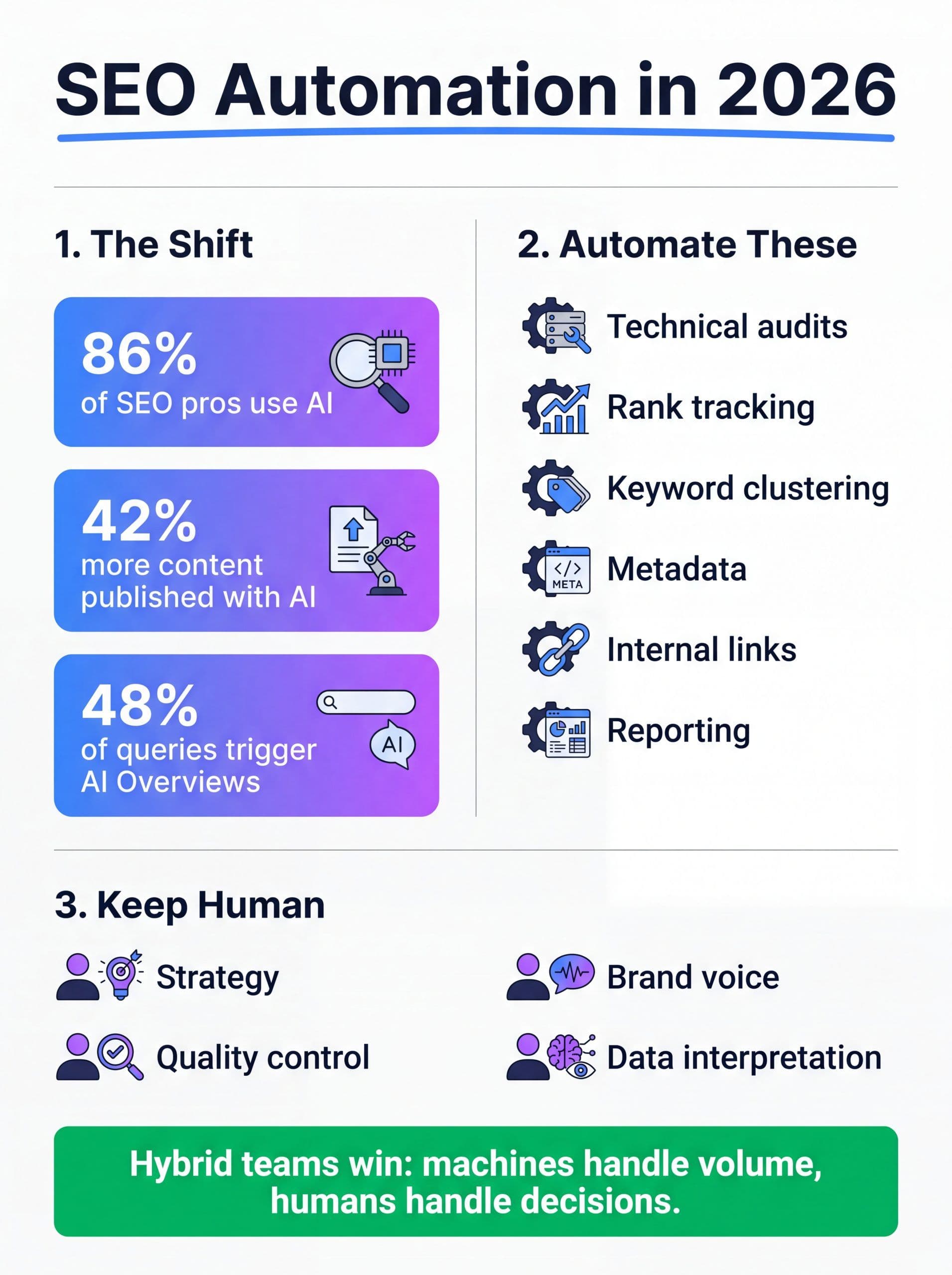
The 2026 SEO automation framework: automate the repetitive, keep the strategic human.
5 SEO Automation Mistakes to Avoid
1. Automating content end-to-end with no review. Fully hands-off publishing is how sites accumulate factual errors and thin pages that invite algorithmic demotion. Keep a human QA gate on anything reader-facing.
2. Tool sprawl. Adding a new point solution for every task recreates the fragmentation problem automation was meant to solve. Consolidate where possible.
3. Set-and-forget configurations. Search behavior shifts constantly, especially with AI Overviews expanding. Workflows tuned for 2024 SERPs quietly optimize for a landscape that no longer exists.
4. Ignoring AI visibility. If your automation stack only tracks blue-link rankings, you are blind to the 48% of queries where an AI Overview shapes the click. Add AI citation monitoring to the stack.
5. Automating before standardizing. If your team has no agreed process for briefs or audits, automation just produces inconsistent output faster. Document the manual process first, then automate it.
Frequently Asked Questions
What is SEO automation?
SEO automation is the use of software and AI to execute repetitive SEO tasks such as technical audits, rank tracking, keyword clustering, metadata generation, internal linking, and reporting without manual effort, so teams can focus on strategy and content quality.
Can SEO be fully automated?
No. Data-heavy tasks automate well, with simple optimizations reaching 85 to 90% accuracy, but strategy, brand voice, fact-checking, and quality assurance still require human judgment. The winning model in 2026 is hybrid: machines handle volume, humans handle decisions.
What SEO tasks should I automate first?
Start with read-only, high-frequency tasks: scheduled technical crawls, daily rank tracking with alerts, and automated reporting. They carry no publishing risk and free up hours immediately. Then add keyword clustering, content briefs, and metadata generation with human review.
Does SEO automation help with AI Overviews and LLM visibility?
Yes. Automation handles the structured data, entity optimization, and continuous citation monitoring that AI visibility requires. With 48% of queries triggering AI Overviews and cited brands earning roughly 35% higher CTR, automated AI visibility tracking is becoming as standard as rank tracking.
How is an SEO automation platform different from individual tools?
Point tools automate single tasks, which forces teams to manage 3 to 5 subscriptions and manually move data between them. A unified platform like MarqOps connects keyword research, content generation, optimization, and analytics in one system, eliminating handoff losses and keeping every output on-brand automatically.
Keep following the signal