Marketing Automation for Agencies in 2026: What to Automate, What to Keep Human
Marketing automation for agencies explained: the eight workflows to automate first, where AI agents fit, how to escape tool sprawl, and a 60-day rollout plan.
Table of Contents
- What Is Marketing Automation for Agencies?
- Why Agencies Need a Different Approach Than In-House Teams
- The 2026 Numbers: AI Is Everywhere, Profit Is Not
- Eight Agency Workflows Worth Automating First
- Where AI Agents Fit Into Agency Automation
- The Tool Sprawl Problem and How to Escape It
- How to Choose Marketing Automation Software for an Agency
- A 60-Day Rollout Plan
- Common Mistakes That Quietly Eat Agency Margin
- How to Measure Whether Automation Is Working
- Frequently Asked Questions
Every agency owner knows the Sunday-night feeling: ten client reports to assemble, three ad accounts to sanity check, a content calendar that slipped, and a team already at capacity. Growth usually means more of that, not less. That is the core tension behind marketing automation for agencies: the work scales with the client list, but the revenue per client does not.
The data shows how widespread the pressure is. Forrester's State of AI Inside US Marketing Agencies, 2026, produced with the 4As and summarized in its press release, found that 90% of US agencies use generative AI and 50% use agentic AI for marketing execution. Adoption is not the problem anymore. Turning adoption into margin is.
This guide is written for agency founders, heads of operations, and account leads who want a practical plan. We cover what agency automation really includes, the workflows to automate first, where AI agents fit, how to avoid tool sprawl, and a 60-day rollout. If you want the broader foundation first, our guides to marketing workflow automation and AI workflow automation cover the mechanics.
What Is Marketing Automation for Agencies?
Marketing automation for agencies is the use of software, rules, and increasingly AI agents to run the repeatable parts of client work with minimal manual effort. Traditional marketing automation, the kind sold by email and CRM platforms, focuses on nurturing a single company's leads. Agency automation is broader and more operational. It covers the machinery of delivering results to many clients at once.
In practice that machinery includes:
- Client reporting: pulling data from ad platforms, analytics, and search tools into branded, scheduled reports.
- Campaign monitoring: spotting spend spikes, disapproved ads, tracking breaks, and performance drops before the client does.
- Content production: briefs, drafts, repurposing, and brand checks at volume.
- Approvals and handoffs: routing work between strategists, designers, and clients without email chains.
- Onboarding: collecting access, brand assets, and goals in a repeatable sequence.
- Lead nurturing: the classic email and CRM sequences, for the agency itself and for clients.
Why Agencies Need a Different Approach Than In-House Teams
A brand team automates one set of workflows for one brand. An agency automates the same workflow many times, each with different data sources, brand rules, approval chains, and client expectations. Three differences matter.
1. Multiplication of context
Every client has its own voice, banned phrases, color palette, and reporting preferences. Automation that ignores this produces generic output that account managers then spend hours fixing. This is why a documented brand guidelines template per client is a prerequisite, not a nicety, and why our guide to brand compliance treats review as a system rather than a favor from the senior designer.
2. Billable time is the product
When revenue is tied to retainers or fixed scopes, every hour spent on low-value assembly work is margin leaking out. Automation is therefore a pricing and profitability decision, not just an efficiency one.
3. Clients judge you on consistency
A missed report or a broken conversion tag damages trust faster than a mediocre campaign. Reliable, automated delivery is a retention tool. The details of building that reliability are covered in our client reporting framework and the white label SEO reports playbook.
The 2026 Numbers: AI Is Everywhere, Profit Is Not
Three sets of figures frame the opportunity, and each comes from a named source so you can check it.
| Metric | Figure | Source |
|---|---|---|
| US agencies using generative AI | 90% | Forrester / 4As, June 2026 |
| US agencies using agentic AI for execution | 50% | Forrester / 4As, June 2026 |
| Agencies treating AI as a cost of doing business | 61% | Forrester / 4As, June 2026 |
| Agencies planning to monetize agentic AI within 24 months | 31% | Forrester / 4As, June 2026 |
| Average digital agency net margin, 2025 | About 13% | Promethean Research (2026 State of Digital Services), as reported by Agiled |
| Share of revenue spent on tools and software | 3.7% | 2023 Digital Shop Tools Survey, cited by Promethean Research |
The pattern is clear. Nearly everyone has AI, most are using it to cut costs, and only about a third expect to turn agentic AI into something clients pay for. Forrester also warns that focusing purely on efficiency can weaken creativity and long-term brand growth, and recommends reinvesting gains in talent, training, and AI-powered operating systems.
With a margin that thin, small operational gains compound. An agency with 20 clients that recovers three hours per client per month has found 60 hours of capacity, enough to onboard several new accounts without a hire. Treat these as planning examples rather than benchmarks, and substitute your own timesheet data.
Eight Agency Workflows Worth Automating First
Use two filters: the task repeats at least weekly, and a reviewer can tell in seconds whether it was done correctly. Tasks that pass both are safe to automate early. Here are the eight that most agencies start with.
1. Client reporting
This is the classic first win. Connect data sources once, template the report per client, schedule delivery, and add an AI-written summary for a human to approve. Our guide to marketing reporting software explains how to evaluate options, and PPC reporting covers what to show and what you can prove.
2. Ad account monitoring and anomaly alerts
Budget pacing, sudden CPA jumps, disapproved ads, and tracking failures are all detectable by rules. Automating the watch means your team reacts in minutes rather than at the next weekly review. See our overview of AI PPC management for the paid search specifics.
3. Content briefs and first drafts
AI can produce briefs from keyword data and first drafts from briefs, as long as a brand profile constrains the output. Our guide to SEO automation walks through scaling search work without losing quality control.
4. Content repurposing
One approved asset becomes social posts, email copy, and ad variants. This is high volume, low risk work, ideal for automation with a final human skim.
5. Creative variations
Resizing, localizing, and testing variants of approved creative is mechanical. The pattern is laid out in our creative automation guide.
6. Brand and compliance checks
Automated checks for banned terms, claim substantiation, and color or logo misuse catch most errors before a client does. Humans then review exceptions instead of everything.
7. Client onboarding
A templated sequence that requests account access, collects brand assets, confirms goals, and creates the first tasks removes the weeks of back and forth that delay launch and revenue.
8. Internal status and approvals
Automatic status updates and approval reminders replace a surprising amount of project management overhead. Fewer "just checking in" messages means fewer interruptions for everyone.
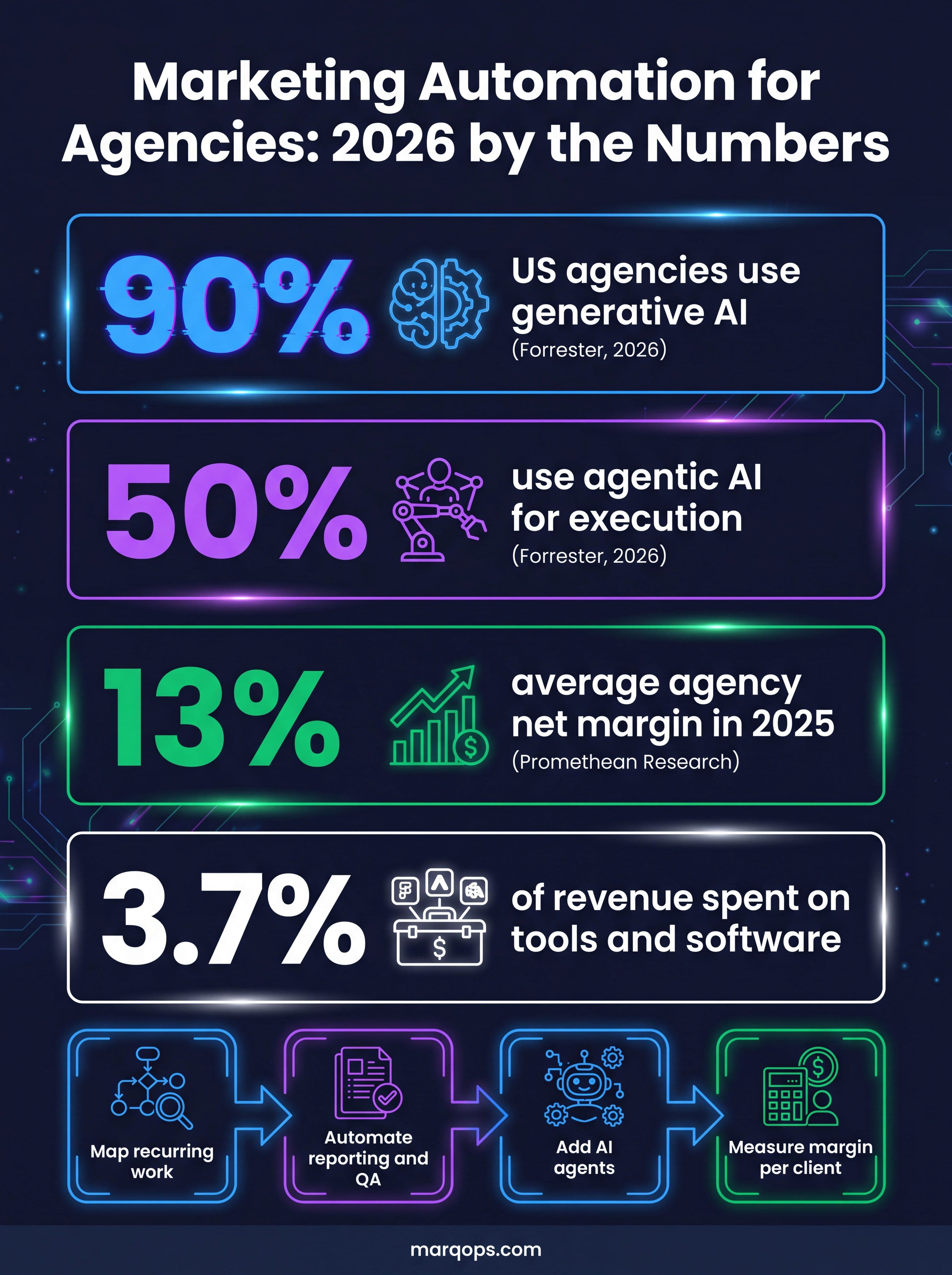
Marketing automation for agencies in 2026: adoption, margins, and a four-step rollout.
Where AI Agents Fit Into Agency Automation
Rule-based automation follows a fixed script: if X, do Y. AI agents can plan a sequence of steps toward a goal, use several tools, and adapt when something unexpected happens. Half of US agencies already use them for execution, according to Forrester. The difference shows up in tasks like "find out why this client's leads dropped": a rule can alert you, an agent can pull the data, compare periods, check tracking, and draft a diagnosis.
The agency-specific risk is autonomy without guardrails. Forrester lists lack of expertise (54%) and data infrastructure gaps (51%) as the top barriers to scaling agents. Start with agents that recommend and humans that approve, then widen permissions as trust is earned. Our guide to AI agents for marketing covers the architecture, and AI in marketing automation explains how the layers fit together.
The Tool Sprawl Problem and How to Escape It
Agencies accumulate tools the way clients accumulate campaigns: one at a time, each with a good reason. A reporting tool, an SEO suite, a scheduler, a design app, an ad management layer, a project board, a brand asset library. Each one has its own login, pricing tier, and data silo.
Tool spend itself is not the main damage. Promethean data puts tools at about 3.7% of revenue, which sounds modest. The real cost is integration labor: people copying numbers between tabs, reconciling mismatched metrics, and rebuilding client context in every app. Automating each silo separately leaves that connective work in human hands.
That is the idea behind consolidating onto one platform. MarqOps was built to replace 7+ disconnected marketing tools with a single system, where Brand Intelligence DNA keeps every output on brand, content production runs about 6x faster, and a unified dashboard brings analytics, ads, SEO, and creative together so teams stop switching tabs. For a deeper look at building a lean stack, read our marketing tech stack guide, and see how the agency reporting features work in practice.
How to Choose Marketing Automation Software for an Agency
Most comparison articles list features. Agencies should weigh these criteria instead. For a side by side of specific products, see our best marketing automation tools in 2026 roundup.
| Criterion | What to look for | Red flag |
|---|---|---|
| Multi-client structure | Separate workspaces, roles, and brand profiles per client | Clients share one flat account |
| Brand control | Stored voice, visuals, and rules applied to every output | Prompts pasted by hand each time |
| Data connections | Native ad, analytics, and search integrations | Reliance on manual CSV uploads |
| White label output | Branded reports and client-facing views | Vendor branding on every export |
| Approvals | Human review steps before publishing or spending | Fully autonomous actions with no gate |
| Pricing model | Predictable per client or per workspace pricing | Per seat costs that grow with every hire |
| Breadth | Creative, SEO, analytics, and ads in one place | Another single-purpose silo |
If you are weighing a reporting specialist against an all-in-one platform, our AgencyAnalytics vs MarqOps comparison lays out the trade-offs, and the pricing page shows how plans scale.
A 60-Day Rollout Plan
Agencies rarely fail at automation because of the software. They fail because they try to change everything at once. A phased plan keeps delivery safe.
Days 1 to 14: Audit and choose
- Track time for two weeks across ten recurring task types. Rank them by hours and by error rate.
- Pick the top three using the weekly-repeat and clear-definition-of-done filters.
- Write a one-page standard for each: inputs, steps, output, owner, and reviewer.
- Shortlist platforms against the criteria table above and run a trial on one client.
Days 15 to 30: Pilot on three clients
Choose cooperative, mid-complexity accounts. Automate reporting and monitoring first, because mistakes there are visible and easy to verify. Compare the automated output with the manual version for two cycles before trusting it.
Days 31 to 45: Add content and brand controls
Load each pilot client's brand profile, then introduce AI drafts and repurposing with a review step. Track edit rates: if reviewers rewrite more than a third of a draft, the brand profile needs work, not the reviewer.
Days 46 to 60: Roll out and price it in
Extend to remaining clients in batches of five. Update scopes and proposals so the efficiency shows up in margin, faster turnaround, or new services, rather than silently disappearing into discounts.
Common Mistakes That Quietly Eat Agency Margin
- Automating a broken process. If the manual version is inconsistent, the automated version is just inconsistent faster. Standardize first.
- Skipping brand profiles. Generic output creates rework, which cancels the time savings.
- Giving agents too much autonomy. Spend and publishing actions need an approval gate.
- Treating AI as a cost cut only. Sixty-one percent of agencies do this, per Forrester. The agencies that package automation into faster delivery or new services can charge for it.
- No ownership. Every automation needs a named owner who fixes it when a data connection breaks.
- Ignoring client communication. Tell clients what is automated and what still gets human review. Transparency builds trust and avoids surprises.
How to Measure Whether Automation Is Working
Pick five numbers and review them monthly. They connect directly to the profitability story, and they pair well with the framework in our AI marketing ROI guide.
- Hours per client per month on recurring tasks, before and after.
- Effective margin per client, using real timesheet data rather than the retainer value.
- Time to detect issues, such as a broken tag or overspend, in hours.
- Draft edit rate, the share of AI content changed by reviewers.
- Client retention and satisfaction, since reliability is the quiet benefit.
For the operating model behind these metrics, see our marketing operations guide. If you want a quick view of where your own accounts stand, MarqOps offers a free audit you can run on a client site.
Frequently Asked Questions
What is marketing automation for agencies?
It is the use of software, rules, and AI agents to run repeatable client work such as reporting, ad monitoring, content production, approvals, and onboarding. The goal is to deliver more consistent results for more clients without adding headcount at the same rate.
What should an agency automate first?
Start with client reporting and ad account monitoring. They repeat every week, have a clear definition of done, and are easy to verify against the manual version. Content repurposing and brand checks usually come next.
Will automation replace agency staff?
Evidence suggests it shifts the work rather than removing it. Forrester found agencies mainly use AI to improve staff productivity (81% for generative AI, 63% for agents). Junior tasks do change, so plan training and new responsibilities deliberately.
How much does agency marketing automation cost?
Costs range from low monthly fees for single-purpose tools to custom enterprise contracts. Compare total cost, including the separate tools an all-in-one platform could retire and the integration time your team spends today.
Is marketing automation different from AI marketing?
They overlap. Classic automation follows fixed rules, while AI adds drafting, analysis, and decision support, and agents can chain steps together. Most agencies end up using both, with rules for predictable tasks and AI where judgment or language is needed.
Bringing It Together
Agencies do not need more software. They need fewer manual handoffs. Automate the weekly repeatable work, give AI clear brand rules, keep humans on approvals, and measure margin per client. Done well, you recover capacity, deliver more consistently, and turn efficiency into a service clients value.
MarqOps brings creative, SEO, analytics, and ad operations into one platform with Brand Intelligence DNA, so agency teams can scale client work without stitching tools together.
Keep following the signal
Related field notes
Marketing
Brand Asset Management in 2026: How to Run It Without Adding Another Tool
14 min readMarketing Operations
Marketing Project Management Software in 2026: How to Choose Without Adding Tool #122
11 min readMarketing Analytics