AI Content Optimization in 2026: The Complete Guide to Ranking in Google and AI Search
AI content optimization is how modern teams rank in Google and get cited by ChatGPT, Perplexity, and AI Overviews. Here is the 2026 playbook, tools, and workflow.
AI Content Optimization in 2026: The Complete Guide to Ranking in Google and AI Search
By MarqOps | Last updated June 2026
TL;DR
- AI content optimization is the practice of using AI to research, structure, write, and refine content so it ranks in Google and gets cited by AI engines like ChatGPT, Perplexity, and Google AI Overviews.
- The game has changed: the overlap between Google’s top-10 results and AI citations has dropped from roughly 75% in mid-2025 to between 17% and 38% in early 2026. You now optimize for two audiences at once.
- Content depth, readability, structure, and factual accuracy now matter more for AI visibility than raw backlinks or keyword density.
- Teams that bake AI into content workflows publish 47% more per month, and nearly 70% report better returns from AI-assisted SEO.
- A unified platform like MarqOps handles keyword research, brief building, writing, and optimization scoring in one place, so you stop stitching together seven disconnected tools.
Table of Contents
- What Is AI Content Optimization?
- Why AI Content Optimization Matters More in 2026
- How AI Content Optimization Actually Works
- The 6 Pillars of Optimized Content
- AI Content Optimization Tools and What to Look For
- A Step-by-Step AI Content Optimization Workflow
- Common Mistakes to Avoid
- Frequently Asked Questions
What Is AI Content Optimization?
AI content optimization is the use of artificial intelligence to research, structure, write, and continuously refine content so it performs well in both traditional search and AI-driven search experiences. In practical terms, it means using AI to find the right topics, build data-backed briefs, draft copy that matches search intent, and then score and improve that copy against the signals that engines actually reward in 2026.
The definition has widened fast. A few years ago, optimizing content meant fitting a keyword into a title, a few headings, and the body. Today it means writing for two readers at once: the human skimming a results page, and the language model deciding whether to quote your page inside an AI-generated answer. That second reader did not exist at scale until recently, and it has rewritten the rules. If you are building a broader content engine, this fits directly inside your AI content strategy rather than sitting off to the side as a one-time cleanup task.
Optimization is no longer a step you do once before hitting publish. It is a loop: research, write, score, refine, and revisit as AI engines and ranking signals shift underneath you.
Why AI Content Optimization Matters More in 2026
Two forces collided this year. First, AI-assisted content became the norm rather than the exception. Roughly 75% of all B2B and B2C web content now involves some form of AI assistance, up from about 20% in 2023, and 86% of SEO professionals have folded AI into their workflows. When almost everyone is producing more content faster, undifferentiated, unoptimized pages simply disappear into the noise.
Second, the surface where people find answers fragmented. Google AI Overviews now reach around 2 billion monthly users, and when an Overview appears, organic click-through can fall by as much as 61%. At the same time, brands cited inside those Overviews earn roughly 35% more organic clicks. Visibility is no longer just a ranking position. It is whether an AI engine chooses your words to answer the question.
75% to 17-38%
Drop in overlap between Google’s top-10 results and AI citations from mid-2025 to early 2026
That last number is the one that should reshape your roadmap. Research tracking AI citations found that the overlap between Google’s top-10 organic results and the sources AI engines cite has crashed from about 75% in mid-2025 to somewhere between 17% and 38% in early 2026. Ranking first on Google no longer guarantees you a mention inside ChatGPT or Perplexity. You have to earn each surface on its own terms, which is exactly why generative engine optimization and answer engine optimization have moved from buzzwords to line items in real content budgets.
The upside is concrete. Nearly 70% of companies report better returns after adding AI to their SEO and content work, 68% of marketers confirm AI helped them achieve higher ROI, and AI-assisted teams publish about 47% more content each month. The GEO market alone is projected to grow from $886 million to $7.3 billion by 2031. Optimization is where that spend either pays off or evaporates.
How AI Content Optimization Actually Works
Under the hood, AI content optimization runs across four stages, and the best results come when the same system handles all of them instead of handing files between disconnected tools.
Research and intent mapping. AI analyzes what already ranks, what AI engines cite, and what questions real people ask. It clusters keywords by intent so you write one strong page instead of five thin ones competing with each other. Pairing this with dedicated AI keyword research tools turns a guess into a data-backed brief.
Drafting against a brief. Once the brief exists, AI drafts sections that cover the right subtopics, entities, and questions. This is where an AI copywriting tool earns its keep, producing a strong first draft in minutes rather than days while staying anchored to the brief.
Scoring and refinement. The draft gets scored against the signals engines reward: topical coverage, readability, structure, entity coverage, and factual grounding. The system flags gaps, weak sections, and missing answers, then suggests fixes. This is the loop that separates content that ranks from content that just exists.
Distribution and measurement. Optimized content gets published, then monitored across both classic search and AI engines. Strong AI marketing analytics close the loop by showing what earned citations and clicks, feeding the next round of research.
The 6 Pillars of Optimized Content in the AI Era
The signals that move the needle have shifted. When researchers studied what earns AI citations, content depth and readability mattered most, while traditional metrics like raw traffic and backlinks had surprisingly little impact. Here is where to focus.
| Pillar | What It Means | Why It Wins in 2026 |
|---|---|---|
| Intent match | The page answers the exact question behind the query | AI engines reward the page that resolves intent fastest |
| Front-loaded answers | The first 200 words directly answer the primary query | Retrieval systems judge relevance on opening content |
| Depth and coverage | Thorough treatment of subtopics and related entities | Depth is the strongest predictor of AI citations |
| Clear structure | Headings, lists, tables, and scannable formatting | Pages with tables and lists earn up to 26% more citations |
| Factual grounding | Verifiable stats, sources, and accurate claims | Accuracy drives trust and reduces AI hallucination risk |
| Brand consistency | A recognizable, on-brand voice across every page | Consistency compounds authority across surfaces |
That last pillar is easy to underrate. When you scale output with AI, voice drifts fast across writers and tools. Keeping a consistent AI brand voice is what stops a high-volume content program from reading like it was assembled by ten different strangers.
AI Content Optimization Tools and What to Look For
The market is crowded. Most AI content optimization tools fall into a few buckets: keyword and brief builders, writing assistants, on-page scorers, and AI-visibility trackers. The trap is that each one solves a slice of the problem, and stitching them together creates exactly the fragmented workflow that drains marketing teams. A typical content operation juggles a research tool, a writing tool, an optimization scorer, a plagiarism checker, an analytics dashboard, and a project tracker. That is six logins before anyone writes a word.
When you evaluate options, look for four things: research and scoring in the same place, a brief that flows straight into drafting, an optimization score you can actually act on, and visibility tracking that covers both Google and AI engines. Standalone AI SEO tools are useful, but the real leverage comes from consolidation.
This is the gap MarqOps was built to close. Instead of seven disconnected tools, MarqOps unifies keyword research, brief building, AI writing, optimization scoring, and analytics in one platform, with Brand Intelligence DNA keeping every output on-brand from the first draft.
That consolidation is not just convenient. It is what makes the 6x faster content output realistic, because the handoffs between tools are usually where time and quality leak out. If you want to see how a unified stack compares to a pile of point solutions, our breakdown of AI-powered marketing platforms walks through the tradeoffs in detail.
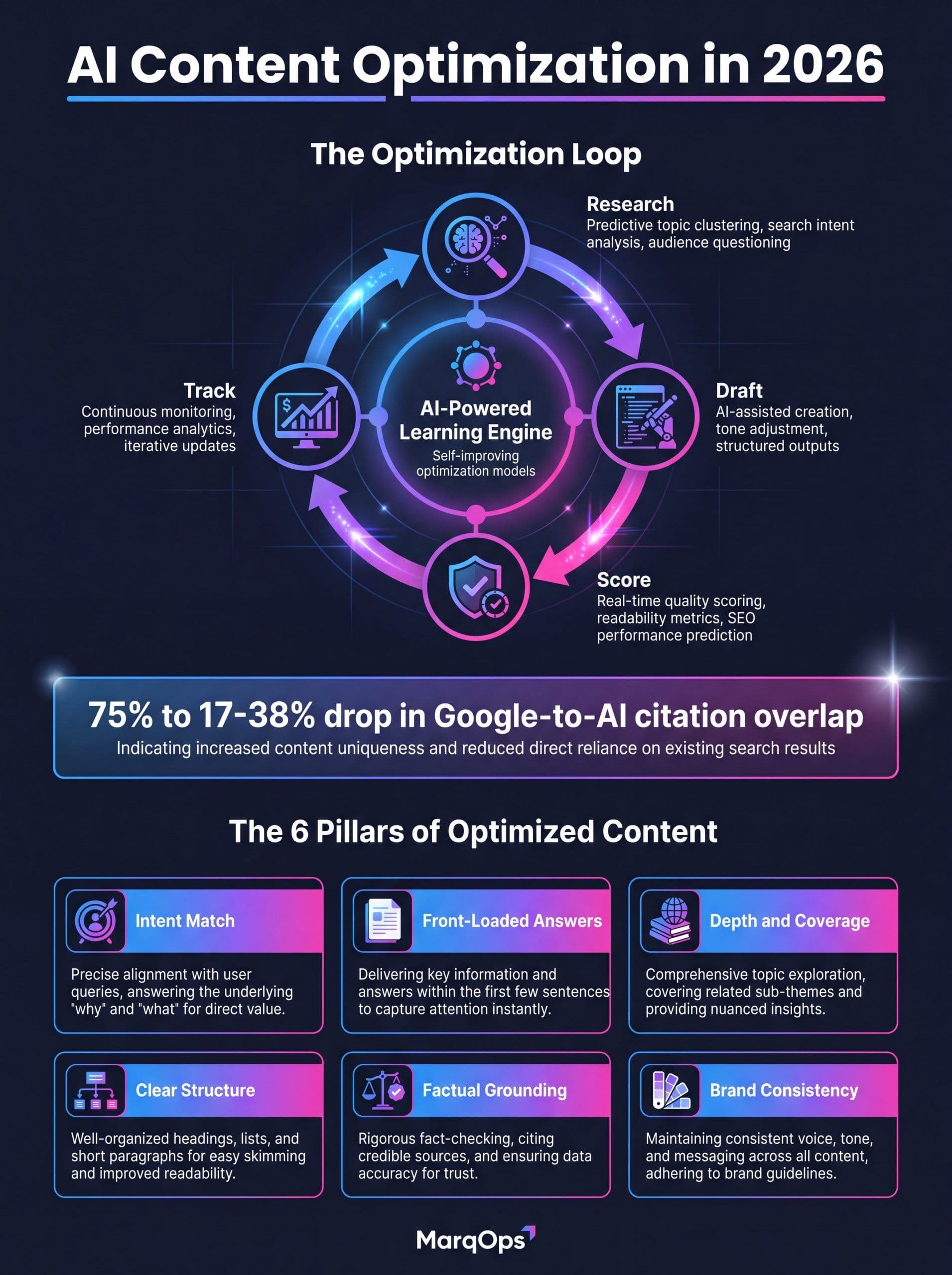
The AI content optimization loop and the six pillars that drive visibility in 2026.
A Step-by-Step AI Content Optimization Workflow
Here is a workflow any marketing team can run, whether you publish four posts a month or four hundred.
1. Start with intent, not keywords
Pull the question behind the query before you pull the keyword. Use AI to cluster related searches and identify the single dominant intent, then commit to one page that owns it. Spreading the same intent across multiple thin pages is the fastest way to lose to a competitor who consolidated.
2. Build a data-backed brief
A good brief lists the subtopics, entities, questions, and competitor gaps the page must cover. This is where optimization is won or lost, because the draft can only be as complete as the brief that guides it. For high-volume programs, this brief stage is also where programmatic SEO approaches let you scale briefs across hundreds of pages without losing quality.
3. Draft, then front-load the answer
Generate the draft against the brief, then make sure the first 200 words answer the primary question directly and completely. AI retrieval systems weight opening content heavily, so a strong lead is doing double duty for human readers and machines.
4. Score and close the gaps
Run the draft through an optimization score that checks coverage, readability, structure, and entity inclusion. Treat anything below a strong threshold as unfinished. Add the missing tables, lists, and direct answers that AI engines reward before you publish.
5. Repurpose and distribute
One optimized pillar can fuel a month of derivative assets. Smart AI content repurposing turns a single guide into social posts, an email, and a video script, multiplying the return on the work you already did.
6. Track visibility across every surface
Finally, monitor where you show up, not just on Google but inside AI answers. Purpose-built AI search visibility tools tell you when ChatGPT or Perplexity starts citing you, which is the new leading indicator of content that is genuinely optimized. Wiring this loop into your broader marketing operations keeps optimization continuous instead of occasional.
Teams that run this full loop instead of optimizing once before publishing are the ones publishing 47% more content while reporting higher ROI. The compounding effect comes from the loop, not any single step.
AI Content Optimization vs Traditional SEO
It helps to be precise about what changed and what did not. Traditional SEO optimized a page to rank in a list of ten blue links, leaning heavily on keywords, backlinks, and technical signals. Those still matter, but they are now table stakes rather than differentiators. AI content optimization adds a second objective on top: getting your content selected, quoted, and cited inside an AI-generated answer where there is no list and often no click at all.
The practical difference shows up in what you measure and reward. Traditional SEO obsesses over position and link volume. AI content optimization weighs how completely you answer intent, how early you answer it, how well-structured the page is, and how factually grounded each claim is. With roughly 58% of US searches ending without a click, a citation inside an AI answer is often worth more than a mid-page ranking that no one scrolls to. That is also why AI referral traffic, while smaller in volume, tends to convert far better than generic organic clicks. You are reaching people at the exact moment an AI handed them your answer.
The takeaway is not to abandon SEO. It is to treat AI optimization as the layer that sits on top of solid fundamentals, so a single well-built page earns visibility everywhere your audience actually looks for answers.
Common Mistakes to Avoid
Even well-resourced teams trip over the same issues. Watch for these.
Chasing keyword density instead of thematic relevance. Modern engines reward depth, accuracy, and information gain, not how many times you repeated a phrase. Stuffing keywords now signals low quality more than it signals relevance.
Optimizing for Google only. With the Google-to-AI citation overlap down near 20%, a page can rank well and still be invisible inside AI answers. You have to optimize for both, deliberately.
Publishing AI drafts without a scoring pass. Faster output is worthless if the content is thin. The optimization and refinement step is exactly what separates a 47% volume increase that drives ROI from one that just clutters your site.
Letting brand voice drift. Scale magnifies inconsistency. Without a system enforcing voice, high-volume AI content quickly reads off-brand, and trust erodes across every surface at once.
Frequently Asked Questions
What is AI content optimization?
AI content optimization is the practice of using artificial intelligence to research topics, build briefs, draft copy, and score and refine content so it ranks in traditional search and gets cited by AI engines like ChatGPT, Perplexity, and Google AI Overviews. It treats optimization as a continuous loop rather than a one-time step before publishing.
How do I optimize my content for AI search?
Answer the primary question completely in the first 200 words, cover subtopics and related entities in depth, use clear structure with headings, lists, and tables, ground every claim in verifiable facts, and keep a consistent brand voice. Then track whether AI engines actually start citing the page and refine based on what you see.
Is SEO dead in 2026?
No, but it has expanded. Classic SEO still drives meaningful traffic, yet the overlap between Google’s top results and AI citations has fallen sharply, so ranking alone no longer guarantees visibility. The discipline has evolved into optimizing for both search results and AI-generated answers at the same time.
Does AI-generated content rank well?
It can, but only when it is optimized. Engines reward depth, accuracy, structure, and intent match regardless of how content was produced. AI drafts that skip the scoring and refinement pass tend to read thin and underperform, while AI content run through a proper optimization loop competes well.
What tools do I need for AI content optimization?
You need research and brief building, an AI writing assistant, an on-page optimization scorer, and visibility tracking across Google and AI engines. Many teams run these as separate tools, but a unified platform like MarqOps combines them so you avoid the handoffs where time and quality usually leak out.
Bringing It Together
AI content optimization in 2026 is less about gaming a single algorithm and more about producing genuinely useful, well-structured, factually grounded content at a pace your competitors cannot match, then proving it earns visibility across every surface that matters. The teams winning are not the ones with the most tools. They are the ones who consolidated research, writing, optimization, and measurement into one loop, kept their brand voice intact, and treated optimization as ongoing work rather than a checkbox.
That is exactly what MarqOps delivers: one platform that replaces seven-plus disconnected tools, Brand Intelligence DNA that keeps output on-brand from the first draft, and 6x faster content backed by a unified dashboard for SEO, analytics, ads, and creative. If you are tired of stitching together your content stack, this is where to start.
Keep following the signal
Related field notes
Marketing
Marketing Automation for Agencies in 2026: What to Automate, What to Keep Human
11 min readMarketing
Brand Asset Management in 2026: How to Run It Without Adding Another Tool
14 min readMarketing Operations