Content Audit in 2026: How to Audit for AI Citations, Not Just Rankings
Rankings alone no longer tell you whether content is working. Here is how to run a 2026 content audit that scores every page on performance and AI citation visibility, then sorts it into keep, refresh, consolidate, or prune.

Most content audits still ask a 2019 question: which pages lost rankings, and how do we get them back? That question is now incomplete. In 2026, AI Overviews appear on roughly 48% of Google searches, close to 60% of searches end without a click, and the pages an AI engine chooses to cite are, on average, 25.7% fresher than the pages ranking organically for the same query. Your best-performing article can hold position three and still be invisible in the answer your buyer actually reads.
A content audit is the systematic review of everything you have published, scored against current performance, so you can decide what to keep, refresh, consolidate, or delete. This guide covers how to run one in 2026: the inventory, the performance layer, the AI visibility layer that most audits skip, a four-bucket scoring system, and the benchmarks that tell you whether it worked.
Table of Contents
- What Is a Content Audit?
- What Changed in 2026
- Content Decay: What the Data Says
- Step 1: Build the Content Inventory
- Step 2: Layer On Performance Data
- Step 3: Add the AI Visibility Layer
- Step 4: Score and Sort Into Four Buckets
- Step 5: Refresh What Deserves It
- Step 6: Consolidate and Prune the Rest
- Step 7: Measure the Outcome
- Content Audit Tools and What Each One Covers
- How Often to Run a Content Audit
- Six Mistakes That Waste an Audit
- Frequently Asked Questions
What Is a Content Audit?
A content audit is a structured inventory of every piece of content you have published, joined to performance data, and scored so that each URL gets an explicit decision. The output is not a report. The output is a prioritized action list where every row says keep, refresh, consolidate, or prune, with an owner and a date.
That distinction matters more than it sounds. Plenty of teams produce a beautiful 400-row spreadsheet, circulate it, and change nothing. An audit that does not end in shipped changes is content inventory, which is a useful but different exercise: inventory describes what exists, audit judges it.
Three questions define the scope before you start:
- What counts as content? Blog posts almost always. Landing pages, docs, glossary entries, case studies, and gated assets often should, because they compete for the same queries and dilute the same topics.
- What is the business goal? Organic traffic recovery, AI citation share, conversion rate, and sales enablement lead to different scoring weights. Pick one primary.
- What is the time window? Twelve months of performance data is the practical minimum, since seasonality will otherwise read as decay.
What Changed in 2026
Four shifts broke the traditional audit model.
1. Rankings decoupled from visibility
AI Overviews now trigger on roughly 48% of Google queries as of March 2026, with wide variance by vertical: about 88% in healthcare, 83% in education, and 37% in entertainment. Where they appear, click-through to organic results drops by an estimated 30% to 60%. A page can hold its rank, lose most of its clicks, and look like a decay problem when it is actually a SERP layout problem. This is the mechanic behind zero-click search, and it means traffic decline alone is no longer a diagnosis.
2. Citation sources drifted away from the top 10
The share of AI Overview citations drawn from top-10 organic results fell from 76% to 38% over eight months, roughly a 50% relative collapse. Engines increasingly cite pages that never ranked on page one. Auditing only your ranking pages now misses a large part of where visibility is won and lost. The mechanics of that selection are covered in more depth in our guide to AI Overviews.
3. Freshness became a ranking-adjacent signal for AI
Content cited in AI Overviews is on average 25.7% fresher than content ranking organically for the same query. Add the finding that the sources AI engines cite change by roughly 65% every two weeks, and the practical conclusion is uncomfortable: a once-a-year audit cadence cannot keep pace with a two-week citation churn cycle.
4. Volume exploded, so the baseline moved
Roughly 74% of new pages now use AI in some part of production. The cost of publishing collapsed, which means the competitive floor rose and thin pages are no longer merely unhelpful, they are undifferentiated. Pruning has gone from housekeeping to a genuine visibility lever.
Content Decay: What the Data Says
Content decay is the gradual loss of traffic, rankings, and conversions as a page ages and the information around it moves on. It is normal, predictable, and mostly reversible, which is exactly why it is worth auditing for.
The numbers make the case for refreshing over republishing from scratch:
| Finding | Result |
|---|---|
| Share of monthly blog views from existing posts (HubSpot) | 76% |
| Share of blog-generated leads from existing posts (HubSpot) | 92% |
| Traffic lift after HubSpot's historical optimization program | 106% increase, leads more than doubled |
| Backlinko traffic gain after a systematic content update | 260.7% in 14 days |
| Average SERP movement for republished pages | 4.6 positions |
| Conversion rate of updated posts vs new posts on the same topic | 27% higher |
| Bloggers who update old posts reporting strong results | 2.5x more likely |
| Average blog post bounce rate | 82.4% |
Set against that, adoption is weak. Only about 50% of marketers update content once it becomes outdated, 39% update high performers preventatively, and 9% rarely update anything. The gap between what the data supports and what teams actually do is the opportunity.
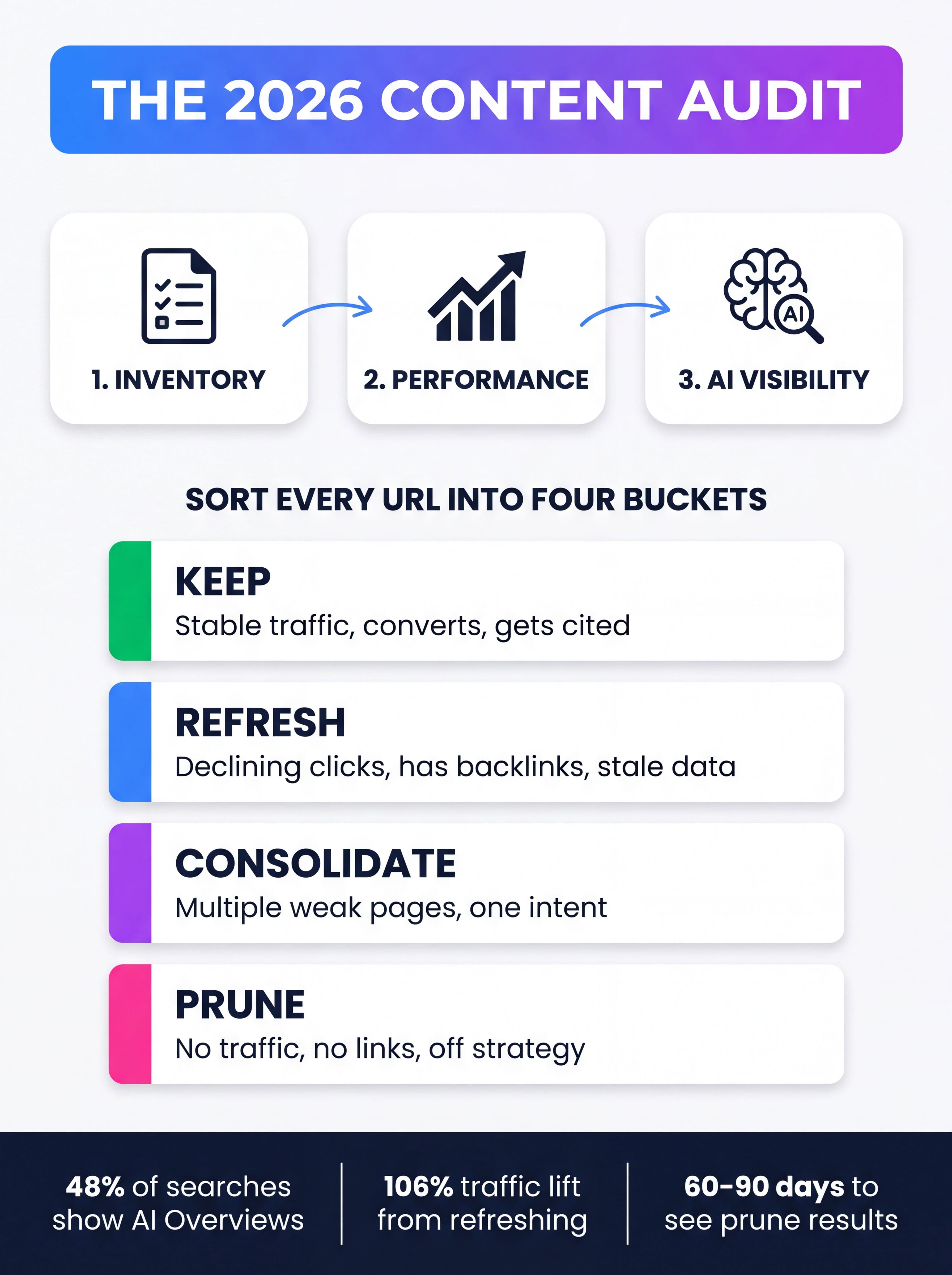
The 2026 content audit workflow: inventory, performance, AI visibility, then a single decision per URL.
Step 1: Build the Content Inventory
Start with a complete URL list. Incomplete inventories are the most common reason audits produce wrong conclusions, because the orphaned and forgotten pages are usually the ones dragging.
Pull from four sources and deduplicate:
- Your CMS export. The canonical list of what you meant to publish.
- An XML sitemap crawl. Catches what is actually being submitted to search engines.
- A full site crawl. Catches orphan pages that exist but are linked from nothing.
- Google Search Console page indexing report. Catches what Google knows about, including pages you forgot were live.
For each URL capture the flat facts: title, URL, publish date, last modified date, word count, primary topic or cluster, content type, author, and funnel stage. Topic and cluster assignment is worth the effort, because cannibalization only becomes visible when you can group pages by intent. If you have already done keyword clustering, reuse those clusters rather than inventing new labels.
Step 2: Layer On Performance Data
Join the inventory to twelve months of performance data. At minimum, pull the following per URL:
- Search Console: clicks, impressions, average position, and the trend over the last 12 months rather than a single snapshot.
- Analytics: sessions, engagement time, entrances, and assisted conversions.
- Conversions: signups, demo requests, or whatever your primary action is, attributed with the same model you use everywhere else.
- Backlinks: referring domains, since a page with links is almost never a prune candidate.
- Internal links in: a page with zero internal links pointing at it is either an orphan or an oversight.
Compute two derived fields that do most of the diagnostic work. Trend is the last 90 days of clicks versus the prior 90, which separates seasonal dips from real decay. Impression-to-click ratio change flags the specific 2026 failure mode: impressions flat or rising while clicks fall usually means an AI Overview or another SERP feature is intercepting the click, not that your page got worse.
Step 3: Add the AI Visibility Layer
This is the layer most audit templates still omit, and it is now the difference between an audit that reflects reality and one that describes 2021.
For your top 50 to 100 commercially important queries, run each through the engines your buyers actually use, which for most B2B teams means ChatGPT, Google AI Mode, Perplexity, and Gemini. Record three things per query:
- Are you cited at all? Binary, per engine. Do not average across engines at this stage, because the platforms disagree constantly.
- Which URL got cited? Frequently it is not the page you optimized. That mismatch is itself an audit finding.
- Where in the answer does the citation appear? A source referenced in the opening sentence carries different weight than one in a trailing list.
Two methodological rules keep this from becoming noise. Fix the prompt wording and never change it between runs, because a reworded prompt produces a new baseline rather than a trend. And treat this as a recurring measurement, not a one-off, since cited sources turn over by roughly 65% every two weeks. A single snapshot tells you almost nothing.
The payoff is measurable. Brands cited inside AI Overviews earn about 35% more organic clicks and 91% more paid clicks than uncited brands, which means citation share behaves like a genuine performance metric rather than a vanity one. Perplexity deserves specific attention for B2B: it accounts for only 15% to 20% of AI referral volume but delivers the highest ROI per citation of any platform. For the tooling side of this, see our breakdown of AI search visibility tools, and for the optimization tactics themselves, LLM SEO and answer engine optimization.
Step 4: Score and Sort Into Four Buckets
Every URL gets exactly one decision. Resist the urge to invent a fifth category called "monitor," which in practice means "do nothing."
| Bucket | Signals | Action | Typical share |
|---|---|---|---|
| Keep | Stable or growing traffic, converts, cited by at least one AI engine, no better page on the same topic | Leave it. Revisit next cycle. | 30% to 40% |
| Refresh | Declining clicks with intact impressions, ranks 4 to 20, has backlinks, topic still commercially relevant, facts stale | Rewrite substantively, update data, improve structure, republish | 10% to 20% |
| Consolidate | Two or more pages competing on one intent, each individually weak, combined they would be strong | Merge into the strongest URL, 301 the others, reconcile internal links | 10% to 15% |
| Prune | Near-zero traffic for 12 months, no conversions, no backlinks, off-strategy or permanently outdated | Delete and 410, or noindex if it serves another purpose | 20% to 30% |
A simple weighted score works better than intuition once you pass a few hundred URLs. Weight business value highest, then trend, then AI citation status, then link equity. The point of scoring is not precision, it is defensibility: when someone asks why their favorite article got pruned, the score answers instead of you.
Two guardrails. Any page with meaningful referring domains moves to refresh or consolidate, never prune, because you would be discarding link equity. And any page that an AI engine currently cites moves to keep or refresh regardless of its click numbers, since it is producing visibility that your analytics cannot see.
Step 5: Refresh What Deserves It
A refresh is not a date change. Republishing with a new timestamp and no substantive edit is the single most common way teams convince themselves they ran an audit.
A real refresh does most of the following:
- Replace every stale statistic with current data and cite the source year explicitly. AI engines lean on freshness signals, and an uncited 2021 figure is a liability in both directions.
- Rewrite the introduction to answer the query in the first 60 words. Extractable answers get quoted, buried answers do not.
- Restructure for parsing. Descriptive H2s phrased as the questions people ask, short paragraphs, and at least one comparison table give an engine something clean to lift.
- Add what competitors cover and you do not. Compare against the current top results, not the ones from when you first published.
- Fix the internal links in both directions, pointing new pages at this one and this one at your cluster hub.
- Update entity and schema signals so the page is unambiguous about who published it and what it is about. Our guide to entity SEO covers the specifics.
Order the refresh queue by expected return, not by how bad the page is. Pages ranking 4 to 15 with intact impressions move fastest, because they are already close. A page at position 60 usually needs a new page, not a refresh.
This is also where most teams hit a throughput wall. A 40-page refresh queue, each requiring current research, brand-consistent rewriting, and updated internal links, is a quarter of work at manual pace. This is the specific problem MarqOps was built for: Brand Intelligence DNA holds your voice, positioning, and terminology so refreshed pages come back on-brand from the first draft rather than after three review rounds, which is where the 6x content throughput figure actually comes from. See AI content optimization for the underlying workflow.
Step 6: Consolidate and Prune the Rest
Pruning is the step teams flinch at, and the evidence does not support the fear. Documented case studies cluster between +23% and +104% organic traffic gains after pruning. CNET removed hundreds of thousands of pages in 2024 and saw a 29% increase in search traffic. One agency reported a 64% revenue increase from a client's strategic blog content after pruning. Another documented clicks and impressions up 30% within weeks, and roughly double the top-three keyword count four months later.
What the case studies also show is a consistent 30-day dip in keyword footprint before recovery, with net positive outcomes landing inside 60 to 90 days. Tell stakeholders this before you start, because an unexplained dip in week three is how pruning programs get cancelled one week before they work.
Mechanically:
- Consolidate first, delete second. Merging two weak pages on one intent into a single strong one is almost always better than deleting both.
- Use 301 redirects for consolidation to the page that absorbed the content, and only where the topic genuinely matches. A redirect to an unrelated page is a soft 404.
- Use 410 rather than 404 for true deletions. It is an explicit signal that removal was intentional and speeds up de-indexing.
- Noindex instead of deleting when a page serves a real non-search purpose, such as a legal page or a sales enablement asset.
- Fix internal links before you ship. Every removed URL leaves inbound links behind, and chains of redirects are their own problem.
Consolidation has a strategic upside beyond cleanup: fewer, deeper pages per topic is exactly the shape that builds topical authority. Ten thin posts on adjacent questions compete with each other. One comprehensive page with ten well-structured sections does not.
Step 7: Measure the Outcome
Set the baseline before you touch anything, or you will spend the next quarter arguing about attribution. Capture, on the day the audit closes: total clicks and impressions, indexed page count, average position for tracked queries, conversions from content, and AI citation rate across your tracked prompt set.
Then measure on a schedule that matches how each metric behaves:
| Timeframe | What to expect |
|---|---|
| Days 1 to 30 | Keyword footprint dips if you pruned. Refreshed pages begin moving. Do not react yet. |
| Days 30 to 60 | Refreshed pages settle at new positions. AI citation changes start showing on re-runs. |
| Days 60 to 90 | Net traffic effect becomes readable. This is the honest evaluation point. |
| Days 90 and beyond | Conversion and pipeline effects. Compare against the pre-audit baseline, not against last month. |
Report the outcome in the same terms as the rest of your program rather than in audit-specific vocabulary. Traffic, conversions, and pipeline sourced are what the audit is ultimately accountable for, and our guide to marketing KPIs covers how those roll up.
Content Audit Tools and What Each One Covers
No single tool covers the full 2026 audit, which is precisely why the stack gets unwieldy.
| Layer | What you need | Common options |
|---|---|---|
| Inventory and crawl | Complete URL list, orphan detection, technical flags | Screaming Frog, Sitebulb, CMS export |
| Search performance | Clicks, impressions, position trend per URL | Google Search Console, Looker Studio |
| Engagement and conversion | Sessions, engagement time, assisted conversions | GA4, your CRM |
| Backlinks | Referring domains per URL | Ahrefs, Semrush, Moz |
| Keyword and cannibalization | Cluster mapping, overlapping intent | Semrush, Ahrefs, clustering tools |
| AI visibility | Citation tracking across ChatGPT, Perplexity, Gemini, AI Mode | Dedicated AI visibility platforms |
| Execution | Refresh production, brand consistency, publishing | Your CMS plus a content platform |
That is seven layers, and for most teams seven subscriptions with seven exports that get reconciled by hand in a spreadsheet nobody wants to own. Consolidating the analytics, SEO, AI visibility, and content production layers into a single system is the entire premise behind replacing 7+ disconnected tools with one platform, and it is the difference between an audit you run twice a year because it is painful and one you run quarterly because it is not. Our overview of the content supply chain covers how these layers connect.
How Often to Run a Content Audit
Survey data shows 33% of marketers audit twice a year, 24% annually, 21% three or more times a year, 6% every two to three years, and 16% never. Given a two-week AI citation churn cycle, the annual crowd is measuring a world that has turned over roughly 26 times since they last looked.
A more realistic 2026 cadence splits the work by weight:
- Monthly, lightweight. AI citation tracking on your core prompt set, plus a decay watchlist of your top 50 pages. An hour of work.
- Quarterly, medium. Full performance review, refresh queue for the next quarter, cannibalization check on any cluster you published into.
- Annually, full. Complete inventory, prune decisions, cluster restructuring, and strategy reset.
- Event-triggered. After every Google core update, and after any significant shift in your own positioning or pricing.
Site size adjusts this. Under 100 pages, the quarterly review can absorb the annual. Over 5,000, the full audit becomes a rolling program by section rather than a single project.
Six Mistakes That Waste an Audit
- Auditing traffic only. A page with 90 sessions that sources pipeline outranks a page with 9,000 sessions that sources nothing. Weight business value first.
- Treating a date change as a refresh. Engines are unimpressed and readers notice. Substantive edits or nothing.
- Pruning pages that have backlinks. Consolidate and redirect instead. You are throwing away the hardest asset to rebuild.
- Skipping the AI visibility layer. With citations increasingly sourced outside the top 10, a ranking-only audit is measuring a shrinking share of reality.
- Reacting to the 30-day dip. It is documented and expected. Set the expectation before you prune, not during.
- Producing findings with no owners. A row without a name and a date is a suggestion. Assign both at scoring time.
Frequently Asked Questions
What is a content audit?
A content audit is a systematic review of every page you have published, joined to performance data and scored so each URL receives an explicit decision: keep, refresh, consolidate, or prune. The deliverable is a prioritized action list with owners, not a report.
How long does a content audit take?
For a 200-page site, expect roughly one to two weeks for inventory, data joins, and scoring, then a rolling execution queue over the following quarter. Sites above 1,000 pages are better handled as a rolling program by section rather than a single project.
Should I delete old blog posts?
Delete only pages with no traffic, no conversions, and no backlinks for at least twelve months, where the topic is off-strategy or permanently outdated. Anything with link equity should be consolidated and redirected instead. Documented pruning case studies show +23% to +104% organic gains, typically after a roughly 30-day dip.
What is the difference between a content audit and a content inventory?
An inventory lists what exists and its attributes. An audit adds judgment: performance data, scoring, and a decision per URL. Inventory is a prerequisite step inside an audit, not a substitute for one.
How do I audit content for AI search visibility?
Take your top 50 to 100 commercial queries, run each through ChatGPT, Perplexity, Gemini, and Google AI Mode with fixed prompt wording, and record whether you are cited, which URL was cited, and where in the answer it appears. Re-run on a fixed schedule, because cited sources turn over by roughly 65% every two weeks.
How often should you do a content audit?
Run lightweight AI citation and decay checks monthly, a medium performance review quarterly, and a full inventory and prune annually, plus an event-triggered review after each Google core update. Most marketers currently audit twice a year, which is slower than the pace at which AI citations change.
Does refreshing old content actually work?
The evidence is strong. HubSpot attributes 76% of monthly blog views and 92% of blog-sourced leads to existing posts, and its optimization program produced a 106% traffic increase with more than double the leads. Republished pages move an average of 4.6 SERP positions, and updated posts convert 27% better than new posts on the same topic.
Where to Start
If your library is under 300 pages, block two days. Pull the inventory, join twelve months of Search Console data, run your top 50 queries through two AI engines, and score every URL into one of four buckets. You will typically find that 10% to 20% deserve a refresh, a similar share should be merged or removed, and the rest can be left alone until next quarter.
The pages you already own are the cheapest visibility you will ever buy. In an environment where engines prefer fresher sources and cite from further down the results than they used to, the audit is no longer cleanup work. It is how you stay in the answer.
Keep following the signal