GEO vs SEO in 2026: The Complete Guide to Winning Both Traditional and AI Search
SEO earns rankings; GEO earns citations in AI answers. Here is the 2026 data on both, how GEO works, and how to run one motion that wins traditional and AI search.
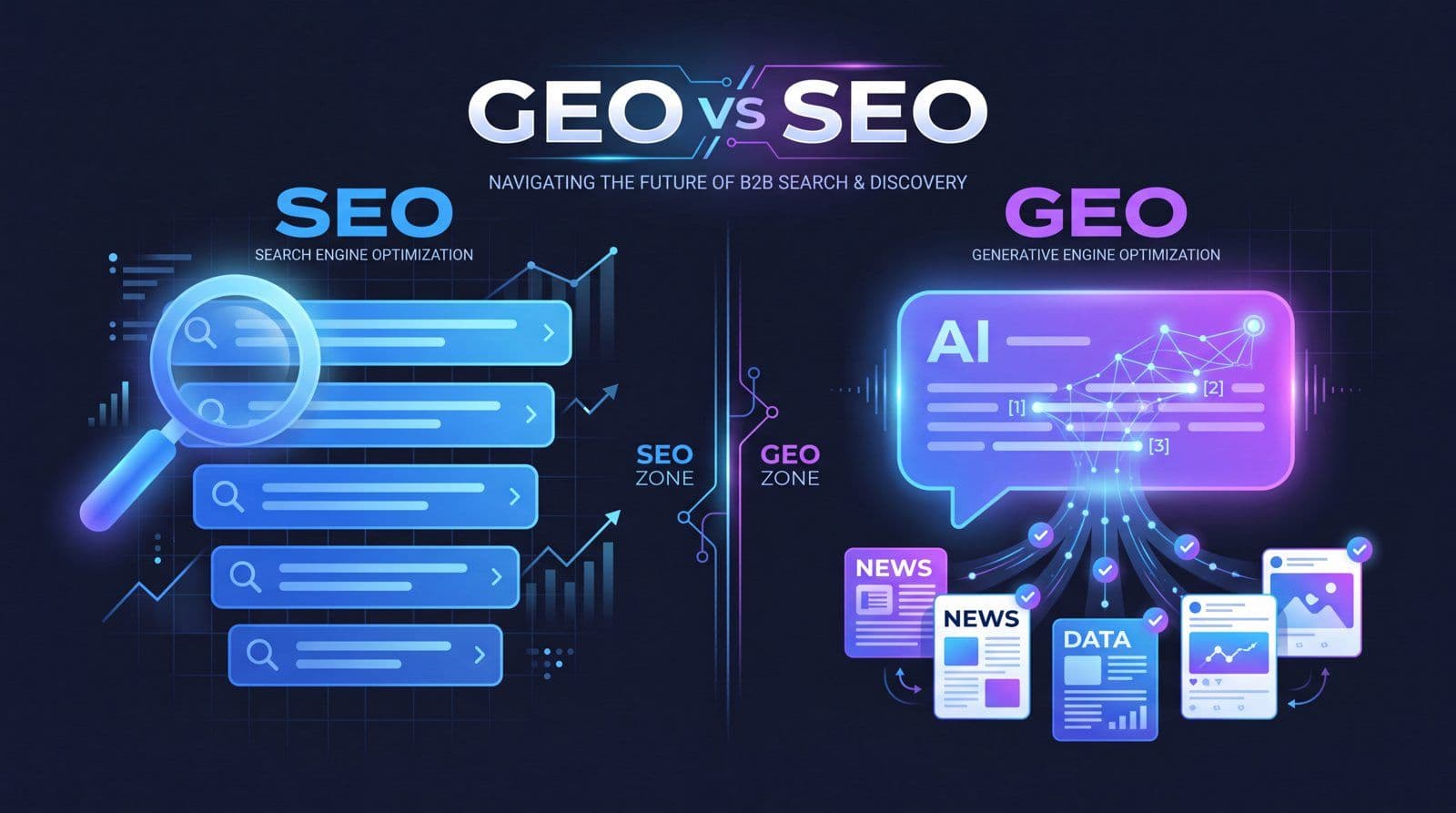
GEO vs SEO in 2026
TL;DR
- The GEO vs SEO debate is not about picking a winner. SEO optimizes for ranking positions in a list of links, while GEO (generative engine optimization) optimizes for being cited inside AI-generated answers from ChatGPT, Perplexity, Gemini, Claude, and Google AI Overviews.
- The ground has moved fast. In the first four months of 2026, 68% of Google searches ended without a click, AI Overviews now appear on more than 20% of searches, and the overlap between top Google links and AI-cited sources has collapsed from around 75% to as low as 17 to 38%.
- AI traffic is small but high-intent. Traditional organic search still sends roughly 345 times more visits than AI engines combined, yet AI referrals convert at 10 to 17% versus about 1.76% for Google organic.
- SEO and GEO share the same foundations. Authority, crawlability, structured data, and genuinely useful content feed both. The difference is in what you measure and how you structure content for extraction.
- The winning 2026 move is to run one motion that serves both, tracking rankings and AI citations side by side. MarqOps unifies SEO, content, and AI-visibility data in one dashboard so you stop optimizing for one channel at the expense of the other.
Table of Contents
- GEO vs SEO: What Each One Actually Means
- Why the Shift Is Happening Now: The 2026 Data
- SEO vs GEO vs AEO: The Full Comparison
- How GEO Actually Works
- Where Traditional SEO Still Wins
- Measuring Success: Rankings vs Citations
- The 2026 Playbook: Running SEO and GEO Together
- Common GEO vs SEO Mistakes to Avoid
- Unifying Search and AI Visibility With MarqOps
- Frequently Asked Questions
GEO vs SEO: What Each One Actually Means
The GEO vs SEO question has become the defining strategic debate in search this year, and most teams frame it wrong. It is not a choice between two competing channels. It is a question of how you want to be found as search itself splits into two surfaces: the classic list of blue links, and the AI-generated answer that increasingly sits on top of it.
Traditional search engine optimization (SEO) is the practice of structuring your site and content so it ranks well in the organic results of engines like Google and Bing. The goal is a high position in a list of links, and the payoff is the click that follows. Every tactic you know, from keyword targeting to backlinks to page speed, exists to move you up that list.
Generative engine optimization (GEO) is the practice of writing and structuring your content so that AI-powered engines cite your pages as a source inside the answers they generate. Instead of competing for a ranking slot, you are competing to be quoted by ChatGPT, Perplexity, Google AI Overviews, Gemini, and Claude when they compose a response. The success metric shifts from rank position to citation frequency: how often your brand shows up across the prompts your buyers actually ask.
Quick definition: SEO gets you into the list of results. GEO gets you into the answer written above the list. One earns rankings; the other earns citations. In 2026 you need both, because your audience is split across both surfaces.
The reason GEO vs SEO feels urgent is that the two now pull on content in slightly different directions. SEO has long rewarded pages built around a target keyword. Generative engines, by contrast, reward entity richness, factual density, clear structure, and natural language they can lift a clean sentence out of. Understanding that difference is the whole game, and it is why a dedicated generative engine optimization approach has become a line item in serious content budgets rather than an afterthought.
Why the Shift Is Happening Now: The 2026 Data
If GEO vs SEO felt like a fringe conversation a year ago, the numbers from early 2026 explain why it no longer is. Search behavior has changed faster than most content strategies have.
68%
of Google searches ended without a click in the first four months of 2026
That zero-click figure is up from 60.45% in 2024, and the driver is obvious. AI Overviews now appear on more than 20% of Google searches, and when they show up, click-through rates on the results below drop by nearly 60%. For queries that specifically trigger an AI Overview, the zero-click rate climbs to roughly 83%, compared with about 60% for queries without one. When an AI Overview is displayed, users click a cited source only about 1% of the time, because the answer already satisfied them.
The picture is even sharper inside Google’s dedicated AI Mode, where Semrush found that 93% of searches end without a click to an external site. AI Mode was still a small slice of total queries in early 2026, but Google said at its I/O event that AI Mode had surpassed one billion monthly users with query volume more than doubling each quarter. The direction of travel is not subtle.
Here is the part that should reorganize your content roadmap. The overlap between what ranks in Google’s top results and what AI engines cite has collapsed. One analysis put the overlap between top Google links and AI-cited sources at below 20%, down from around 70%. Others measured the overlap between Google’s top-10 organic results and AI citations crashing from roughly 75% in mid-2025 to somewhere between 17 and 38% in early 2026. Ahrefs found that 28.3% of ChatGPT’s most-cited pages have zero organic visibility in Google at all.
The takeaway from that overlap collapse: ranking number one on Google no longer guarantees you get cited by the AI answer sitting above it. You can win SEO and still be invisible in GEO, which is exactly why treating them as one combined practice matters.
None of this means SEO is dead. Traditional organic search still sends roughly 345 times more traffic than ChatGPT, Gemini, and Perplexity combined as of late 2025. The volume is still overwhelmingly on the classic search side. What has changed is quality of intent: AI referrals convert far better. ChatGPT traffic converts at around 14.2 to 15.9%, Perplexity near 10.5%, and Claude at up to 16.8%, against roughly 1.76% for Google organic. ChatGPT alone drives about 87.4% of all AI referral traffic. Small channel, high-value visitors.
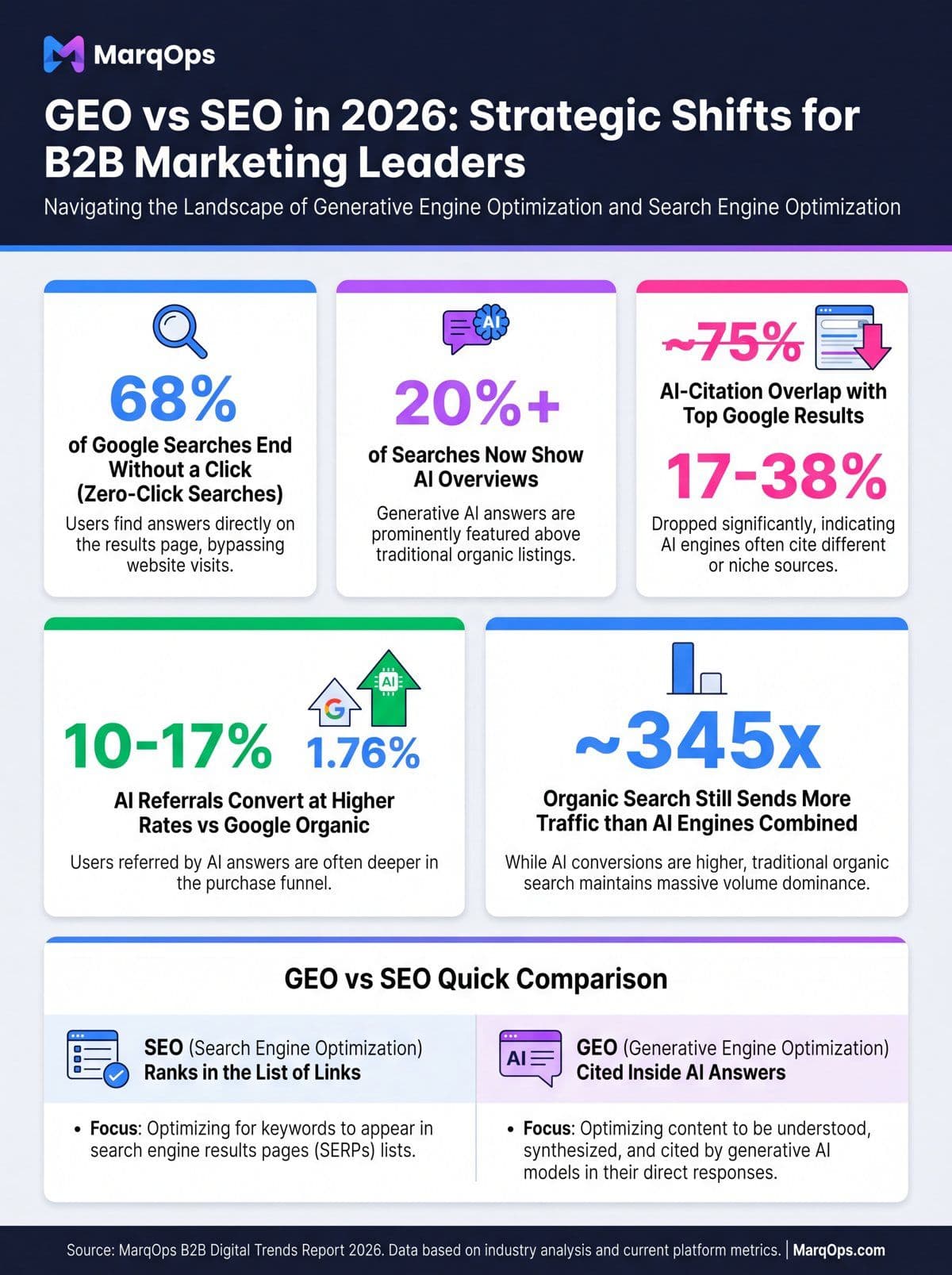
GEO vs SEO in 2026: how search behavior, citation overlap, and conversion rates have shifted.
SEO vs GEO vs AEO: The Full Comparison
Any honest GEO vs SEO discussion has to bring in a third acronym, because you will see it everywhere: AEO, or answer engine optimization. The short version is that SEO optimizes for rankings, AEO optimizes for answer selection, and GEO optimizes for AI citation. Here is how the three line up.
| Dimension | SEO | GEO | AEO |
|---|---|---|---|
| Optimizes for | Ranking position in the results list | Citation inside AI-generated answers | Selection as the direct answer or snippet |
| Primary surfaces | Google, Bing organic results | ChatGPT, Perplexity, Gemini, Claude | AI Overviews, featured snippets, voice |
| Success metric | Rank, organic clicks, sessions | Citation frequency, share of voice | Answer inclusion, snippet capture |
| Content bias | Keyword targeting, depth, backlinks | Entity richness, factual density, structure | Direct, concise, well-marked-up answers |
Here is the honest nuance that many guides skip: in practice, AEO and GEO describe almost the same goal, which is getting your brand cited or recommended in AI-generated answers. Some practitioners treat GEO as the content execution layer (structuring pages, schema markup, and factual density so AI can retrieve your content) and AEO as the broader discipline that adds brand monitoring, share-of-voice tracking, and third-party source influence. Others use the terms interchangeably. What matters for your GEO vs SEO strategy is not the label but the recognition that generative and answer engines rely on many of the same authority and relevance signals as traditional search. GEO and AEO enhance SEO rather than replace it. If you want to go deeper on the answer-box side, our guide to answer engine optimization breaks it down, and the mechanics of getting cited by large language models are covered in our LLM SEO playbook.
How GEO Actually Works
Once you accept that GEO vs SEO is really GEO plus SEO, the practical question becomes: what do you do differently to earn citations? Generative engines are not ranking pages so much as retrieving and synthesizing passages. That changes what good content looks like.
Write for extraction, not just for ranking. AI models pull clean, self-contained statements out of your content and stitch them into answers. Pages that lead with a clear, direct answer to a specific question, then support it with evidence, get cited more often than pages that bury the point under three paragraphs of throat-clearing. Structure helps enormously: descriptive headings, short definitional sentences, lists, and tables give models clean units to lift.
Feed entities, not keyword repetition. One of the clearest findings from GEO research is that simple keyword stuffing performs worse than baseline in generative engines. Models prefer natural language, entity richness, and topic depth over repeated exact-match phrases. That means naming the concepts, people, products, and relationships in your space explicitly and accurately, so the model builds a confident map of your expertise.
Earn factual density and citations. Generative engines favor content that includes specific statistics, named sources, quotes, and verifiable claims. Adding relevant data and citing credible sources measurably increases how often a page is referenced in AI answers. This is where solid AI content optimization pays off, because it forces the discipline of backing statements with evidence rather than assertion.
Keep the technical foundation clean. AI engines still crawl and parse the web. Structured data, fast load times, logical information architecture, and machine-readable markup all make your content easier for a model to retrieve and trust. Much of what you already do for technical SEO, from schema to crawlability, directly supports GEO. Google’s own guidance for AI features leans heavily on the same fundamentals that have always defined quality search content.
The encouraging news: roughly 80% of what earns AI citations is content you would build for good SEO anyway. GEO is less a new discipline than a new layer on top of the fundamentals, with a sharper focus on structure, evidence, and entities.
Where Traditional SEO Still Wins
It would be a mistake to read the GEO vs SEO data as a signal to abandon search. Several realities keep classic SEO essential in 2026 and beyond.
First, the raw volume. That 345-to-1 traffic advantage for organic search is not a rounding error; it is the bulk of how people still find information. Most commercial, navigational, and long-tail queries continue to happen in traditional search, and they still send clicks. Second, generative engines learn from the web they crawl. Content that ranks well and earns authority is disproportionately likely to be pulled into AI answers, which means strong SEO is often the on-ramp to strong GEO. Third, transactional and bottom-of-funnel intent still overwhelmingly resolves in classic search and on your own site, where programmatic SEO and well-optimized landing pages convert visitors who are ready to act.
The strategic error is not choosing SEO or GEO. It is assuming your top-ranking pages are automatically your top-cited pages, when the overlap data shows they increasingly are not. You have to check both, because the winners on each surface are drifting apart.
Measuring Success: Rankings vs Citations
The measurement gap is where most teams feel the GEO vs SEO tension most acutely. Your existing analytics were built for a world of rankings and clicks. AI visibility needs a different scoreboard.
On the SEO side, you keep tracking the familiar signals: keyword rankings, organic sessions, click-through rate, impressions, and conversions from organic traffic. These remain valid and important, and tools like a solid marketing dashboard keep them visible.
On the GEO side, you are measuring presence inside answers rather than position in a list. The core metrics are citation frequency (how often your brand or pages are referenced across a set of buyer prompts), share of voice against competitors within AI answers, sentiment and accuracy of how you are described, and referral traffic and conversions from AI engines. Tracking the last one requires watching for referral sources like chatgpt.com, perplexity.ai, and gemini.google.com in your analytics. Purpose-built AI search visibility tools and AI brand monitoring exist precisely because the old tools do not see this surface.
The practical problem is that these two scoreboards usually live in different tools, which makes it hard to answer a simple executive question: is our content winning across all of search, or just half of it? That fragmentation is the real cost of the GEO vs SEO split, and it is a measurement problem more than a strategy problem.
The 2026 Playbook: Running SEO and GEO Together
Here is a practical, unified approach that treats GEO vs SEO as a single motion rather than two competing budgets.
1. Start from one keyword and question map. Build your content plan around the real questions buyers ask, not just head keywords. The same research that surfaces ranking opportunities also surfaces the prompts people type into AI engines. Good AI keyword research tools increasingly capture both.
2. Write answer-first, evidence-backed content. Lead each section with a direct answer, support it with data and named sources, and structure it with clean headings, lists, and tables. This single change serves rankings and citations simultaneously. Pair it with a broader AI content strategy so structure and evidence are baked into every brief.
3. Keep the technical layer airtight. Schema markup, fast pages, clean architecture, and crawlability serve both surfaces. Do not let a technical gap quietly exclude you from AI retrieval.
4. Measure both scoreboards in one place. Track rankings and organic clicks next to citation frequency, AI share of voice, and AI referral conversions. Watching them together is the only way to spot the pages that rank but do not get cited, or vice versa.
5. Iterate on the gaps. When a page ranks but is not cited, tighten its structure and add evidence. When a page is cited but does not rank, strengthen its authority and internal links. Feed everything back into your AI marketing analytics loop so the next brief is smarter than the last.
Common GEO vs SEO Mistakes to Avoid
A few recurring errors trip up teams navigating the transition.
Treating them as either/or. The most expensive mistake is reallocating your whole budget to one surface. SEO still owns the volume; GEO owns a growing slice of high-intent discovery. You need coverage on both.
Assuming ranking equals citation. With the overlap between top rankings and AI citations down to as low as 17 to 38%, you cannot infer AI visibility from your ranking report. Measure citations directly.
Keyword-stuffing for AI. Since exact-match repetition performs worse than baseline in generative engines, porting old keyword-density habits into GEO actively hurts you. Write for entities and clarity instead.
Ignoring the measurement gap. If you never instrument AI referral traffic or citation share, you will underinvest in a channel that converts at 10 times the rate of organic. What you do not measure, you cannot defend at budget time. Broader context on this shift lives in our overview of generative AI in marketing.
Unifying Search and AI Visibility With MarqOps
The deepest lesson of the GEO vs SEO debate is that the strategy is straightforward but the execution fractures across tools. Your rankings live in one platform, your AI citations in another, your content workflow in a third, and your analytics in a fourth. That fragmentation is why so many teams optimize hard for one surface and lose the other by default.
MarqOps was built to close that gap. It brings SEO content, AI-visibility tracking, analytics, and creative into one brand-intelligent system, so you can see rankings and AI citations on the same screen and act on both from a single workflow. Instead of stitching together seven disconnected tools, your team works from one marketing intelligence platform that understands your brand and produces content structured to win in both traditional and AI search, at roughly six times the pace of a manual process.
GEO vs SEO is not a fork in the road. It is a widening of the road, and the teams that win in 2026 will be the ones that stop choosing between rankings and citations and start measuring and earning both from one place.
Frequently Asked Questions
What is the difference between GEO and SEO?
SEO (search engine optimization) structures your content to rank highly in the list of organic results on engines like Google and Bing, aiming for clicks. GEO (generative engine optimization) structures your content to be cited inside AI-generated answers from ChatGPT, Perplexity, Gemini, Claude, and Google AI Overviews. SEO competes for a ranking slot; GEO competes to be quoted in the answer. In 2026 you need both because audiences are split across both surfaces.
Is GEO replacing SEO in 2026?
No. Traditional organic search still sends roughly 345 times more traffic than ChatGPT, Gemini, and Perplexity combined, so SEO remains the volume engine. GEO is growing quickly and captures high-intent visitors who convert at 10 to 17% versus about 1.76% for Google organic, but it complements SEO rather than replacing it. Both rely on the same core signals of authority, structure, and useful content.
What is the difference between GEO, AEO, and SEO?
SEO optimizes for rankings in the results list. AEO (answer engine optimization) optimizes for being selected as the direct answer in AI Overviews, featured snippets, and voice results. GEO optimizes for being cited inside longer AI-generated responses from tools like ChatGPT and Perplexity. In practice AEO and GEO overlap heavily and are sometimes used interchangeably, since both aim to get your brand into AI answers using many of the same authority and structure signals as SEO.
Does ranking number one on Google mean AI engines will cite me?
Not anymore. The overlap between Google’s top organic results and the sources AI engines cite has fallen from around 75% in mid-2025 to as low as 17 to 38% in early 2026, and Ahrefs found that 28.3% of ChatGPT’s most-cited pages have no organic visibility in Google at all. You can rank first and still be absent from the AI answer, which is why you should measure citations directly rather than assuming rankings cover you.
How do I optimize content for GEO?
Write answer-first content that leads with a clear, self-contained response to a specific question, then support it with statistics and named sources. Favor entity richness and natural language over exact-match keyword repetition, since keyword stuffing performs worse than baseline in generative engines. Use clean structure with descriptive headings, lists, and tables, and keep your technical foundation, including schema markup and fast load times, solid so AI systems can retrieve and trust your content.
How do I measure GEO performance?
Track citation frequency across a set of buyer prompts, your share of voice against competitors inside AI answers, the sentiment and accuracy of how you are described, and referral traffic and conversions from sources like ChatGPT, Perplexity, and Gemini in your analytics. Because these metrics usually live in separate tools from your ranking data, a unified platform like MarqOps that shows rankings and AI citations together makes the combined picture far easier to act on.
Keep following the signal