AI Copywriting Tool Guide 2026: How Marketing Teams Write 6x Faster Without Losing Brand Voice
The complete 2026 guide to the AI copywriting tool – how it works, top platforms ranked, and how to use one without flattening your brand voice.
TL;DR
- An ai copywriting tool uses large language models plus brand voice training to generate ad copy, emails, landing pages, product descriptions, and blog drafts in seconds instead of hours.
- 87% of marketers now use generative AI in at least one workflow, and teams that adopted AI content tools produce 4.1x more published content per marketer per month.
- The leading ai copywriting tools in 2026 (Jasper, Copy.ai, Anyword, Writesonic, Rytr, and brand-intelligent platforms like MarqOps) have diverged hard. Pick by use case, not hype.
- Brand voice training is the difference between generic AI slop and copy that actually sounds like your company.
- The fastest-growing pattern: combining an ai copywriter with a unified marketing operations stack so the same brand DNA flows through ads, SEO content, and email.
Table of Contents
- What Is AI Copywriting and Why It Matters in 2026
- How an AI Copywriting Tool Actually Works
- The Market Data: Adoption, ROI, and the 4.1x Output Curve
- Best AI Copywriting Tools in 2026 (Ranked by Use Case)
- Jasper AI Copywriting vs Copy.ai: The Head-to-Head
- The Brand Voice Problem and How to Solve It
- High-Impact Use Cases for AI Marketing Copywriting
- How to Choose the Best AI for Copywriting for Your Team
- Building a Production Workflow Around Your AI Copywriter
- FAQs
What Is AI Copywriting and Why It Matters in 2026
An ai copywriting tool is software that uses large language models, prompt engineering, and (in the good ones) brand voice training to generate marketing copy on demand. You give it a brief. It gives you ad headlines, email subject lines, landing page hero sections, product descriptions, social captions, or a 1,500-word blog draft. Minutes, not days.
So what is ai copywriting in practice? It is not a robot replacing your writers. It is a system that compresses the blank page problem, handles the 70% of copy that is repetitive (variant testing, localization, channel adaptation), and frees humans to do the 30% that actually moves the brand forward. The best teams treat it like a junior copywriter who never sleeps, never complains, and needs editing every time.
If you are still hand-writing every Google ad variant or rewriting every email for each segment, you are burning calendar on work an ai copywriter does in thirty seconds. The question in 2026 is not whether to use AI copywriting, it is which ai copywriting tools to trust with your brand.
For a wider view of how this fits into your overall stack, our guide to the best AI marketing tools in 2026 covers the adjacent categories (analytics, paid, creative, SEO) you will want to integrate with your ai copywriter.
How an AI Copywriting Tool Actually Works
Under the hood, every modern ai copywriting tool sits on top of a foundation model (GPT-5, Claude 4, Gemini 2.5, or a blend) and wraps it with three layers that turn a generic chatbot into a marketing-grade writer.
Layer 1: Task-Specific Templates
Instead of making you write a prompt from scratch, the tool exposes pre-built templates for common copy jobs. Meta ad, Google RSA, AIDA landing page, cold outbound email, product description, TikTok hook. Each template is a purpose-built prompt under the hood, tuned for that format’s length, tone, and conversion patterns.
Layer 2: Brand Voice Training
This is where good AI copywriting tools separate from toys. You feed the system 5-20 samples of your existing copy. It extracts tone markers, sentence rhythm, vocabulary preferences, banned words, and signature phrases. Every subsequent output is generated with that voice embedded in the system prompt. Jasper pioneered this. Every serious ai copywriter now has some version of it, though quality varies wildly.
Layer 3: Performance Feedback Loops
The 2026 wave of tools closes the loop between copy and conversion. Platforms like Anyword score every variant for predicted performance before you publish. Others pipe ad-level CTR data back in to fine-tune what the model generates next. This is how you get ad CTR lifts of 38% and CPC reductions of 32% reported in recent benchmarks.
4.1x
more published content per marketer per month after AI copywriting adoption
The Market Data: Adoption, ROI, and the 4.1x Output Curve
Let’s ground this in numbers. The 2026 state of AI in marketing is no longer a forecast, it is a baseline.
- 87% of marketers use generative AI in at least one workflow in 2026, up from 51% in 2024. (Source: 2026 state-of-AI-marketing surveys.)
- 91% of marketing professionals actively use AI tools, up from 63% a year prior.
- Content production tools specifically have hit 68.9% penetration inside marketing orgs.
- The global market for AI-assisted copywriting sits at an estimated $6.3B in 2025 and is projected at $19.2B by 2030 (24.5% CAGR).
- AI copywriting tools drive an average 38% lift in ad CTR and 32% reduction in CPC in controlled tests.
- Teams that adopted AI content tools now produce 4.1x more published content per marketer per month. Content marketing output lifts to 4.6x, social to 3.8x, email to 2.9x.
The caveat: the share of marketers who can prove AI ROI dropped from 49% to 41%. Adoption is near-universal. Measurement is lagging. This is exactly why predictive marketing analytics has become the co-requisite skill to AI content ops.
Best AI Copywriting Tools in 2026 (Ranked by Use Case)
There is no single “best ai copywriting tool” anymore. The category has fragmented by use case. Here is how the leaders stack up in 2026.
1. Jasper – Best for Enterprise Brand-Consistent Long Form
Jasper has gone all-in on enterprise brand management and multi-channel campaigns. Its brand voice training is best-in-class. Feed it 10-20 samples, it maps tone and vocabulary, and every subsequent output lands close to your real voice. Jasper Pro runs $69/month. Jasper ai copywriting is the default choice for teams shipping long-form blogs, thought leadership, and campaigns where brand voice cannot drift.
2. Copy.ai – Best for Sales and GTM Workflow Automation
Copy.ai pivoted hard toward sales and go-to-market automation. Its 2026 product is less about “write my ad” and more about “automate my outbound sequence + landing page + follow-up cadence end-to-end.” Pro tier is $49/month. Strong for short-form, weaker for long-form blog content than Jasper.
3. Anyword – Best for Predictive Ad Performance Scoring
Anyword’s differentiator is scoring every copy variant for predicted conversion before it ships. If your team runs a lot of paid media, the data-driven scoring plan ($79-99/month) pays for itself the first week. Pair it with our AI Max Google Ads guide to understand how Google’s own AI is scoring the same variants.
4. Writesonic – Best Balanced Generalist
Writesonic covers blog drafting, ad copy, product descriptions, and SEO briefs at a reasonable $29-49/month. Not best-in-class at any one thing, but solid across the board for mid-market teams.
5. Rytr – Best Free and Entry-Level AI Copywriter
Rytr remains the pragmatic starter. Generous free tier, 40+ templates, decent quality for short-form copy. It is the gateway drug most marketers try before upgrading. For a wider free-tier roundup, see our best free AI writing tools guide.
6. Copy Matic, QuillBot AI Copywriter, and the Long Tail
The tail of the market is crowded. Copymatic, QuillBot, SeedProd’s built-in writer, Canva’s Magic Write, and a dozen others all do the basics. The differentiation above them is brand voice depth, workflow automation, and performance feedback. Anything that does not offer at least one of those three is a commodity.
7. Unified Platforms – MarqOps and the Brand-Intelligent Approach
The newest pattern in 2026 is unified platforms that include ai marketing copywriting as one feature inside a broader marketing operations suite. MarqOps, for example, ships copy generation alongside analytics, ads, SEO content, and creative under one Brand Intelligence DNA. The pitch: you stop re-training six tools on your brand voice because the brand lives at the platform layer. One platform replaces 7+ disconnected point tools. For teams tired of the copywriting tool plus a separate social tool plus a separate ad tool plus a separate SEO tool tax, this is the direction of travel.
Quick rule of thumb: If you ship a lot of long-form and care about brand voice, start with Jasper. If your revenue comes from paid ads, start with Anyword. If you are drowning in tool sprawl and want copywriting inside one marketing OS, look at unified platforms like MarqOps.
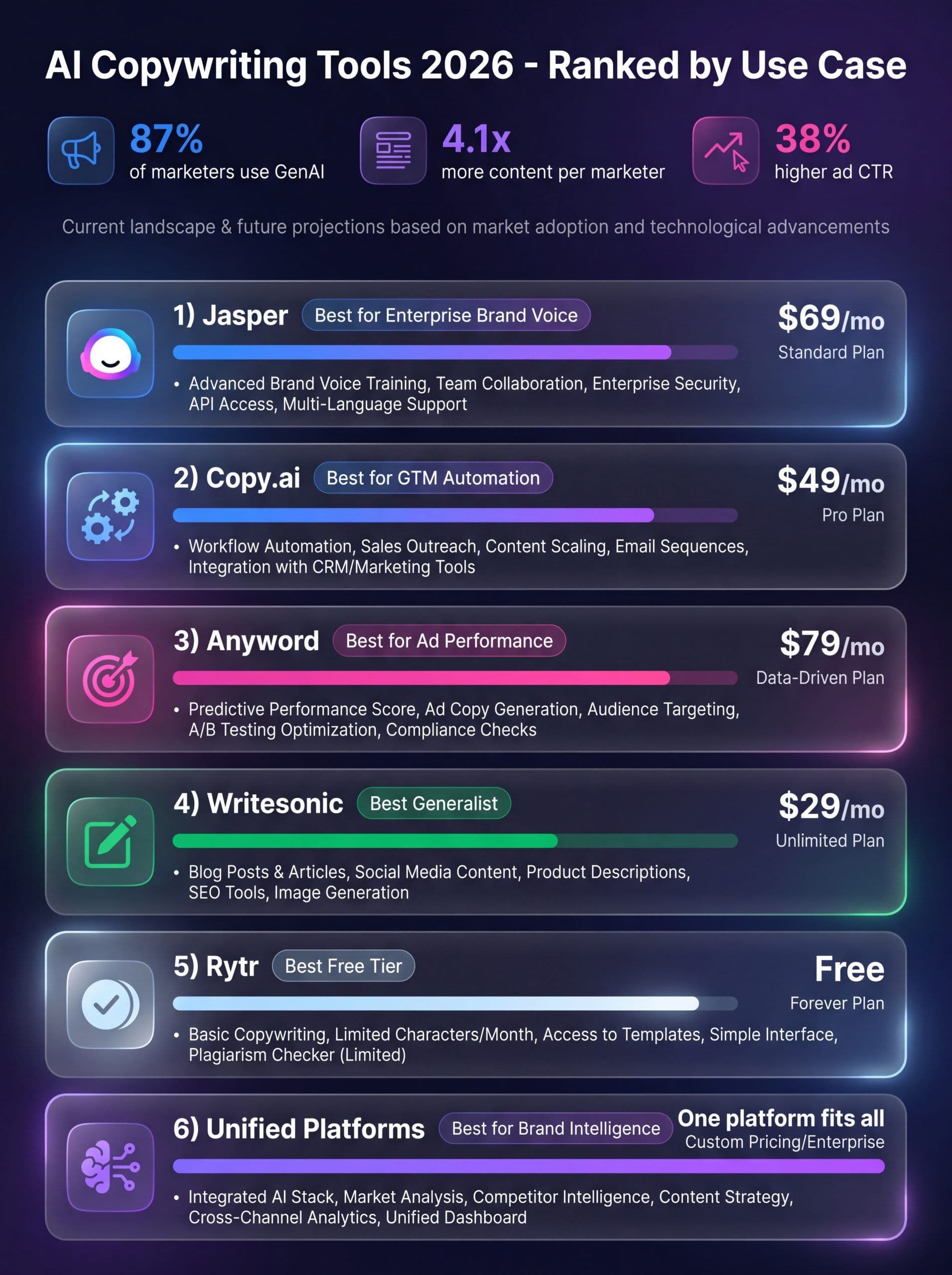
How the top AI copywriting tools in 2026 compare across brand voice, use case, and pricing.
Jasper AI Copywriting vs Copy.ai: The Head-to-Head
This is the most-asked comparison in the category, so it deserves a dedicated section.
Where Jasper Wins
Jasper ai copywriting is stronger for long-form content, brand voice fidelity, and enterprise governance. If you care about a blog post still sounding like your company after 2,000 words, Jasper’s brand voice engine holds up better across document length. Its SEO mode, Boss Mode, and team workspace features make it the obvious choice for content-heavy orgs.
Where Copy.ai Wins
Copy.ai wins for short-form speed and GTM automation. The 2026 Copy.ai workflow builder lets you chain prompts: research the prospect, write the cold email, adapt it to LinkedIn DM format, draft the follow-up sequence, push to your CRM. That workflow orchestration is ahead of Jasper’s product today.
The Real Answer
Most teams running both agree: Jasper for content marketing and brand-heavy work, Copy.ai for sales and GTM. If you must pick one, pick by where your revenue actually comes from. Content-led SaaS with a blog engine? Jasper. Outbound-led sales motion? Copy.ai. Paid-heavy e-commerce? Skip them both and go to Anyword.
The Brand Voice Problem and How to Solve It
The single biggest complaint about AI copywriting tools in 2026 is “it all sounds the same.” And mostly, it does. A generic prompt into a generic model produces generic copy. That flat, hedge-everything, LinkedIn-y tone is what marketers mean when they say “AI slop.”
The fix is mechanical, not creative.
- Write or collect 10-20 samples of your best existing copy. Ad hero lines, landing page above-the-fold, a few emails, a few social posts. Diverse formats, consistent voice.
- Train the tool’s brand voice feature with those samples. Do not skip this. Every tool that has this feature lifts from “generic” to “close to us” the moment you feed it real examples.
- Define banned words and phrases. The cliches you hate. “In today’s fast-paced world.” “Unlock.” “Delve.” “Game-changer.” Blacklist them.
- Edit every output. Not rewrite. Edit. The 70/30 rule: AI gets you 70% of the way, you close the last 30% that carries the voice.
- Tie copy generation to brand guidelines at the platform level. This is why brand-intelligent platforms are beating point tools. If your brand DNA lives at the platform, every asset inherits it: the ad, the SEO content, the email, the landing page.
For deeper strategy on how content, voice, and positioning tie together, our AI content strategy guide walks through the full operating system behind AI-assisted content production.
High-Impact Use Cases for AI Marketing Copywriting
Where does an ai copywriter actually earn its keep? The highest-ROI use cases in 2026:
Paid Ad Variant Generation
Generate 20-50 headline and description variants per campaign, test them programmatically, let the platform’s ML sort winners. Pairs perfectly with Performance Max campaigns, which demand high asset volume to function.
Email Subject Line and Body Variants
Every send now has 3-5 subject line variants tested on a 10% split before the main batch. An ai copywriting tool generates those variants in seconds. Our roundup of the best AI email marketing tools shows how this plugs in.
Landing Page Hero and CTA Testing
Generate five hero variants against one control, run the split test for two weeks, lock in the winner. A pattern that has lifted conversion rates 15-25% in teams running it consistently. Related reading: best free AI landing page generators.
Social Media Caption and Post Generation
Batch-generate a month of captions aligned to your content calendar. Edit, schedule, move on. See the best AI social media post generators for the dedicated tools in this layer.
SEO Content Drafts at Scale
Brief-to-draft in 10 minutes instead of 10 hours. The editor still owns the final version. Output can 10x without quality collapse if the briefs are strong and editing is real.
Ad Creative Copy
The copy that sits inside your visuals. Pair an ai copywriting tool with AI ad generators so the copy and the creative are born together, on-brand.
How to Choose the Best AI for Copywriting for Your Team
A short, honest framework for picking the best ai for copywriting in your specific context.
- What do you write the most? Long-form blogs = Jasper. Short ad copy = Anyword or Copy.ai. Outbound emails = Copy.ai. Mixed = Writesonic or unified platforms.
- How protective is your brand voice? If the answer is “very,” brand voice depth is the deciding feature. Jasper and MarqOps-style unified platforms lead here.
- How many tools do you already pay for? If you have five content tools and are frustrated with context-switching, a unified platform that bundles copywriting with analytics, ads, SEO, and creative is worth evaluating. One platform replaces 7+ point tools.
- Do you run paid media? If yes, predictive performance scoring (Anyword) is non-negotiable.
- What’s your budget? Free tier teams should start with Rytr or the free plan of our recommended generalists. Enterprise teams should skip the free tier and buy on capability, not price.
Building a Production Workflow Around Your AI Copywriter
Owning an ai copywriting tool is not a strategy. Building a workflow around it is. The teams getting 6x content output are not doing it by buying Jasper. They are doing it by rewiring how copy moves from brief to publish.
The Modern AI Copy Workflow
- Brief – Structured brief from SEO tool or strategist. Target keyword, audience, angle, word count, internal links.
- Draft – AI copywriter generates a first draft against the brief + brand voice.
- Edit – Human editor tightens, adds original insight, fact-checks, strengthens voice.
- Optimize – SEO tool scores the draft. AI rewrites weak sections.
- Approve – Brand or legal review if the category demands it.
- Publish – Push to CMS, distribute across channels, adapt copy for each channel via AI.
- Measure – Feed conversion data back into the system. Next brief reflects what worked.
This is where AI agents for marketing start to matter. An agentic system chains those steps and runs the orchestration layer so humans stay in the editing and strategy roles. It is also why AI in marketing automation and AI copywriting are converging into the same stack.
The honest takeaway: An AI copywriting tool is not magic. It is a forcing function to rebuild your content workflow. Teams that treat it as a plug-and-play typewriter get mediocre results. Teams that redesign brief -> draft -> edit -> measure get the 6x lift.
Frequently Asked Questions
What is an AI copywriting tool and how is it different from ChatGPT?
An ai copywriting tool is purpose-built for marketing copy with templates, brand voice training, workflow automation, and performance feedback. ChatGPT is a general assistant. You can copy-paste prompts into ChatGPT and get decent copy, but an ai copywriter keeps your brand voice consistent, integrates with ad platforms and CMSs, and scales across a team with governance.
Which is the best ai copywriting tool for small businesses in 2026?
For small teams, Rytr (free to $9/month) or Writesonic ($29-49/month) offer the best value. Jasper is overkill unless you are shipping daily long-form content. The best ai for copywriting for your business depends on whether you write more ads, emails, or blog content.
Is Jasper AI copywriting worth the price in 2026?
For enterprise and content-heavy teams, yes. Jasper’s brand voice training is still the strongest in the category, and its governance features (team workspaces, brand books, SOC 2) justify the $69/month tier. For solo marketers or small startups, cheaper alternatives like Writesonic or Copy.ai deliver 80% of the value.
Can an AI copywriting tool match my brand voice?
Yes, but only if you train it properly. Feed the tool 10-20 samples of your best existing copy, define banned words, and edit every output. Without that setup, any ai copywriting tool produces generic output. With it, the top tools can land 70-85% close to your voice on first draft.
How do AI copywriting tools impact SEO and search rankings?
Google does not penalize AI content by default. It penalizes low-quality content regardless of source. AI-assisted content that is edited, adds original insight, and maps to search intent ranks fine. Pair your ai copywriter with strong AI SEO tools to build briefs, validate keyword coverage, and optimize for AI search engines.
Will AI copywriting tools replace human copywriters?
No. They are changing what human copywriters do. The best copywriters in 2026 own strategy, voice, brand positioning, and final judgment. An ai copywriter handles the first 70% so humans can focus on the 30% that actually differentiates the brand. Teams that use AI well ship more work and keep their writers.
The Bottom Line
An ai copywriting tool is no longer a competitive advantage. Not using one is a competitive disadvantage. But owning a tool without rebuilding your workflow, training its brand voice, and connecting it to your analytics stack will give you mediocre results and a new subscription bill.
The teams shipping 6x more content at higher quality in 2026 have done three things: picked the right tool for their actual use case, invested in brand voice training, and integrated copywriting into a unified marketing operations stack so the same brand DNA flows through every asset they publish.
That last piece is where the category is heading. Standalone AI copywriting tools will still exist, but the teams with the biggest lift are the ones running brand-intelligent platforms that handle copywriting, analytics, SEO, ads, and creative under one system. If you are still wiring six point tools together with glue and duct tape, the 2026 unified platform approach is worth a serious look.
Keep following the signal