AI Overviews in 2026: How to Win Citations When Google Answers Before the Click
AI Overviews now appear on 48% of Google searches. Here is the 2026 data on click-through impact, the six factors that get you cited, and a seven-step playbook to rank in AI Overviews.
TL;DR
- AI Overviews now appear on roughly 48% of Google searches (February 2026), up about 58% year over year, across 200 countries and 40 languages. They are no longer an experiment. They are the default search experience. [Primary source: Google Search Central: AI features and your website]
- They quietly reroute your traffic. AI Overviews cut organic click-through rates by 34 to 61%, position-one CTR drops around 58% when an Overview appears, and zero-click searches climbed past 68% in early 2026. Many sites lost 20 to 40% of search traffic.
- But getting cited is a growth channel. Brands cited inside an AI Overview earn 35% more organic clicks and 91% more paid clicks than uncited competitors on the same results page.
- The unit of optimization is the passage, not the page. Self-contained answers of roughly 134 to 167 words, high semantic completeness, real E-E-A-T signals, and clean schema are what win citations. A page ranking #4 with one excellent paragraph can beat the #1 result for the cite. [Primary source: Google Search: optimizing for generative AI features]
- MarqOps unifies brand-consistent content, SEO, analytics, and AI visibility tracking in one platform, so you can produce cite-worthy content at 6x speed and watch which pages Google actually pulls into its answers.
Table of Contents
- What Are AI Overviews (and Why 2026 Is the Tipping Point)
- The Data: How AI Overviews Reshaped Search Traffic
- How AI Overviews Actually Pick Their Sources
- The 6 Factors That Get You Cited
- The Practical Playbook: How to Rank in AI Overviews
- How to Measure AI Overview Visibility
- Where MarqOps Fits
- Frequently Asked Questions
What Are AI Overviews (and Why 2026 Is the Tipping Point)
An AI Overview is the AI-generated answer box that sits at the top of many Google search results, above the traditional blue links. Instead of asking you to click through and read, Google synthesizes an answer from multiple sources, cites a handful of them, and hands the searcher a finished response in place.
For years marketers treated this as a fringe feature worth watching. That window has closed. As of February 2026, AI Overviews appear on roughly 48% of all Google searches, an increase of about 58% year over year, and they now show up in 200 countries and 40 languages. When nearly half of every query your audience types returns an AI answer first, “wait and see” is no longer a strategy. This is the same shift that made answer engine optimization and LLM SEO move from niche experiments to core marketing disciplines.
The important mental shift is this: AI Overviews are not a competitor to search. They are search now. Your job is no longer only to rank a page. It is to get a specific passage of that page selected, quoted, and credited inside the answer itself.
Think of the AI Overview as a citation economy layered on top of classic SEO. Ranking gets you eligible. Being quotable gets you cited. And being cited is where the remaining clicks now concentrate.
The Data: How AI Overviews Reshaped Search Traffic
The numbers behind this shift are stark, and they explain why so many marketing teams saw unexplained traffic drops through late 2025 and into 2026.
Click-through rates are falling fast
Multiple field studies converge on the same conclusion: when an AI Overview appears, fewer people click anything below it. Overall, AI Overviews reduce organic click-through rates somewhere between 34% and 61% depending on query type. The drop is sharpest at the very top. Position-one CTR falls roughly 58% when an Overview is present, up from a 34.5% drop measured back in April 2025. One large field study found AI Overviews cut outbound organic clicks by 38% on the queries they trigger.
68%
of Google searches ended without a click in the first four months of 2026
Zero-click is the new normal
In the first four months of 2026, about 68% of Google searches ended without a single click to the open web. Independent analysis from SparkToro reached a similar verdict: less than one third of Google searches now send a click to a non-Google property. For triggered queries specifically, zero-click behavior jumped from roughly 54% to 72% once an Overview was present.
The publisher impact followed directly. Since AI Overviews rolled out broadly, many websites reported search traffic declines in the 20 to 40% range, and smaller sites without strong brand authority absorbed the worst of it.
The counterintuitive upside: citations pay
Here is the part most doom-and-gloom coverage skips. Getting cited inside an AI Overview is measurably good for business. Brands quoted inside the Overview earn 35% more organic clicks and 91% more paid clicks than comparable brands that are not cited on the same results page.
The strategic takeaway is not “AI Overviews are killing traffic.” It is “the clicks that remain are concentrating around the cited few.” The goal is to be one of them. Winning that placement is exactly what generative engine optimization is built for.
How AI Overviews Actually Pick Their Sources
To optimize for AI Overviews, you have to understand what Google’s system is doing under the hood. It is not scoring whole pages the way classic ranking does. It is scanning for extractable, trustworthy passages that completely answer a sub-question, then stitching them into a synthesized response.
Three mechanics matter most:
1. The passage is the unit, not the page. The system evaluates cite-worthy passages, not entire URLs. That is why a page ranking #4 with one outstanding, self-contained paragraph can win the citation while the #1 page does not. Research shows the sweet spot for an extractable answer is roughly 134 to 167 words that fully resolve the question on their own, with no dependency on surrounding context.
2. Semantic completeness is the strongest signal. Across studies, semantic completeness, meaning how thoroughly a passage covers the entities, sub-questions, and context of a topic, shows the highest correlation with citation (around r=0.87). Content scoring 8.5 or higher out of 10 on semantic completeness is about 4.2 times more likely to be cited. Thin, keyword-stuffed content does not make the cut.
3. Traditional ranking is still the gate. AI Overviews are not a separate index. Roughly 76% of AI Overview citations come from pages already ranking in the top 10 organic results. Structured data and clever formatting cannot rescue a page that does not rank. This is why the relationship between GEO and SEO is complementary, not either-or. You still need the SEO foundation, then you layer citation optimization on top.
Rule of thumb: rank in the top 10, then make one paragraph so complete and quotable that the model would be lazy not to use it.
The 6 Factors That Get You Cited
Pulling the 2026 research together, six factors consistently separate content that gets cited from content that gets ignored.
1. Semantic completeness
Answer the full question and its obvious follow-ups in one place. Cover the entities and sub-topics a knowledgeable reader would expect. This is the single highest-correlation factor, so it deserves the most attention. Strong AI content optimization starts here.
2. Verifiable E-E-A-T
Experience, Expertise, Authoritativeness, and Trustworthiness correlate strongly with citation (around r=0.81), and roughly 96% of AI Overview content comes from sources with verified E-E-A-T signals. In practice that means named authors with real credentials and a cross-domain footprint, a clearly identified publishing organization, and inline citations to primary sources rather than to other marketing blogs.
3. Extractable structure
Use question-based headings, clear definitions up front, short self-contained paragraphs, and logical formatting. The easier it is for the model to lift a clean answer, the more likely it is to do so. Tables, ordered lists, and direct-answer intros all help.
4. Schema markup (with nuance)
Pages with valid Article, FAQPage, HowTo, Author, and Organization schema appear in citation chips at a higher rate, and attribute-rich schema pushes citation rates to about 61.7% versus 41.6% for generic implementations. The honest caveat: a large Ahrefs study found that adding schema alone produced no major citation uplift. The correlation is largely because authoritative sites already maintain clean structured data. So use schema, but treat it as table stakes, not a magic lever.
5. Freshness
AI engines bias toward recently updated content. A page modified last month frequently outperforms one last touched two years ago, even for evergreen queries. A disciplined refresh cadence is now a ranking input, not just hygiene.
6. Original data and first-hand insight
Models prefer sources that add something new. Original research, proprietary benchmarks, survey results, and first-hand case studies get cited more than content that restates what everyone else already published. If you sit on unique data, publishing it is one of the highest-leverage moves available. This pairs naturally with a strong first-party data strategy.
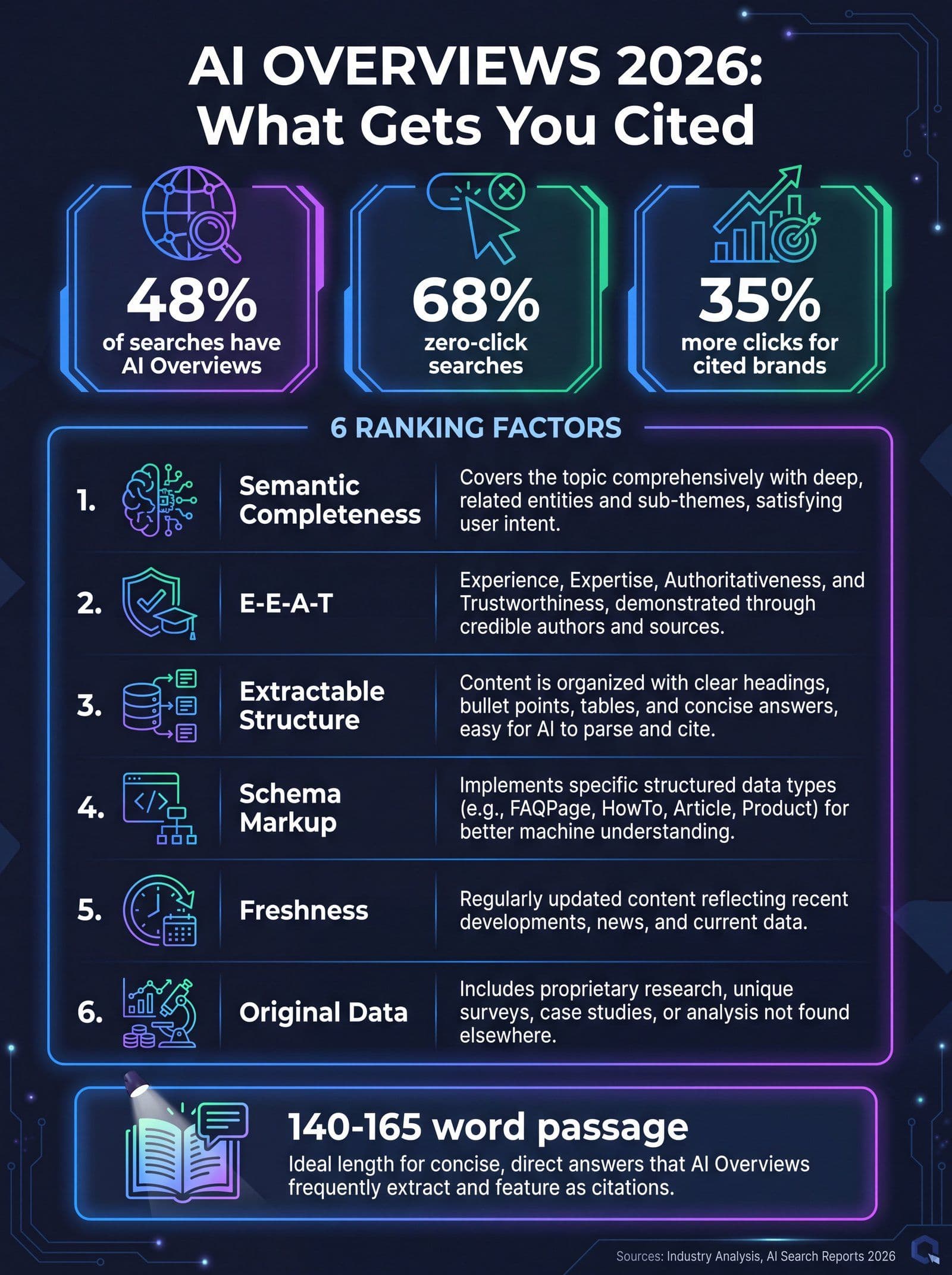
The six factors that earn AI Overview citations, and why zero-click search changed the math.
The Practical Playbook: How to Rank in AI Overviews
Frameworks are useful, but you need a repeatable process. Here is a seven-step playbook a marketing team can run this quarter.
Step 1: Find the queries that trigger Overviews
Not every keyword triggers an AI Overview. Informational, comparison, and “how to” queries do most often. Audit your priority keywords and flag which ones already surface an Overview. Those are your battleground. Transactional and branded terms are usually safer ground where classic SEO still wins the click.
Step 2: Confirm you rank in the top 10 first
Since about three quarters of citations come from top-10 results, any keyword where you rank #15 needs classic SEO work before citation optimization is even worth attempting. Prioritize pages sitting at positions 4 through 10, where a citation is realistically within reach. The right AI SEO tools make this triage far faster.
Step 3: Engineer one cite-worthy passage per target question
For each question you want to own, write a single self-contained paragraph of roughly 140 to 165 words that answers it completely, leads with a direct definition or answer, and needs no surrounding context. Place it directly under a question-formatted heading. This is the passage you are asking Google to lift.
Step 4: Add depth around the answer
Surround that passage with the sub-questions, examples, and context that signal semantic completeness. Cover the topic more thoroughly than competitors, then link the sub-topics together so the page reads as a genuine authority hub rather than a thin snippet farm. A well-run content supply chain makes this depth repeatable across dozens of pages.
Step 5: Strengthen trust signals
Attach a credentialed, named author with a real bio. Add Organization and Author schema. Cite primary sources inline. Make sure your brand has a consistent, verifiable presence off-site, because AI systems cross-check authority. Consistent, on-brand publishing at scale is easier when your AI brand voice is codified once and applied everywhere.
Step 6: Add clean structured data
Implement Article, FAQPage, HowTo, Author, and Organization schema where relevant, with rich, accurate attributes. Remember it is table stakes rather than a shortcut, so do not expect schema alone to carry a weak page.
Step 7: Refresh on a schedule and measure
Set a recurring refresh cadence for priority pages so freshness signals stay strong, and track which pages Google is actually citing so you can double down on what works. Continuous measurement closes the loop, and AI marketing analytics turns that tracking into a repeatable growth system.
Field note: teams that treat AI Overview optimization as an add-on to their existing SEO workflow, rather than a separate project, ship far faster. The winning content is 80% great SEO and 20% citation engineering.
How to Measure AI Overview Visibility
You cannot improve what you cannot see, and AI Overviews are harder to track than blue-link rankings. Classic rank tracking tells you where you sit in organic results, but it does not tell you whether Google quoted you in the answer box. Three metrics matter now:
Citation share. Of the queries you care about that trigger an Overview, on what percentage does your brand appear as a cited source? This is your new share-of-voice metric for AI search.
Presence versus absence. Track which of your ranking pages get pulled into Overviews and which get skipped despite ranking well. The skipped ones are your optimization backlog. Pairing this with AI brand monitoring shows you not just Google but how ChatGPT, Perplexity, and Gemini represent your brand too.
Downstream behavior. Because cited brands see 35% more clicks, watch whether pages that win citations show a corresponding lift in qualified traffic and conversions. That connects AI visibility to revenue instead of leaving it as a vanity metric.
The uncomfortable truth: most legacy SEO dashboards were built for a ten-blue-links world. Measuring AI Overview visibility requires tooling designed for the citation economy, ideally sitting in the same place as your content and analytics so you are not stitching another tab into an already fragmented stack.
Where MarqOps Fits
Here is the practical problem. Winning AI Overview citations touches content production, SEO, structured data, brand consistency, and analytics all at once. In a typical stack, that means a writing tool, an SEO platform, a schema plugin, a brand-guidelines doc, a rank tracker, and an analytics suite, none of which talk to each other. The average marketing team is stitching together more than seven disconnected tools, and that fragmentation is exactly why cite-worthy content is so slow to ship.
MarqOps collapses that into one brand-intelligent platform. Its Brand Intelligence DNA means content comes out on-brand from the first draft, so the E-E-A-T and consistency signals AI systems reward are baked in rather than bolted on. The unified dashboard puts content creation, SEO, ad management, and analytics in one place, so you are not tab-switching between the tool that writes the passage and the tool that tells you whether Google cited it.
Because the AI content and SEO operations run through a single multi-model pipeline, teams produce cite-worthy, semantically complete content roughly 6x faster than a manual, multi-tool workflow allows. And since visibility tracking lives alongside production, the loop from “publish a stronger passage” to “see whether it earned the citation” closes inside one system instead of across six. That is the difference between reacting to AI Overviews and systematically winning them.
Start Free – No Card RequiredSee How MarqOps Works
Frequently Asked Questions
What are Google AI Overviews?
Google AI Overviews are AI-generated answer boxes that appear at the top of many search results, above the traditional links. Google synthesizes an answer from multiple web sources, cites a few of them, and gives the searcher a finished response in place. As of early 2026 they appear on about 48% of Google searches across 200 countries and 40 languages, making them the default search experience for nearly half of all queries.
Do AI Overviews hurt my website traffic?
They can. AI Overviews reduce organic click-through rates by 34 to 61%, and zero-click searches rose past 68% in early 2026, with many sites losing 20 to 40% of search traffic. However, brands that get cited inside an Overview earn 35% more organic clicks and 91% more paid clicks than uncited competitors. So the remaining clicks concentrate around cited sources, which makes earning a citation the priority rather than avoiding AI Overviews.
How do I get my content cited in an AI Overview?
First, rank in the top 10 organic results, since roughly 76% of citations come from there. Then engineer a self-contained passage of about 140 to 165 words that completely answers a specific question under a question-formatted heading. Reinforce it with strong semantic completeness, verifiable E-E-A-T signals such as a named credentialed author and Organization schema, clean structured data, a regular refresh cadence, and original data or first-hand insight the model cannot find elsewhere.
Does schema markup guarantee an AI Overview citation?
No. Attribute-rich schema correlates with higher citation rates (about 61.7% versus 41.6% for generic schema), but a large Ahrefs study found that adding schema alone produced no meaningful citation uplift. The correlation exists mostly because authoritative sites already maintain clean structured data. Treat Article, FAQPage, HowTo, Author, and Organization schema as table stakes that support strong content, not as a standalone shortcut to citations.
Is optimizing for AI Overviews different from SEO?
It builds on SEO rather than replacing it. Classic SEO still gets you into the top 10, which is the gate for citation. On top of that, AI Overview optimization focuses on the passage rather than the page, prioritizing self-contained answers, semantic completeness, and trust signals so the model selects and quotes you. Think of it as roughly 80% strong SEO and 20% citation engineering, which is closely related to generative engine optimization and answer engine optimization.
Keep following the signal
Related field notes
Marketing Operations
Marketing Project Management Software in 2026: How to Choose Without Adding Tool #122
11 min readMarketing Analytics
Marketing Attribution Software in 2026: The Buyer's Guide for a Stack That Won't Stop Growing
11 min readMarketing Operations