Content Supply Chain in 2026: The Complete Guide for Marketing Teams
What a content supply chain is, why most are broken in 2026, the six core stages, and how to build an AI-powered, brand-consistent system that ships content faster.
TL;DR
- A content supply chain is the connected system your team uses to plan, create, review, distribute, and measure content – from first idea to performance report.
- Content demand has at least doubled for 88% of marketers in two years, and enterprise content volume is projected to hit 155 exabytes by 2026, up from 47 exabytes in 2021. Most supply chains were never built for this.
- 94% of marketers plan to use AI for content creation in 2026, and AI has already cut content production costs by up to 68% for enterprise teams.
- The fix is not more tools. It is fewer, connected ones – a unified workflow where strategy, creation, brand governance, distribution, and analytics live in one place.
- MarqOps replaces 7+ disconnected tools with one brand-intelligent platform, helping teams produce content up to 6x faster without losing brand consistency.
Table of Contents
- What Is a Content Supply Chain?
- Why Most Content Supply Chains Are Broken in 2026
- The 6 Stages of a Modern Content Supply Chain
- How AI Is Rewiring the Content Supply Chain
- How to Build an AI-Powered Content Supply Chain
- Metrics That Prove It Is Working
- Common Mistakes to Avoid
- Frequently Asked Questions
What Is a Content Supply Chain?
A content supply chain is the end-to-end system your organization uses to plan, produce, approve, distribute, and measure content. Think of it the way a manufacturer thinks about getting a physical product from raw material to the shelf. The “raw material” is an idea or a brief. The “finished goods” are the blog posts, ads, emails, landing pages, social clips, and product pages your audience actually sees. Everything in between – the people, the tools, the approvals, the handoffs – is the supply chain.
For years, marketing teams treated content as a series of one-off projects. Someone wrote a brief, someone designed an asset, someone else posted it, and a fourth person tried to figure out later whether it worked. That model is quietly collapsing. The volume, speed, and personalization that modern channels demand have turned content from a craft into an operations problem. And operations problems need systems, not heroics.
This is why “content supply chain” has become one of the most talked-about phrases in marketing operations. It reframes content as a flow that can be designed, measured, and improved – the same discipline you would apply to your marketing operations overall. When the flow is healthy, content moves quickly and stays on brand. When it is broken, deadlines slip, quality drops, and your best people spend their time chasing approvals instead of doing creative work.
Simple definition: A content supply chain is how an idea becomes published, performing content – and how every team, tool, and approval connects along the way.
Why Most Content Supply Chains Are Broken in 2026
Here is the uncomfortable truth: most content supply chains were never built for the load they now carry. They grew organically, one tool and one workaround at a time, until the whole thing started buckling under the weight of real-time personalization, an explosion of formats, and new AI-driven channels that did not exist a few years ago.
The numbers tell the story. Nearly 88% of marketers say content demand has at least doubled in the last two years, and 85% feel direct pressure to deliver faster. At the enterprise level, the scale is staggering: content volume is projected to reach 155 exabytes by 2026, up from just 47 exabytes in 2021. Audiences now expect tailored content across more touchpoints than any team can manually keep up with.
70%
of a marketer’s time is spent on non-core tasks because of fragmented workflows
That fragmentation is the root cause. When your strategy lives in one tool, your briefs in another, your creative in a third, your approvals in email, your publishing in a CMS, and your analytics somewhere else entirely, every handoff becomes a chance for delays, version confusion, and off-brand output. The result is predictable: more than 8 out of 10 marketing teams report missing an opportunity in the last quarter simply because they could not respond in time.
The instinct is usually to buy another tool. But adding software to a broken process just adds another seam where things tear. The teams winning in 2026 are doing the opposite – consolidating their marketing tech stack so that fewer systems do more of the work, with less friction between them.
The 6 Stages of a Modern Content Supply Chain
Every content supply chain, whether you have named it or not, moves through six core stages. Mapping yours against this model is the fastest way to spot where work gets stuck.
1. Planning and Ideation
This is where strategy meets the calendar. You decide what to create, for whom, on which channels, and why. Strong planning ties every asset back to a business goal and an audience need, which is exactly what a clear AI content strategy is built to do. Skip this stage and you produce content that is busy but not useful.
2. Creation and Production
Writing, design, video, and multimedia all happen here. This is the most visible stage and historically the biggest bottleneck, because it depends on specialized people and time. It is also where AI has made the largest dent, with AI copywriting tools and creative automation now handling drafts, variations, and resizing at machine speed.
3. Review and Approval
Content has to meet quality and brand standards before it ships. This stage is where most timelines actually die – not in creation, but in the back-and-forth of feedback, legal checks, and stakeholder sign-off. Standardizing how reviews happen, and who is responsible for what, removes more delay than almost any other fix.
4. Asset Management
Approved content needs a home where teams can find, reuse, and adapt it. Without a single source of truth, people recreate assets that already exist or accidentally ship outdated versions. Good asset management is also what makes content repurposing possible, so one strong asset becomes ten.
5. Distribution and Publishing
This is the moment content reaches the audience across owned, earned, and paid channels. The challenge in 2026 is the sheer number of destinations, each with its own format and timing. Workflow automation is what keeps multi-channel publishing from turning into a manual copy-paste nightmare.
6. Measurement and Optimization
The loop closes when performance data flows back into planning. Creative analytics show which formats, messages, and channels actually drive results, so the next cycle starts smarter than the last. A supply chain without this feedback loop is just a content factory running blind.
A healthy content supply chain is a loop, not a line. Measurement feeds planning, and the whole system gets smarter with every cycle.
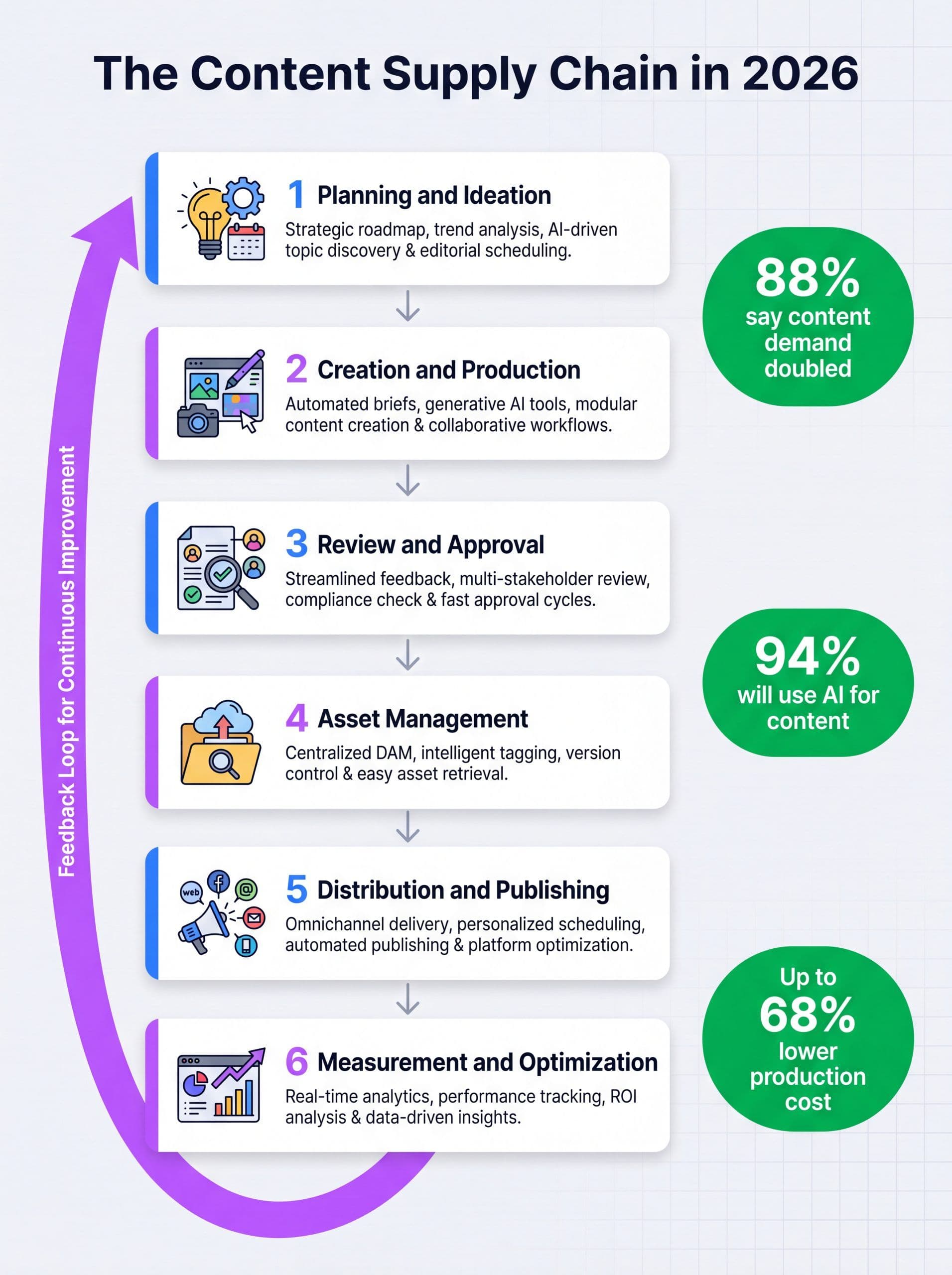
The six stages of a modern, AI-powered content supply chain.
How AI Is Rewiring the Content Supply Chain
AI is not a single feature bolted onto one stage. It is becoming the connective tissue across the entire supply chain, and the adoption curve is nearly vertical. In 2026, 94% of marketers plan to use AI for content creation, and the global AI content generation market is forecast to grow from roughly $6 billion in 2026 to $45 billion by 2033, a compound annual growth rate of about 35%.
The payoff is already measurable. AI adoption has cut content production costs by up to 68% for enterprise users, and a similar share of businesses report higher content ROI after introducing AI into their workflows. But the gains are not evenly distributed. The teams seeing the biggest results are not the ones using AI to write faster in isolation. They are the ones using AI to connect stages that used to be disconnected.
Consider what that looks like in practice. AI can take a strategic brief and generate on-brand drafts across formats. It can resize and adapt a single asset for every channel automatically. It can flag off-brand language before a human ever reviews it, and it can surface the performance patterns that should shape the next campaign. This is the difference between using generative AI in marketing as a novelty and using it as infrastructure.
The maturity gap is the opportunity. AI usage is everywhere, but the operational discipline to turn it into consistent performance is still rare – which means teams that get the system right now will pull ahead fast.
There is a catch worth naming. More AI output means more content moving through review, distribution, and measurement. If those downstream stages are still manual, AI just creates a faster bottleneck. That is why brand governance matters more than ever. Tools that understand your brand – your voice, your visual rules, your messaging – keep quality intact at scale. This is the idea behind AI brand voice: the model produces brand-perfect output from the start, instead of forcing humans to fix it later.
How to Build an AI-Powered Content Supply Chain
You do not need to rip everything out and start over. A modern content supply chain is built in deliberate steps, each one reducing friction in the flow.
Step 1: Map your current flow
Before you fix anything, draw it. Document how content actually moves today, from request to published. Note every tool, every handoff, and every place work waits. Most teams are shocked by how many seams they find. The waiting points, not the working points, are where you will recover the most time.
Step 2: Consolidate your tools
Every tool boundary is a handoff, and every handoff is a delay. The single highest-leverage move is reducing the number of systems content has to cross. This is the core promise of an AI-powered marketing platform: one connected environment for strategy, creation, brand control, distribution, and analytics instead of seven disconnected ones.
Step 3: Encode your brand once
Brand consistency cannot depend on people remembering the rules. Capture your voice, visual identity, and messaging as a reusable layer that every asset inherits automatically. MarqOps calls this Brand Intelligence DNA – a way to make brand-perfect output the default, not a manual checkpoint at the end.
Step 4: Automate the predictable work
Resizing, reformatting, routing for approval, scheduling, and reporting are all rules-based tasks. Automate them so your people spend their time on judgment and creativity, not logistics. This is where workflow automation pays for itself fastest.
Step 5: Close the loop with analytics
Wire performance data back into planning so every cycle is informed by the last. Pair distribution with AI content optimization so assets keep improving after they ship, not just before.
Metrics That Prove It Is Working
A content supply chain is only as good as what it produces, so measure the flow, not just the output. The metrics below tell you whether your system is actually getting healthier.
Cycle time. How long does an asset take from request to published? This is the single clearest measure of supply chain health. As you remove handoffs, this number should drop sharply. Teams that consolidate often see content move up to 6x faster.
Throughput. How many quality assets does your team ship per cycle without adding headcount? Rising throughput at flat cost is the clearest sign your system, not just your people, is doing more.
Brand consistency rate. What percentage of assets pass brand review on the first try? When brand is encoded into the system, this climbs toward 100% and review time collapses.
Reuse rate. How often is existing content repurposed instead of rebuilt? Higher reuse means your asset management is working and your team is not wasting effort recreating what already exists.
Content ROI. Only 41% of marketers actively measure content ROI, which is a huge gap given that content marketing generates roughly 3x more leads than outbound at 62% lower cost. Tie content back to pipeline and revenue, and you turn the supply chain from a cost center into a growth engine.
Common Mistakes to Avoid
Buying tools instead of fixing flow. Adding software to a broken process creates more seams, not fewer. Fix the workflow first, then choose tools that consolidate rather than fragment.
Treating AI as a writing shortcut only. If you speed up creation but leave review, distribution, and measurement manual, you just relocate the bottleneck. AI should connect stages, not accelerate one in isolation.
Leaving brand to chance. More content at higher speed means more chances to drift off brand. Encode brand rules into the system so consistency scales automatically.
Ignoring the feedback loop. A supply chain without measurement is a factory running blind. If performance data does not flow back into planning, you repeat the same mistakes faster.
Optimizing one team, not the whole chain. Cross-departmental collaboration is a top-three challenge for content teams. A local fix in one team rarely helps if the handoffs to other teams stay broken.
Ready to fix your content supply chain?
MarqOps replaces 7+ disconnected tools with one brand-intelligent platform – so your team ships on-brand content up to 6x faster from a single unified dashboard.
Frequently Asked Questions
What is a content supply chain in simple terms?
It is the connected system that takes content from an idea all the way to a published, performing asset. It includes every person, tool, approval, and handoff involved in planning, creating, reviewing, distributing, and measuring content.
Why does the content supply chain matter in 2026?
Content demand has at least doubled for 88% of marketers in two years, and enterprise content volume is heading toward 155 exabytes by 2026. Manual, fragmented workflows cannot keep up, so the supply chain is now the difference between shipping on time and missing the moment.
How does AI improve the content supply chain?
AI connects stages that used to be disconnected. It generates on-brand drafts, adapts assets across channels, flags off-brand output before review, and surfaces performance patterns. Enterprise teams have cut content production costs by up to 68% using AI in their workflows.
What are the stages of a content supply chain?
Six core stages: planning and ideation, creation and production, review and approval, asset management, distribution and publishing, and measurement and optimization. A healthy chain runs as a loop, with measurement feeding back into planning.
How is a content supply chain different from a content strategy?
Strategy decides what content to make and why. The supply chain is how that content actually gets made, approved, shipped, and measured. You need both – strategy without a working supply chain stays stuck on the whiteboard.
Keep following the signal