Brand Compliance in 2026: The Three-Layer Review Every Marketing Team Needs
Brand compliance used to mean the logo was the right one. In 2026 it has three layers: does the asset look right, is the claim inside it true, and is AI involvement disclosed where the law now requires it. Around 95% of companies have brand guidelines and only 25% enforce them. Here is the pass, flag, or block review that closes the gap, plus what the EU AI Act and the FTC changed this year.

Ask ten marketing teams what brand compliance means and you will get roughly the same answer: the logo is the right one, the colours match the palette, nobody stretched the wordmark. That definition was adequate when a small number of designers made a small number of assets and a brand manager could eyeball the lot on a Friday afternoon.
It is not adequate now. A mid-sized agency running four clients through generative tooling can produce more creative variants in a week than it used to produce in a quarter. The volume broke the eyeball method, and then 2026 added something the eyeball method was never designed to catch: statements inside the asset that may not be true, and AI involvement that in several jurisdictions now has to be declared.
This guide covers what brand compliance means once you account for all three, why the guidelines document you already wrote is not doing the work you think it is, and how to build a review that a client, a regulator, or a nervous general counsel could actually inspect.
Contents
- What brand compliance actually means in 2026
- The enforcement gap: guidelines exist, compliance does not
- The three layers of brand compliance
- Layer three is new: what changed in 2026
- Build the review: pass, flag, block
- A brand compliance checklist you can run this week
- Where tools help and where they quietly do not
- Agencies carry the client's risk, not just their own
- Five ways brand compliance fails without anyone noticing
- Where MarqOps fits
- Frequently asked questions
- The bottom line
What brand compliance actually means in 2026
Brand compliance is the practice of confirming that every asset leaving your organisation matches the standards your brand has committed to, before anyone outside sees it. The important word is confirming. A guideline is a statement of intent. Compliance is the evidence that the intent was met on this specific asset, on this specific day.
Most teams have the first half and not the second. They can show you a beautifully typeset brand guidelines document with colour values, clear space rules, and a tone of voice section. What they cannot show you is a record proving that last Tuesday's carousel was checked against it, by whom, and what the check found.
That distinction matters more every year because the number of assets keeps climbing while the number of people qualified to review them does not. Somewhere in that gap, compliance stops being a process and becomes a hope.
The enforcement gap: guidelines exist, compliance does not
The data on this is unusually consistent, and unusually bleak. Around 95% of companies have brand guidelines, but only about 25% actively enforce them. Only around 30% of organisations have guidelines that are widely used or recognised internally, which means the majority of the documents that do exist are effectively shelfware. Roughly 77% of brands admit to publishing off-brand content at least occasionally, and about 81% of organisations say they are still dealing with off-brand content despite having guidelines in place.
The cost is not abstract. Consistent brand presentation is associated with revenue increases in the 10% to 20% range, and about a third of businesses report consistency lifting revenue by 20% or more. On the other side of the ledger, senior professionals at mid-sized and large businesses estimate that poor brand consistency costs their companies more than $6 million a year in lost revenue, and roughly 46% of enterprises report wasting budget recreating assets they already owned but could not find or trust.
| What teams believe | What the data shows |
|---|---|
| We have brand guidelines, so we are covered | 95% have guidelines. Around 25% enforce them. Having the document is the common case, not the differentiator. |
| Off-brand work is rare and obvious | About 81% of organisations report ongoing off-brand content, and 77% of brands admit publishing it at least occasionally. |
| Consistency is a nice-to-have | Consistent presentation tracks with 10% to 20% revenue gains, and inconsistency is estimated to cost mid-to-large businesses over $6 million annually. |
| Our asset library keeps us efficient | Around 46% of enterprises report budget wasted recreating assets because of poor asset management and retrieval. |
| AI made this easier | Over 70% of marketers have already encountered an AI-related issue including off-brand output, while fewer than 35% plan to increase governance investment this year. |
Read that last row twice. It is the whole problem in one line. Output volume went up, the failure rate is already visible to the people producing the work, and investment in catching failures is not moving. That is not a tooling gap. It is a process gap that tooling alone will not close.
The three layers of brand compliance
Splitting compliance into layers is useful because each one fails differently, is caught by different people, and carries a different consequence when it escapes. Most organisations run layer one properly, run layer two informally, and until this year did not run layer three at all.
Layer one: visual and verbal compliance
Does the asset use approved logo lock-ups, palette values, type, spacing, imagery style, and tone of voice? This is what brand guidelines describe and what brand compliance software checks. It is the most automatable layer and the least dangerous when it slips, and it overlaps heavily with the checks in any serious AI content optimization workflow. An off-palette blue is embarrassing and dilutive over time, but nobody gets sued for it.
Tone of voice belongs here too, and it is the part teams most often leave to instinct. If your brand voice is defined precisely enough for a generative model to follow it, it is defined precisely enough to check against. If it is a paragraph of adjectives, it is not really a standard and no review can enforce it.
Layer two: claim compliance
Is every factual statement inside the asset true, current, and traceable to a source? This is the layer almost nobody formally runs, and it is where the real damage lives. A social post citing a customer result, an ad naming a percentage improvement, a case study describing an outcome: each is a claim, and each needs a source that a stranger could check.
Generative tooling made this layer urgent rather than optional, and it is the reason generative AI in marketing needs a review step that older creative workflows never had. A model asked to write persuasive copy will produce persuasive copy, and persuasive copy contains numbers. Those numbers are plausible by construction and sourced by nobody. The same discipline that keeps a client report defensible applies to creative: sort each claim into verified, needs context, or unsupported, and do not ship the unsupported ones.
Layer three: disclosure compliance
Where AI was used to generate or materially alter the asset, is that disclosed in the way the relevant jurisdiction requires, and is any required machine-readable marking present? Until 2026 this was a reputational judgement call. It is now, in several jurisdictions, a legal duty with a number attached.
Layer three is new: what changed in 2026
Four regulatory developments landed close enough together that many marketing teams have not yet mapped them onto their own workflow. None of them are aimed at marketers specifically. All of them apply to marketing output.
| Development | What it requires | Exposure |
|---|---|---|
| EU AI Act, Article 50 (in force 2 August 2026) | Disclosure when people interact directly with an AI system, plus clear labelling and machine-readable marking of AI-generated or manipulated content. A transitional window runs to 2 December 2026 for generative systems already on the market. | Up to 15 million euro or 3% of worldwide annual turnover, whichever is higher. |
| FTC AI enforcement unit (established January 2026) | Sponsored content involving AI generally needs both the sponsorship and the AI involvement disclosed. Claims about AI capability must be backed by competent and reliable evidence. | Up to $53,088 per violation. |
| California metadata requirement | Invisible provenance metadata on AI-created content. | State enforcement, applies to content distributed into the state. |
| New York performer disclosure | Disclosure of AI-generated performers appearing in advertising. | State enforcement, applies to ads running in the state. |
Two practical notes on the EU rule, because they are frequently misread. Content generated and published before 2 August 2026 does not need retroactive labelling. And the obligations attach from that date regardless of when the system was placed on the market, so "we bought this tool in 2024" is not a defence.
The operational consequence is smaller than the legal language suggests, but it is real: you now need to know, for every asset, whether AI was materially involved in producing it. Not roughly. Per asset. If your content supply chain does not record that fact at the point of creation, reconstructing it later is guesswork, and guesswork is exactly what a disclosure regime is designed to punish.
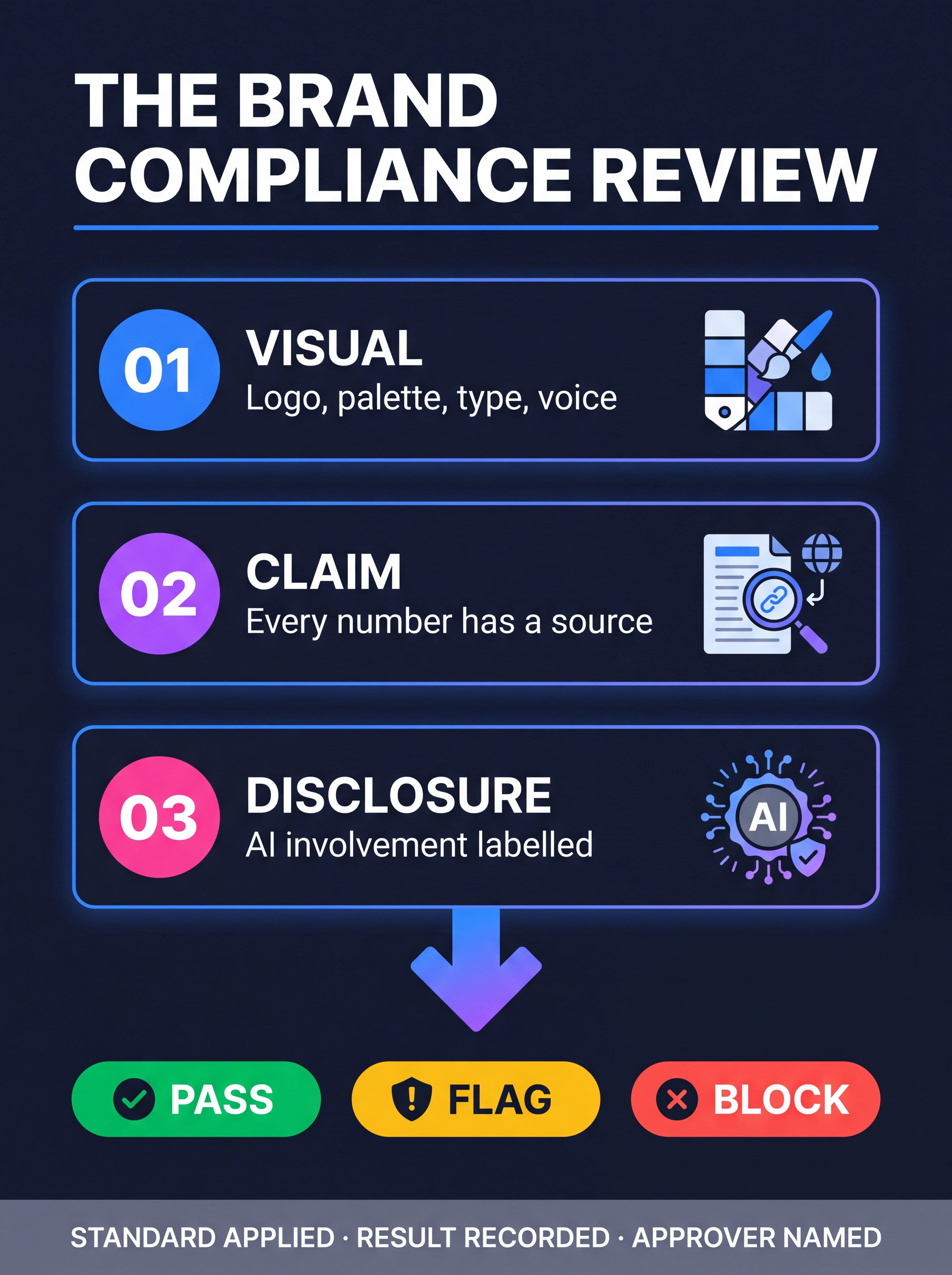
Every asset passes three checks and leaves with a verdict, the evidence behind it, and a named approver.
Build the review: pass, flag, block
A compliance review that produces a discussion has failed. A compliance review that produces a verdict has worked. Three outcomes are enough, and the third one has to actually stop things or the other two are theatre.
Pass. The asset matches the standard on all three layers, and the evidence for that is recorded. It ships.
Flag. Something is off but the asset is salvageable, or a claim is directionally right without adequate support. It goes back with the specific issue named. "Needs work" is not a flag. "The 40% figure has no source attached" is a flag.
Block. The asset cannot ship as it stands. An unsupported factual claim, a missing legally required disclosure, or an unlicensed asset all belong here. Blocking has to be a real state that a person has to clear, not a strong suggestion.
Attach three things to every verdict: the standard that was applied, the result, and the approver. That trio is what turns a review into a record. Six months later, when a client asks where a number came from or a regulator asks how a disclosure decision was made, the record answers and memory does not.
Run the layers in the cheap-to-expensive order. Automate layer one so reviewers never spend attention on a hex value. Route layer two to whoever can actually reach the source data, because a designer cannot verify a conversion-rate claim and should not be asked to. Handle layer three at the point of generation, where the answer is known for free, rather than at the end, where it has to be reconstructed.
A brand compliance checklist you can run this week
You do not need a platform to start. You need a repeatable list and someone willing to enforce it. Pick one client or one campaign and run every asset through this before it ships.
- Logo and lock-up: approved variant, correct clear space, no recolouring, no distortion, adequate contrast against its background.
- Palette and type: exact colour values from the system, approved typefaces and weights, no substituted system fonts introduced by a template or a generative tool.
- Imagery and likeness: licensed and in date, style consistent with the brand, and if a person appears, permission on file. If the person is synthetic, note it, because that is a layer three question.
- Voice: reads as your brand, not as generic marketing copy. Check the specifics you defined, not the vibe.
- Every number has a source: named system, date pulled, and a link or file reference. No source, no number.
- Causal language audit: where the copy says a campaign caused a result, confirm the evidence supports causation rather than correlation. This is the single most common unsupported claim in marketing creative.
- Comparative and superlative claims: "fastest", "best", "leading" all need substantiation on file before they ship.
- AI involvement recorded: yes or no, and if yes, which parts, so the disclosure decision is made from fact.
- Disclosure applied: visible labelling and machine-readable marking where required for the markets the asset runs in.
- Accessibility: contrast ratios, alt text, caption presence. It is a brand standard, and increasingly a legal one.
- Named approver: a person, not a team inbox, recorded against the final verdict.
Run that list manually for two weeks and you will learn something more useful than any benchmark: which line fails most often in your organisation. That single data point tells you what to automate first, and it is almost never the line you would have guessed.
Where tools help and where they quietly do not
The brand compliance software category has matured fast. Adobe's GenStudio for Performance Marketing runs an AI brand check that scores generated content against uploaded guidelines and flags issues such as off-brand fonts before publication, and Adobe introduced Brand Intelligence in April 2026 as a continuously learning governance engine that studies approved and rejected work to judge consistency across channels. Siteimprove, Ziflow, PageProof, Templafy and others occupy adjacent ground with review workflows, asset governance and automated checks.
These tools are genuinely good at layer one. Scoring an image against a visual system is a well-shaped machine learning problem, and automating it removes real drudgery from creative production workflows. If your team is still checking hex values by hand, buy something.
Be precise about what they do not do. A brand check confirms an asset looks like your brand. It does not know whether the statistic in the headline is true, because it has no connection to the system that would hold the answer. Layer two requires the asset to be checked against your data, not against your style guide, and that is a different integration entirely. An asset can score 100 on brand compliance and contain a number nobody can source.
Layer three has a similar shape. Tools increasingly write provenance metadata, which is necessary and welcome. Whether a given asset requires visible disclosure in a given market remains a judgement about jurisdiction, materiality and context. That judgement is yours, and the record of having made it is what protects you.
Agencies carry the client's risk, not just their own
For agencies the exposure is asymmetric, and the market has noticed. Only around 21.8% of brands believe their agency partners have a well-defined vetting process for AI-generated work, and just 29% of agencies report offering standardised vetting protocols. Roughly 80% of multinational brand owners have expressed concern about how agencies use generative AI on their behalf, citing legal, ethical and reputational risk.
Sit with the first two numbers. Fewer than a third of agencies have a documented process, and fewer than a quarter of brands believe their agency has one. The belief gap is smaller than the reality gap, which means some agencies are getting credit for rigour they cannot demonstrate. That credit does not survive the first incident.
The uncomfortable part is that the failure lands on the client's brand and the liability conversation lands on you. An off-brand asset is a client complaint. An unsupported claim in a client's ad is a client's regulatory problem that starts with a question about your process. The absence of a written, followed process is the thing that turns a mistake into a negligence discussion.
Which is why the process is worth more than the incident it prevents. A documented brand compliance review is a commercial asset. It is inspectable, it is a genuine differentiator in a pitch, and per the numbers above roughly 70% of your competitors cannot produce one. The same logic that makes marketing operations discipline saleable applies here: clients are buying reliability, and reliability is only credible when it is visible.
Five ways brand compliance fails without anyone noticing
1. The guidelines live somewhere nobody works. A PDF in a shared drive is not in the workflow. If checking compliance means leaving the tool you are producing in, the check gets skipped under deadline every time. This is most of the gap between the 95% who have guidelines and the 25% who enforce them.
2. Review is one person at the end. One reviewer can hold one layer in their head. Ask them to also verify claims and make disclosure judgements and you have not added rigour, you have added a bottleneck that will be bypassed the first busy week.
3. Nobody records what AI touched. The information is free at the moment of creation and expensive forever after. Teams that skip the field now will spend a genuinely unpleasant week reconstructing it when someone asks.
4. Templates carry old standards forward. A rebrand updates the guidelines and leaves twenty campaign templates on the previous palette. Every asset built from them is compliant with a standard you retired. Tracking how your brand actually shows up in market catches this. Reviewing individual assets does not, because each one looks internally consistent. AI brand monitoring is useful here for the same reason: it looks at the aggregate rather than the artifact.
5. The block state is not real. If a blocked asset can ship because a deadline is close and a senior person waved it through without recording why, you do not have a review. You have a queue. The exception itself is fine. The unrecorded exception is the failure.
Where MarqOps fits
MarqOps is built as the evidence layer for marketing operations, which is the same shape as the problem this article describes. Two parts of the platform map onto it directly.
Creative Ops generates and refines brand-aware images from a governed creative system, with brand intelligence and asset history attached. That covers layer one, and the asset history is the part that matters for compliance: it records what was produced, from what, and when, which is the raw material for both the audit trail and the AI involvement question.
The claim review method sits underneath the reporting side of the platform. Material claims are traced to a source and held for human approval, and each is sorted into verified, needs context, or unsupported before it reaches a client. That is layer two as a working process rather than an aspiration, and the interactive sample report shows the evidence receipts without requiring a connection or an account.
Governance runs across both: source context, human approval, account scope, and an activity trail attached to consequential decisions. It is the same trio the review needs, which is standard applied, result recorded, approver named.
To be straight about the boundary: MarqOps is not a replacement for a dedicated digital asset management system, and it does not adjudicate your legal obligations in any given market. What it does is keep the evidence attached to the work so that the compliance question has an answer, rather than a search through Slack. For agencies specifically, verified client reporting extends the same discipline to the deliverable clients actually read.
Frequently asked questions
What is brand compliance?
Brand compliance is the practice of confirming that every asset leaving an organisation matches its committed standards before publication. In 2026 that covers three layers: visual and verbal consistency with brand guidelines, factual accuracy of any claim inside the asset, and disclosure of AI involvement where regulation requires it. Compliance is distinct from having guidelines. It requires a recorded check, a result, and a named approver for each asset.
What is the difference between brand guidelines and brand compliance?
Brand guidelines describe the standard. Brand compliance is the evidence that the standard was applied to a specific asset. Around 95% of companies have guidelines while only about 25% enforce them, which is exactly the gap between the two. If you cannot show who checked an asset and what the check found, you have guidelines without compliance.
Do I have to disclose AI-generated marketing content?
In several jurisdictions, yes. EU AI Act Article 50 transparency obligations took effect on 2 August 2026 and require clear labelling plus machine-readable marking of AI-generated or manipulated content, with a transitional deadline of 2 December 2026 for generative systems already on the market. In the US the FTC generally expects both sponsorship and AI involvement to be disclosed in sponsored content, and California and New York have added their own requirements. Requirements vary by market and by how materially AI was involved, so record the AI involvement per asset and take the disclosure decision from that record rather than from memory.
How do you measure brand compliance?
Measure the rate, not the incidents. Track the percentage of published assets that went through a recorded review, the pass, flag and block distribution, which checklist line fails most often, and the number of blocked assets that shipped anyway with a recorded exception. That last figure is the honest measure of whether your review has authority. Incident counts alone only tell you what got caught after publication.
Is brand compliance software enough on its own?
It handles the visual layer well and that is worth buying. Tools such as Adobe's GenStudio brand check score generated content against uploaded guidelines and flag off-brand elements before publication. What they cannot do is verify that a statistic in the copy is true, because they have no connection to the system holding the answer, or decide whether a specific market requires visible AI disclosure. Those two layers need access to your data and a human judgement, so the realistic setup is automated visual checks plus a human claim and disclosure review.
Who should own brand compliance in a small agency?
One named person owns the process and the record. The checks themselves should be distributed, because they need different access: a designer or an automated check covers the visual layer, whoever can reach the client's analytics covers claims, and whoever manages production covers AI disclosure. Concentrating all three in one reviewer creates a bottleneck that gets bypassed under deadline, which is one of the most common ways compliance quietly stops happening.
The bottom line
Brand compliance got harder in 2026 for two reasons that arrived together. Output volume rose sharply as generative tooling spread through marketing teams, with roughly 73% of US advertisers now using AI to produce images for display and social. And the definition of compliance widened to include claims and disclosure, with real penalties attached for the first time.
Most organisations responded to the first change and not the second. They bought tools that produce more, kept a review process designed for a smaller volume of simpler work, and left governance investment flat while over 70% of their own marketers were already running into AI-related problems. That combination is stable right up until the moment it is not.
The correction is unglamorous and available now. Write down the three layers. Give every asset a pass, flag, or block verdict. Record the standard applied, the result, and the approver. Automate the visual layer because a machine does it better, and keep humans on the claims and the disclosure decisions because those require access and judgement.
Start with one client and one week of assets. Count how many would have shipped without a source for their central number. In most teams the answer is uncomfortable, and it is also the fastest brand risk reduction available without hiring anyone.
Keep following the signal
Related field notes
Marketing
Marketing Automation for Agencies in 2026: What to Automate, What to Keep Human
11 min readMarketing
Brand Asset Management in 2026: How to Run It Without Adding Another Tool
14 min readMarketing Operations