AI Content Repurposing in 2026: The Complete Guide to Turning One Asset Into Twenty
Modern marketing teams use AI content repurposing to turn one blog or webinar into 15+ channel-ready pieces, cutting production cost by 65% and lifting ROI 32%. Here is the full 2026 workflow, tool stack, and brand voice playbook.

Most marketing teams publish one blog post, share it twice on LinkedIn, and move on. Meanwhile, 65% of the value of that asset stays buried in a Google Doc nobody reopens. That is the gap AI content repurposing closes in 2026. By feeding a single piece of long-form content into a brand-aware AI pipeline, modern marketing teams now turn one webinar into 25 posts, one podcast into 12 newsletters, and one blog into a complete cross-channel campaign without hiring a single freelancer.
This guide breaks down exactly how that works. You will see the data behind why AI content repurposing produces a 32% lift in ROI, the workflow that high-performing teams use to keep brand voice consistent across formats, the tools worth paying for, and the common traps that quietly burn budget. If you run a content team, manage a marketing ops function, or simply hate watching good content die after one publish, this is the playbook.
TL;DR
- AI content repurposing turns one source asset into 15 to 25 channel-ready pieces while cutting production cost by up to 65%.
- Teams using AI repurposing see a 32% lift in content ROI and 40% more published output without adding headcount.
- The winning workflow is source asset, brand voice check, format split, channel adaptation, scheduled distribution.
- The biggest 2026 shift is brand-aware AI that protects your tone, not generic tools that flatten every output.
- One unified platform like MarqOps replaces the 5 to 7 point tools most teams currently duct tape together.
Table of Contents
- What Is AI Content Repurposing?
- Why It Matters in 2026: The Numbers
- The 6-Step AI Content Repurposing Workflow
- Formats You Can Repurpose Into
- Best AI Content Repurposing Tools
- How to Protect Brand Voice at Scale
- Mistakes That Kill AI Repurposing ROI
- How to Measure Success
- Why Teams Run Repurposing Inside MarqOps
- FAQs
What Is AI Content Repurposing?
AI content repurposing is the process of using artificial intelligence to transform a single source asset, like a blog post, podcast, webinar, or research report, into multiple channel-native formats without rewriting from scratch. Instead of a writer manually carving a 2,000-word article into LinkedIn posts, Instagram carousels, an email teaser, and short-form video scripts, an AI pipeline reads the source, understands your brand voice, and produces all of those derivatives in minutes.
The term ai content repurposing covers three meaningfully different things, and teams that mix them up usually waste money:
- Format conversion. Turning a video into a transcript, a podcast into show notes, a webinar into a blog. This is mostly transcription plus light editing.
- Channel adaptation. Taking a single message and rewriting it for the rhythm, length, and conventions of each channel. A LinkedIn post is not a tweet, and a YouTube Short is not a TikTok.
- Asset multiplication. Generating entirely new derivatives like quote graphics, carousel slides, email subject lines, ad copy variants, and SEO landing page sections from the same source.
The 2026 version of this works because models can now read multimodal input (text, audio, video frames), preserve a documented brand voice, and write in long form without the robotic cadence that plagued 2022-era tools. If you are catching up on the full landscape, start with our broader AI content strategy guide for 2026, then come back here for the repurposing layer.
Why It Matters in 2026: The Numbers
Repurposing has always been smart. AI is what finally made it scalable. The data that matters:
65%
reduction in content production cost when AI handles repurposing
The bigger picture, pulled from 2025 and 2026 industry research:
- 94% of marketers plan to use AI for content creation in 2026, but only 35% actively repurpose. The teams that do both pull ahead fast.
- AI content repurposing improves overall content ROI by an average of 32%.
- Teams report 60 to 80% time savings on adaptation work and 40% more published output without proportional headcount growth.
- Netflix reported a 43% lift in social engagement after switching to AI-driven repurposing across marketing channels.
- HubSpot generated a 28% boost in lead gen by turning blog posts into podcast episodes using AI tooling.
- Only 19% of content teams track AI-specific KPIs, which is why so many feel busy without proving impact.
The pattern in the data is simple. Teams that repurpose produce more, reach more channels, and earn more, while teams that ship one format per asset compete on volume they cannot afford.
The 6-Step AI Content Repurposing Workflow
This is the workflow used by content teams that consistently get 15 to 25 derivatives from a single source asset. It works for B2B and B2C, agencies and in-house teams, written and video-first creators.
Step 1: Choose the right source asset
Not every asset deserves repurposing. Run any candidate through these three filters: it covers a topic with proven demand, it carries genuine insight or data that competitors do not have, and it is at least 1,200 words or 15 minutes of video. Pillar pieces, original research, customer interviews, and webinar replays are the highest-yielding sources.
Step 2: Brand voice check before AI touches it
Load your brand voice profile, tone rules, terminology preferences, and forbidden phrases into the AI before generating anything. Tools without persistent brand memory produce generic output that quietly erodes brand equity. If your team has not formalized this yet, see our walkthrough on building an AI brand voice that scales across every channel.
Step 3: Format split
Decide upfront which formats you want before you generate anything. A typical split for a single 2,000-word blog post looks like this: 1 LinkedIn long post, 3 LinkedIn micro posts, 1 carousel (8 to 10 slides), 5 quote graphics, 1 email newsletter, 3 short-form videos (60 to 90 seconds), 1 podcast script, and 1 SEO landing page section. That is 16 derivatives from one source.
Step 4: Channel adaptation, not copy paste
This is where most teams cheap out and pay the price. The same idea needs a different opening on LinkedIn versus X, a different hook for Reels versus YouTube Shorts, and a different CTA for email versus blog. Modern AI handles this well if you give it the channel context, audience, and conversion goal.
Step 5: Human edit pass
Always review AI output before publishing. AI is fast at structure but you are better at voice. Edit for tone, trim anything generic, and make sure the final piece sounds like your brand. A 10 minute edit pass on a piece that took the AI 30 seconds to generate is still a massive net win.
Step 6: Scheduled distribution and measurement
Drop the finished pieces into your scheduler with proper UTM tags, and track each derivative independently. The point is to find out which formats actually drove your KPIs, not just which ones got published. This connects directly into your broader marketing workflow automation stack.
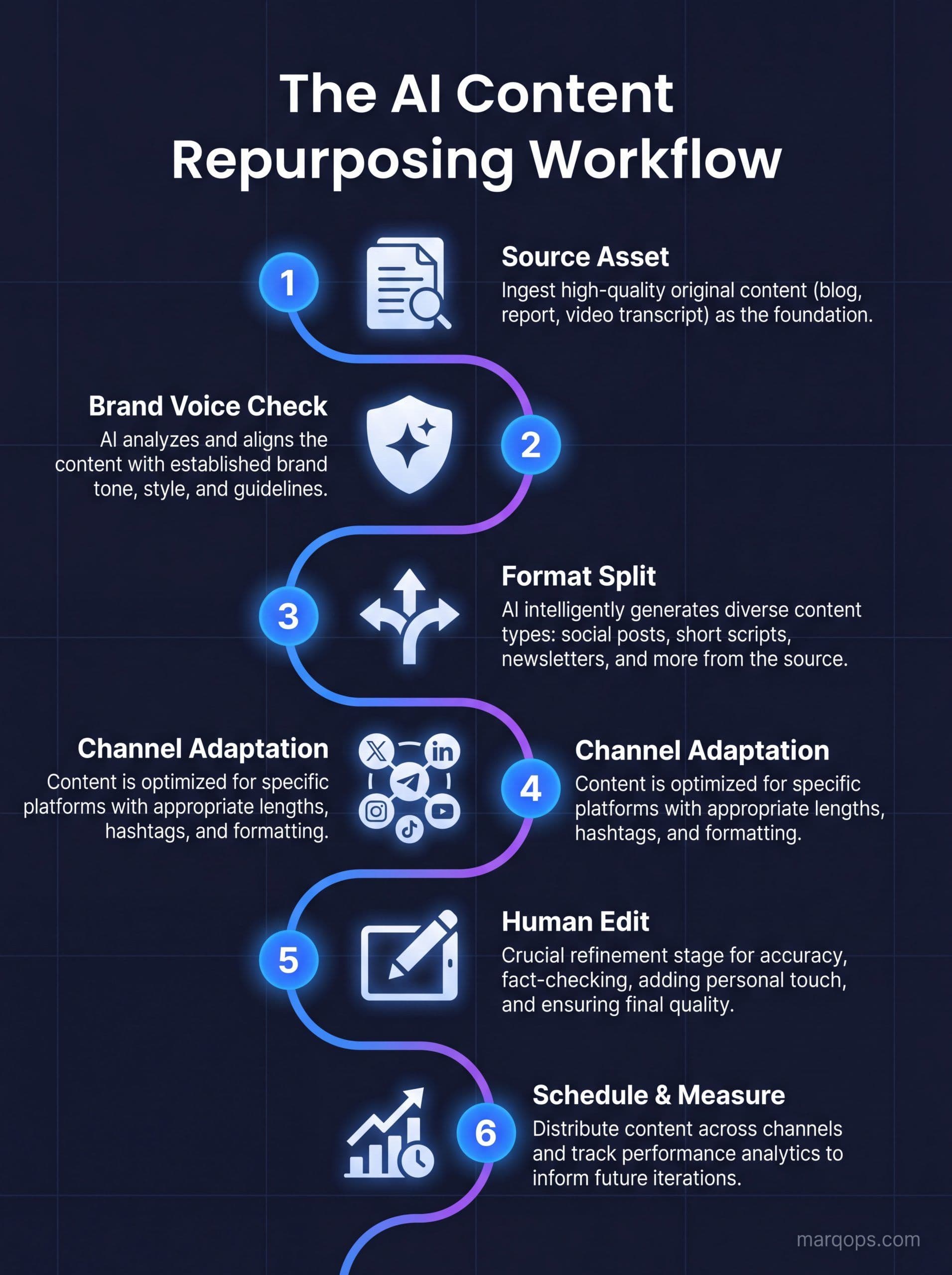
The 6-step AI content repurposing workflow used by high-performing marketing teams in 2026.
Formats You Can Repurpose Into
Knowing the menu helps you plan smarter. Below is the practical 2026 repurposing matrix, organized by source asset type.
From a long-form blog post (1,500 to 3,000 words)
- LinkedIn carousel (8 to 12 slides)
- Twitter or X thread (8 to 15 tweets)
- Email newsletter section
- Short-form video scripts for Reels, Shorts, TikTok
- Quote graphics for Instagram and LinkedIn
- Pinterest pin descriptions
- Podcast episode outline
- SEO landing page variants (programmatic)
- Sales enablement one-pager
From a podcast or webinar (30 to 60 minutes)
- Show notes blog post
- 5 to 10 short clips with captions
- Quote cards for social
- Email recap newsletter
- LinkedIn discussion posts (one per key moment)
- YouTube chapters and description
- Transcript SEO page
- Audiogram for Instagram
From a single research report or whitepaper
- 4 to 6 standalone blog posts (one per chapter)
- Data-driven LinkedIn carousels
- Webinar deck and script
- Email drip series (5 to 7 emails)
- Sales pitch deck section
- Press release
- Bylined contributed article for industry publication
- Stat-of-the-week posts for 8 to 12 weeks
For teams running heavy video output, our coverage of the best AI video generators for marketing pairs well with this repurposing workflow.
Best AI Content Repurposing Tools in 2026
The market splits into three buckets: video-first clippers, text-first generators, and unified platforms. Pick based on what your source asset actually is.
Video-first repurposing
- Opus Clip. Auto-clips long video into vertical shorts with captions and virality scoring. Strong for podcasters and YouTubers.
- Descript. Edit video by editing text, remove filler words, generate clips. Best end-to-end editor for talking-head content.
- Repurpose.io. Distribution-first. Pulls source content and pushes to every channel automatically with the right formatting.
- Quso.ai. Long-to-short clipping with brand templates and scheduled multi-platform posting.
Text-first repurposing
- Jasper. Brand Voice feature keeps output on tone. Strong for B2B teams turning whitepapers into derivative content.
- Copy.ai. Workflow-driven. Lets you build repeatable chains for blog to email to social.
- Postiv AI. Built specifically for LinkedIn posts and carousels from existing content.
Unified platforms
- MarqOps. Combines AI content generation, brand voice intelligence, multi-channel distribution, and analytics in one workspace. Designed to replace the 5 to 7 point tools teams stack together.
- Distribution.ai. Repurposes long-form into multiple formats with scheduling and analytics across eight channels.
If your starting point is text, our breakdown of the best AI copywriting tools for marketing teams covers the generation side in more depth.
How to Protect Brand Voice at Scale
Here is the uncomfortable truth about AI repurposing: most of it sounds like AI repurposing. The same phrases, the same rhythm, the same generic confidence. Once your audience notices, your brand equity quietly drops.
The fix is not stricter prompts. It is a structured brand voice layer that every generation pulls from. That layer should include your voice attributes (e.g., direct, data-driven, confident without being preachy), terminology preferences (what you call your product, what you never call competitors), forbidden phrases (no em dashes, no “in today’s fast-paced world”, no “game-changer”), and reference examples of your best-performing past content.
Platforms like MarqOps build this into the foundation through what is called Brand Intelligence DNA. The brand profile lives once, and every piece of content generated, whether a blog, an ad, a carousel, or a video script, runs through that layer before output. The result is brand consistency across formats and across teammates, not just within a single asset.
Rule of thumb: if your AI output could plausibly come from any company in your industry, you have a brand voice problem, not a writing problem.
Mistakes That Kill AI Content Repurposing ROI
These are the patterns we see most often when teams complain that repurposing “did not work”:
- Repurposing low-quality sources. Garbage in, twenty pieces of garbage out. Only repurpose assets that performed well or carry unique insight.
- Skipping the channel adaptation. Posting the same text on LinkedIn, X, and Threads with no rewrite trains your audience to ignore you on at least two of those channels.
- No human edit pass. Speed without quality control burns trust faster than slow output.
- Stack sprawl. Teams end up with a separate tool for clipping, generating, scheduling, analytics, and brand voice. The handoffs between them eat any time savings AI created.
- No measurement. If you do not know which derivative formats actually drove pipeline, you are repurposing on vibes.
- Overpublishing. Twenty mediocre derivatives perform worse than five great ones. AI throughput is not a substitute for editorial judgment.
Pair this with our broader marketing operations guide for 2026 to make sure your team is set up to scale the workflow, not just the output.
How to Measure AI Content Repurposing Success
The 19% of teams that track AI-specific KPIs are the ones generating real returns. Here is the lean measurement framework that works.
Input metrics
- Source assets repurposed per month
- Derivatives produced per source asset
- Time spent per derivative (human + AI combined)
Output metrics
- Reach per derivative format
- Engagement rate per channel
- Click-through to owned properties
- Pipeline or signups attributed by format
Efficiency metrics
- Cost per derivative (loaded labor + tool cost)
- ROI per source asset (revenue or pipeline attributable to all derivatives)
- Time saved vs. manual baseline
If you are wiring this up properly, the analytics layer is where it lives or dies. Our deep dive on AI marketing analytics in 2026 covers the measurement architecture in detail.
Why Teams Run AI Content Repurposing Inside MarqOps
Most teams adopting AI content repurposing in 2026 hit the same wall: their stack grows faster than their output. Opus Clip for video, Jasper for text, Repurpose.io for distribution, Buffer for scheduling, Looker for analytics, and a separate brand guidelines doc that nobody opens. Each tool is fine in isolation. Together they create context loss, brand drift, and a $4,000 monthly bill before anyone publishes.
MarqOps was built to collapse this. The same Brand Intelligence DNA layer governs every output. The same workspace handles long-form generation, channel adaptation, asset multiplication, scheduling, and the analytics dashboard that proves what worked. Teams that switch typically replace 7+ disconnected tools, cut content production time by 6x, and ship campaigns where every derivative actually looks and sounds like the brand. If you want the broader category context first, see our overview of AI-powered marketing platforms in 2026.
Frequently Asked Questions
What is the difference between AI content repurposing and AI content generation?
AI content generation creates new content from a prompt. AI content repurposing transforms an existing source asset into multiple channel-native derivatives. Repurposing preserves your original research, insight, and brand voice while expanding reach. Generation builds from zero. Most mature teams use both, but repurposing usually delivers higher ROI per dollar.
How much time does AI content repurposing actually save?
Industry data shows 60 to 80% time savings on adaptation work versus manual repurposing. A blog post that historically took a content marketer four hours to break into a carousel, three social posts, and an email can now be generated in 15 minutes and edited to publish quality in another 30. The savings compound across a content calendar.
Does AI content repurposing hurt SEO with duplicate content?
Done right, no. The point of repurposing is channel adaptation, not duplication. A LinkedIn post is not indexed the same way as your blog, and a podcast transcript on a new page is typically distinct enough in structure to avoid duplicate content issues. The risk shows up only when teams paste identical long-form text across multiple owned web properties.
What is the best AI content repurposing tool for a small marketing team?
It depends on your source format. If you produce video, Opus Clip or Descript are the fastest path. If you produce written content, Jasper or Copy.ai handle text-to-text well. If you want one platform that handles every format with built-in brand voice and analytics, a unified system like MarqOps removes the tool sprawl that small teams cannot afford to manage.
How do I keep AI repurposed content sounding like my brand?
Load a structured brand voice profile, terminology rules, and reference examples into your AI before generating anything. Platforms with persistent brand memory, like MarqOps Brand Intelligence DNA or Jasper Brand Voice, produce consistent output across formats. Generic ChatGPT prompts without that scaffolding will drift toward a recognizable, flat tone within a few generations.
How many derivatives should I generate per source asset?
A practical target is 8 to 16 derivatives per pillar source. Beyond that you typically hit diminishing returns and start cannibalizing your own reach. The goal is intentional coverage of every channel where your audience actually pays attention, not a brute-force flood of every possible format.
Closing Thought
Content teams that figured out AI repurposing in 2025 have a structural advantage now. They publish more, reach more channels, and burn less budget per outcome. Teams still treating each asset as a single-format ship will spend 2026 trying to catch up on volume while losing ground on ROI. The smart move is not to add more tools to your stack. It is to build a clean workflow with one brand-aware system that turns every good source asset into the campaign it deserves.
Keep following the signal
Related field notes
Marketing Operations
Marketing Project Management Software in 2026: How to Choose Without Adding Tool #122
11 min readMarketing Analytics
Marketing Attribution Software in 2026: The Buyer's Guide for a Stack That Won't Stop Growing
11 min readMarketing Operations