AI Marketing ROI in 2026: The Complete Guide to Measuring, Proving, and Multiplying Marketing’s Revenue Impact
The 2026 playbook for AI marketing ROI: benchmarks, formulas (MER, iROI), the modern measurement stack, a 90-day roadmap, and how unified platforms unlock 5x returns.

AI Marketing ROI in 2026: The Complete Guide to Measuring, Proving, and Multiplying Marketing’s Revenue Impact
If your CFO still squints when you say “marketing ROI,” you are not alone. Here is the data-driven playbook for measuring, proving, and multiplying the revenue impact of AI-powered marketing in 2026.
TL;DR
- 83% of marketing teams now report clear ROI from generative AI tools, with an average lift of 22 to 35 percent across campaigns.
- The 2026 standard for measuring AI marketing ROI is a triangulated stack: platform attribution, marketing mix modeling, and incrementality testing.
- Marketing Efficiency Ratio (MER) is the new shared language between CMOs and CFOs. Healthy AI-driven programs target 5.0x or higher.
- The biggest blocker is not AI capability, it is data fragmentation. 65.7% of marketers say integration is their top measurement challenge.
- Unified platforms like MarqOps replace 7+ disconnected tools, collapse the data layer, and make AI marketing ROI directly observable on a single dashboard.
Table of Contents
- What is AI Marketing ROI?
- Why AI Has Rewritten the ROI Equation
- 2026 AI Marketing ROI Benchmarks
- The AI Marketing ROI Formula
- The Modern Measurement Stack
- The KPIs Your CFO Actually Cares About
- 10 Tactics That Multiply AI Marketing ROI
- A 90-Day Roadmap to Higher AI Marketing ROI
- 5 Mistakes That Quietly Kill AI Marketing ROI
- How MarqOps Makes AI Marketing ROI Provable
- FAQs
What is AI Marketing ROI?
AI marketing ROI is the financial return generated from investments in AI-powered marketing tools, agents, and workflows, expressed as a ratio of incremental revenue to total cost. In plain English: how many dollars of new pipeline did every dollar you spent on AI software, models, data, and people actually create?
In 2026 the definition has tightened. It is no longer enough to report that an AI tool generated 6x more blog posts or 3x more ad variants. CFOs want to see that those outputs moved a revenue number, lowered a cost number, or shortened a cycle time. That shift, from output metrics to outcome metrics, is the single biggest change in how marketing leaders prove value this year. For the broader strategic context, see our AI marketing strategy framework.
Why AI Has Rewritten the ROI Equation
Three things changed at once between 2024 and 2026, and together they made the old marketing ROI playbook obsolete.
1. The cost side dropped through the floor
Generative AI cut content production costs by 60 to 75 percent on average. Performance creative that used to take an agency two weeks now ships in a morning. Predictive lead scoring that needed a data science team can now run inside a marketing platform. When the cost denominator shrinks that fast, ROI ratios that looked impossible in 2023 become standard in 2026.
2. AI moved into the delivery layer
Google Smart Bidding, Meta Advantage+, and channel-level AI now make millions of allocation decisions per day. That means the “creative” and the “media” are jointly optimized in real time. Old, channel-by-channel attribution math cannot keep up with a system that reshuffles spend hourly. You can read more about this shift in our deep dive on AI for Google Ads.
3. The signal got noisier
Privacy changes, walled gardens, and AI-generated traffic broke deterministic tracking. The honest answer in 2026 is that no single number is “the truth.” Smart marketing teams stopped chasing perfect attribution and started building defensible triangulation systems. We unpack this in our multi-touch attribution guide and the deeper marketing mix modeling playbook.
The teams winning in 2026 do not optimize for attributed ROAS. They optimize for incremental profit. That single mental shift is worth more than any new tool.
2026 AI Marketing ROI Benchmarks
Here is what the data actually says. These numbers come from a synthesis of 2026 industry reports, vendor studies, and large-scale campaign analyses covering tens of thousands of advertisers.
5.2x
Average return on AI tool investment across marketing teams in 2026
| AI Use Case | Typical ROI Impact | Time to See Lift |
|---|---|---|
| AI bidding (Smart Bidding, Advantage+) | 20 to 35% ROAS improvement | 2 to 4 weeks |
| AI email personalization | 26% higher open rates, 20%+ click lift | 1 to 2 send cycles |
| Predictive lead scoring | 25 to 40% SQL rate improvement | 30 to 60 days |
| AI content generation | 60 to 75% lower production cost | Immediate |
| AI ad creative (gen AI variants) | 1.8x higher CTR vs human-only | 2 to 6 weeks |
| AI personalization (ecommerce) | 26% higher AOV, 31% ROI lift | 4 to 8 weeks |
A few headlines worth pinning to the wall. JPMorgan Chase tested AI-written ad copy variations against human-written controls and saw click-through rate lifts as high as 450 percent on the best AI versions. A joint Meta and LinkedIn study across more than 41,000 campaigns found AI-generated creative beat human-only creative on CTR by 1.8x. Starbucks’ Deep Brew AI lifted loyalty spend by 34 percent. Sephora’s AI try-on bumped average order value by 28 percent.
The pattern is clear. AI marketing ROI is not a marginal improvement. When it is implemented well, it is a step change. The catch is that “implemented well” hides a lot. For the analytical foundation, see our complete guide to AI marketing analytics.
The AI Marketing ROI Formula
There are three formulas every marketing leader should be able to recite in 2026. They look simple. Most teams still get the inputs wrong.
Formula 1: Classic marketing ROI
Marketing ROI = (Incremental Revenue – Total Marketing Cost) / Total Marketing Cost
The word “incremental” is the entire game. Revenue your campaign caused, not revenue that would have happened anyway. Without an incrementality test, this formula returns a flattering fiction.
Formula 2: AI-specific ROI
AI ROI = (Revenue Lift Attributable to AI + Cost Savings from AI) / Total AI Investment
Total AI investment is more than software licenses. Include model usage costs, data preparation, prompt engineering time, integration work, and the salary share of anyone tuning the system. Cost savings should include reduced agency fees, fewer freelancers, and recovered hours that moved to higher-leverage work.
Formula 3: Marketing Efficiency Ratio (MER)
MER = Total Revenue / Total Marketing Spend
MER is the metric that finally aligned marketing with finance. It does not pretend to know which channel did what. It just asks how efficient the whole machine is. For 2026 AI-led programs, a healthy MER is 5.0x or higher. Anything under 3.0x in a steady-state business is a red flag. Pair MER with a unified marketing dashboard and you have a shared scorecard your CFO will actually believe.
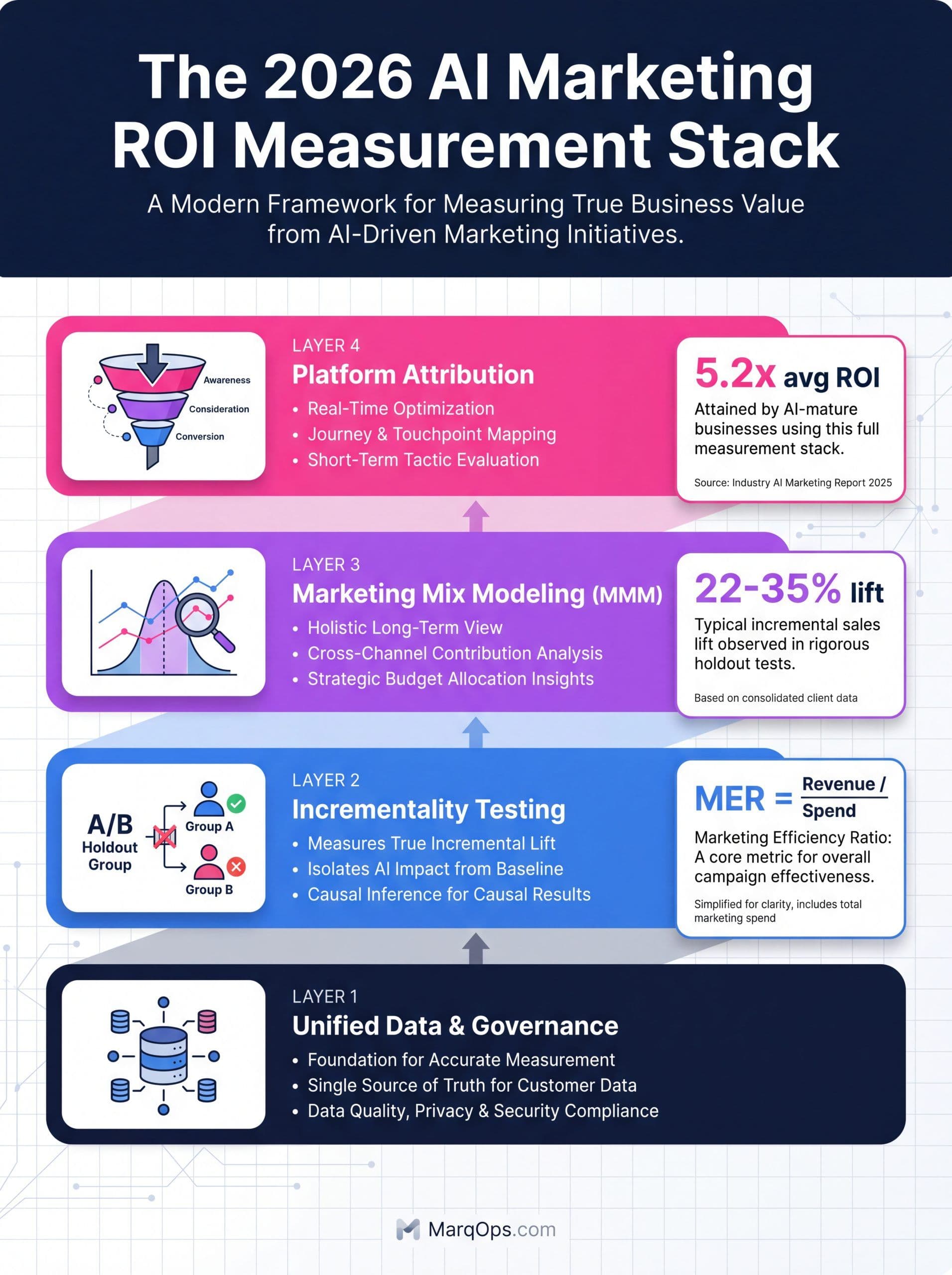
The 2026 AI marketing ROI measurement stack: how leading teams triangulate platform data, MMM, incrementality testing, and unified governance.
The Modern Measurement Stack
In 2026 no single methodology gives you “the answer.” The leading teams run a triangulated stack with four layers. Each layer answers a different question.
Layer 1: Platform attribution (the operational lens)
Multi-touch attribution from your ad platforms, web analytics, and CRM tells you what is happening at a campaign level day to day. Treat it as operational visibility, not truth. It is great for spotting anomalies and pacing decisions, weak for budget allocation. Our multi-touch attribution guide covers the model choices in detail.
Layer 2: Marketing mix modeling (the strategic lens)
MMM uses statistical modeling on aggregated historical data to quantify the contribution of every channel, including offline and brand spend. It is the right tool for annual budget planning and answering questions like “what would happen if we cut TV by 20 percent.” Bayesian MMM, increasingly powered by AI, is the 2026 standard. See our marketing mix modeling deep dive.
Layer 3: Incrementality testing (the truth lens)
Geo-lift tests, holdout groups, and conversion lift studies are how you prove causality. A 10 percent universal holdout, a segment that never sees your AI-driven campaigns, is now considered the gold standard for proving incremental lift. Without it, every ROI claim has an asterisk.
Layer 4: Unified data and governance (the foundation)
None of the above works on top of fragmented data. 65.7 percent of marketers cite data integration as their top measurement challenge. You need a shared data layer where identity is resolved across channels, conversions are on a single timeline, and finance and marketing agree on definitions. This is exactly what unified marketing intelligence platforms are built to deliver.
The KPIs Your CFO Actually Cares About
If you walk into a board meeting with a 40-tile dashboard, you have already lost. The 2026 best practice is a six to eight metric executive view that anchors marketing in financial language.
- Marketing-attributed revenue. Quarter over quarter, by segment.
- Marketing Efficiency Ratio (MER). The blended number that ties spend to revenue.
- Blended customer acquisition cost (CAC). All marketing spend divided by new customers, no channel cherry-picking.
- CAC payback period. Months to recover acquisition cost. Tighter is better.
- Marketing cost per dollar of pipeline. A leading indicator of ROI before revenue lands.
- Pipeline velocity. Volume x deal size x win rate divided by sales cycle.
- Funnel conversion rate by stage. Where AI personalization and CRO tools show up first.
- Incremental ROI (iROI). The number that survives a CFO interrogation.
Track these eight, on one dashboard, refreshed on the same cadence as your finance reports. That alignment alone, before any new AI tool, is often worth 10 to 15 percent more credibility for marketing spend requests.
10 Tactics That Multiply AI Marketing ROI
Measurement tells you where you stand. These tactics are how you actually move the number. Each one has a documented ROI footprint in 2026 data.
1. Switch to AI bidding on at least 70% of paid media
Smart Bidding, Advantage+, and equivalent algorithms consistently outperform manual bidding once they have enough conversion data. 20 to 35 percent ROAS lift is the typical range. See our Performance Max guide for execution detail.
2. Stand up an AI creative variant factory
Ship 10 to 20 ad variants per concept, let the algorithm pick the winner, kill the losers fast. Generative creative now beats human-only creative on CTR by 1.8x at scale.
3. Personalize email send times and subject lines with AI
Send time optimization alone is worth a 20 percent open-rate bump. Layer in AI subject line testing and you compound the lift on every send.
4. Deploy predictive lead scoring on every inbound lead
AI scoring routes the right leads to sales faster, which compresses cycle time and lifts SQL conversion 25 to 40 percent. The math flows straight to CAC payback.
5. Use predictive analytics to forecast churn and revenue
Saving 5 percent of at-risk accounts often beats acquiring 5 percent more new ones. Our guide to predictive marketing analytics walks through churn, LTV, and demand models.
6. Replace manual content production with AI-assisted workflows
60 to 75 percent cost reduction on content production is the typical outcome. Reinvest the savings in distribution, not headcount cuts, and the ROI compounds.
7. Run real-time personalization on high-traffic pages
Real-time personalization engines accounted for 9.7 percentage points of the average 18 percent conversion lift seen across 6,800 AI-optimized campaigns. Start with your top five highest-traffic pages.
8. Move from MTA-only to a full triangulated measurement stack
Teams that combine platform data, MMM, and incrementality see 20 to 30 percent higher ROI on the same spend because their budget decisions are no longer based on partial truths.
9. Consolidate your martech stack
Every additional point tool is a new integration tax. Replacing 7+ disconnected platforms with a single AI-native system removes contract spend, vendor management overhead, and duplicate data. This is the consolidation thesis behind AI-powered marketing platforms.
10. Codify Brand Intelligence DNA before scaling AI output
AI without brand guardrails creates volume and brand inconsistency at the same time. Codify your voice, colors, claims, and compliance rules into a Brand Intelligence layer so every generated asset is on-brand the first time. This is the difference between AI that scales and AI that creates rework. See our AI brand voice playbook.
A 90-Day Roadmap to Higher AI Marketing ROI
If you are not sure where to start, here is the sequence that compresses time to value without overhauling everything at once.
Days 1 to 30: Baseline and instrument
- Calculate your current MER, blended CAC, and CAC payback. Lock these as your baseline.
- Audit every AI tool, model, and license already in use. Most teams discover 30 to 50 percent duplication.
- Stand up a 10 percent universal holdout group so you can prove incrementality starting in month two.
- Align with finance on the executive metric set. Get sign-off on definitions before publishing any numbers.
Days 31 to 60: Quick wins
- Move all eligible paid media to AI bidding.
- Launch AI creative variant testing on your top three campaigns.
- Turn on AI send-time and subject-line optimization across email.
- Deploy predictive lead scoring on inbound, with a clean route-to-sales rule.
Days 61 to 90: Compounding plays
- Run your first MMM refresh and reconcile against MTA. Expect surprises.
- Consolidate at least two redundant point tools.
- Codify Brand Intelligence DNA so AI output is brand-perfect from the first draft.
- Publish a single executive dashboard with the eight CFO-grade metrics, refreshed weekly.
Teams that follow this 90-day sequence typically report a 22 to 35 percent ROI lift inside two quarters, with most of the gain coming from incrementality discipline and stack consolidation rather than from any single AI tool.
5 Mistakes That Quietly Kill AI Marketing ROI
- Counting AI outputs instead of outcomes. “We produced 6x more content” is not ROI. Tie every output to a revenue, cost, or cycle-time metric.
- Trusting last-click attribution alone. In an AI-delivered media world it systematically over-credits bottom-funnel and under-credits brand and discovery.
- Skipping incrementality tests. Without a holdout you cannot tell AI lift from baseline behavior. Most reported “AI wins” inflate by 30 to 50 percent.
- Adding AI tools without consolidating. Every new tool is a new integration, a new data silo, and a new license fee. Tool sprawl is the silent ROI killer of 2026.
- Ignoring brand-safety at scale. The hidden cost of AI is rework when output drifts off brand. Codified brand rules pay for themselves the first month.
How MarqOps Makes AI Marketing ROI Provable
The biggest reason AI marketing ROI is hard to prove is not the AI. It is the fact that the data, the creative, the campaigns, and the analytics all live in different tools with different definitions. Every handoff is a place where ROI gets lost.
MarqOps collapses that fragmentation. One AI-powered platform replaces 7+ disconnected marketing tools across creative production, SEO content, paid media management, and analytics. The Brand Intelligence DNA layer keeps every AI-generated asset on-brand from the first draft, so the cost of rework drops toward zero. And because creative, distribution, and measurement live on the same data spine, ROI is observable in real time on a single unified dashboard, no manual stitching required.
For marketing teams trying to push MER from 3x to 5x, the lever is rarely “one more tool.” It is unifying the stack so AI can actually do what it is good at: learn fast, allocate intelligently, and compound results. See how the unified approach works in our marketing operations guide and the AI marketing assistant deep dive.
Start Free – No Card RequiredSee How MarqOps Works
Frequently Asked Questions
What is a good AI marketing ROI in 2026?
The average return on AI tool investment for marketing teams in 2026 is 5.2x. Enterprise teams average 3.4x, mid-market 2.8x, and SMB 2.3x. A Marketing Efficiency Ratio (MER) of 5.0x or higher is considered healthy for AI-led programs.
How do I actually measure ROI from AI marketing?
Use a triangulated stack: platform attribution for operational visibility, marketing mix modeling for strategic allocation, incrementality testing (geo-lift or holdout groups) to prove causality, and a unified data layer that finance and marketing both trust. No single methodology gives you the full picture.
How long does it take to see ROI from AI marketing investments?
It depends on the use case. AI bidding shows lift in 2 to 4 weeks, email personalization in 1 to 2 send cycles, content cost savings are immediate, and predictive lead scoring kicks in around 30 to 60 days. Most teams that follow a structured 90-day rollout report a 22 to 35 percent ROI lift inside two quarters.
Why is my AI marketing ROI lower than the benchmarks?
The most common reasons are tool fragmentation (data does not flow between systems), lack of incrementality testing (real lift is masked by baseline conversions), counting outputs instead of outcomes, and unmanaged brand drift that creates rework. 65.7 percent of marketers say data integration is their top measurement challenge.
What is the difference between attributed ROAS and incremental ROI?
Attributed ROAS assigns revenue credit to touchpoints based on a model. Incremental ROI (iROI) measures only the revenue that would not have happened without the campaign, validated by a control group. iROI is the more honest metric for budget decisions, especially in an AI-delivered media environment where attribution alone systematically over-credits some channels and under-credits others.
Keep following the signal
Related field notes
Marketing Operations
Marketing Project Management Software in 2026: How to Choose Without Adding Tool #122
11 min readMarketing Analytics
Marketing Attribution Software in 2026: The Buyer's Guide for a Stack That Won't Stop Growing
11 min readMarketing Operations