Topical Authority in 2026: The Complete Guide to Building Topic Clusters That Win Google and AI Search
Topical authority is now a primary ranking and AI-citation factor. Learn what it is, why it matters in 2026, and the pillar-and-cluster playbook to build it at scale.

Google stopped grading pages one at a time. In 2026, search engines and AI answer engines judge whether your whole site is a credible expert on a subject. That shift has a name: topical authority. This guide breaks down what it is, why it now decides who ranks and who gets cited by ChatGPT and AI Overviews, and the exact pillar-and-cluster playbook to build it without burning your team out.
TL;DR
- Topical authority is the degree to which Google and AI engines see your entire domain as a comprehensive, consistent expert on a subject, not just one keyword-matched page.
- It is now a primary ranking factor. Sites with strong topical authority rank up to 3x faster than sites leaning only on domain authority.
- In AI search it matters even more: domain authority explains under 4% of AI citation variance, while topical authority explains around 17%.
- The winning structure is a pillar page plus 8 to 15 cluster articles, tied together with descriptive internal links and consistent entity coverage.
- The bottleneck is production, not strategy. Building 15 deep articles per topic is where most teams stall, and where an AI content operations platform like MarqOps compresses months into weeks.
Table of Contents
- What Is Topical Authority?
- Why Topical Authority Matters More in 2026
- Topical Authority vs Domain Authority
- Topical Authority in the Age of AI Search
- The Pillar and Cluster Architecture
- How to Build Topical Authority: 8 Steps
- A Worked Example: Mapping One Cluster
- How to Measure Topical Authority
- Common Mistakes to Avoid
- How MarqOps Builds Topical Authority at Scale
- Frequently Asked Questions
What Is Topical Authority?
Topical authority is a search engine’s confidence that your website is a trusted, comprehensive expert on a specific subject. Instead of asking “does this one page match this one keyword,” Google asks a bigger question: “does this domain cover this entire topic deeply, consistently, and with genuine expertise?” When the answer is yes, every page you publish on that topic inherits a head start.
The concept grew out of semantic search. Modern engines map content to entities and concepts rather than raw keyword strings, so they can tell the difference between a site that wrote one thin post about a topic and a site that has answered every meaningful question around it. Building that breadth and depth is what earns topical authority, and it is closely related to entity SEO, where you optimize for the things and relationships Google associates with your brand.
Think of topical authority as a reputation, not a score you buy. A dermatology site that has published thorough content on every skin condition, treatment, and ingredient will outrank a general health site on skin queries, even if the general site has more backlinks. Depth in one area beats shallow breadth across many.
Why Topical Authority Matters More in 2026
Two forces made topical authority the dominant SEO strategy this year. First, Google’s core updates keep rewarding comprehensive topic coverage and punishing thin, disconnected content. Google’s March 2026 core update elevated topical authority to a primary ranking factor, and the pattern has held across every update since: sites that own a subject are far more resilient when the algorithm shifts.
Second, the arrival of AI answer engines changed what “ranking” even means. When ChatGPT, Gemini, Perplexity, and Google’s AI Overviews answer a question directly, they pull from sources that demonstrate consistent, credible coverage of a topic. A single strong page is rarely enough. The engines look for a body of work.
3x
faster rankings for sites with strong topical authority vs domain authority alone
The traffic case is just as concrete. Sites that implement content clusters correctly see an average 40% lift in organic traffic, with some studies reporting 46% to 55% within six months of building strategic pillar topics. Clustered content also earns roughly 3.2x more AI citations than standalone posts. In other words, the same strategy that wins Google rankings also wins visibility inside AI answers, which is why topical authority sits at the center of both classic SEO and GEO vs SEO planning.
Topical Authority vs Domain Authority
These two are often confused, but they answer different questions. Domain authority is a third-party metric (popularized by Moz and others) that estimates overall ranking strength, largely from backlink quantity and quality. Topical authority is subject-specific and driven mostly by content depth, structure, and semantic coverage rather than raw links.
Here is the shift that matters most in 2026: the two are decoupling. A focused site with modest domain authority can now outrank a giant on a specific topic if its coverage is deeper. In AI search this is dramatic. Research on AI citations found that domain authority explains less than 4% of citation variance, while topical authority explains around 17%. Pages ranking positions 6 to 10 with strong topical authority get cited about 2.3x more often than number-one pages with weak topical authority.
| Dimension | Domain Authority | Topical Authority |
|---|---|---|
| Scope | Whole site, all topics | One subject area |
| Main driver | Backlinks | Content depth and structure |
| Speed to build | Slow, needs outreach | Faster, within your control |
| AI citation weight | Under 4% of variance | Around 17% of variance |
Topical Authority in the Age of AI Search
In AI search, topical authority is measured through coverage depth, entity consistency, and citation frequency across a complete topic cluster. LLMs recognize a domain as a source when it shows up repeatedly and reliably across an entire subject, not when it has one lucky page. This is the core mechanic behind LLM SEO and answer engine optimization.
The concentration is striking. Across a given topic, the top 10 domains capture about 46% of all ChatGPT citations, and the top 30 capture 67%. Authority compounds, so the sites that establish coverage early pull further ahead. Freshness matters too: an Ahrefs analysis of 17 million citations found that AI-cited content is on average 25.7% fresher than content ranking in traditional search, which means maintaining your cluster is as important as building it.
The practical takeaway: if you want to be the source AI engines quote, you need to be visibly comprehensive. Answer the obvious questions and the obscure ones, keep them current, and connect them so the engine can see the full shape of your expertise. Track the results through AI visibility monitoring.
The Pillar and Cluster Architecture
The structure that best builds topical authority is the pillar and cluster model. It gives search engines a clear map of your expertise and gives readers an obvious path through your content.
The pillar page
A pillar is a central, comprehensive article (usually 2,500 to 4,000 words) that covers a broad topic end to end. It defines the subject, links out to every cluster, and serves as the hub of the wheel. Your pillar should target the head term and read like the definitive overview.
The cluster articles
Clusters are 8 to 15 satellite articles, each 1,500 to 2,500 words, that go deep on one subtopic or specific question. Every cluster links back to the pillar with descriptive anchor text and links to sibling clusters where relevant. This is the same logic behind a well-run content supply chain: many connected assets, produced on a repeatable system.
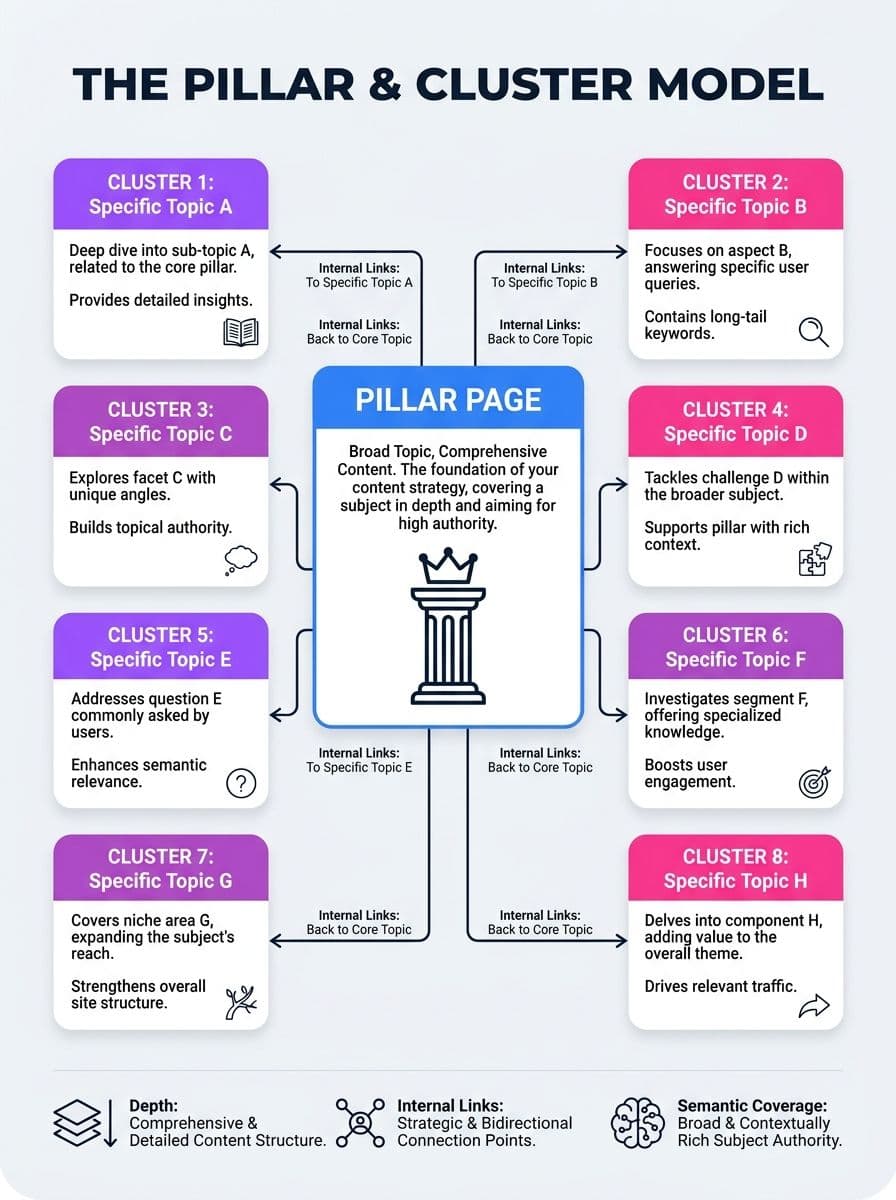
The pillar and cluster model: one comprehensive hub connected to deep satellite articles.
How to Build Topical Authority: 8 Steps
1. Choose a topic you can genuinely own
Pick a subject narrow enough to cover exhaustively and close to your business. Owning “AI email deliverability” beats being page 4 for “email marketing.” Depth in a defined lane is how smaller sites beat larger ones.
2. Build a topical map
List every question, subtopic, and entity a real expert would address. Group them into pillar-level themes and cluster-level questions. This map becomes your content plan and your internal-linking blueprint. Keyword tools and programmatic SEO techniques help you find the long-tail questions competitors missed.
3. Research entities and semantic terms, not just keywords
Semantic search connects synonyms, related concepts, and intent. Your content does not need to repeat one keyword to rank; it needs to cover the topic naturally and completely. Map the entities and co-occurring terms that top-ranking pages use so your coverage matches what engines expect.
4. Write the pillar first
Publish the comprehensive hub page so clusters have somewhere to point. Make it genuinely useful, well structured with clear headings, and answer-first so both readers and AI engines can extract clean answers.
5. Produce clusters on a schedule
Publish clusters steadily rather than all at once. Consistency signals an active, expert domain. This is where SEO automation and SEO agents earn their keep, because manual production rarely keeps pace with a 15-article cluster plan.
6. Link with descriptive anchors
Every cluster links back to the pillar using anchor text that includes the pillar’s target concept. Skip “click here.” Descriptive anchors like “topical authority content strategy” tell engines exactly how your pages relate, strengthening the semantic web across your site.
7. Optimize each page for depth and clarity
Add schema markup, clear summaries, and E-E-A-T signals such as author expertise and cited sources. Strong AI content optimization raises semantic completeness so a page fully satisfies intent instead of skimming it.
8. Refresh relentlessly
Because AI-cited content skews fresher, update stats, examples, and guidance on a cadence. A cluster that decays loses citations. Treat maintenance as part of the build, not an afterthought.
Timeline check: initial ranking improvements usually appear within 60 to 90 days of publishing a complete cluster, with full impact materializing over 6 to 12 months. The first few articles take the longest; later content ranks faster as authority compounds.
A Worked Example: Mapping One Cluster
Say you sell an email deliverability tool and want to own that topic. Your pillar page is “Email Deliverability: The Complete Guide,” a 3,000-word hub that defines the subject and links out to every subtopic. From there you build clusters that each answer a distinct, high-intent question.
A realistic first wave of cluster articles might include: what a spam trap is and how to avoid one; how SPF, DKIM, and DMARC actually work; how to warm up a new sending domain; how to read and improve your sender reputation; how to reduce hard and soft bounces; how to run list hygiene without shrinking your audience; and how inbox placement differs from delivery rate. That is seven clusters, each 1,500 to 2,500 words, each linking back to the pillar with a descriptive anchor and to relevant siblings.
Notice what this does. Every article targets a specific query a buyer actually searches, the pillar ties them together, and the whole set signals to Google and AI engines that your domain covers deliverability comprehensively. Add a second wave (authentication troubleshooting, ISP-specific guidance, deliverability metrics benchmarks) and you move from “a site with some email content” to “the site on deliverability.” That is the exact transition topical authority rewards.
How to Measure Topical Authority
You cannot manage what you do not track. Watch these signals as your cluster matures:
- Keyword coverage: how many keywords across the topic your domain ranks for, and how that grows as you add clusters.
- Rankings velocity: how quickly new articles in the cluster reach page one compared with your earliest posts.
- Share of AI citations: how often you appear in AI Overviews, ChatGPT, Perplexity, and Gemini answers for topic queries. Pair this with AI Overviews tracking and AI brand monitoring.
- Internal link equity: whether every cluster connects cleanly to the pillar and to relevant siblings.
- Engagement depth: whether readers move between your related pages, a proxy for perceived expertise.
A single well-clustered article can compound remarkably. One widely cited Healthline article ranks for roughly 2,500 Google keywords while surfacing in hundreds of AI Overview, ChatGPT, and Perplexity prompts at once. That is topical authority paying off across every surface.
Common Mistakes to Avoid
- Going too broad. Trying to own “marketing” instead of a defined niche spreads your coverage too thin to signal expertise anywhere.
- Publishing orphan posts. Great articles with no internal links to a pillar waste their authority. Structure is not optional.
- Chasing volume over depth. Ten shallow posts lose to three genuinely comprehensive ones. Semantic completeness beats word count padding.
- Building once, then walking away. Stale clusters lose rankings and AI citations. Refresh on a schedule.
- Ignoring entities. Keyword-only thinking misses the concepts and relationships that modern engines actually evaluate.
How MarqOps Builds Topical Authority at Scale
The strategy is not the hard part; production is. A single pillar plus 15 clusters is 16 researched, optimized, interlinked, on-brand articles per topic, and most teams stall long before the cluster is complete. That is exactly the gap MarqOps closes.
MarqOps unifies keyword and entity research, brand-consistent content generation, SEO optimization, and analytics in one platform, replacing 7 or more disconnected tools. Its Brand Intelligence DNA keeps every cluster article on-voice from the first draft, so scaling output never means diluting your brand. Teams using this AI-powered creative and SEO workflow report up to 6x faster content output, which turns a 6-month cluster plan into a matter of weeks.
Because research, production, internal linking, and performance tracking live in one AI-powered marketing platform, you build and maintain topical authority as a system rather than a scramble across tabs. If a dedicated content engine sounds useful, an AI marketing assistant is the fastest way to see it in action.
Frequently Asked Questions
How long does it take to build topical authority?
Initial ranking gains usually appear within 60 to 90 days of publishing a complete cluster, with full impact over 6 to 12 months. Your first articles take the longest to rank; later ones rank faster as authority compounds.
Is topical authority more important than backlinks?
For many queries, yes. Topical authority increasingly decouples from domain authority. In AI search it explains around 17% of citation variance versus under 4% for domain authority, so deep, structured coverage can outrank link-heavy competitors.
How many articles do I need to build a topic cluster?
A typical cluster is one pillar page plus 8 to 15 cluster articles. The right number depends on how many meaningful subtopics and questions exist in your niche. Cover them all rather than hitting an arbitrary count.
Does topical authority help with AI Overviews and ChatGPT citations?
Strongly. AI engines cite sources that show consistent, comprehensive topic coverage. Clustered content earns roughly 3.2x more AI citations than standalone posts, and the top 10 domains in a topic capture about 46% of ChatGPT citations.
Can a small website build topical authority?
Yes. Because topical authority rewards depth over raw link volume, a focused smaller site can outrank larger ones on a specific subject. Choose a narrow lane you can cover exhaustively and be relentless about depth and freshness.
Topical authority is the throughline connecting classic SEO, GEO, and AI visibility in 2026. Win the topic, and you win rankings, citations, and durable traffic at once. The strategy is clear; the advantage goes to teams that can actually produce and maintain the full cluster, which is exactly what MarqOps was built to do.
Keep following the signal
Related field notes
Marketing
Brand Asset Management in 2026: How to Run It Without Adding Another Tool
14 min readMarketing Operations
Marketing Project Management Software in 2026: How to Choose Without Adding Tool #122
11 min readMarketing Analytics