Keyword Clustering in 2026: The Complete Guide to Grouping Keywords, Killing Cannibalization, and Building Topical Authority
Keyword clustering groups search terms by intent so one page ranks for many queries. Learn the SERP overlap, semantic, and hybrid methods, a 7-step workflow, and how to cluster at scale with AI.
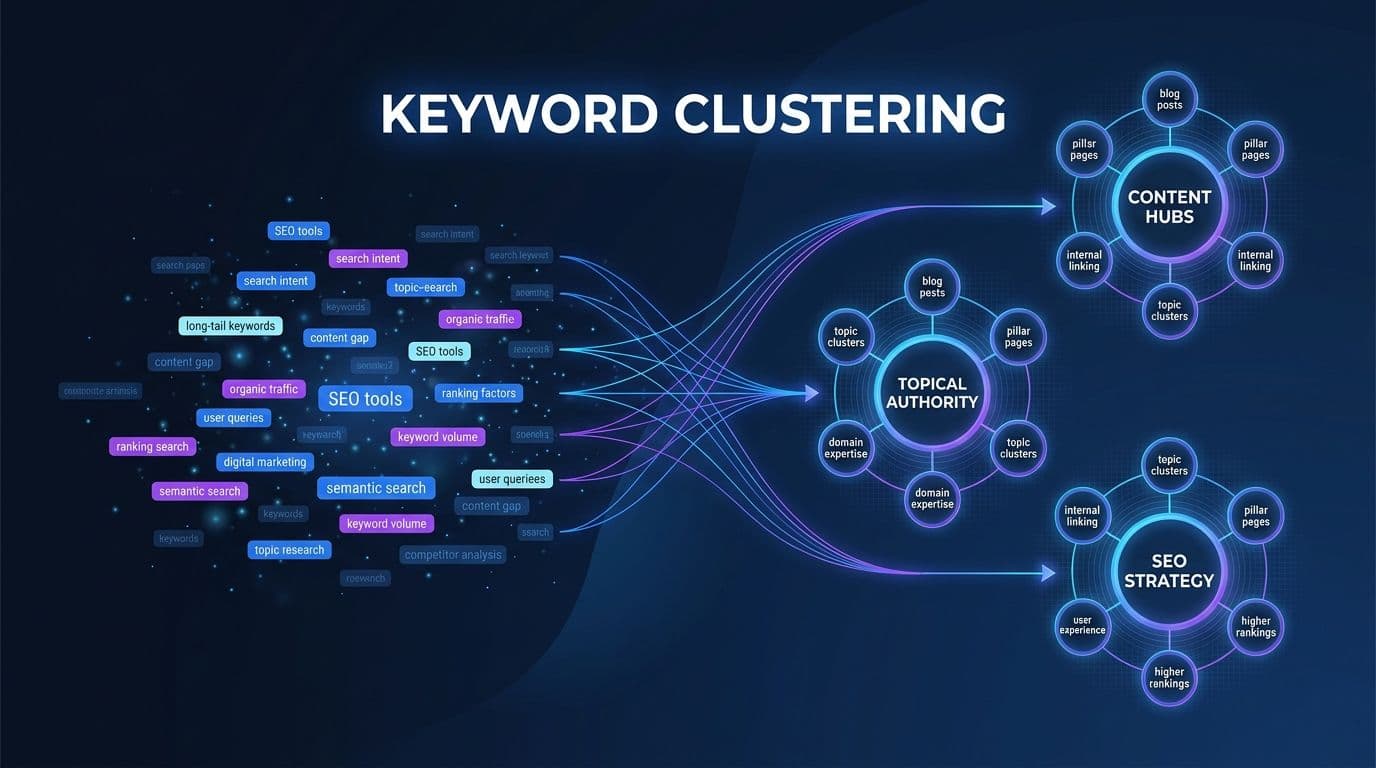
Keyword Clustering in 2026: The Complete Guide to Grouping Keywords, Killing Cannibalization, and Building Topical Authority
TL;DR
- Keyword clustering groups related search terms that share the same intent so one page can rank for dozens of queries instead of splitting authority across many thin pages.
- Cannibalization from unclustered content can cut organic traffic by 30 to 50 percent in affected keyword groups. Proper clustering lifts cluster share of voice by 10 to 25 percent in 60 to 90 days.
- There are three clustering methods: SERP overlap (what Google actually ranks together), semantic embeddings (meaning-based), and a hybrid that combines both for accuracy at scale.
- In 2026 the winning workflow is AI-first and human-refined: automation compresses days of manual grouping into a 2 to 4 hour job, then a strategist reviews the clusters for intent.
- Clustering is the foundation of topical authority and AI search visibility. MarqOps runs research, clustering, and brand-perfect content generation in one unified platform.
Table of Contents
- What Is Keyword Clustering?
- Why Keyword Clustering Matters More in 2026
- The Three Clustering Methods (and When to Use Each)
- How to Do Keyword Clustering: A 7-Step Workflow
- Mapping Clusters to Search Intent and Pages
- Clustering at Scale With AI
- Keyword Clustering Tools: What to Look For
- Common Keyword Clustering Mistakes
- Frequently Asked Questions
What Is Keyword Clustering?
Keyword clustering is the practice of grouping search terms that share the same underlying intent so a single page can target the whole group instead of spreading effort across many near-duplicate pages. Instead of writing one article for “keyword clustering,” another for “how to do keyword clustering,” and a third for “keyword clustering examples,” you recognize that Google treats those queries as the same job and you cover them together on one authoritative page.
The logic is simple once you see it. Google does not rank keywords, it ranks pages against intent. When several queries return largely the same set of results, the search engine is telling you it considers them variations of one need. Clustering makes your content architecture match that reality. It is the connective step between raw keyword research and a content plan that actually builds topical authority.
In practice, clustering produces two page types. A pillar page covers a broad topic at a high level and typically runs 3,000 to 5,000 words, addressing the full subject and linking out to every supporting page. Cluster pages, sometimes called spokes, each target a specific subtopic, long-tail phrase, or narrower intent and link back to the pillar. Together they signal to search engines that your site covers a subject with real depth, not surface-level snippets.
Why Keyword Clustering Matters More in 2026
Search has changed shape. Google now handles roughly 14.4 billion queries per day, and an estimated 34 percent of them are AI-assisted or conversational. Long-tail keywords drive 74.3 percent of all organic search traffic, up from 70 percent a year earlier. The searches that convert are specific, and they arrive in clusters of related phrasing rather than as single high-volume terms. If your content is organized around individual keywords, you are fighting the way people actually search.
The most expensive problem clustering solves is keyword cannibalization, where two or more of your own pages compete for the same intent. When authority splits across competing URLs, organic traffic in that keyword group can fall by 30 to 50 percent. Google is not sure which page to rank, so it under-ranks all of them. Most growing sites have this problem without realizing it, because it accumulates quietly every time someone publishes another post on an already-covered subtopic.
30 to 50%
Organic traffic lost in keyword clusters affected by cannibalization
Done well, the upside is just as concrete. Sites that restructure into pillar pages and topic clusters typically see a 10 to 25 percent increase in cluster share of voice and a 15 to 30 percent increase in keyword breadth within 60 to 90 days, with some reporting organic traffic gains of around 40 percent driven by topical authority. The lift compounds because the whole cluster tends to rise together, which is the clearest signal that search engines trust your site on that subject.
Clustering also feeds the newer visibility game. AI answer engines and Google AI Overviews reward comprehensive, well-structured topic coverage because they need to synthesize an answer from sources that clearly own a subject. The same clustered architecture that wins classic rankings also improves your odds of being cited in answer engine optimization and LLM search. As the line between generative engine optimization and traditional SEO blurs, topic clusters are the shared foundation.
The Three Clustering Methods (and When to Use Each)
Not all clustering is the same. The three dominant approaches differ in how they decide two keywords belong together, and each has a clear best-fit use case.
1. SERP Overlap Clustering
This method pulls the top 10 organic results for each keyword and compares them. If keyword A and keyword B share three or more of the same ranking URLs, they cluster together. The premise is powerful: SERP overlap is a direct read of how Google itself groups intent, not a guess. It is fast, scalable, and reliable for high-volume commercial niches. The trade-off is that it struggles on thin niches where SERPs are sparse or dominated by broad editorial publishers that rank for everything.
2. Semantic (NLP Embedding) Clustering
Semantic clustering uses natural language processing to group keywords by meaning. Each phrase is converted into an embedding, a mathematical vector that represents its meaning, and cosine similarity between vectors decides which terms belong together. This catches relationships that share no common words, grouping “men’s running shoes” with “male athletic footwear.” Because it never queries Google, it is fast and inexpensive, but it has a blind spot: it cannot detect intent overlap that only shows up in the actual search results.
3. Hybrid Clustering
The strongest approach in 2026 combines both. You use embeddings to create broad clusters at scale, then refine them with SERP data so the groups match Google’s real-world interpretation. This gives you the efficiency of NLP with the accuracy of live search behavior, which is exactly why modern SEO automation pipelines default to it.
| Method | Groups By | Best For | Weakness |
|---|---|---|---|
| SERP overlap | Shared ranking URLs | Commercial, high-volume niches | Thin or noisy SERPs |
| Semantic | Embedding similarity | Large keyword sets, speed | Misses SERP-only intent |
| Hybrid | Embeddings plus SERP check | Production SEO at scale | Slightly more setup |
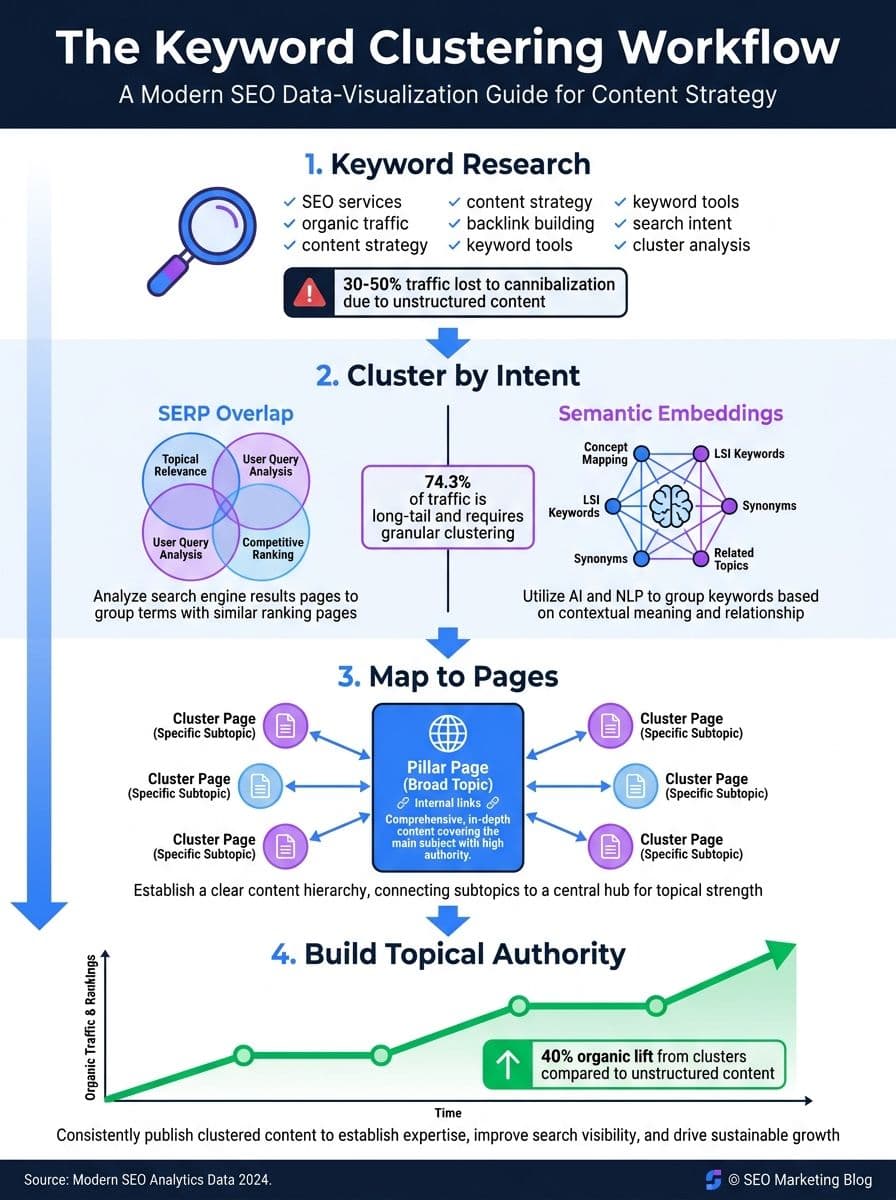
The keyword clustering workflow: from raw keywords to a clustered content architecture that builds topical authority.
How to Do Keyword Clustering: A 7-Step Workflow
Here is a repeatable process that works whether you cluster 200 keywords or 10,000.
Step 1: Build the seed keyword list
Export everything relevant from your research tool: head terms, long-tail variations, questions, and modifiers. For meaningful cluster fidelity, teams typically target 3,000 to 10,000 keywords per niche. Pull volume, difficulty, and current ranking URL for each.
Step 2: Classify intent
Tag each keyword as informational, commercial, navigational, or transactional. Intent is the spine of a good cluster. Roughly 70 percent of searches are informational, 22 percent commercial, 7 percent navigational, and 1 percent transactional, though the split shifts by industry and funnel stage.
Step 3: Run the clustering pass
Apply your chosen method. If you are doing this by hand, start with SERP overlap for the terms that matter most. If you are automating, run embeddings first, then validate the borderline groups with SERP data.
Step 4: Name and prioritize each cluster
Give every cluster a clear label and a primary keyword, usually the highest-volume term that represents the group. Prioritize by a blend of volume, difficulty, and business value rather than volume alone.
Step 5: Assign clusters to pages
Decide which cluster becomes a pillar and which become cluster pages. Pair every spoke with a distinct angle and a measurable goal. If you cannot articulate a unique angle for a spoke, it is a cannibalization risk and probably belongs inside another page.
Step 6: Build the internal link map
Each cluster page links back to its pillar, and the pillar links to every spoke. Maintain a living master sheet with a keyword-to-URL map so no two pages ever chase the same intent. This is the discipline that programmatic SEO depends on when you scale to hundreds of pages.
Step 7: Produce, publish, and track by cluster
Write to the whole cluster, not one keyword, then measure topical visibility by monitoring keyword groups instead of individual rankings. When an entire cluster climbs together, your topical authority is compounding. This is where a strong AI content strategy and disciplined content optimization turn a cluster map into rankings.
Mapping Clusters to Search Intent and Pages
A cluster is only useful when it maps to a specific page with a specific job. The best framework pairs each cluster with three things: a need (the intent), a target page, and a measurable objective such as traffic, a micro-conversion, or a sale. That discipline keeps clusters from bloating into vague catch-all pages.
Group by intent, not by surface modifiers. Words like “best,” “free,” and “2026” matter, but the intent behind the query determines the structure. “Keyword clustering tool” and “best keyword clustering tools” are commercial-investigation queries that belong on one comparison page, while “what is keyword clustering” is informational and belongs on a guide. Mixing those on a single URL confuses both the reader and the ranking algorithm.
A useful test: if you cannot write a one-sentence summary of what a page uniquely answers that no other page on your site answers, the cluster is not yet clean. Split it or merge it before you write a word.
This is also where clustering connects to entity SEO. When your clusters map neatly to the entities and subtopics a search engine associates with your subject, you reinforce that your brand is a recognized authority on the whole topic, not just a handful of keywords.
Clustering at Scale With AI
Manual clustering breaks down past a few hundred keywords. The 2026 production workflow uses three layers. The data layer exports keywords and metrics from a research tool. The clustering layer runs embeddings and clustering algorithms, often validated against SERP data. The strategy layer is where a human reviews, prioritizes, and connects clusters to the content calendar. The shift everyone is watching is AI moving from a standalone tool to connective tissue across the entire workflow.
The efficiency gain is real. Automation compresses what used to take teams several days into a 2 to 4 hour job, and a skilled strategist reviewing the AI-generated clusters for 60 to 90 minutes adds most of the remaining value. The pattern is AI-first and human-refined, never AI-only. Machines are excellent at grouping thousands of terms by similarity, but humans still catch the intent nuances and business context that make a cluster map worth publishing against.
MarqOps runs keyword research, semantic and SERP clustering, and brand-perfect content generation inside one unified platform. Instead of stitching together an export tool, a clustering script, and a separate writer, your team moves from keyword list to published cluster in a single workflow, with Brand Intelligence DNA keeping every page on-voice.
This is the same operating model behind modern SEO agents and a well-run content supply chain: automate the mechanical grouping, keep humans on strategy, and let one platform replace the seven disconnected tools most teams juggle today.
Keyword Clustering Tools: What to Look For
The keyword clustering tool market has exploded, and most options fall into three buckets: dedicated SERP-overlap clusterers, semantic clustering tools built on embeddings, and all-in-one SEO suites that bundle clustering into a broader workflow. The right choice depends less on the algorithm and more on how the tool fits the rest of your content operation.
Prioritize four things. First, method transparency: a good tool tells you whether it clustered by SERP overlap, embeddings, or both, so you can trust the groups. Second, intent labeling, so each cluster arrives tagged rather than as a raw bucket of terms. Third, scale, since serious clustering means processing thousands of keywords in one pass without manual babysitting. Fourth, and most overlooked, integration. The tools that win in 2026 connect to content production through a CMS, an API, or workflow automation, so a cluster becomes a brief and then a draft without a dozen copy-paste steps.
That last point is where standalone clustering tools quietly cost teams the most time. A cluster map that lives in a spreadsheet still has to be handed to a writer, checked against brand guidelines, and reconciled with the content calendar. A unified platform collapses that handoff. MarqOps treats clustering as one stage of a connected pipeline: research feeds clustering, clusters feed brand-aware content generation, and a single dashboard tracks how each cluster performs, so you are not exporting data between seven tools to ship one page.
Common Keyword Clustering Mistakes
Even experienced teams trip on the same few things. Avoid these and you are ahead of most competitors.
Clustering by keyword volume instead of intent. Chasing high-volume terms without matching intent produces traffic that converts to nothing, or no traffic at all. Intent first, always.
Creating a separate page for every keyword. This is how cannibalization starts. If two keywords share three or more ranking URLs, they are one page, not two.
Building clusters once and never revisiting them. SERPs shift, intent evolves, and new subtopics appear. Treat your cluster map as a living document, not a one-time project.
Ignoring the internal link map. Clusters without a deliberate pillar-and-spoke link structure leave most of the topical authority benefit on the table.
Forgetting AI search. A cluster map optimized only for blue links misses the growing share of visibility inside AI Overviews and answer engines. Structure for both from the start.
Frequently Asked Questions
What is keyword clustering in simple terms?
It is grouping search terms that mean the same thing so one page can rank for all of them. Rather than writing separate posts for “keyword clustering” and “how to do keyword clustering,” you cover the whole group on one authoritative page, which concentrates ranking signals instead of splitting them.
How many keywords should be in one cluster?
There is no fixed number. A cluster should contain every query that shares one intent and could reasonably be answered by a single page. What matters is that each page has a distinct angle. If you cannot describe a unique job for a page, its keywords likely belong in another cluster.
SERP overlap or semantic clustering, which is better?
SERP overlap reflects how Google actually groups intent and is best for commercial niches. Semantic clustering is faster and cheaper for very large lists but can miss intent that only appears in the results. A hybrid approach that uses embeddings first and validates with SERP data gives the best balance of speed and accuracy.
How does keyword clustering prevent cannibalization?
By mapping every intent to exactly one page. When you maintain a keyword-to-URL master list, you never unknowingly publish two pages targeting the same query. That keeps Google from splitting authority across competing URLs, which is what causes the 30 to 50 percent traffic drops seen in cannibalized clusters.
Can AI do keyword clustering automatically?
Yes, and it is now the standard. AI compresses days of manual grouping into a few hours using embeddings and clustering algorithms. The best results still come from an AI-first, human-refined workflow where a strategist reviews the clusters for intent and business context. MarqOps builds this directly into its research and content pipeline.
Keep following the signal
Related field notes
Marketing
Marketing Automation for Agencies in 2026: What to Automate, What to Keep Human
11 min readMarketing
Brand Asset Management in 2026: How to Run It Without Adding Another Tool
14 min readMarketing Operations