Entity SEO in 2026: The Complete Guide to Owning Your Brand Identity in Google and AI Search
Entity SEO makes your brand machine-identifiable in Google’s Knowledge Graph and in AI answers. A complete 2026 guide to entity resolution, schema and sameAs, Wikidata, topic clusters, and measuring AI citations instead of rankings.
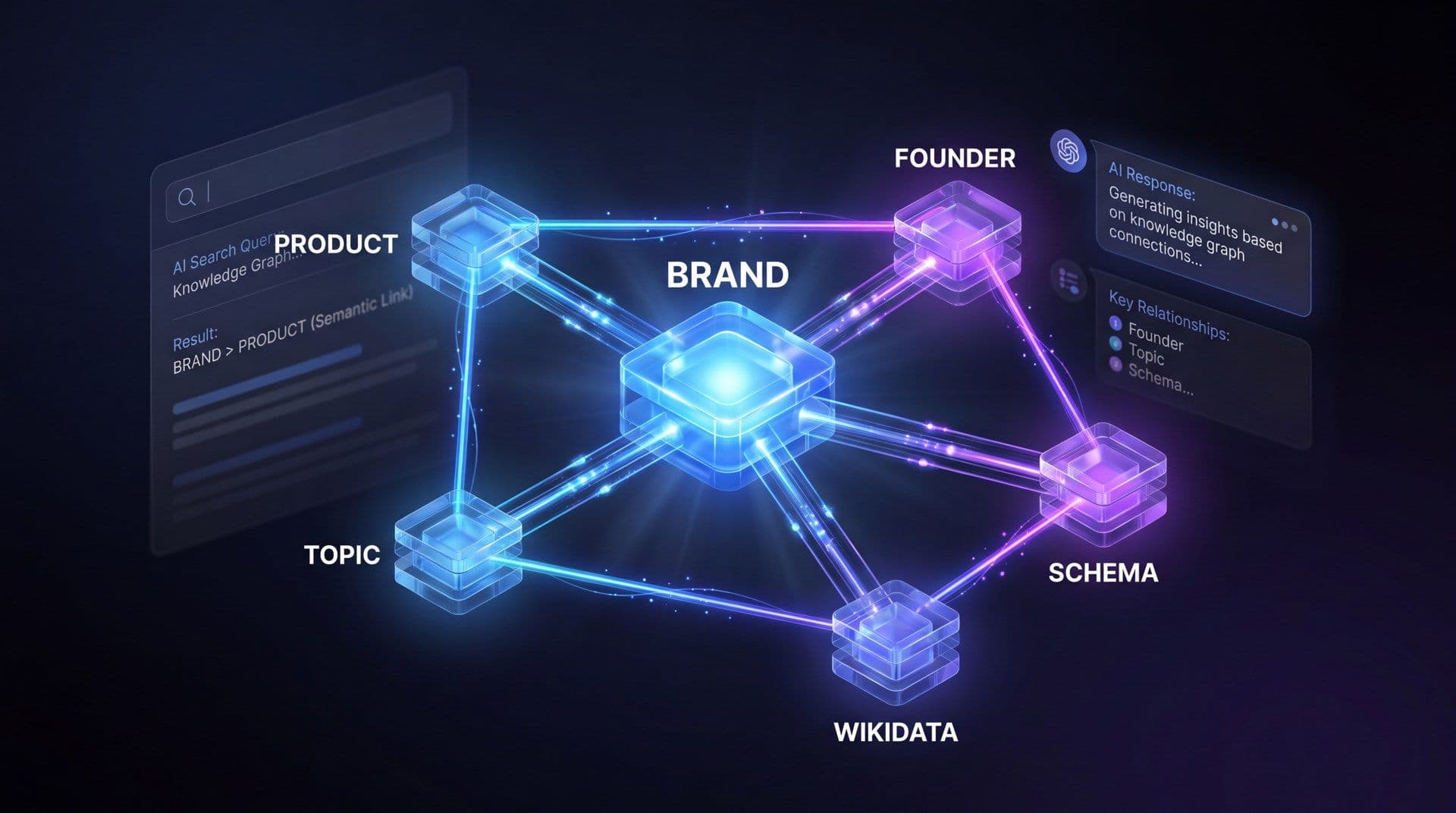
TL;DR
- Entity SEO is the work of making your brand machine-identifiable. Google and LLMs no longer match strings of text. They resolve entities: people, companies, products, and topics that exist as nodes in a knowledge graph.
- The stakes moved. In the first four months of 2026, 68.01% of Google searches ended without a click. When an AI Overview appears, CTR drops by roughly 60%. Being cited inside the answer is now the win condition.
- Brand mentions beat backlinks for AI visibility. Analyses put brand mentions at a 0.664 correlation with AI Overview visibility versus 0.218 for backlinks.
- Schema is your entity passport. Pages with thorough structured data are reported to be roughly 36% to 40% more likely to show up in AI-generated summaries, and attribute-rich markup pushes citation rates from about 41.6% to 61.7%.
- The build order matters: entity home, then Wikidata, then Organization schema with sameAs, then entity-linked content clusters, then third-party mentions. Expect three to nine months for recognition.
- Consistency is the hard part. Entity SEO breaks when your bio, boilerplate, and product descriptions drift across 40 pages and 12 channels. That is a brand governance problem before it is an SEO problem.
What Is Entity SEO?
Entity SEO is the practice of making sure search engines and AI models can unambiguously identify your brand, your people, your products, and the topics you own, and can place them correctly inside a knowledge graph alongside everything else they already know.
The distinction that matters: a keyword is a string. An entity is a thing. “Apple” is a string. Apple Inc. the Cupertino company and apple the fruit are two entities, and Google has known the difference since it launched the Knowledge Graph in 2012 with the phrase “things, not strings.”
What changed is the consequence. For a decade, entity understanding mostly affected which of ten blue links you got. In 2026, entity understanding decides whether you exist at all inside an AI Overview, an AI Mode response, a ChatGPT answer, or a Perplexity citation block. If Google’s Knowledge Graph does not have a confident record of who you are, an LLM asked “what are the best marketing operations platforms” has no reliable node to retrieve. You are not outranked. You are simply not in the conversation.
The short version: keyword SEO gets you ranked. Entity SEO gets you retrieved. In an answer-first search landscape, retrieval is the thing that pays.
Table of Contents
- What Is Entity SEO?
- Why Entity SEO Suddenly Matters More Than Keywords
- How Google and LLMs Actually Resolve Entities
- The Entity SEO Stack: Five Layers, In Order
- A Step-by-Step Entity SEO Playbook
- Schema Markup That Actually Moves Citations
- Entity SEO vs Semantic SEO vs Topical Authority
- How to Measure Entity SEO (Rankings Will Lie to You)
- Seven Mistakes That Quietly Kill Entity Signals
- How MarqOps Operationalizes Entity SEO
- Frequently Asked Questions
Why Entity SEO Suddenly Matters More Than Keywords
Three data points explain the shift better than any think piece.
68.01%
of Google searches in early 2026 ended without a click
First, the click is disappearing. SparkToro’s 2026 analysis found that fewer than one third of Google searches still send a click to an external site. Zero-click sat at 60.45% in 2024 and reached 68.01% across the first four months of 2026. The share of searches producing at least one external click fell 9.51 percentage points over two years, a 22.9% decline. In Google’s AI Mode, the pattern is far starker, with reports of roughly 93% of sessions ending without a click.
Second, AI Overviews compress everything below them. AI Overviews now appear on more than 20% of searches, and when one is present, click-through rate drops by close to 60%. Roughly 83% of AI Overview searches end with no click at all. Ranking third on a page nobody scrolls is an expensive kind of nothing. We covered the mechanics of this in depth in our guide to winning citations in AI Overviews.
Third, and this is the one that should reorganize your roadmap: the signals that predict AI citation are not the signals you have been optimizing. Studies of AI Overview visibility put brand mentions at a 0.664 correlation coefficient, while backlinks land at 0.218. Link building, the discipline that ate a generation of SEO budgets, is roughly a third as predictive as simply being talked about consistently and credibly across the web.
That is an entity problem. An LLM does not have a link graph in its head at inference time. It has embeddings shaped by how often and how coherently your brand co-occurs with the topics you claim to own. If “MarqOps” reliably appears near “marketing operations,” “AI content generation,” and “unified marketing dashboard” across many trusted sources, the model builds a strong, well-connected entity embedding. If your brand appears rarely, or appears inconsistently described, the embedding stays fuzzy and the model reaches for a competitor it is more sure about.
How Google and LLMs Actually Resolve Entities
Four mechanisms are running under the hood. Understanding them tells you exactly what to build.
1. Entity extraction and disambiguation
Natural language processing pulls named entities out of your text and tries to match each one to a known node. When your page says “Marq,” the system asks whether that means your company, a fashion label, or a typo. It resolves the ambiguity using surrounding context. Co-occurring entities are the strongest disambiguation signal available. A page that mentions your brand alongside “marketing automation,” “SEO agents,” and “creative production” resolves cleanly. A page that mentions it alongside nothing in particular does not resolve at all.
2. Entity salience
Salience measures how central an entity is to a document, not how many times it appears. This is the part most teams get backwards. Keyword repetition does not increase salience. Writing clearly and substantively about an entity, in proper context, early in the document, with supporting detail, does. A 3,000 word page that mentions your focus entity 40 times but explains it once has low salience. A 1,200 word page that genuinely defines, contextualizes, and relates the entity has high salience.
3. sameAs resolution
The sameAs property in schema.org is the closest thing entity SEO has to a passport stamp. It says: this entity on my site is the same entity as this record on Wikidata, this LinkedIn company page, this Crunchbase profile, this trade association listing. Organization and Person schema carrying sameAs identifiers lets an AI system resolve the publishing entity against knowledge graph records instead of guessing.
4. Corroboration across independent sources
Knowledge graphs do not trust a single source, including you. They look for the same claim made by multiple independent parties. Your about page says you were founded in 2023 and serve marketing teams. Does Crunchbase agree? Does the press coverage agree? Does your LinkedIn agree? Every corroboration raises confidence. Every contradiction lowers it, and low confidence entities get skipped in AI answers because the model has no reliable fact to state.
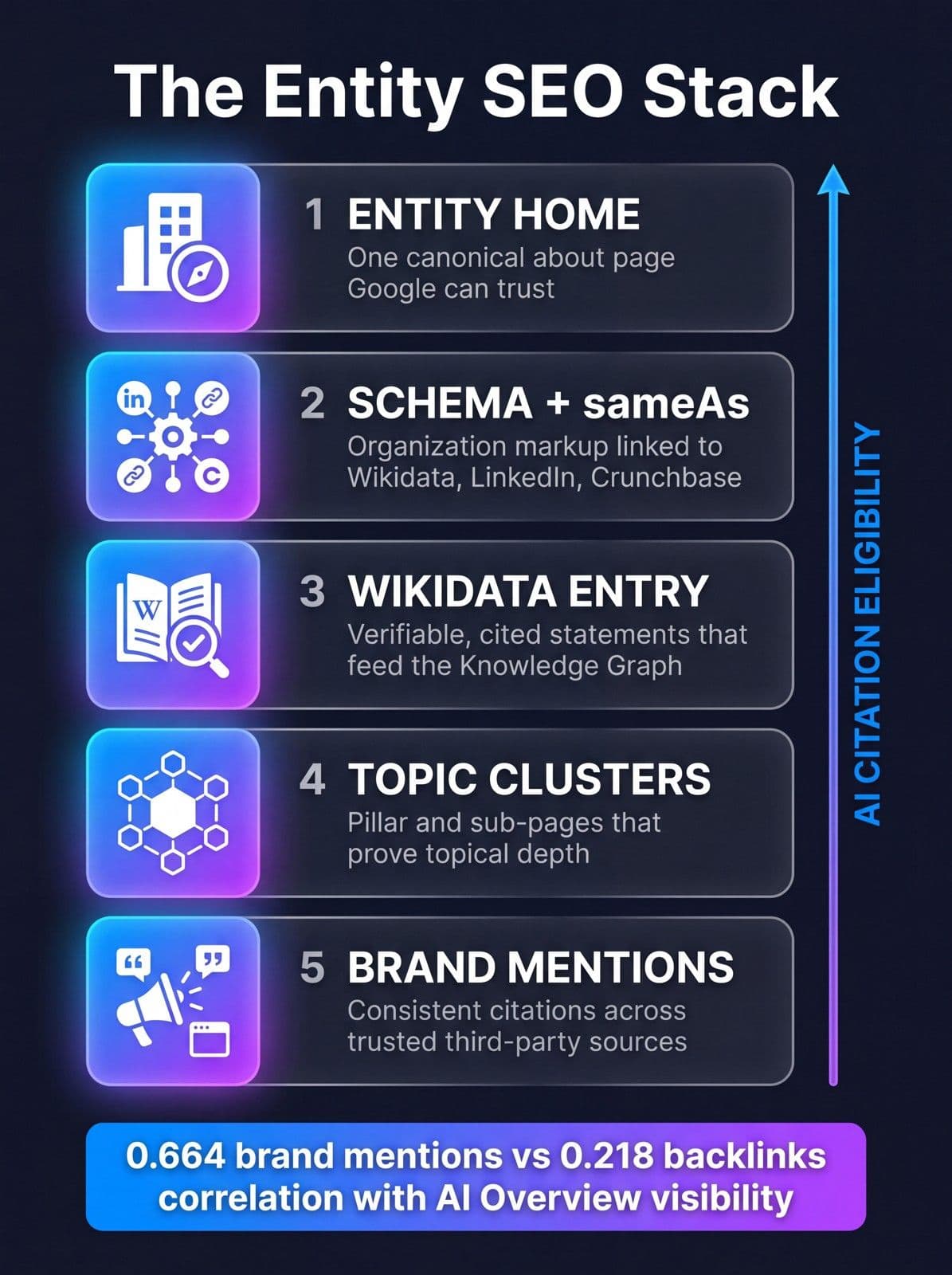
The five layers of the entity SEO stack, in the order you should build them.
The Entity SEO Stack: Five Layers, In Order
Most teams start with schema because it feels technical and therefore feels like real SEO work. That is the wrong entry point. Schema without a coherent entity underneath it is a passport with no citizen. Build in this order.
Layer 1: The entity home
Pick one canonical URL that is the definitive statement of what your brand is. For most companies this is the about page or a dedicated company page. It must state, in plain declarative language: what the company is, what category it operates in, who it serves, when it was founded, where it operates, who runs it, and what it is known for. No mission-statement fog. Google cannot resolve “we are reimagining the future of human connection.” It can resolve “MarqOps is an AI marketing operations platform that unifies creative production, SEO content, analytics, and paid advertising for marketing teams.”
Layer 2: Wikidata
Google’s Knowledge Graph draws heavily on Wikidata, and unlike Wikipedia, Wikidata has a lower notability bar and is directly editable. Every statement you add must be verifiable and backed by a public, reliable source citation. Get your Q-identifier, populate the core properties (instance of, industry, founded, official website, headquarters), and cite each one. This is the single highest-leverage hour most brands never spend.
Layer 3: Organization schema with sameAs
Now the passport makes sense. Ship rigorous Organization schema on the entity home, with sameAs pointing to your Wikidata Q-ID, LinkedIn, Crunchbase, GitHub, G2, industry directories, and any authoritative third-party profile. Keep your name, address, and phone identical everywhere. NAP inconsistency is the most common and most avoidable entity killer.
Layer 4: Entity-linked content clusters
Internal linking is how you tell Google which entities relate to which. Build strict clusters: a pillar page for the entity, sub-pages for each meaningful sub-entity, links running both directions. Inside content, use Article schema’s about property to declare the page’s primary entity and mentions to list significant secondary entities, with each linked to its Wikipedia or Wikidata URI. This is the difference between “we wrote about SEO” and “this document is about the entity Q_____.” Our guides to AI content optimization and programmatic SEO at scale both depend on this cluster structure holding up.
Layer 5: Third-party mentions
Last, and hardest to fake: get talked about. Podcasts, review sites, industry roundups, analyst coverage, partner pages, conference listings, community threads. What you want is not a link. It is your brand name appearing near your topic entities in a source the model trusts. Given the 0.664 versus 0.218 gap, an unlinked mention in a credible industry publication may well be worth more to your AI visibility than a followed link from a directory nobody reads.
Realistic timeline: entity recognition typically takes three to nine months of consistent signals. Brands that combine schema, a cited Wikidata entry, sameAs equity, and roughly 30 or more entity-defining content pieces tend to see knowledge panel features and AI Overview citations inside two quarters. This is a compounding asset, not a campaign.
A Step-by-Step Entity SEO Playbook
Step 1: Audit whether you exist
Query the Google Knowledge Graph Search API for your brand name. If nothing returns, or the wrong thing returns, you have no entity. Then run your brand through ChatGPT, Gemini, Perplexity, and Claude with a neutral prompt: “What is [brand]?” and “Who are the leading vendors in [your category]?” Write down exactly what comes back, including the errors. Those errors are your entity gaps made visible. We built a full workflow for this in our guide to AI brand monitoring.
Step 2: Map your entity set
List every entity you need to own: the company, each product or module, each founder and executive, each core topic, and each named framework or methodology you have coined. For each, decide whether it should be a distinct entity or a property of another. Most brands over-fragment here, spinning up entity pages for things that are really just features.
Step 3: Fix the contradictions before you add anything
Pull your boilerplate description from your website footer, your LinkedIn, your Crunchbase, your G2 profile, your press releases, and your last ten guest posts. Line them up. If your one-line description of the company differs meaningfully across those, stop and standardize before you write another word of schema. Contradiction actively suppresses entity confidence.
Step 4: Ship the technical layer
Organization schema on the entity home. Person schema for named executives, with sameAs to their LinkedIn and any speaker or author profiles. Article schema with about and mentions on every content page. Product or SoftwareApplication schema where applicable, filled out properly, because attribute-rich markup with real prices, ratings, and specs hits around a 61.7% citation rate versus roughly 41.6% for minimal implementations.
Step 5: Write for entity coverage, not keyword density
Every page on a topic should name and briefly define the related entities a knowledgeable human would naturally mention. Writing about entity SEO without mentioning the Knowledge Graph, schema.org, Wikidata, salience, and disambiguation signals shallow coverage to an NLP system, no matter how many times you repeat the phrase. Coverage of the entity neighborhood is the modern version of comprehensiveness.
Step 6: Instrument for citations, not positions
Track how often each AI surface names you, and in what context. Rankings and AI citations are now two separate competitions, and you can win one while losing the other badly. More on the measurement stack below.
Schema Markup That Actually Moves Citations
A necessary caveat first, because the SEO internet is currently full of overclaiming. Google’s official documentation says there is no special structured data required for AI Overviews or AI Mode. Take that at face value. There is no schema type that buys you a citation.
What structured data does is make your entity trivially easy to parse and verify, and the correlational evidence for that being valuable is consistent across independent studies:
- BrightEdge found sites implementing structured data and FAQ blocks saw a 44% increase in AI search citations.
- Pages with thorough schema markup are reported as roughly 36% more likely to appear in AI-generated summaries.
- Sites with complete Tier 1 schema have been observed with up to 40% more AI Overview appearances.
- Bing confirmed in 2025 that schema markup helps its LLMs understand content for Copilot, and Google’s Search team acknowledged that structured data gives an advantage in search results.
Correlation, not proof of causation. But the cost of shipping good schema is a few engineering hours and the downside is zero, which makes this one of the easiest expected-value calls in marketing.
The Tier 1 set worth building properly:
- Organization on the entity home, with sameAs, logo, foundingDate, and a plain-language description that matches your canonical boilerplate exactly.
- Person for every executive who publishes, speaks, or gets quoted. Author entities are increasingly load-bearing for trust.
- Article with
about(one primary entity, linked to its Wikidata URI) andmentions(the secondary entities). - FAQPage on content that answers real questions, since question-and-answer structure maps cleanly onto how LLMs chunk and retrieve.
- Product or SoftwareApplication, filled out completely. Half-populated product schema is where the 41.6% versus 61.7% citation gap lives.
- BreadcrumbList, because hierarchy is a relationship signal and relationships are the whole game.
Entity SEO vs Semantic SEO vs Topical Authority
These three get used interchangeably and they are not the same thing. The distinction is practically useful.
- Entity SEO is about identity. Can machines tell who and what you are, and connect you correctly to other known things? The output is a resolved, high-confidence node in a knowledge graph.
- Semantic SEO is about meaning. Does your content cover a topic in a way that reflects how concepts genuinely relate, rather than how keywords cluster in a tool? The output is content that satisfies intent across a concept space.
- Topical authority is about earned trust across a subject. Have you covered the topic and its subtopics with enough depth, consistency, and corroboration that you are treated as an expert source? The output is being surfaced for queries you never explicitly targeted.
They stack. Entity resolution is the foundation, semantic coverage is the structure, topical authority is the result. Skip the foundation and you get a site that is comprehensive, well written, and invisible in AI answers because nothing knows who wrote it. This is exactly the failure mode we mapped in GEO vs SEO and expanded on in our LLM SEO guide.
How to Measure Entity SEO (Rankings Will Lie to You)
Position tracking is now an incomplete instrument. You can hold position two and lose 60% of your clicks to an AI Overview that cites someone else. Here is the measurement stack that actually reflects reality.
Entity resolution metrics
- Knowledge Graph presence: does the Knowledge Graph Search API return your entity, with the right description and type? Track the MID.
- Knowledge panel: does a branded search produce one, and is the information correct?
- sameAs coverage: how many authoritative profiles are cross-linked, and are they all live and consistent?
AI visibility metrics
- Citation rate: across a fixed prompt set for your category, how often does each AI surface name you? Run the same prompts weekly and chart the trend.
- Share of voice against named competitors in those same answers.
- Accuracy: when you are named, is the description right? A confidently wrong entity is worse than no entity.
- Implicit mentions: being described without being linked still counts, and most tools miss it.
Corroboration metrics
- Unlinked brand mentions per month across trusted domains. Given the correlation data, this deserves a place on the executive dashboard next to traffic.
- Entity co-occurrence: when your brand is mentioned, which topic entities appear nearby? That neighborhood is what the model learns.
If you need a place to run all of this, our roundups of AI search visibility tools and AI SEO platforms compare the current options honestly, including where they fall short.
Seven Mistakes That Quietly Kill Entity Signals
- Boilerplate drift. Four different one-line descriptions of your company across four channels. This is the number one entity killer and it is entirely self-inflicted.
- Schema without substance. Marking up a page that says nothing definitive about the entity. The markup validates. The entity still does not resolve.
- Vague category language. “Platform for modern teams” is not a category. If a human cannot tell what you sell in one sentence, neither can a language model.
- Orphaned author identities. Publishing under names with no Person schema, no sameAs, no author page. Author entities carry trust and you are throwing it away.
- Over-fragmenting the entity set. Creating separate entity pages for every feature dilutes salience across pages instead of concentrating it.
- Chasing links while ignoring mentions. Optimizing the 0.218 signal and neglecting the 0.664 one is the most expensive misallocation in SEO right now.
- Treating it as a one-off project. Every new page, product launch, and executive hire either reinforces or dilutes the entity. This is an operating discipline, not a sprint ticket. Which is precisely where most teams break.
How MarqOps Operationalizes Entity SEO
Here is the honest problem with everything above: none of it is intellectually difficult, and almost nobody executes it well. The reason is not talent. It is fragmentation.
Entity SEO requires your website copy, your blog, your ad creative, your social bios, your sales decks, and your third-party profiles to describe the same entity the same way, forever, across every person who touches the brand. In a typical stack, that content is produced in seven or more disconnected tools by different teams with different briefs. Drift is not a risk in that setup. It is the default outcome.
MarqOps was built around that failure. Brand Intelligence DNA encodes your canonical entity definition once (category, positioning, boilerplate, approved terminology, the topic entities you own, the entities you must not be confused with) and then every asset the platform generates inherits it. The blog post, the ad copy, the landing page, and the social caption all describe the same company in the same terms, because they are all drawing from the same source of truth rather than from whatever a writer had open in another tab.
That has three downstream effects on entity signals. Your on-site corpus stops contradicting itself, which raises entity confidence. Your content velocity goes up roughly 6x, which means you can actually produce the 30-plus entity-defining pieces that recognition requires instead of shipping four a quarter. And because creative, SEO, analytics, and paid advertising run in one unified platform rather than seven disconnected tools, the entity signals you send through ads and social reinforce the ones you send through search instead of quietly undermining them.
The measurement side sits in the same dashboard. Track knowledge panel status, AI citation rate across ChatGPT, Gemini, Perplexity, and Google AI Overviews, unlinked mention volume, and competitive share of voice next to your traffic and pipeline numbers, rather than in a spreadsheet somebody updates when they remember. If you want the broader context for how this fits a modern operating model, start with our guide to marketing operations or see how AI SEO agents handle the repetitive execution layer.
The one-sentence takeaway: entity SEO is brand governance with a technical output, and the brands that will get cited in 2027 are the ones that fix their identity consistency in 2026.
Frequently Asked Questions
What is entity SEO in simple terms?
Entity SEO is the work of making search engines and AI models understand exactly who you are and what you are known for, as a thing rather than as a set of keywords. It means giving them a clear, consistent, corroborated identity they can place inside a knowledge graph and retrieve with confidence when someone asks a relevant question.
Is entity SEO the same as semantic SEO?
No, though they overlap. Entity SEO is about identity and resolution: can a machine tell who you are and how you connect to other known things. Semantic SEO is about meaning and coverage: does your content reflect how concepts actually relate. Entity SEO is the foundation that semantic SEO is built on, and topical authority is what you earn when both are done well.
How long does entity recognition take?
Typically three to nine months once consistent signals are in place, and faster in niches with low entity competition. Brands that combine schema markup, a properly cited Wikidata entry, strong sameAs coverage, and 30 or more entity-defining content pieces often see knowledge panel features and AI Overview citations within two quarters.
Do I need a Wikipedia page for entity SEO?
No, and most companies will not qualify for one. Wikipedia has a high notability bar and editing it promotionally will backfire. Wikidata is the practical alternative: it feeds the Knowledge Graph directly, has a lower bar, and accepts entries as long as every statement is verifiable and cited to a reliable public source.
Does schema markup guarantee AI Overview citations?
No. Google states plainly that no special structured data is required for AI Overviews or AI Mode. What the evidence does show is a consistent correlation: sites with thorough, attribute-rich schema appear in AI summaries more often, with observed lifts in the 36% to 44% range and citation rates rising from roughly 41.6% to 61.7% when markup is fully populated rather than minimal. Treat schema as making your entity easy to verify, not as a lever that forces a citation.
Are brand mentions really more valuable than backlinks now?
For AI visibility specifically, the data points that way. Analyses of AI Overview visibility find brand mentions correlating at 0.664 versus 0.218 for backlinks. Backlinks still matter for traditional organic rankings, so this is not a reason to abandon them. It is a reason to stop treating an unlinked mention in a credible industry publication as a failed link-building attempt, because for AI retrieval it may be the more valuable outcome.
How do I measure entity SEO if rankings no longer reflect traffic?
Track three layers. Entity resolution: Knowledge Graph API presence, knowledge panel accuracy, sameAs coverage. AI visibility: citation rate and share of voice across a fixed prompt set run weekly on ChatGPT, Gemini, Perplexity, and Google AI Overviews, plus whether the description of you is accurate. Corroboration: unlinked brand mentions per month and which topic entities co-occur with your brand.
Where should a small team start if they can only do one thing?
Standardize your entity description. Write one clear, declarative sentence about what your company is, who it serves, and what category it competes in, then make that exact sentence appear on your about page, your LinkedIn, your Crunchbase, your G2 profile, and in every author bio and press boilerplate you publish. Contradiction suppresses entity confidence more than any missing schema tag, and fixing it costs nothing but discipline.
The Bottom Line
Search stopped being a ranking competition and became a retrieval competition. Two thirds of Google searches now end without a click, AI Overviews cut CTR by roughly 60% where they appear, and the signal that best predicts whether a model names you is not your backlink profile but whether the web talks about you consistently enough for a machine to know what you are.
That is not a content problem or a technical SEO problem. It is an identity problem, and identity is only as strong as its weakest, most contradictory touchpoint. Fix the entity, ship the schema, earn the mentions, and measure citations instead of positions. The brands doing that work now are the ones AI will be recommending for the next decade.
Keep following the signal
Related field notes
Marketing
Brand Asset Management in 2026: How to Run It Without Adding Another Tool
14 min readMarketing Operations
Marketing Project Management Software in 2026: How to Choose Without Adding Tool #122
11 min readMarketing Analytics