Google AI Mode in 2026: The Complete Guide to Getting Cited When Google Answers With AI
Google AI Mode replaces blue links with cited AI answers built via query fan-out. Here is how it works and a practical 2026 playbook to get your brand cited.
TL;DR
- Google AI Mode is the conversational, Gemini-powered search experience that answers questions directly with synthesized responses and inline citations instead of a list of ten blue links. It passed 1 billion monthly users about a year after launch. [Primary source: Google Search Central: AI features and your website] [Primary source: Google Search: optimizing for generative AI features]
- It works through query fan-out: your single question is broken into roughly a dozen or more parallel sub-searches, and the results are reasoned over and stitched into one answer. That changes what “ranking” even means.
- Roughly two-thirds of US Google searches now end without a click, and AI Mode sessions are far more zero-click than that. The new prize is being the cited source inside the answer, not position 1.
- AI Mode and AI Overviews cite the same URLs only about 14% of the time, so you need to optimize for both surfaces separately. Topical depth, entity clarity, and clean structured data are the levers that move citation odds.
- Only about 14% of marketers currently track AI visibility. The teams that measure it and build for it now will own the next few years of search.
Table of Contents
- What Is Google AI Mode?
- How Google AI Mode Actually Works
- Why AI Mode Breaks Traditional SEO
- AI Mode vs AI Overviews vs Classic Search
- How to Optimize for Google AI Mode
- How to Measure Your AI Mode Visibility
- Your 30/60/90-Day AI Mode Roadmap
- Frequently Asked Questions
What Is Google AI Mode?
Google AI Mode is a conversational search experience built into Google Search that answers your question with a generated, reasoned response and inline citations, then lets you ask follow-ups in the same thread. Instead of scanning ten blue links, you get a synthesized answer at the top of the page, assembled by a custom build of Gemini that is tuned for search-grounded retrieval rather than open-ended chat.
The scale is the part most marketing teams still underestimate. AI Mode crossed 1 billion monthly active users roughly a year after launch, and query volume on the surface has been more than doubling quarter over quarter. Google has also started making AI-first experiences the default for more searches, which means this is no longer an experimental tab that a few power users click. It is becoming the front door to search itself.
If you have already read our guide to AI Overviews, think of AI Mode as the next step along the same curve. AI Overviews inject a summary above the results for a slice of queries. AI Mode replaces the results page entirely with a conversation. Both are pulling attention away from the classic link list, and both reward a very different kind of content than the keyword-stuffed pages of the last decade.
The shortcut definition: AI Mode turns search from “here are pages that might answer you” into “here is the answer, and here is who I trusted to build it.” Your job is to become one of those trusted sources.
How Google AI Mode Actually Works
To optimize for AI Mode you have to understand the mechanism underneath it, because it is genuinely different from the classic crawl-index-rank pipeline. The core technique is called query fan-out.
Query fan-out, explained simply
When you type a question into AI Mode, Google does not run one search. It parses the entities, constraints, and intent in your question, decomposes it into many smaller sub-questions, and fires those off as parallel searches across its index. Reporting on the system suggests it can launch on the order of a dozen or more of these hidden queries at once. It then collects the results, filters them, reasons over them, and synthesizes a single answer with citations attached to the specific claims.
This matters enormously. A user asks one thing, but your content is being evaluated against a whole tree of related sub-topics they never typed. Pages that only answer the literal head query lose. Pages that comprehensively cover the topic and its adjacent questions get pulled into multiple fan-out branches and cited far more often. One large study of citation patterns found that pages ranking for these fan-out sub-queries were roughly 161% more likely to be cited than pages ranking only for the main query.
Retrieval, reasoning, and citation
AI Mode runs on Gemini variants fine-tuned specifically for retrieval-augmented generation and citation handling, distinct from the consumer Gemini app. After the fan-out step, the model grounds its answer in retrieved passages and attaches citations to sources it considers reliable. About 97% of AI Mode responses include at least one citation, so there is real, ongoing demand for trustworthy source pages. The competition is simply for which pages fill those citation slots.
~161%
more likely to be cited if you rank for fan-out sub-queries, not just the head term
Why AI Mode Breaks Traditional SEO
The old model was a competition for ten ranked positions. AI Mode inverts it. Instead of fighting for a spot in a list the user scrolls, you are fighting to be named inside an answer the user reads and then acts on without scrolling at all.
The click math has already shifted hard. Roughly two-thirds of US Google searches now end without a click to any website, and inside AI Mode specifically the zero-click rate runs much higher because the answer is so complete. This is the same structural change we covered in depth in our zero-click search guide: traffic to your site is no longer the only unit of value. Being the cited authority, even without the click, builds brand recall, trust, and downstream demand.
There is also a nasty measurement gap. AI Mode and AI Overviews reach the same conclusion for a query about 86% of the time, yet they cite the same URLs only about 14% of the time. In practice that means you can be winning AI Overviews and completely absent from AI Mode for the identical question. You cannot treat them as one surface. This is where generative engine optimization and classic SEO stop being interchangeable and start needing separate playbooks.
The uncomfortable truth: ranking on page one is now an upstream filter for citation, not the finish line. You still need strong organic positions to be in the retrieval pool, but that only earns you the audition. Depth, clarity, and trust decide whether you get quoted.
What this means for your content team day to day
The practical consequence is that content can no longer be planned one keyword at a time. A page that targets a single phrase is competing in a world where the model is quietly asking a dozen related questions on the reader’s behalf. Teams that still brief writers around isolated head terms will keep losing citation slots to competitors who plan around whole question trees. The winning workflow starts from the topic and its cluster of sub-questions, then produces coverage fast enough to actually fill it. That combination of breadth and speed, rather than any single clever tactic, is what separates the brands that show up in AI Mode from the ones that do not.
AI Mode vs AI Overviews vs Classic Search
These three surfaces coexist on the same results page today, and each rewards slightly different behavior. Here is how they compare.
| Dimension | Classic Search | AI Overviews | AI Mode |
|---|---|---|---|
| Output | Ranked list of links | Summary above results | Full conversational answer |
| Win condition | Rank in top 10 | Get cited in the summary | Get cited across fan-out branches |
| Best content shape | Keyword-targeted pages | Clear, extractable answers | Deep topical clusters |
| Typical click behavior | Moderate CTR | Lower CTR, some clicks | Heavily zero-click |
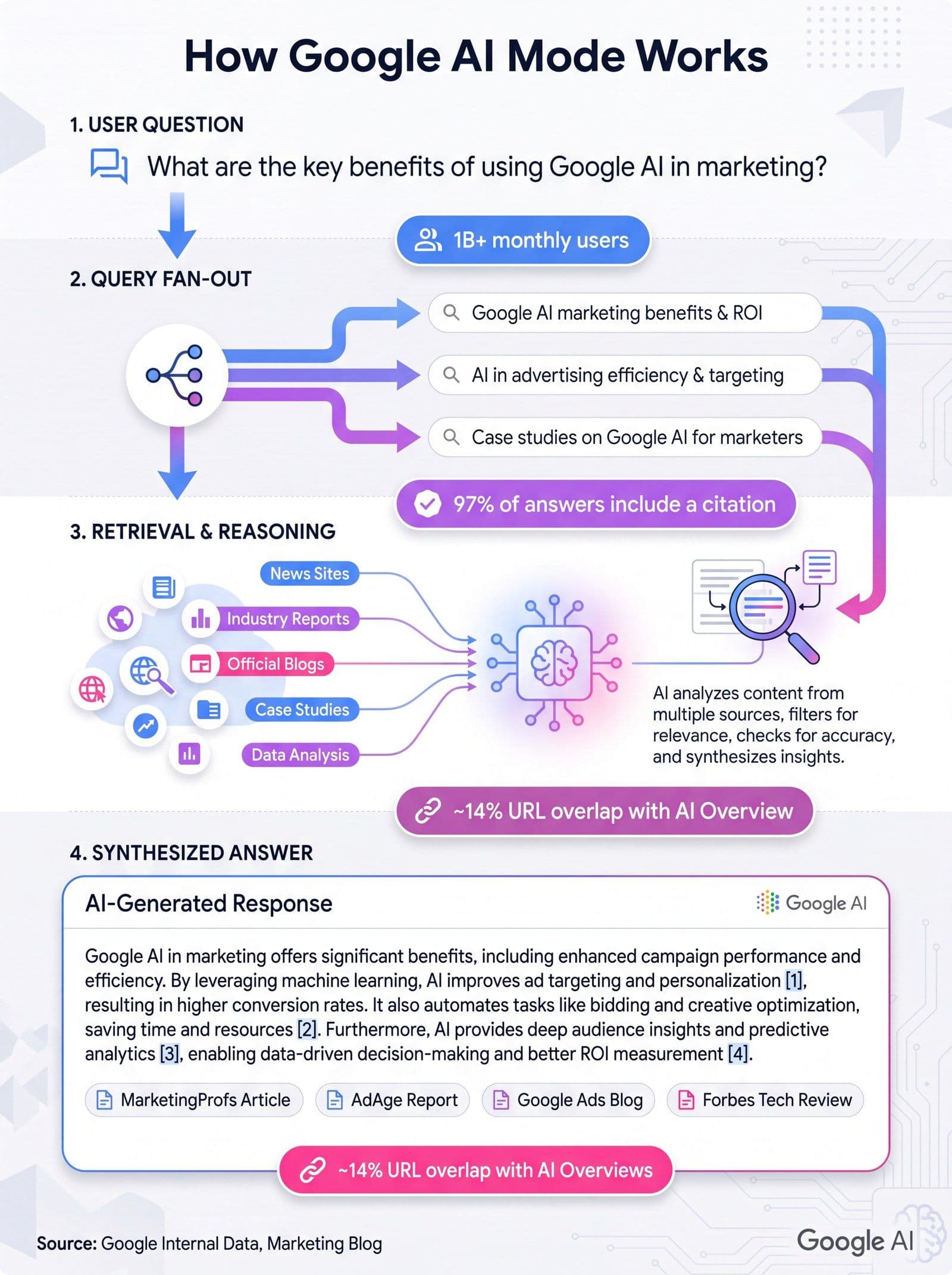
How Google AI Mode turns one question into a cited answer through query fan-out.
How to Optimize for Google AI Mode
There is no secret setting or schema flag that forces AI Mode to cite you. Google has been explicit that no special markup is required. What actually moves the needle is a stack of signals that make your content easy to retrieve, easy to verify, and worth trusting. Here is the practical stack, in priority order.
1. Build genuine topical depth, not one-off pages
Because AI Mode fans a query out into many sub-topics, the sites that win cover a subject and everything around it. A single thin article rarely gets pulled into multiple fan-out branches. A well-built cluster does. This is exactly why topical authority has become the dominant ranking story of 2026, and why keyword clustering is the planning discipline underneath it. Map the main topic, then deliberately publish for the adjacent questions a curious reader would ask next.
2. Answer conversational, multi-part questions directly
AI Mode users ask longer, messier, more conversational questions than they typed into classic search. Structure your content so the answer to a real question is stated clearly and early, ideally in the first sentence or two of a section, then supported with detail. Extractable, self-contained answers are what a retrieval model can lift cleanly into a cited response. This is the same discipline behind answer engine optimization.
3. Make your entity unmistakable
AI systems cite sources they can verify. That starts with a clear, consistent identity: who you are, what you are an authority on, and how that maps to known entities in Google’s knowledge graph. Consistent naming, an accurate Organization profile, and tight internal linking all reinforce this. Our guide to entity SEO walks through building that foundation so AI Mode understands not just your pages but your brand.
4. Use structured data as a clarity signal
Structured data has quietly shifted from a rich-result trigger to a trust and verification signal for AI systems. JSON-LD now sits on roughly 41% of all pages, and while Google says no special schema is required for AI Mode citation, clean Organization, Article, and FAQ markup makes your content and authority easier for the model to confirm. Think of schema as removing ambiguity, not gaming the system.
5. Keep strong organic rankings as the entry ticket
Ranking well is now the upstream filter that gets you into the retrieval pool. If you are not on page one for the head query and its variants, you rarely make it into the fan-out results at all. Classic fundamentals still matter, which is why scaling them through SEO automation and disciplined AI content optimization is how lean teams keep pace without burning out.
6. Optimize for both AI Mode and AI Overviews separately
Because the two surfaces cite the same URL only about 14% of the time, a win on one is not a win on the other. Track them independently and look at which pages get cited where. If you are strong in AI Overviews but invisible in AI Mode, the fix is usually deeper topical coverage and clearer entity signals rather than more of the same summary-style content.
Quick win: take your five highest-traffic pages, list every sub-question a reader might ask around each one, and check whether your content actually answers them. The gaps you find are your fan-out citation opportunities.
How to Measure Your AI Mode Visibility
You cannot improve what you do not track, and right now most teams are flying blind. Only about 14% of marketers currently monitor AI visibility, even as roughly 43% say they are actively implementing generative engine optimization. That gap is the opportunity: the teams measuring AI Mode citations today have almost no competition for the insight.
Start by tracking three things. First, citation presence: is your brand named in AI Mode answers for your priority queries, and for which sub-topics? Second, citation share of voice against competitors, a concept that maps closely to share of search. Third, sentiment and accuracy: when you are cited, is the framing correct and on-brand? Purpose-built AI search visibility tools and ongoing AI brand monitoring make this trackable across ChatGPT, Gemini, Perplexity, and Google AI Mode in one view.
This is precisely the kind of fragmented, multi-surface measurement problem that MarqOps was built to collapse. Instead of stitching together a rank tracker, a GEO tool, an analytics tab, and a brand monitor, the platform pulls AI visibility, SEO, and content performance into one unified dashboard so you can see where you are cited and where you are missing without switching tools.
Your 30/60/90-Day AI Mode Roadmap
If AI Mode feels overwhelming, sequence it. Here is a realistic plan a marketing team can actually run.
Days 1 to 30: Baseline and audit
Establish where you stand. Identify your 20 most important queries, check whether you appear in AI Mode and AI Overviews for each, and record your citation baseline. Audit your top pages for entity clarity and Organization schema. This is your before picture, and you will be glad you captured it.
Days 31 to 60: Depth and structure
Turn thin pages into clusters. For each priority topic, publish the adjacent sub-topic content that fan-out will reward, and rewrite key sections so answers are stated cleanly up front. Tighten internal links between cluster pages to reinforce topical relationships. This is where LLM-oriented SEO practices and a fast content engine pay off, since depth at speed is the whole game.
Days 61 to 90: Measure, iterate, and scale
Re-run your citation audit and compare against the baseline. Double down on the topics where you gained citations and diagnose the ones where you did not. Feed those learnings back into your content plan and your AI marketing analytics so the loop compounds. AI Mode rewards consistency, and teams that produce brand-perfect depth 6x faster than a traditional workflow simply cover more ground before competitors even start measuring.
Frequently Asked Questions
What is Google AI Mode in simple terms?
Google AI Mode is a conversational search experience inside Google that answers your question with a Gemini-generated response and inline citations, then lets you ask follow-up questions in the same thread. It replaces the traditional list of ten blue links with a synthesized answer built from multiple sources.
How is AI Mode different from AI Overviews?
AI Overviews add a summary above the normal results for a portion of queries, while AI Mode replaces the results page with a full conversational answer. They reach the same conclusion for a query about 86% of the time but cite the same URLs only around 14% of the time, so you have to optimize for and measure each surface separately.
Can I force Google AI Mode to cite my website?
No. There is no setting or special schema that guarantees citation. Google has said no special markup is required. What raises your odds is a combination of strong organic rankings, deep topical coverage that matches query fan-out, clear entity signals, and content that states answers cleanly enough for the model to lift and trust.
Does AI Mode kill my website traffic?
It reduces clicks for many informational queries, since about two-thirds of US searches already end without a click and AI Mode sessions skew even more zero-click. But being the cited source still builds brand awareness, trust, and downstream demand. The goal shifts from pure traffic to being the named authority inside the answer.
How do I track whether I appear in Google AI Mode?
Use AI search visibility tools that check whether your brand is cited across AI Mode and other engines for your priority queries, then track citation share of voice and sentiment over time. A unified platform like MarqOps brings AI visibility together with SEO and content performance so you are not stitching insights across separate tools.
Keep following the signal
Related field notes
Marketing
Marketing Automation for Agencies in 2026: What to Automate, What to Keep Human
11 min readMarketing
Brand Asset Management in 2026: How to Run It Without Adding Another Tool
14 min readMarketing Operations