How to Monitor Brand Visibility in ChatGPT & Gemini
Monitor how your brand appears in ChatGPT and Gemini by tracking repeatable prompts, mentions, citations, competitors, sentiment, and visibility trends.
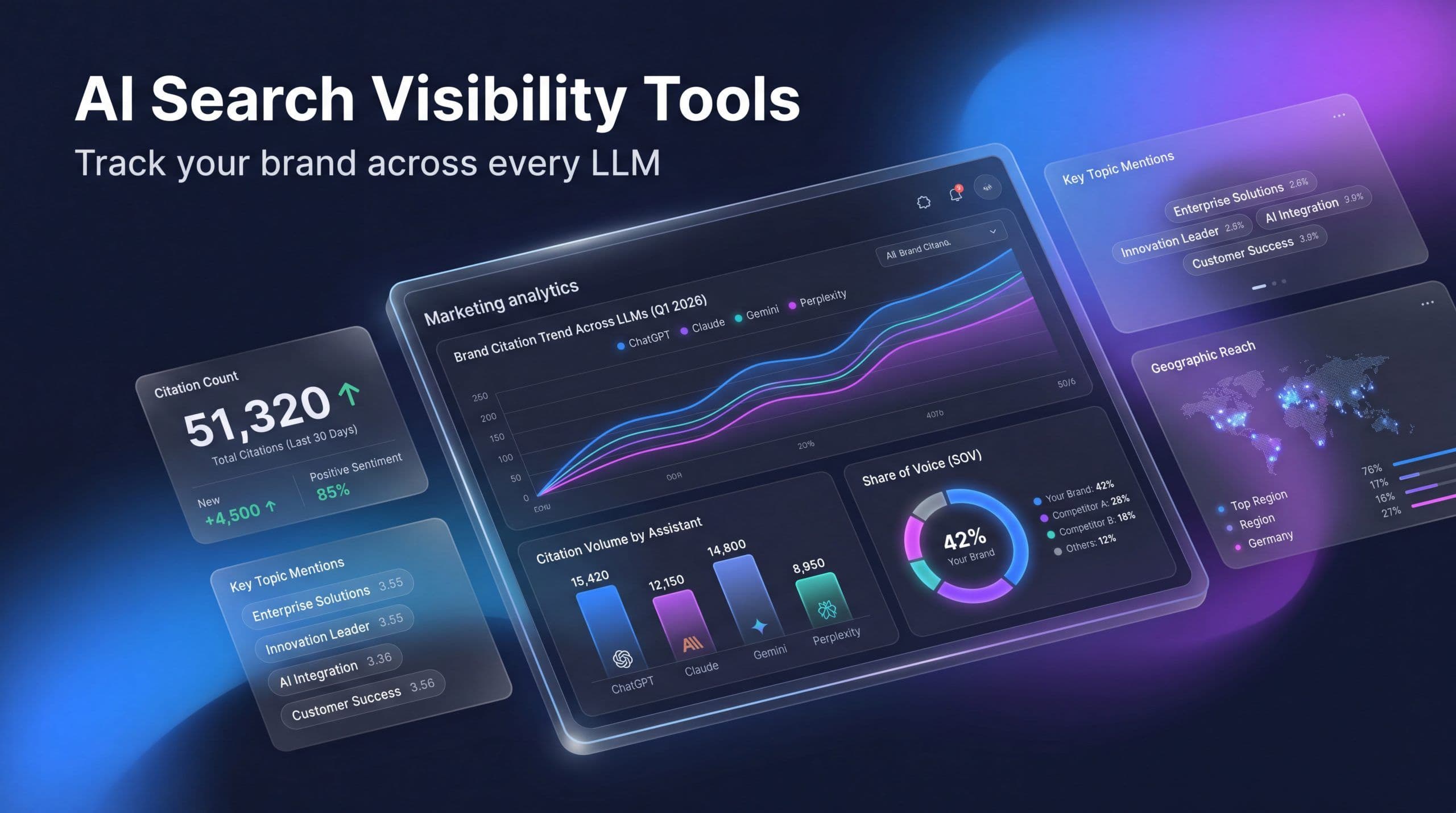
What ChatGPT visibility actually means
ChatGPT visibility is the observed frequency and context in which a brand appears for a defined set of prompts. It is not a universal rank. Two people can receive different answers because the product, model, date, location, account state, conversation history, and available sources can differ. A credible report therefore describes the sample that was measured instead of claiming complete coverage.
Keep three signals separate. A mention means the answer names the brand. A recommendation means it presents the brand as a possible choice. A citation means the answer links to a source. A brand can be mentioned without its own website being cited, and a page can be cited without the brand receiving a favorable recommendation.
Where AI visibility data comes from
No single report measures every generative answer. Use three complementary evidence sources: repeatable prompt observations, search-platform reporting, and website analytics.
| Evidence source | What it can show | What it cannot prove |
|---|---|---|
| Repeatable prompt panel | Mentions, citations, competitors, wording, and accuracy for a controlled sample. | Every answer shown to every user or a fixed global rank. |
| Google Search Console | Google Search clicks, impressions, queries, pages, and—where available—dedicated generative-AI reporting. | Visibility inside ChatGPT, Gemini conversations, Claude, or Perplexity. |
| Google Analytics 4 | Sessions and outcomes when a click reaches your site with usable referral information. | Zero-click mentions, hidden referrers, or the full answer that produced a visit. |
OpenAI documents that ChatGPT Search can answer with current web information and links to relevant sources. Google states that appearances in AI Overviews and AI Mode are included in Search Console’s overall Web performance data, and it has begun rolling out dedicated generative-AI performance reports. GA4’s Traffic acquisition report can then show session source and medium for visits that retain referral information.
A reproducible AI brand visibility workflow
1. Start with decisions, not a vanity score
Decide what the program should change. Common decisions include which comparison page to improve, which product fact needs clarification, which third-party source deserves outreach, and which competitor owns a buyer question. A visibility score without a decision owner becomes another chart nobody acts on.
2. Build a small, representative prompt set
Begin with 20 to 50 prompts drawn from customer interviews, sales calls, Search Console queries, support questions, and comparison searches. Include category discovery, use-case, alternative, comparison, implementation, and risk prompts. Keep the wording stable for trend measurement; add new prompts as a separate cohort rather than rewriting the baseline.
3. Record the testing context
Save the surface, model when exposed, date, country or locale, account state, and whether web search was active. Run the same prompt set on a consistent schedule. One answer is an observation, not a market share estimate.
4. Capture mentions, citations, competitors, and accuracy separately
Do not collapse every signal into “visible.” Preserve the response and cited URLs, then mark whether the brand was named, recommended, linked, or described inaccurately. Product, price, people, policy, and legal claims should be checked against current approved sources by a human reviewer.
5. Join observations to Search Console and GA4
Use Search Console to find the Google queries and pages already earning impressions, including Google’s generative-AI view when it is available for the property. In GA4, review Traffic acquisition using Session source / medium and compare sessions, engagement, and key events from identifiable AI referrals. Keep zero-click visibility and referred traffic as different metrics.
6. Turn gaps into owned work
Route each verified gap to the appropriate lever: technical eligibility, an unclear entity or product fact, missing first-party evidence, weak comparison content, an outdated third-party source, or an earned authority gap. Google’s guidance is explicit that normal technical and people-first SEO practices remain foundational for its AI features; there is no special markup that guarantees inclusion.
7. Re-test the same cohort
Re-run the original prompts after the changed page has been crawled or the external source has been updated. Compare the same cohort and annotate the intervention date. This does not establish perfect causality, but it is far more useful than comparing two unrelated prompt samples.
The minimum evidence schema
A spreadsheet can support a credible pilot if every row preserves the observation. These are the minimum fields to capture before evaluating software.
Prompt ID
A stable identifier so the same question can be compared over time.
Prompt text
The exact buyer question, without silently rewriting it between runs.
Surface and model
For example, ChatGPT Search, Gemini, or Google AI Overviews.
Date, locale, and account state
Context that can change the answer or the sources selected.
Brand mentioned?
A yes/no observation plus the exact surrounding passage.
Domain cited?
The cited URL and whether it belongs to your site or a third party.
Competitors mentioned
The brands recommended, compared, or cited in the same response.
Accuracy status
Verified, inaccurate, ambiguous, or awaiting review.
Evidence
A saved response, screenshot, export, or tested URL tied to the observation.
Metrics that stay honest
- Mention rate: prompts with a brand mention divided by prompts successfully observed.
- Owned citation rate: prompts citing your domain divided by prompts successfully observed.
- Recommendation rate: prompts where the brand is explicitly recommended divided by eligible buyer-intent prompts.
- Sample share of voice: your mentions divided by all tracked-brand mentions in the fixed prompt panel.
- Accuracy rate: verified brand claims divided by all reviewable brand claims in the sample.
- Referral outcomes: sessions, engagement, and key events from identifiable AI referral sources in GA4.
Publish the prompt count, successful-run count, date range, surfaces, and locale beside every percentage. Avoid presenting a sample share of voice as total market share, and never treat a missing referral as proof that no AI system influenced the visit.
How to choose an AI visibility tool
Use your own prompt cohort during a trial and ask the vendor to trace a dashboard number back to a real response. Score the workflow below before comparing pricing or the number of advertised models.
Repeatability
Can you preserve exact prompts, schedules, model names, locale, and run history?
Evidence
Can every score be traced back to the response, citation, date, and tested prompt?
Coverage
Does the tool monitor the AI surfaces your buyers actually use?
Citation detail
Can you separate a brand mention from a link to your domain or another source?
Accuracy review
Can a human verify product, pricing, people, and policy claims against approved facts?
Workflow
Can findings become owned content, PR, entity, or technical tasks instead of dashboard noise?
AI search visibility tools compared
The right platform depends on the AI surfaces your buyers use, the evidence you need to preserve, and how findings move into content, SEO, and communications work. Product coverage and packaging change quickly, so validate current capabilities with each vendor and test the shortlist against the same prompt cohort.
1. Profound
Profound is a dedicated generative-engine-optimization platform with prompt-level analytics across major AI answer engines. It is best suited to enterprise teams that want a specialized command center for monitoring brand visibility and cited sources.
2. Otterly.ai
Otterly.ai combines AI-search monitoring, citation tracking, competitor comparisons, and alerts in an approachable interface. It is a practical option for mid-market teams that want recurring visibility checks without an enterprise implementation.
3. Frase
Frase connects AI visibility monitoring with its established content research and optimization workflow. That makes it useful for content teams that want to move from identifying a citation gap to preparing the content intended to address it in the same product.
4. Evertune
Evertune focuses on measuring brand visibility in AI-generated answers and turning those observations into content and communications recommendations. It is worth evaluating for teams that coordinate SEO, content, and digital PR.
5. Semrush AI Visibility Toolkit
Semrush extends an existing SEO workflow with AI visibility, prompt monitoring, and competitive share-of-voice analysis. It is the most natural shortlist candidate for teams that already use Semrush for keyword research, rankings, and reporting.
6. HubSpot AEO
HubSpot brings answer-engine-optimization reporting into its broader CRM and content ecosystem, including visibility, prompt, and citation analysis. The strongest fit is an organization that already manages its website and customer data in HubSpot.
7. Scrunch
Scrunch pairs AI-search visibility monitoring with recommendations about content and site structure. Content-led teams should assess it on the quality and traceability of those recommendations using their own prompt cohort.
8. Peec AI
Peec AI offers brand visibility monitoring and competitive benchmarking for AI answer engines. Its focused workflow makes it a useful candidate for teams piloting the category before adopting a broader enterprise platform.
9. Adobe LLM Optimizer
Adobe LLM Optimizer is designed to connect AI visibility work with Adobe’s content, analytics, and experience stack. It is most relevant to larger organizations already standardized on Adobe Experience Cloud.
10. Bluefish
Bluefish packages AI visibility monitoring for marketing teams that want a workflow non-technical operators can use. Evaluate its model coverage, evidence retention, and integrations against the buyer questions your team actually tracks.
11. BuzzSense
BuzzSense monitors brand visibility, competitors, cited sources, and sentiment across AI models and markets. Its multilingual and regional positioning makes it especially relevant to teams evaluating coverage beyond the English-speaking web.
What to improve after measurement
For Google AI Overviews and AI Mode, start with indexability, snippet eligibility, internal discovery, helpful original content, and accurate structured data. Google says there are no additional technical requirements beyond eligibility for Search and no special AI file or schema that guarantees inclusion.
Across other AI surfaces, make important facts easy to verify on canonical pages, cite primary evidence, maintain consistent organization and product information, and earn relevant independent coverage. Do not manufacture third-party praise or add unsupported statistics merely to look authoritative. The objective is a source ecosystem that helps both people and systems verify the same facts.
Use the generative engine optimization guide for the content workflow and the AI Overviews tracker for Google-specific citation checks.
Where MarqOps fits
MarqOps provides a workflow for checking whether selected AI systems mention a brand, cite its domain, name competitors, or state claims that need review. The public checker supports a single prompt; the product workflow connects prompt panels and reviewed observations to the wider marketing-operations process. It does not claim to observe every answer shown to every user.
Run the AI brand visibility tracker, or see how MarqOps connects the findings to SEO operations and evidence-checked reporting.
Frequently asked questions
Can I see ChatGPT visibility in Google Search Console?
No. Search Console reports Google Search performance, including Google’s AI features; it does not report appearances inside ChatGPT. Measure ChatGPT with repeatable observations and use GA4 for identifiable referral visits that reach your site.
Is ChatGPT visibility the same as a Google ranking?
No. Generated answers can vary and do not expose a stable universal position. Report visibility for a documented prompt sample, surface, date range, and locale.
Does `llms.txt` make a site appear in AI answers?
There is no guarantee that an `llms.txt` file will improve inclusion. For Google’s AI features, official guidance points to standard Search eligibility, helpful content, internal discovery, and supported robots or snippet controls—not a special AI file.
How often should prompts be checked?
Match the cadence to the decision. Weekly checks are usually sufficient for a stable category baseline; product launches, reputation issues, and rapidly changing comparisons may justify more frequent checks. Consistency and preserved evidence matter more than maximum run volume.
Primary documentation
- OpenAI: Searching the web with ChatGPT
- Google Search Central: AI features and your website
- Google Search Central: Optimizing for generative AI features
- Google Search Central: Generative AI performance reports
- Google Analytics: Traffic acquisition report
- Google Analytics: Traffic-source dimensions
Documentation reviewed August 24, 2026.
Keep following the signal