AI Brand Monitoring in 2026: Track Visibility, Sentiment, and Reputation Across AI Search
The complete 2026 guide to AI brand monitoring. Track brand visibility across ChatGPT, Perplexity, Gemini, plus sentiment shifts and reputation risk in one workflow.
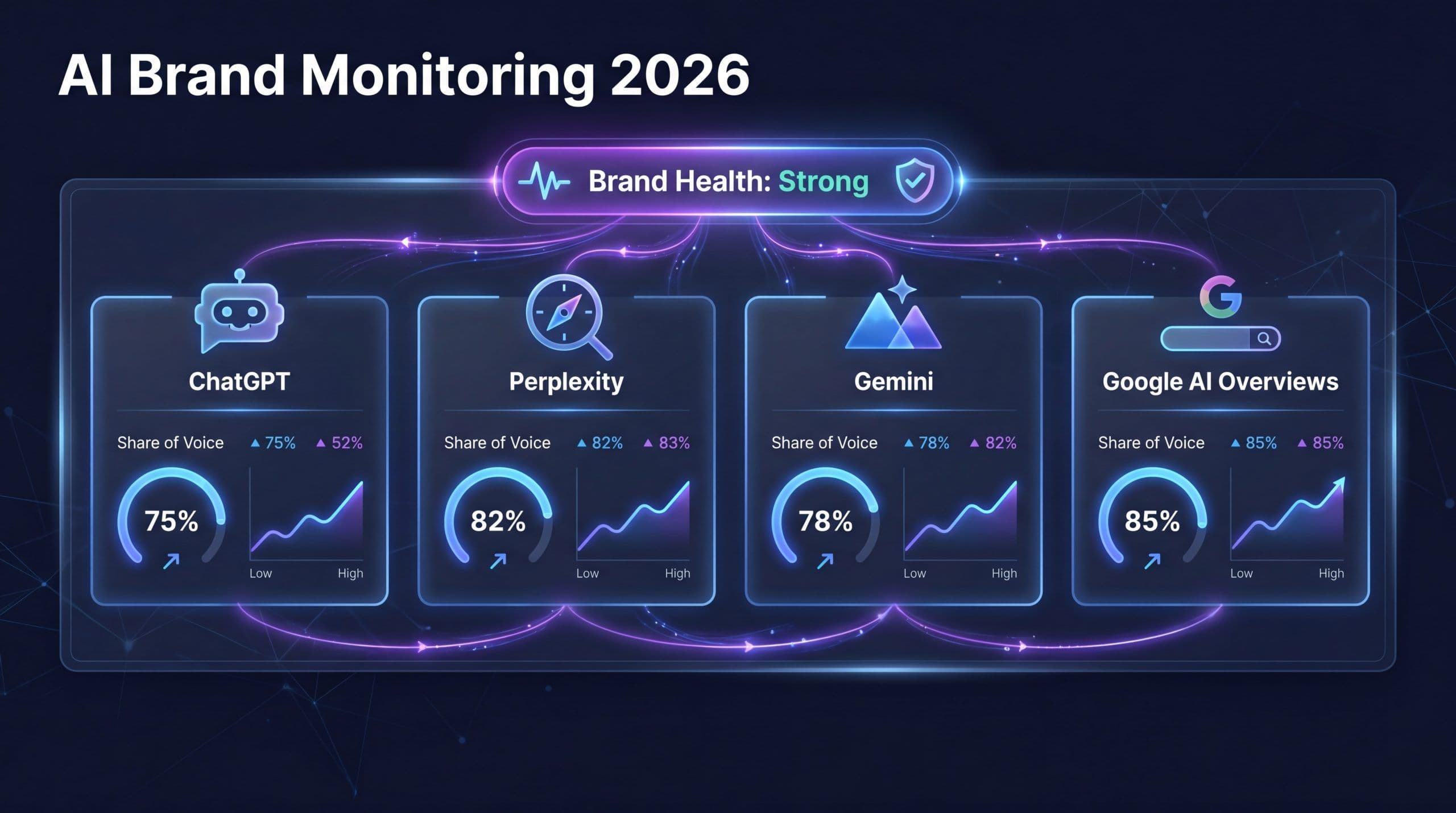
AI Brand Monitoring in 2026: Track Visibility, Sentiment, and Reputation Across AI Search
By MarqOps | Updated May 25, 2026 | 12 min read
TL;DR
- AI brand monitoring tracks how your brand shows up across ChatGPT, Perplexity, Gemini, Google AI Overviews, and traditional social channels in one feed.
- 89% of B2B buyers now use generative AI tools for vendor research, and 17% of B2B SaaS discovery already happens through AI answers (up from 4% a year ago).
- Citation rates, sentiment, and mention patterns vary up to 615x across AI platforms, so single-channel monitoring leaves massive blind spots.
- Top SaaS brands score 84/100 in AI visibility versus a median of 62, and earn 8.4x more AI citations than competitors.
- The smartest 2026 stacks combine AI search visibility, sentiment analysis, crisis detection, and brand-aware reporting in one workflow rather than five disconnected tools.
Table of Contents
- What is AI brand monitoring?
- Why AI brand monitoring matters in 2026
- The four signals every AI brand monitor should track
- How AI brand monitoring actually works under the hood
- The 2026 AI brand monitoring tools landscape
- The metrics that actually matter (and the ones that don’t)
- A practical 30-day rollout roadmap
- Common mistakes that wreck AI brand monitoring programs
- How MarqOps approaches brand monitoring
- FAQs
What is AI brand monitoring?
AI brand monitoring is the continuous, automated tracking of how your brand appears, gets cited, and is talked about across the surfaces that shape buyer perception in 2026. That now includes AI search engines (ChatGPT, Perplexity, Gemini, Claude, Google AI Overviews, Microsoft Copilot), traditional social platforms, review sites, podcasts, forums, news, and YouTube. The “AI” part isn’t just where you’re monitored, it’s also how. Modern monitoring stacks use large language models and machine learning to classify sentiment, detect tone shifts, cluster topics, and flag anomalies in real time, at a volume no human team could read through.
Five years ago, brand monitoring meant a Google Alert and a Hootsuite stream. Today it means querying ChatGPT 200 times a day to see how it describes your category, scoring the sentiment of every mention across 40 platforms, and getting a Slack ping the moment a competitor overtakes you in AI search visibility. It’s a different job, and most teams’ stacks haven’t caught up.
Think of AI brand monitoring as the union of three older disciplines: social listening, online reputation management, and search visibility tracking. The newest layer, AI search visibility, is the one most brands are still ignoring even though it now drives a sixth of all B2B SaaS discovery.
Why AI brand monitoring matters in 2026
The marketing surface area exploded. Google AI Overviews now appear in roughly 48% of all Google searches, ChatGPT has crossed 883 million monthly users, and roughly 93% of Google AI Mode sessions end without a single click to any website. That last number is the one that should scare every CMO: your buyer is forming an opinion of your brand without ever visiting your site. If you’re not measuring what AI says about you, you’re flying blind on the channel that increasingly decides whether you make the shortlist.
89%
of B2B buyers now use generative AI tools like ChatGPT and Perplexity for vendor research (2026)
The market is responding. The global social media listening market alone is valued at $11.91 billion in 2026 and is projected to reach $29.63 billion by 2033, growing at a 13.9% CAGR according to Coherent Market Insights. AI-specific brand monitoring is a faster-growing sub-segment as buyers shift their research behavior. And the gap between leaders and laggards is enormous: top SaaS brands earn 8.4x more AI citations than their competitors, and score 84/100 on AI visibility benchmarks versus a median of 62, according to Data-Mania’s 2026 benchmarks.
Reputation risk has changed shape too. According to Sprout Social’s 2025 Crisis Management Report, 68% of brand crises that went viral originated outside of business hours, and 41% started on platforms or channels the brand was not actively monitoring. AI-powered detection isn’t optional anymore, it’s the only way to catch a brewing crisis at 2am on a Sunday on a subreddit your team forgot exists.
The four signals every AI brand monitor should track
Forget the 30-metric dashboards. The signals that actually move marketing decisions in 2026 fall into four buckets. Get these four right and you can ignore most of the rest.
1. AI search visibility and share of voice
This measures how often your brand appears in AI-generated answers for queries that matter to your business. The standard formula is simple: AI Share of Voice equals the number of times your brand is cited divided by the total citations in an AI answer, times 100. According to Cassie Clark’s 2026 measurement guide, a 40 to 70% AI Share of Voice indicates strong visibility for a given prompt, depending on competition and category maturity. The trick is tracking it consistently across ChatGPT, Perplexity, Gemini, Google AI Overviews, and Microsoft Copilot, since citation rates vary by up to 615x across these platforms.
2. Mention volume and source distribution
How often is your brand being talked about, and where? This is classic social listening, modernized. The key shift is that “where” now includes AI chatbot transcripts (where they’re public), AI Overview citations, podcast transcripts (auto-transcribed), YouTube captions, and review sites alongside the usual social platforms. Net mention volume is a vanity metric on its own. Source distribution, the breakdown by channel, is what tells you where to invest.
3. Sentiment and tone
Generative AI now classifies nuance across languages and formats with accuracy that legacy keyword-based sentiment tools couldn’t touch. Short-form video sentiment analysis specifically is growing at a 13.29% CAGR because tools can now read facial expressions and tone of voice in TikTok, Reels, and Shorts. The signal you care about isn’t average sentiment, it’s the velocity of change. A 3% drop over 48 hours is worth more attention than a flat negative baseline.
4. Competitive context
Brand monitoring without competitive benchmarks is half a picture. You want to know: how does our AI Share of Voice compare to our top three competitors? Are they being described as “the leader” while we’re described as “a fast follower”? Modern tools pull both your brand and your competitors’ mentions in the same query so you can compare descriptors, sentiment, and citation rates side by side. AI competitive intelligence tools have made this layer dramatically cheaper than it was even 18 months ago.
How AI brand monitoring actually works under the hood
Most AI brand monitoring tools follow a similar four-stage pipeline. Understanding the pipeline helps you evaluate vendors and know what you’re really buying.
Stage 1: Prompt or query generation. The tool generates a set of representative prompts a buyer might ask, for example “what’s the best marketing operations platform” or “compare MarqOps and Adobe Marketo.” The richer and more behavior-accurate this prompt set, the more meaningful your data.
Stage 2: Multi-platform querying. The tool fires those prompts at ChatGPT, Perplexity, Gemini, Claude, and others on a schedule, often daily. Some tools also pull from Google AI Overviews scraping and Microsoft Copilot. This is the layer where you should ask about coverage, frequency, and how the vendor handles rate limiting.
Stage 3: Response parsing and entity extraction. An LLM (often a smaller, fine-tuned one) reads each AI response and extracts: which brands were mentioned, in what order, with what descriptors, with what sentiment, and with which sources cited. Accuracy here separates the credible vendors from the ones that look good in a demo.
Stage 4: Aggregation, alerting, and reporting. Data flows into dashboards, share-of-voice trends, anomaly detection runs, and alerts get pushed to Slack, email, or SMS when thresholds get crossed. The best systems also surface explanations, “your share of voice dropped 12% because Perplexity stopped citing your G2 page after their algorithm update,” not just numbers.
A useful evaluation question for any AI brand monitoring vendor: “show me the actual ChatGPT response your tool pulled for prompt X on date Y.” If they can’t, the underlying data is opaque and the dashboard is just a black box.
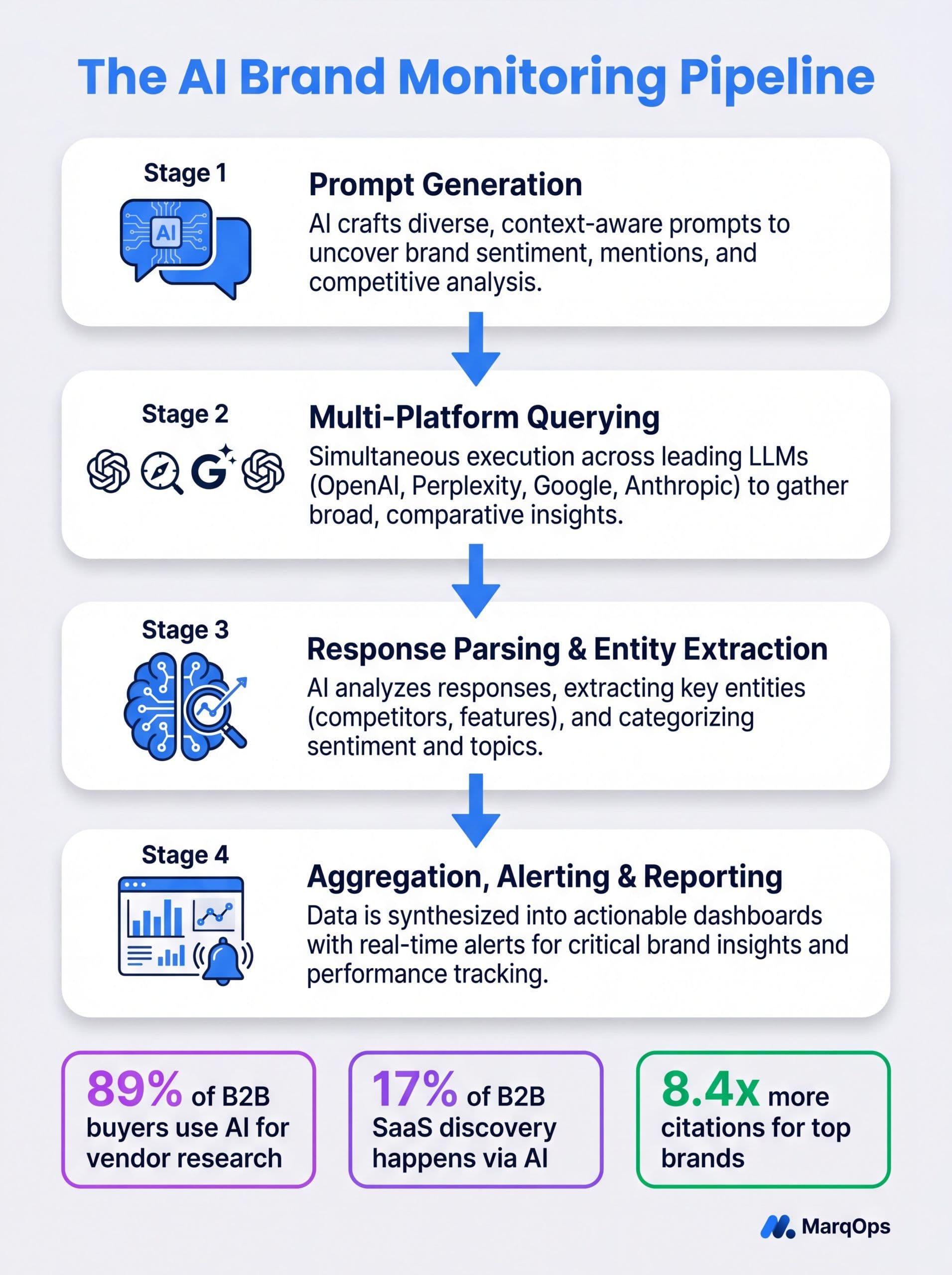
The AI brand monitoring pipeline that powers every modern visibility tool
The 2026 AI brand monitoring tools landscape
The vendor map has fragmented into three camps. Understanding which camp a tool belongs to saves you from accidentally buying three tools that do the same thing.
Camp 1: AI search visibility specialists
Built specifically to track brand presence in ChatGPT, Perplexity, Gemini, and AI Overviews. Examples include Profound, Evertune, Otterly.AI, Ahrefs Brand Radar, Authoritas LLM Brand Visibility, SE Ranking AI Visibility Tracker, and HubSpot’s free AEO Grader. Strongest on the AI search side, weaker on traditional social and sentiment depth. Pricing typically ranges from $99 to $2,000+ per month depending on prompt volume.
Camp 2: Legacy social listening platforms with AI features bolted on
The Brandwatches, Sprinklrs, Hootsuites, Meltwaters, Brand24s, and Sprout Socials of the world. Strong on traditional channels, sentiment, crisis detection, and historical depth. Most have added AI Overview tracking in the last 12 months but it’s rarely as deep as the specialists. Best fit for large brands that already use them and need one place to do everything.
Camp 3: AI reputation management point solutions
Focused on review monitoring, crisis detection, or specific verticals (hospitality, healthcare, retail). BrandMentions, Eclincher, BenchMark, Revuze, and similar tools fit here. Useful as bolt-ons if you have a specific gap, dangerous if you mistake them for a complete monitoring stack.
The realistic 2026 stack for most marketing teams: one specialist for AI search visibility, one platform for traditional social and sentiment, and a marketing operations layer that pulls both signals into the same reporting view alongside your campaigns, content, and ads. That last layer is where tool sprawl is killing marketing teams, and where unified platforms like AI-powered marketing platforms are starting to replace seven or more disconnected tools.
The metrics that actually matter (and the ones that don’t)
Most brand monitoring dashboards drown teams in numbers. Here are the five worth a weekly look, the three worth a daily look, and a few that are usually a waste of attention.
| Metric | Cadence | Why it matters |
|---|---|---|
| AI Share of Voice (per platform) | Weekly | Direct measure of competitive AI visibility |
| Citation source mix | Weekly | Tells you which content surfaces drive AI mentions |
| Net sentiment velocity | Daily | Catches tone shifts before they turn into crises |
| Mention volume anomalies | Daily | Spikes flag earned attention or emerging issues |
| Negative mention clusters | Daily | Multiple complaints about the same issue is your real PR risk |
| Brand descriptor drift | Weekly | Are AI tools describing you the way you want? |
| Competitor citation gap | Weekly | Where competitors are winning AI visibility you’re not |
Metrics to mostly ignore: total impressions across all channels (too noisy), follower count growth (rarely correlates with revenue), reach without engagement (vanity), and any “AI score” without a clear formula behind it. AI marketing analytics is most useful when it cuts the metrics down to what changes decisions, not when it adds another tab.
A practical 30-day AI brand monitoring rollout
Here’s the roadmap we’d give a marketing ops team standing up AI brand monitoring from zero. It’s deliberately scoped to 30 days, because the perfect-stack-first approach is what kills most monitoring programs before they ship anything useful.
Days 1 to 5: Establish baselines
Pick 20 to 30 prompts a buyer in your category would ask an AI tool. Half should be branded (“is MarqOps better than HubSpot”), half unbranded (“what’s the best marketing operations platform”). Run them manually across ChatGPT, Perplexity, and Google AI Overviews. Note which brands get cited, in what order, with what descriptors. This is your zero-cost baseline and you’ll come back to it every quarter.
Days 6 to 14: Pick your two tools
One AI search visibility specialist, one social and sentiment platform. Start with free or low-tier plans. The HubSpot AEO Grader is genuinely useful as a free starting point. Set up tracking for your brand, your three top competitors, and your category. Connect alerts to Slack so the team gets pinged on anomalies without having to log into another dashboard. Use the existing baseline from week one to validate the tool’s numbers, do they match what you saw manually?
Days 15 to 22: Build the report and the rituals
Create a single weekly snapshot, one page, that shows your AI Share of Voice trend per platform, sentiment velocity, mention volume by source, and a “anything weird this week” section. Run a 15-minute brand monitoring standup every Monday. The format matters more than the tool: if there’s no recurring conversation about the data, no one acts on it.
Days 23 to 30: Start optimizing
Take the first three insights from your snapshots and ship work against them. Common early wins: publishing stat-rich pillar pages on topics where competitors out-cite you (research shows content with statistics and citations gets 30-40% higher AI visibility), updating older high-traffic pages (pages updated within 2 months earn 28% more AI citations), and tightening your AI search visibility through answer engine optimization and generative engine optimization.
Teams that follow this 30-day rollout typically catch their first preventable visibility issue inside the first two weeks. The point isn’t the dashboard, it’s the early intervention.
Common mistakes that wreck AI brand monitoring programs
Monitoring only branded keywords. If you only track mentions of your company name, you miss every “best [category]” query where the AI is recommending someone else. Unbranded prompts are where the real visibility gap lives.
Treating sentiment as a vanity score. A flat 72% positive sentiment number tells you nothing. Sentiment velocity, the change over time and by topic, is what reveals what’s actually happening with your brand. Build alerts on changes, not absolutes.
Ignoring AI platform differences. Perplexity is heavily Reddit-influenced. ChatGPT relies more on indexed knowledge and authoritative sources. Gemini leans on Google search results. Your strategy to win visibility on each one is different. Treating them as one channel is a recipe for diluted effort.
Buying the dashboard before designing the workflow. Most teams buy a tool, then try to figure out who reads what data when. The teams that get value flip this: define the recurring conversation and the decisions first, then buy the smallest tool that supports them. A marketing intelligence platform is only useful if you’ve decided who acts on it.
Letting brand descriptors drift unmanaged. AI tools generate descriptions of your brand based on whatever content they crawled. If your homepage, your G2 page, and your About page all describe you differently, the AI will pick the loudest one. Audit your brand descriptors quarterly and consider building a documented brand guidelines template that explicitly tells AI tools who you are.
How MarqOps approaches brand monitoring
MarqOps was built around a hard observation: marketing teams in 2026 are managing 7+ disconnected tools to do work that should live in one platform. Brand monitoring is one of the worst examples. Most teams have a social listener, a sentiment dashboard, an AI visibility checker, a review tracker, and a separate analytics tool, and none of them talk to each other or to the content and ads work that the same team is shipping.
MarqOps’ Brand Intelligence DNA is the layer that ties brand monitoring into the rest of the operating system. Every piece of content, every ad, and every AI-generated asset gets created with your brand voice, visual guidelines, and positioning baked in from the start. That means when AI search tools query your site to describe your brand, they see consistent language across every surface, which is the single biggest driver of strong, stable AI Share of Voice. The unified dashboard pulls AI search visibility, traditional social sentiment, content performance, ad spend, and SEO into one view, so the team running brand monitoring is the same team optimizing the content and campaigns that drive it. No tab-switching, no five-tool reconciliation, no waiting for the agency report.
For teams shipping content 6x faster with AI but worried about brand drift, that closed loop, brand-aware creation feeding brand-aware monitoring, is the part that makes the speed sustainable. You can read more about how this fits into a broader AI marketing strategy, the role of AI brand voice consistency, and how citation-friendly content drives AI search performance in the guide on boosting your AI search citations.
Start Free – No Card RequiredSee How MarqOps Works
Frequently Asked Questions
What’s the difference between AI brand monitoring and traditional social listening?
Traditional social listening tracks mentions across social media, blogs, and forums. AI brand monitoring extends that to AI search engines (ChatGPT, Perplexity, Gemini, Google AI Overviews) and uses machine learning to classify sentiment, detect anomalies, and surface insights that legacy keyword-based tools miss. The two overlap, but only AI brand monitoring measures how your brand appears in AI-generated answers, which now drive 17% of B2B SaaS discovery.
How much does AI brand monitoring cost in 2026?
It ranges from free (HubSpot’s AEO Grader, manual prompt testing) to $99 per month for small business tiers of AI visibility specialists like Otterly.AI, up to $2,000+ per month for enterprise platforms like Brandwatch or Sprinklr. Most mid-market marketing teams land in the $300 to $800 per month range across one AI search visibility tool and one social and sentiment platform.
Which AI search engines should I prioritize tracking?
Start with ChatGPT (883M monthly users), Perplexity (high B2B research influence), Google AI Overviews (in roughly 48% of Google searches), and Gemini. Add Microsoft Copilot and Claude based on your buyer behavior. Citation patterns vary by up to 615x across platforms, so don’t assume one platform’s results predict another.
How do I improve my AI Share of Voice if I’m losing to competitors?
Three high-impact moves: publish stat-rich pillar content (pages with citations and statistics get 30-40% higher AI visibility), refresh top pages every two months (refreshed pages earn 28% more citations), and pursue mentions on the authoritative third-party sources that AI tools cite for your category. Tracking which sources drive your competitors’ citations is the fastest way to find the gap.
Can AI brand monitoring actually predict crises before they go viral?
Yes, when set up correctly. Modern systems surface early warning signals like sudden negative mention clusters, one-star review pattern shifts, or unusual engagement spikes on a single piece of content. Given that 68% of viral brand crises start outside business hours and 41% on channels brands aren’t actively monitoring, real-time AI-powered alerts are now table stakes for any team that wants to intervene proactively rather than react after the fact.
Keep following the signal
Related field notes
Marketing Operations
Marketing Project Management Software in 2026: How to Choose Without Adding Tool #122
11 min readMarketing Analytics
Marketing Attribution Software in 2026: The Buyer's Guide for a Stack That Won't Stop Growing
11 min readMarketing Operations