LLM SEO in 2026: The Complete Guide to Ranking in AI Search
LLM SEO is how brands get cited by ChatGPT, Gemini, and Perplexity. Learn the six signals behind AI citations, an 8-step playbook, tools, metrics, and a 90-day roadmap.
TL;DR
- LLM SEO is the practice of optimizing your content, brand, and technical setup so large language models like ChatGPT, Gemini, and Perplexity understand, trust, and cite you in their answers.
- It matters because AI platforms drove 1.13 billion referral visits in June 2025 alone, a 357% jump year over year, and ChatGPT traffic now converts at 7.1%, second only to paid search.
- LLMs cite differently than Google ranks. Only 12% of AI-cited URLs appear in Google’s top 10, so chasing classic rankings is no longer enough.
- Six signals decide who gets cited: entities, authority, structure, freshness, depth, and machine accessibility. Brand mentions now outweigh backlinks.
- Most brands see citation lifts in 60 to 90 days; compounding authority takes 6 to 9 months. A unified platform like MarqOps shortens that cycle.
Search did not die in 2025. It split in two. One half still runs through Google’s familiar blue links. The other half now happens inside answer engines, where a person types a question into ChatGPT, Gemini, or Perplexity and gets a synthesized answer with a handful of cited sources. If your brand is not one of those citations, you are invisible to a fast-growing slice of your market. That is the problem LLM SEO exists to solve.
This guide breaks down exactly how large language models choose what to cite, the six signals that move the needle, a step-by-step playbook your team can run this quarter, and how to measure whether any of it is working. It builds on adjacent disciplines we have covered before, including answer engine optimization and generative engine optimization, and pushes them into the practical, repeatable territory marketing teams need.
Table of Contents
- What Is LLM SEO?
- Why LLM SEO Matters Now
- LLM SEO vs Traditional SEO vs GEO vs AEO
- How LLMs Actually Choose What to Cite
- The Six Signals That Drive AI Citations
- The LLM SEO Playbook: 8 Steps
- LLM SEO Tools Worth Knowing
- How to Measure LLM SEO
- Your 90-Day LLM SEO Roadmap
- Frequently Asked Questions
What Is LLM SEO?
LLM SEO is the process of optimizing your website, content, and brand presence so that large language models can understand what you do, trust that you are credible, summarize your expertise accurately, and cite you when they answer a user’s question. The “LLM” stands for large language model, the technology that powers ChatGPT, Google Gemini, Microsoft Copilot, Claude, and Perplexity.
Traditional SEO optimizes for a ranking algorithm that returns ten links. LLM SEO optimizes for a reasoning system that reads, synthesizes, and decides which sources are worth attributing inside a single generated answer. The goal shifts from “rank number one” to “be the source the model trusts enough to name.” That is a different game with different rules, and it rewards depth, clarity, and entity strength over keyword density and link volume.
LLM SEO is not a replacement for SEO. It is an expansion of it. The fundamentals of clear, authoritative, well-structured content still apply. What changes is how that content is discovered, parsed, and surfaced to your audience.
Why LLM SEO Matters Now
The shift is not theoretical, and it is not slow. AI platforms generated 1.13 billion referral visits in June 2025, a 357% increase from the same month a year earlier. ChatGPT alone reached 900 million weekly active users by February 2026, up from 400 million just twelve months prior. Google’s AI Overviews now reach roughly 1.5 billion monthly users, making it the single largest AI search surface by audience size.
7.1%
ChatGPT referral conversion rate, second only to paid search at 7.8%
That last number is the one that should change how budgets are allocated. AI referral traffic is still a small share of total web traffic, but it converts at a rate that rivals paid search and far exceeds typical organic. These are high-intent visitors who arrived after an AI vouched for you. At the same time, the old channel is shrinking. Google search traffic to publishers fell 33% globally in the year to November 2025 as AI Overviews absorbed clicks that used to flow to websites.
For B2B specifically, answer engines are projected to influence 10 to 20% of all software purchase decisions by the first quarter of 2026. If your category is researched inside ChatGPT and you are not cited, a competitor is quietly being recommended in your place. This is the same visibility crisis we mapped in our guide to AI brand monitoring, and LLM SEO is the offensive counterpart to that defensive tracking.
LLM SEO vs Traditional SEO vs GEO vs AEO
The acronyms overlap, which causes a lot of confusion. Here is how they actually relate. LLM SEO is the broad practice of getting cited inside any large language model. Generative engine optimization (GEO) is essentially a synonym, emphasizing the generative engines doing the citing. Answer engine optimization (AEO) focuses on direct-answer formats and featured snippets. Traditional SEO still governs how crawlable and authoritative your site is, which feeds all of the above.
| Discipline | Optimizes For | Primary Win |
|---|---|---|
| Traditional SEO | Google’s ranking algorithm | A top-10 blue-link position |
| AEO | Direct answers and snippets | Owning the one-box answer |
| GEO | Generative AI engines | Being included in synthesized output |
| LLM SEO | Every LLM that cites sources | Being named and linked as a trusted source |
The critical insight is that these are no longer the same audience. Only 12% of URLs cited by ChatGPT, Perplexity, and Copilot rank in Google’s top 10 for the same query. Even more striking, 28.3% of ChatGPT’s most-cited pages have zero organic visibility in Google at all. You cannot assume that winning classic rankings wins AI citations. They require deliberate, separate optimization, which is the entire reason LLM SEO has become its own discipline.
How LLMs Actually Choose What to Cite
Most LLM answers with citations are produced through a retrieval-augmented generation (RAG) pipeline. Understanding that pipeline tells you where to intervene. It runs in four stages. First, the model analyzes the query and extracts intent. Second, it retrieves candidate documents using vector embeddings, which compare the mathematical meaning of your content to the meaning of the question rather than matching exact keywords. Third, it re-ranks those candidates on relevance, authority, and information gain. Fourth, it generates an answer and attributes the sources it leaned on.
This is why semantic clarity beats keyword stuffing. The model is matching meaning, so content that explains a concept thoroughly and unambiguously retrieves better than content packed with repeated phrases. Recent analysis found that pages most frequently cited by LLMs actually have fewer backlinks than less-cited pages, which upends a decade of link-building orthodoxy. Information gain, the degree to which your page adds something not already covered elsewhere, is doing heavy lifting in the re-ranking step.
One honest caveat for your team: a 2025 study found that between 50% and 90% of LLM responses are not fully supported by the sources they cite. AI citation is powerful but imperfect, which is exactly why consistent, accurate, well-structured content gives models fewer ways to misrepresent you.
There is also a format pattern worth exploiting. Listicles account for 21.9% of citations, articles 16.7%, and product pages 13.7%. The match is intent-specific: roughly 45% of informational queries cite articles, while 41% of commercial queries cite listicles. Map your format to the query type you want to win. For commercial comparison queries, a well-structured listicle is your best citation bait.
The Six Signals That Drive AI Citations
Across the major analyses, six recurring signals decide whether you get cited. Treat these as your optimization checklist.
1. Entities
LLMs reason about the world as a graph of entities, the people, brands, products, and concepts that are clearly defined and consistently described. A strong entity is one the model recognizes and can connect to your area of expertise. Define your brand, your authors, and your core concepts explicitly and consistently everywhere they appear.
2. Authority
Authority in the LLM era is built less by raw backlinks and more by recognition. Models weigh whether credible sources discuss you, whether your authors have verifiable expertise, and whether your claims hold up. Demonstrate first-hand experience, cite your data, and attribute content to real, identifiable experts.
3. Structure
Clear headings, short answer-first paragraphs, tables, and lists make your content trivially parseable. When a model can lift a clean two-sentence answer directly from your page, it is far more likely to use it. This is where solid AI content optimization pays off directly.
4. Freshness
AI answers favor current information. Dated statistics and stale advice get passed over for sources that reflect the present. Update cornerstone content on a schedule, stamp it with visible dates, and refresh the data points that anchor your authority.
5. Depth
Information gain rewards comprehensive coverage. Pages that fully answer a question, including the follow-up questions, give models more to work with and more reasons to cite. Thin content rarely earns a citation because it adds nothing new to the model’s existing knowledge.
6. Machine Accessibility
If a crawler cannot reach or render your content, none of the above matters. Ensure AI user agents are not blocked, that content is server-rendered or otherwise readable without heavy JavaScript, and that your schema markup is valid. Increasingly, teams also add an llms.txt file at the site root to point AI systems toward their most citation-worthy assets.
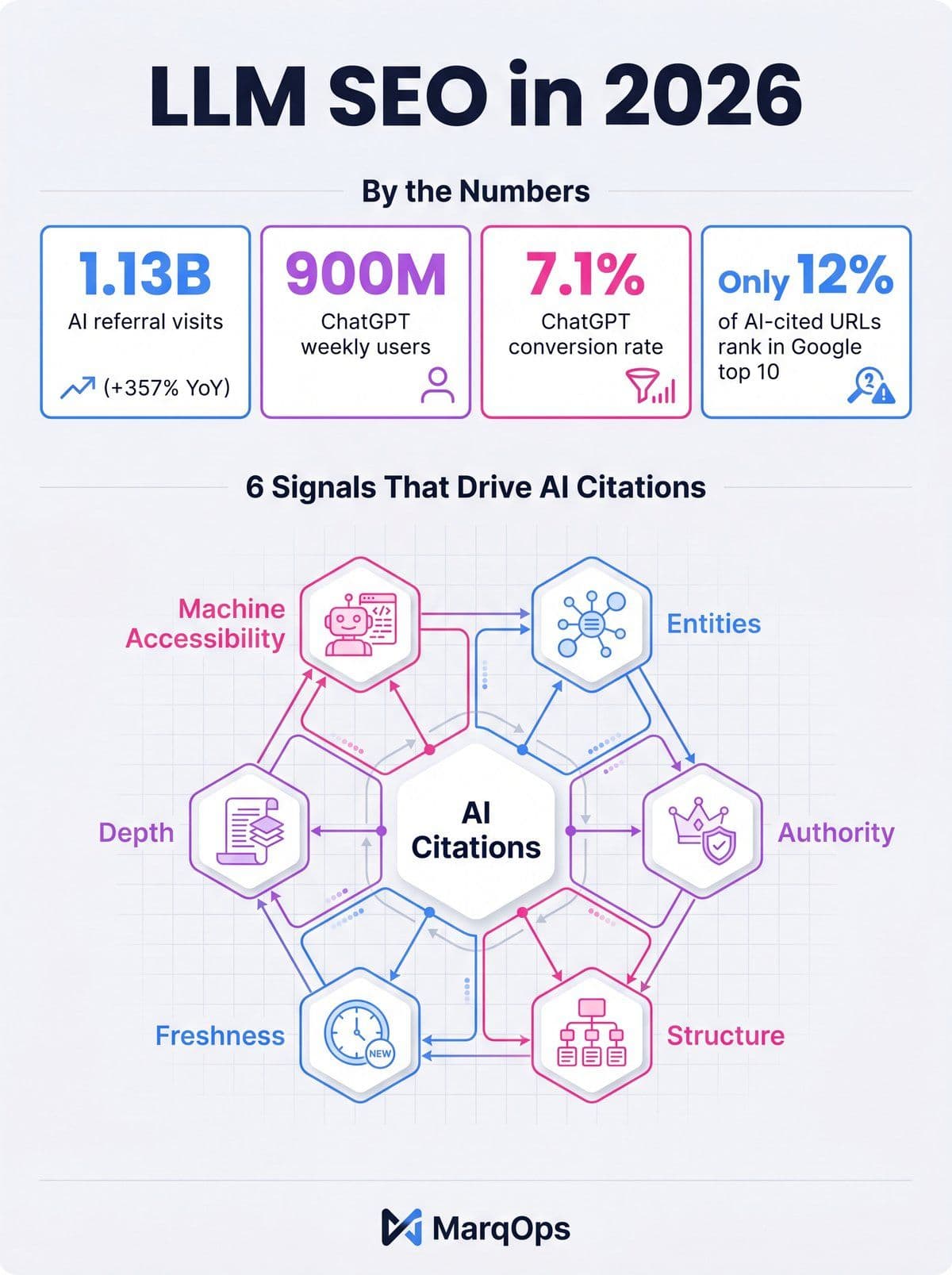
The six signals that drive AI citations, plus the 2026 data behind the shift to LLM SEO.
The LLM SEO Playbook: 8 Steps
Signals tell you what matters. This playbook tells you what to do. Run these eight steps as a repeatable workflow.
Step 1: Audit your current AI visibility
You cannot improve what you do not measure. Run your core brand and category prompts through ChatGPT, Gemini, and Perplexity and record whether you appear, how you are described, and who is cited instead. Tools built for AI search visibility automate this across hundreds of prompts.
Step 2: Map citation-worthy queries
Identify the questions your buyers actually ask AI tools, then sort them by intent. Informational queries call for deep articles; commercial comparison queries call for structured listicles. Pair this with disciplined AI keyword research to find the prompts with real volume.
Step 3: Write answer-first, depth-backed content
Lead each section with a clean, liftable answer, then back it with depth, data, and examples. This dual structure satisfies both the snippet-hungry model and the human who clicks through. A repeatable AI content strategy keeps this consistent across dozens of pages.
Step 4: Strengthen your entities and authorship
Add author bios with verifiable credentials, define your brand and products consistently, and link entities to authoritative external profiles. The model should never be unsure who you are or why you are qualified to answer.
Step 5: Implement schema markup
Use JSON-LD to add Article schema for the page, Organization schema for your brand, Person schema with sameAs links for authors, and FAQPage and HowTo schema where they fit. Schema is how machines confirm what your page actually is, and it directly supports citation accuracy.
Step 6: Earn brand mentions across trusted sources
Brand mentions now outweigh links, and LLMs give weight even to unlinked mentions. Pursue placements, expert roundups, and credible third-party coverage. Note that LinkedIn is the number one cited domain for professional queries across all six major AI platforms, with citation frequency doubling between November 2025 and February 2026, so an active company presence there is no longer optional.
Step 7: Fix technical accessibility
Confirm AI crawlers are allowed, render critical content server-side, validate your structured data, and publish an llms.txt that maps your best assets. Technical hygiene is the floor that everything else stands on.
Step 8: Monitor, refresh, and repeat
LLM SEO is a loop, not a launch. Track citations weekly, refresh cornerstone content on a cadence, and feed what you learn back into step two. Pair this with AI brand monitoring so you catch shifts in how models describe you.
The teams winning at LLM SEO are not running these eight steps once. They are running them every week across every priority topic, which is exactly the kind of repeatable, brand-consistent execution a unified platform is built to deliver.
LLM SEO Tools Worth Knowing
The tooling landscape splits into three jobs: tracking your citations, producing optimized content, and managing technical accessibility. Visibility trackers monitor whether and how you appear across ChatGPT, Gemini, Perplexity, and Copilot. Content tools help you structure answer-first, schema-rich pages at scale, a category we cover in depth in our roundup of AI SEO tools. Technical tools validate schema, audit crawlability, and generate your llms.txt.
The trap most teams fall into is stitching a separate tool to each job, then losing hours moving data between them. That fragmentation is precisely the problem MarqOps was built to remove. By unifying citation tracking, brand-intelligent content generation, and analytics in one dashboard, MarqOps replaces seven-plus disconnected tools and produces brand-perfect content roughly six times faster, so your LLM SEO loop actually runs at the cadence the channel demands. This is the same unification thesis behind effective generative AI marketing programs.
How to Measure LLM SEO
Classic SEO metrics do not capture this channel cleanly, so define new ones. Track your citation rate, the percentage of priority prompts where your brand is cited. Track your share of voice against named competitors inside AI answers. Track sentiment, since how a model describes you matters as much as whether it names you. And track AI referral traffic and its conversion rate in analytics, segmenting visits from AI sources to prove revenue impact.
Set realistic timelines. Most brands see early citation lifts within 60 to 90 days of restructuring content, adding schema, and earning two or three category-relevant placements. Compounding authority, the kind that makes you a default citation, typically takes 6 to 9 months of consistent execution. Patience plus cadence is the formula. For teams already mature in classic analytics, this layers naturally onto an existing programmatic SEO operation.
Your 90-Day LLM SEO Roadmap
Days 1 to 30: Baseline and fix the foundation. Audit your AI visibility across the major engines, map your priority prompts, confirm crawler access, validate or add schema, and publish your llms.txt. The goal of month one is a clean technical floor and a clear picture of where you stand.
Days 31 to 60: Produce and restructure. Rewrite your top cornerstone pages answer-first, strengthen author entities, and ship new depth-backed content mapped to your highest-intent prompts. Keep your brand voice consistent across all of it, a job made far easier with a defined AI brand voice system.
Days 61 to 90: Amplify and measure. Pursue brand mentions and third-party placements, lean into LinkedIn for professional-query visibility, and stand up your citation, share-of-voice, and sentiment dashboards. By day 90 you should see your first measurable citation lifts and have a repeatable loop to compound from there.
Frequently Asked Questions
What is LLM SEO?
LLM SEO is the practice of optimizing your content, brand signals, and technical setup so large language models such as ChatGPT, Gemini, and Perplexity can understand, trust, and cite your website when they generate answers. It expands traditional SEO to target AI-generated search results rather than only Google’s blue links.
Is LLM SEO different from traditional SEO?
Yes. They share fundamentals like clear, authoritative content, but they target different systems. Only 12% of URLs cited by AI engines rank in Google’s top 10 for the same query, and 28.3% of ChatGPT’s most-cited pages have no organic visibility at all. Winning classic rankings does not guarantee AI citations, so LLM SEO requires its own deliberate work.
How do large language models decide what to cite?
Most cited answers come from a retrieval-augmented generation pipeline that matches the meaning of your content to the user’s question using vector embeddings, then re-ranks candidates on relevance, authority, and information gain. Semantic clarity, depth, and entity strength matter more than keyword density, and cited pages often have fewer backlinks than less-cited ones.
How long does LLM SEO take to work?
Most brands see early citation lifts within 60 to 90 days of restructuring content, adding schema, and earning a few category-relevant placements. Building the kind of compounding authority that makes you a default citation typically takes 6 to 9 months of consistent execution.
Do I need an llms.txt file for LLM SEO?
An llms.txt file at your site root helps AI systems navigate to your most citation-worthy content, so it is a useful piece of infrastructure. But it is not a shortcut. Brands win citations through genuine topical authority, consistent mentions across trusted sources, structured answer-first content, and strong entity signals. The file supports those efforts; it does not replace them.
Keep following the signal