ChatGPT Ads in 2026: How to Advertise Inside AI Conversations
OpenAI went from no ads to a full auction, self-serve Ads Manager, first-party pixel, Conversions API, and product carousels in six months. This guide covers what ChatGPT ads are as of August 2026: who can actually see them, how the relevance-weighted second-price auction works, why targeting is context rather than audiences, what the OAIQ pixel and Conversions API measure, the OAI-AdsBot crawler requirement that silently blocks ad approvals, which categories are still excluded, what the early Reuters and Criteo numbers do and do not tell you, and a 30 day test structure that produces a decision instead of an anecdote.

Six months ago, ChatGPT had no ads. Today it has an auction, a self-serve buying interface, a first-party measurement pixel, a server-side Conversions API, a dedicated validation crawler, and a product carousel format shipped in time for Q4. OpenAI has built in half a year what took Google and Meta the better part of a decade.
That speed is the whole story for marketing teams. Most channels give you a year to form an opinion. This one is rewriting its own rules every few weeks, which means the usual approach of waiting for benchmarks and case studies leaves you evaluating a platform that no longer exists. Below is what ChatGPT ads actually are as of August 2026, what you can and cannot control, what the early numbers show, and how to structure a test that produces a real answer rather than an anecdote.
Table of Contents
- What ChatGPT Ads Actually Are
- The 2026 Timeline: How Fast This Moved
- Where Your Ads Can Actually Appear
- How Buying Works: Objectives, Auction, and Bids
- Targeting Is Context, Not Audiences
- Creative: The Chat Card and What Is Coming
- Measurement: The OAIQ Pixel and Conversions API
- The Prerequisite Most Teams Miss: OAI-AdsBot
- Policy: Which Categories Can Run Today
- What the Early Performance Data Shows
- How to Structure Your First 30 Day Test
- Where This Sits Next to Google and Meta
- Frequently Asked Questions
- The Bottom Line
What ChatGPT Ads Actually Are
When an eligible user on the Free or Go tier asks ChatGPT a question, a sponsored card can appear below the answer. The card carries an advertiser name, a favicon, a headline, a short description, an image, and a link. It is labeled as sponsored and visually separated from the response.
OpenAI's stated position is that ads do not influence the answer itself. In its own words, answers are optimized for what is most helpful, and the ad is selected afterward by matching advertiser submissions against the topic of the conversation, past chats, and past ad interactions. Advertisers never receive chat content. They get aggregate impressions and clicks.
The distinction that matters commercially is where the ad sits in the user's decision process. Someone typing a query into a search box is looking for a link. Someone scrolling a feed is not looking for anything. Someone three messages into a conversation about which project management tool fits a twelve person team has already externalized their requirements, constraints, and budget to the assistant. That is a materially different moment, and it is why this channel behaves less like display and more like the high-intent end of search. We covered the broader shift in AI advertising and how buying behavior is changing inside assistants in agentic commerce.
The 2026 Timeline: How Fast This Moved
Understanding the sequence matters because most of the advice published about this channel is already out of date. Here is what actually shipped and when.
| Date | What changed | Why it mattered |
|---|---|---|
| Feb 9, 2026 | Ads test begins in the US for logged-in adults on Free and Go tiers | First inventory, invite-only advertiser access |
| Mar 26, 2026 | OpenAI reports no measurable hit to consumer trust metrics and low ad dismissal rates; pilot extends to Canada, Australia, New Zealand | Signal that the format was not damaging the product |
| May 5, 2026 | Self-serve Ads Manager opens to US businesses; CPC bidding added alongside CPM; pixel and Conversions API launch | Removed the direct sales relationship requirement, opening the long tail |
| May 7, 2026 | Pilot expansion announced for the UK, Mexico, Brazil, Japan, and South Korea | First meaningful move beyond English-speaking test markets |
| May 21, 2026 | New ad experience test: larger image, personalizable CTA buttons such as "shop now" and "book now," plus a dedicated e-commerce format with price and review data | First direct-response element inside the unit itself |
| Aug 6, 2026 | Product carousels arrive, building on product feed campaigns | A Google Shopping style placement positioned ahead of Q4 |
Benji Shomair, OpenAI's VP of monetization, told a press roundtable that "creative variation has been a real key to success," which is a useful tell about where the platform's own optimization pressure sits. The features still in development are the ones performance buyers care most about: audience targeting including retargeting and exclusions is in gated rollout, and outcome-based optimization against CPA rather than clicks is in development without a public timeline.
Where Your Ads Can Actually Appear
This is the number most media plans get wrong. ChatGPT's total user base is not your addressable inventory. Four filters stack on top of each other:
- Tier. Ads appear only to Free and ChatGPT Go users. Plus, Pro, Business, Enterprise, and Education subscribers see nothing. For B2B advertisers in particular, a meaningful share of your target buyers are sitting on paid or enterprise seats and are structurally unreachable through this channel.
- Age and login. Logged-in adults only. OpenAI states it will not serve ads to accounts it predicts belong to under-18 users.
- Opt-out. Free tier users can turn ads off in exchange for fewer daily messages, and can disable personalization separately.
- Context safety. Ads are ineligible near sensitive or regulated topics including health, mental health, and politics. Reporting has also cited exclusions around child safety, self-harm, hate, weapons, and terrorism. This puts a real ceiling on inventory that feed-based platforms do not have.
During the pilot, an OpenAI spokesperson indicated that fewer than 20% of eligible users were being shown ads on a given day. Combine that with the tier filter and the practical reach is a fraction of the headline user count. Plan accordingly rather than modeling off total monthly actives.
How Buying Works: Objectives, Auction, and Bids
Two objectives are live. A CPM-priced awareness buy, labeled Views or Reach depending on which OpenAI document you read, and a CPC-priced Clicks objective. Both resolve through a relevance-weighted second-price auction, meaning your bid is one input and the relevance of your ad and landing page to the conversation is another. A tighter, more contextually appropriate ad can win at a lower bid.
Budget, flight dates, and country targeting live at the campaign level. Bids and context hints live at the ad group level.
| Model | Objective | Published guidance | Observed in market | Best fit |
|---|---|---|---|---|
| CPM | Views / Reach | $60 default max bid | Pilot CPMs reportedly settled nearer $25 | Category visibility, share-of-voice tests |
| CPC | Clicks | $3 to $5 recommended starting max bid | No reliable public benchmark yet | Traffic to comparison, product, or lead pages |
OpenAI has not published CPC, CPM, CTR, CPA, or ROAS benchmarks by vertical, so treat any efficiency assumption in your media plan as provisional. The more important change for mid-market teams is access: the pilot-era minimum spend commitment, reported at various points between $50,000 and $200,000, was removed for the self-serve beta. A genuine test is now within reach of budgets that would never have qualified in February.
Targeting Is Context, Not Audiences
If you come from Google Ads or Meta, this is where your instincts will mislead you. The controls are deliberately thin, and it helps to separate what you can configure from what OpenAI does internally.
| Signal | Who controls it | Notes |
|---|---|---|
| Country include and exclude | Advertiser | Set at campaign level |
| Context hints | Advertiser | Broad thematic guidance at ad group level, not exact-match keywords |
| Current thread relevance | OpenAI, internal | The core matching signal, no advertiser controls |
| General location and language | OpenAI, internal | No advertiser controls beyond country |
| Past chats, memory, prior ad interactions | OpenAI, optional | Used only where the user has ad personalization enabled |
| Demographics, customer lists, lookalikes, retargeting, device, placement | Not generally available | Audience targeting is in gated rollout; assume unavailable unless enabled on your account |
Context hints are the single skill worth developing here. OpenAI's guidance is to write them as descriptions of the questions, needs, or situations a user brings to the assistant, not as keyword strings. "Comparing CRM tools for a small sales team that has outgrown spreadsheets" is a context hint. "crm software" is a keyword, and it will underperform.
The privacy architecture is genuinely different from the cross-web tracking model. Matching happens inside OpenAI's infrastructure, and nothing about the conversation reaches you. That has an obvious upside for compliance and an obvious downside for optimization: you cannot see the query, so you cannot mine it. Teams that have already invested in first-party data infrastructure will adapt faster, because they are used to reasoning about intent without a query report.
Creative: The Chat Card and What Is Coming
The documented format is called a chat_card. It accepts a title of 3 to 50 characters, body copy up to roughly 100 characters, an image, a favicon, and a destination URL. That is a small canvas, and every word has to do work.
As of May 2026 OpenAI began testing an expanded experience on a subset of ads: a larger image plus an optional, personalizable call-to-action button with options including shop now, book now, sign up, and learn more. A separate e-commerce format displays in portrait or landscape and pulls in shopping data such as price and customer reviews, with the portrait version designed to stack into a carousel. Product carousels went live in August.
Three creative rules follow from how the auction works:
- Build many distinct variants, not many versions of one idea. Relevance weighting rewards the ad that matches the specific conversation. Ten different angles beat one angle in ten crops. This is the same principle that governs dynamic creative optimization elsewhere, applied to a much smaller unit.
- Write benefit-led, not brand-led. Generic brand messaging has nowhere to land in a 50 character headline attached to a specific question.
- Send traffic to the most relevant page, never the homepage. Landing page relevance is an auction input, not just a conversion factor. A homepage dilutes both.
Because creative variation drives both cost and performance here, the production bottleneck becomes the constraint. Teams running ten to twenty distinct concepts per ad group across multiple context clusters are producing more assets per campaign than a typical paid social flight. This is precisely the volume problem that creative analytics and AI-assisted production were built for, and it is worth solving before you scale spend rather than after.
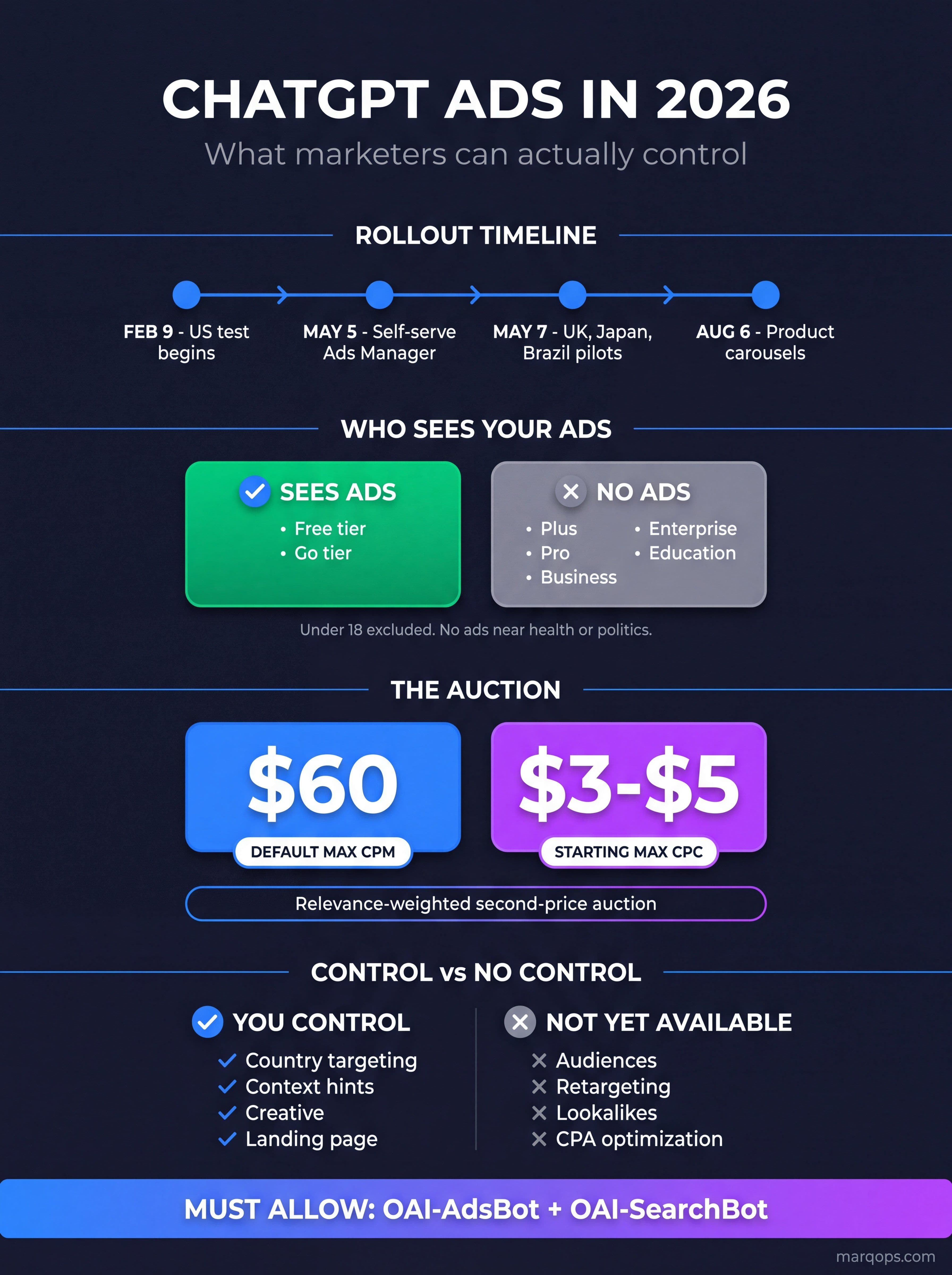
ChatGPT Ads in 2026: rollout timeline, buying mechanics, targeting controls, and the measurement stack at a glance.
Measurement: The OAIQ Pixel and Conversions API
For a platform this young, the measurement stack is unusually complete. Ads Manager exposes impressions, clicks, spend, CTR, average CPC, average CPM, and conversions, with table and chart views, CSV export, and an Insights API that returns performance data at account, campaign, ad group, and ad level.
Two conversion mechanisms run in parallel:
The OAIQ pixel is a small JavaScript SDK for browser-side collection. When a user clicks through, it sets a first-party cookie called __oppref on your domain with a 30 day (720 hour) lifetime, then posts event data to OpenAI's measurement endpoint. Because the cookie is first-party, it sidesteps the browser restrictions that have degraded third-party attribution. One operational quirk: OpenAI generates the pixel for you based on the events you declare, rather than letting you author measurement code freely. Consistent taxonomy across the platform, less control over your own tracking changes.
The Conversions API is the server-side path, and OpenAI describes it as more reliable than the pixel alone. It supports batch sending, validation mode, opt-out, and deduplication via a shared event ID. Accepted action sources include web, mobile_app, offline, physical_store, phone_call, and email, which makes CRM and offline conversion use cases technically viable even though native connectors for major CRM, MMP, and CDP platforms have not shipped.
The correct posture for a serious test is to run both, with a shared event ID on your primary conversion so deduplication can do its job. What is still undocumented matters too: attribution windows, view-through methodology, lift studies, and incrementality tooling are not publicly described. If your organization makes budget decisions on modeled incrementality, you will need to bring your own approach, which is a good argument for reading this channel through multi-touch attribution and incrementality testing frameworks you already trust rather than platform-reported conversions alone.
The Prerequisite Most Teams Miss: OAI-AdsBot
This is the failure mode that costs teams a week and generates no useful error message. OpenAI requires that landing pages submitted as ads do not block two user agents: OAI-AdsBot and OAI-SearchBot. If your edge bot management challenges or rate-limits them, ad review fails quietly.
OpenAI now runs four distinct crawlers with separate purposes, and they are independent tokens. Blocking one does not block the others.
| Crawler | Purpose | Block it? |
|---|---|---|
| OAI-AdsBot | Validates ad landing pages against policy and assesses relevance | No, if you want ads to run |
| OAI-SearchBot | Powers ChatGPT search and citations | No, if you want organic visibility in ChatGPT |
| GPTBot | Collects training data | Optional, blocking has no effect on ads or search |
| ChatGPT-User | Fetches a page when a user asks the assistant to look at a URL | User-initiated, robots.txt may not always apply |
A baseline robots.txt that lets ads and citations work while keeping training opt-out intact looks like this:
User-agent: GPTBot
Disallow: /

User-agent: OAI-SearchBot
Allow: /

User-agent: OAI-AdsBot
Allow: /

User-agent: ChatGPT-User
Allow: /
OpenAI publishes IP range files for three of the four crawlers but not yet for OAI-AdsBot, so edge filtering has to rely on user-agent matching for now. Check your CDN and WAF rules explicitly, then watch server logs for the visit. While you are in that file, it is worth reviewing your llms.txt setup and broader AI visibility configuration, since paid and organic presence inside assistants are governed by adjacent controls.
Policy: Which Categories Can Run Today
Policy is the most underrated planning constraint on this platform. At launch, permitted categories clustered around lifestyle and household goods, local services, travel and experiences, and digital products or education. Excluded at launch: dating and sexual content, health claims, alcohol and drugs, healthcare, financial services, legal services, gambling, and political content.
Baseline creative rules also prohibit misleading claims, offensive language, discrimination, and any design that imitates the ChatGPT interface. That last one is worth flagging to your design team early, because the temptation to mimic the assistant's visual language for native feel will get your ads rejected.
OpenAI has signaled movement from blanket category exclusions toward more selective contextual rules for medical, legal, and financial contexts, but the operational thresholds are not public. If you are in a regulated vertical, expect conservative approvals and build extra time into your flight planning.
What the Early Performance Data Shows
There are no standardized vertical benchmarks yet. What exists is channel-level and partner-level evidence, which tells you the inventory works for someone without forecasting your own result.
- Reuters reported the US pilot crossing roughly $100 million in annualized revenue within six weeks, with more than 600 advertisers participating.
- Criteo, a launch technology partner, reported that across a sample of 500 retailers, LLM-referred traffic converted at roughly 1.5x the rate of other referral channels, which is consistent with the intent-rich positioning.
- OpenAI's own March update cited no measurable impact on consumer trust metrics and low ad dismissal rates.
The honest read: these are encouraging and they are not a media plan. A 1.5x conversion rate on referred traffic says nothing about your CPC, your approval timeline, or whether your category has inventory. Treat them as a reason to test, not a reason to shift budget.
How to Structure Your First 30 Day Test
A test that produces a decision looks different from a test that produces a slide. Here is a structure that works given today's constraints.
Week 0, before you spend anything. Get the account verified early, because approval queues have been slow and multiple advertisers have reported waiting on verification. In parallel, confirm your robots.txt and edge rules allow OAI-AdsBot and OAI-SearchBot, install the OAIQ pixel, and wire the Conversions API with a shared event ID on your primary conversion. If tracking is not clean before the flight starts, the test tells you nothing.
Week 1 and 2, learn what matches. Run CPC at the low end of the $3 to $5 guidance across three to five clearly different context clusters, each with its own ad group. Give every cluster at least four genuinely distinct creative concepts and a landing page built for that specific situation. You are not optimizing yet, you are discovering which conversations your offer can win.
Week 3, consolidate. Kill the clusters with no click volume, and reallocate to the two or three that produced qualified traffic. Rewrite context hints for the winners with more situational specificity. Refresh creative in the losers before you write them off, since a 50 character headline gives you very little signal about whether the cluster or the copy failed.
Week 4, decide against a preset criterion. Set your kill and scale thresholds in week 0, not week 4. Cost per qualified lead or cost per add-to-cart against your blended target is the honest measure. Platform-reported conversions alone will flatter the channel the same way every platform's own attribution does.
Budget realistically. Meaningful early signal at current bid guidance generally means five figures monthly rather than a few thousand dollars, and lead generation or considered-purchase e-commerce will need more room than a narrow impulse test.
Where This Sits Next to Google and Meta
ChatGPT ads sit closer to search-intent media than to social or programmatic display, but without the audience machinery either mature platform gives you. The comparison that clarifies the decision is not "should we move budget from Google" but "what job does this do that nothing else does."
What it does uniquely: it reaches people mid-deliberation, inside a session where they have already articulated constraints an ad platform would normally have to infer. What it cannot do yet: optimize toward CPA or ROAS, retarget, exclude existing customers, or give you the attribution depth that a CFO conversation usually requires.
For most teams that means ChatGPT ads is an incremental line item alongside a mature AI-assisted PPC program, not a replacement for one. It also does not replace the organic work. Appearing inside AI answers without paying for it remains a separate discipline, covered in GEO vs SEO and zero-click search. If anything, paid presence inside assistants raises the value of organic presence, because the same conversation can surface both. And OpenAI is not alone here. Google has moved in the same direction with AI Mode, and retail assistants are shipping ads at launch, which points at a broader shift covered in retail media networks.
Frequently Asked Questions
How much do ChatGPT ads cost?
Buying runs through a relevance-weighted second-price auction. Published guidance points to a $60 default max CPM and a recommended starting max CPC of $3 to $5, with pilot CPMs reportedly settling nearer $25 in some cases. OpenAI has not released average CPC, CTR, CPA, or ROAS benchmarks by vertical, so treat efficiency assumptions as provisional.
Is there a minimum spend to advertise on ChatGPT?
Not for the self-serve Ads Manager. The pilot-era minimum spend commitment, reported at various points between $50,000 and $200,000, was removed when self-serve buying opened on May 5, 2026. Mid-market and SMB advertisers can now run meaningful tests without an enterprise commitment.
Can I retarget people who saw my ChatGPT ad?
Not in general availability yet. Audience targeting, which would enable retargeting, customer exclusion, and eventually lookalikes, is in gated rollout. Assume it is unavailable on your account unless OpenAI or a partner has explicitly enabled it.
Do advertisers see what people type into ChatGPT?
No. Ad matching happens inside OpenAI's infrastructure. Advertisers do not receive chats, chat history, memories, names, emails, IP addresses, or precise locations. Reporting is aggregate: impressions, clicks, spend, and conversions you measure on your own site.
Why was my ChatGPT ad rejected?
The two most common causes are category policy and crawler access. Several verticals including healthcare, financial services, legal services, gambling, alcohol, dating, and political content were excluded at launch. Separately, if your CDN or WAF blocks the OAI-AdsBot user agent, the validation crawler cannot review your landing page and approval fails without an obvious error.
Which countries can see ChatGPT ads?
The pilot started in the US in February 2026, extended to Canada, Australia, and New Zealand in the spring, and OpenAI announced planned expansion into the UK, Mexico, Brazil, Japan, and South Korea. Advertiser-side access has lagged user-side availability in some markets, so confirm delivery eligibility inside your own account rather than assuming parity.
Should I block GPTBot if I want to run ChatGPT ads?
You can. GPTBot collects training data and is entirely separate from OAI-AdsBot and OAI-SearchBot. Blocking GPTBot has no effect on whether your ads run or whether your pages appear in ChatGPT's organic answers. Blocking the other two does.
The Bottom Line
ChatGPT ads in August 2026 are real enough to plan around and immature enough that you should not plan too much. The auction works, the measurement stack is more developed than the buying controls, and access is no longer gated behind enterprise budgets. What is missing is exactly what performance teams need most: outcome-based optimization, audience controls, and documented attribution.
The reasonable posture is a scoped experiment with clean tracking, a handful of tightly written context clusters, more creative variation than feels necessary, and a kill criterion agreed in advance. Get the crawler access and pixel work done now regardless, because both take longer than the campaign build and both block everything downstream.
The larger point is that assistant-adjacent inventory is not a one-platform story. Google is building it, retailers are building it, and the teams that learn how contextual, conversation-matched advertising behaves this year will be operating a channel their competitors are still arguing about. Testing early is cheap. Learning late is not.
Keep following the signal