Agentic Commerce in 2026: The Complete Guide for Marketing Teams
Agentic commerce lets AI agents discover, compare, and buy for shoppers. Here is what it is, the new protocols, and how marketing teams should prepare in 2026.
TL;DR
- Agentic commerce is the shift from people browsing stores to AI agents discovering, comparing, and buying products on a shopper’s behalf. McKinsey projects it could move $3 trillion to $5 trillion globally by 2030.
- Roughly 45% of consumers already use AI for part of their buying journey, and nearly half of online shoppers are expected to rely on agents by 2030, accounting for about a quarter of their spending.
- New rails make it real: the OpenAI and Stripe Agentic Commerce Protocol, Google’s AP2, the Shopify and Google UCP, plus Mastercard Agent Pay and Visa’s Trusted Agent Protocol.
- Agents read structured data, not glossy landing pages. Clean product feeds, complete attributes, schema markup, and consistent brand facts everywhere become your new shelf.
- Marketing teams that unify product data, brand signals, and AI-search visibility now will win the agent’s recommendation. A unified platform like MarqOps keeps every agent-readable surface accurate and on-brand.
Table of Contents
- What Is Agentic Commerce?
- Why Agentic Commerce Is Exploding in 2026
- How Agentic Commerce Works: The New Protocols
- Agentic Commerce Use Cases to Watch
- How Agents Rewrite the Marketing Funnel
- How Marketing Teams Should Prepare
- Where MarqOps Fits In
- Frequently Asked Questions
What Is Agentic Commerce?
Agentic commerce is a model of shopping in which autonomous AI agents handle the work a person used to do by hand: searching for products, comparing options, weighing reviews and price, and in many cases completing the purchase and payment. Instead of a customer opening five tabs to research a running shoe, they tell an assistant what they need, and the agent does the legwork against live product data, then comes back with a short list or simply buys.
The simplest way to understand the change is to ask who you are actually marketing to. For two decades the answer was a human scanning a results page. In agentic commerce, the first audience is often a machine that never sees your hero image, ignores your clever headline, and judges you on the completeness and accuracy of your data. This is a meaningful extension of the agentic marketing shift, where AI agents for marketing already plan and run campaigns. Now those same agent capabilities are moving into the buying seat.
It helps to separate three layers. Discovery is the agent finding and evaluating products, which leans heavily on the same forces behind answer engine optimization. Decision is the agent ranking and recommending. Transaction is the agent completing checkout and payment through a supported protocol. Most brands are reasonably prepared for none of these yet, which is exactly why early movers have room to win.
Quick definition: agentic commerce is commerce where an AI agent, acting on a shopper’s instructions and consent, discovers, evaluates, and transacts for products and services with limited or no human clicks at the point of sale.
Why Agentic Commerce Is Exploding in 2026
Two things changed at once. Consumer behavior crossed a threshold, and the payment and protocol infrastructure caught up. Both are now moving fast enough that this is no longer a futurist talking point.
On the demand side, roughly 45% of consumers already use AI for at least part of their buying journey. Forecasts suggest that by 2030 nearly half of online shoppers will use AI agents, and those agents could account for around a quarter of their spending. People have learned to trust a chat box to plan a trip or shortlist a laptop, and trusting it to buy is a short next step.
$3T to $5T
Global agentic commerce value McKinsey projects by 2030
The market estimates vary by firm but all point the same direction. The agentic commerce market is pegged in the range of several billion dollars in 2026 with compound annual growth rates around 35% to 40% over the next decade. Looking wider, the agentic AI in retail and ecommerce market is estimated near $60 billion in 2026 and projected to grow at roughly 29% per year through 2031. Bain forecasts the US market alone could reach $300 to $500 billion by 2030, representing 15% to 25% of total ecommerce sales.
On the supply side, the dam broke in late 2025 and early 2026 when the major platforms shipped real standards instead of demos. That is the part marketers need to understand, because the protocols determine who can sell to an agent and how. This builds directly on the same infrastructure thinking behind AI programmatic advertising, where machine-to-machine transactions already dominate.
How Agentic Commerce Works: The New Protocols
An agent cannot buy from you unless there is a shared language for checkout, payment, and trust. In 2026 several competing and overlapping standards are racing to become that language. Here is the landscape in plain terms.
The Agentic Commerce Protocol (ACP)
Co-developed by OpenAI and Stripe and launched on September 29, 2025, the Agentic Commerce Protocol defines how an AI agent completes a purchase through four checkout endpoints: create, update, complete, and cancel. It uses Shared Payment Tokens so the agent can pay securely without exposing raw card details. This is the protocol behind buying directly inside ChatGPT, which puts your product one conversation away from a sale if your catalog is connected.
Google AP2 and the Shopify and Google UCP
Google’s AP2, released in September 2025 with more than 60 launch partners including Mastercard, American Express, PayPal, and Salesforce, is an open and settlement-agnostic protocol. A payment can clear over a card network, a bank account, or a stablecoin rail. In January 2026, Shopify and Google announced UCP, a common language for agents and merchants that spans the full journey from discovery through post-purchase. For the millions of merchants on Shopify, this is the path of least resistance into agentic selling.
Mastercard Agent Pay and Visa’s Trusted Agent Protocol
The card networks are building the trust layer. Mastercard Agent Pay, announced April 29, 2025, lets verified agents transact using Agentic Tokens that bind a tokenized card credential to a specific agent, a specific merchant scope, and a specific consent policy. Visa has its own Trusted Agent Protocol and has signaled alignment with ACP. The shared idea is verifiable consent: proof that a real consumer authorized this agent to spend within these limits.
The honest caveat: even Stripe has admitted agentic commerce was overhyped too early in some corners. Standards are still consolidating, and universal interoperability is not here yet. The right posture is to prepare your data and presence now, not to bet the company on one protocol.
The protocols at a glance
It is easy to lose track of who built what. This table summarizes the major standards marketing and commerce teams are watching in 2026.
| Protocol | Backers | What it does |
|---|---|---|
| ACP | OpenAI, Stripe | Agent checkout and payment via four endpoints and Shared Payment Tokens. Powers buying inside ChatGPT. |
| AP2 | Google plus 60+ partners | Open, settlement-agnostic payments that clear over cards, bank rails, or stablecoins. |
| UCP | Shopify, Google | Common language for agents and merchants across discovery through post-purchase. |
| Agent Pay | Mastercard | Agentic Tokens that bind a credential to a specific agent, merchant scope, and consent policy. |
| Trusted Agent Protocol | Visa | Verifies agent identity and consumer authorization, with signaled alignment to ACP. |
Agentic Commerce Use Cases Marketing Teams Should Watch
The abstract idea gets concrete fast once you look at where agents are already buying or about to. A few patterns are worth planning around now.
In consumer retail, the replenishment buy is the obvious first domino. When a household runs low on a staple, an agent can reorder the exact product, or quietly swap to a cheaper equivalent if your data does not make the case for paying more. Brands that win here have rich attributes, strong verified reviews, and a clear reason-to-believe encoded as data, not just as a tagline.
In considered purchases such as electronics, travel, or insurance, agents act as tireless comparison engines. They assemble a shortlist from dozens of sources in seconds, which rewards brands with consistent specs and pricing everywhere and punishes anyone with conflicting listings. This is the moment where conversational marketing meets the buying decision, because the agent is effectively having the sales conversation on the shopper’s behalf.
In B2B, procurement agents are beginning to source vendors, request quotes, and shortlist suppliers against defined criteria. The brands that surface are the ones whose case studies, specifications, and pricing logic are machine-readable and unambiguous. For teams already investing in intent data, the natural extension is making sure the agent acting on that intent can actually find and trust your offer.
Across all of these, the through-line is the same. The agent buys what it can read clearly, trust quickly, and check out from easily. Everything else is noise to a machine.
How Agents Rewrite the Marketing Funnel
When an agent shops, most of your funnel collapses into a single moment: the agent decides whether to surface, rank, or buy your product. That has hard consequences for how marketing teams spend time and budget.
First, discovery moves away from the classic results page. BCG analysis found only an 8% to 12% overlap between traditional search results and AI-generated answers. That gap means winning Google’s blue links no longer guarantees you show up where the agent is actually looking. You need both: LLM SEO and generative engine optimization to influence top and middle funnel agentic discovery, and conventional SEO to capture bottom-funnel intent.
Second, persuasion changes shape. Agents are weakly moved by emotional copy and strongly moved by structured facts, verified reviews, return policies, availability, and price. The brand storytelling still matters for the human who reads the agent’s summary, but the agent’s shortlist is built from data. This is where tracking your visibility across AI assistants becomes a core metric, not a vanity one.
Third, loyalty gets harder and easier at the same time. An agent will happily switch brands if a competitor has cleaner data and a better fit, so weak differentiation gets punished. But an agent that has bought from you successfully, and has your data wired in, becomes a reliable repeat channel. Strong AI personalization and first party data are what let you stay the preferred choice.
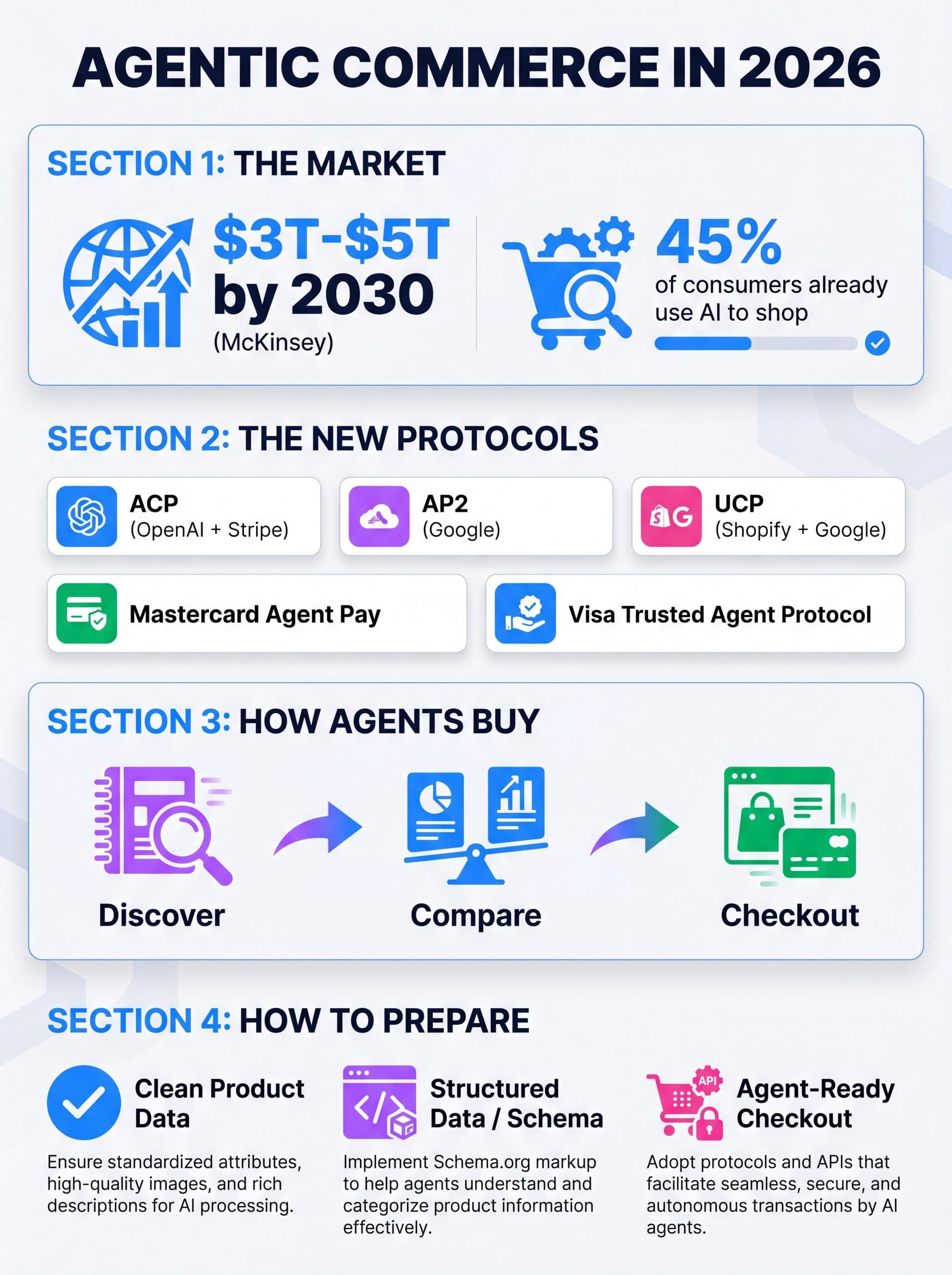
Agentic commerce at a glance: market growth, the new protocols, and the shift from human browsing to agent buying.
How Marketing Teams Should Prepare
You do not need to predict which protocol wins to act. Almost everything that makes you visible and buyable to an agent also helps human shoppers. Here is a practical roadmap.
1. Get your product data to zero empty fields
Product data completeness is where agentic discovery starts and where most brands lose before they begin. Every empty attribute is a disqualifier. Audit every feed and marketplace listing and fill in materials, dimensions, compatibility, use cases, and specifications. Agents cannot recommend what they cannot read.
2. Move from pages to structured data
Agents parse JSON-LD and Schema.org markup far faster than they parse HTML. Mark up products, prices, availability, reviews, and FAQs so an agent can ingest your facts instantly and without guessing. This is the same discipline that powers AI content optimization for written content, applied to your catalog.
3. Make your brand facts consistent everywhere
Agents aggregate from Amazon, Walmart, Target, your own site, and third-party sources that AI assistants cite heavily, such as Reddit and Wikipedia. Inconsistent specs, prices, or descriptions across these surfaces create conflicts that agents penalize. One source of truth for brand and product facts is now a competitive requirement, which ties closely to running disciplined marketing operations.
4. Reduce checkout friction for agents
Streamlined checkout APIs that let a verified agent finalize a payment without fighting CAPTCHAs or clumsy 3D-Secure flows are becoming the difference between a completed sale and an abandoned one. Work with your commerce platform on agent-ready checkout and confirm which protocols it supports.
5. Treat AI visibility as a tracked KPI
If you cannot see whether agents are surfacing and recommending you, you cannot improve it. Build agent and AI-assistant visibility into your reporting alongside traffic and conversions, and connect it to your broader customer journey orchestration so you know where agents enter and exit.
Where MarqOps Fits In
The hardest part of agentic commerce is not understanding it. It is keeping every agent-readable surface accurate, complete, and on-brand at the same time, across product feeds, content, marketplaces, and AI assistants. That work spans tools that usually do not talk to each other, which is exactly the fragmentation that slows most teams down.
MarqOps was built for this. It replaces 7 or more disconnected marketing tools with one platform, so your product facts, brand voice, and content all flow from a single source of truth. Its Brand Intelligence DNA keeps output brand-perfect from the start, which matters enormously when an agent is comparing your data to a competitor’s and looking for the cleaner, more trustworthy signal. Teams using it produce content up to 6 times faster, and a unified dashboard for analytics, ads, SEO, and creative means no more switching tabs to find out whether agents are surfacing you. If you are also rethinking your stack for this shift, our guide to AI-powered marketing platforms shows how a unified system changes the math.
Agentic commerce rewards the brands that are consistent, structured, and fast. That is a marketing operations problem before it is a technology problem, and it is the problem MarqOps exists to solve.
Frequently Asked Questions
What is agentic commerce in simple terms?
Agentic commerce is shopping done by an AI agent on a person’s behalf. The shopper states what they want, and the agent searches, compares, decides, and often completes the purchase and payment, with little or no human clicking at checkout.
What is an agentic commerce protocol?
An agentic commerce protocol is a shared standard that lets AI agents and merchants transact safely. Leading examples include the OpenAI and Stripe Agentic Commerce Protocol, Google’s AP2, the Shopify and Google UCP, Mastercard Agent Pay, and Visa’s Trusted Agent Protocol. They define how agents complete checkout, pay, and prove the shopper’s consent.
How big is the agentic commerce market?
Estimates vary, but McKinsey projects agentic commerce could move $3 trillion to $5 trillion globally by 2030. Bain forecasts the US market alone at $300 to $500 billion by 2030, or 15% to 25% of total ecommerce. Around 45% of consumers already use AI for part of their buying journey.
How do I optimize my brand for AI shopping agents?
Start with complete product data and zero empty fields, add structured data such as JSON-LD and Schema.org markup, keep your brand and product facts consistent across every marketplace and source agents cite, reduce checkout friction with agent-ready APIs, and track your visibility inside AI assistants as a KPI.
Does traditional SEO still matter in agentic commerce?
Yes, but it is no longer enough on its own. BCG found only an 8% to 12% overlap between traditional search results and AI-generated answers, so you need conventional SEO for bottom-funnel intent and answer engine optimization plus LLM SEO to influence how agents discover and recommend you.
Keep following the signal