AI PPC Management in 2026: The Complete Guide to Automating Paid Search
AI PPC management now drives most paid search spend. Learn how marketing teams use AI for bidding, creative, budgets, and reporting to cut waste and scale ROAS in 2026.
AI PPC Management in 2026: The Complete Guide to Automating Paid Search
By MarqOps | Updated June 2026
TL;DR
- AI PPC management uses machine learning to run the heavy lifting of paid search: bidding, audience targeting, creative generation, budget pacing, and reporting. Smart Bidding alone now manages roughly 78% of Google Ads spend.
- Performance Max adoption jumped from 60% of advertisers in 2024 to 71% in 2025, and AI Max for Search reached general availability in early 2026. Automation is no longer optional, it is the default.
- Teams that use AI well see 14% to 18% higher conversion rates and 75% to 85% time savings on routine bid tasks, but automation can underperform manual management by 30% to 50% when the data and inputs are weak.
- The real differentiator in 2026 is not the algorithm, it is clean first-party data, strong creative inputs, and a unified workflow that connects ads to the rest of your marketing operations.
- MarqOps brings paid search, creative, SEO, and analytics into one brand-intelligent platform so your AI PPC management runs from the same source of truth as the rest of your marketing.
Table of Contents
- What Is AI PPC Management?
- Why AI PPC Management Matters in 2026
- How AI PPC Management Works: 5 Core Functions
- The Benefits and the Hidden Risks
- A Practical Roadmap to Implement AI PPC
- Why a Unified Platform Beats a Stack of Point Tools
- Frequently Asked Questions
What Is AI PPC Management?
AI PPC management is the use of machine learning and generative AI to plan, run, and optimize pay-per-click campaigns with far less manual effort. Instead of a marketer adjusting bids by hand, writing every ad variation, and pulling reports across platforms, AI systems analyze auction signals in real time, predict which clicks are most likely to convert, generate and test creative, and reallocate budget toward what works. The marketer shifts from operator to strategist.
This is not a future concept. It already runs most of the paid search you see today. Smart Bidding manages roughly 78% of all Google Ads spend, and the question facing marketing teams is no longer whether to adopt automation but how to control it well. If you want the broader context on how machine learning is reshaping search campaigns, our guide to AI for Google Ads in 2026 is a useful companion read.
In plain terms: AI PPC management does not replace the marketer. It removes the repetitive, math-heavy parts of campaign management so your team can spend time on strategy, offers, and the creative and audience decisions that machines still cannot make for you.
Why AI PPC Management Matters in 2026
Three forces have made AI PPC management a baseline requirement rather than a competitive edge. First, the platforms themselves have gone AI-native. Second, costs keep climbing, so wasted spend hurts more. Third, measurement has become harder, which means the teams with the cleanest data win.
The platforms are now AI-first by default
Google has steadily moved automation from optional to default. Performance Max adoption rose from 60% of advertisers in 2024 to 71% in 2025, and AI Max for Search reached general availability in early 2026 with expanded query matching and auto-generated ad copy. Roughly 85% of advertisers now use automated bidding strategies such as Target CPA and Target ROAS. When the auction is run by AI, fighting it with manual controls usually leaves performance on the table. Our deep dives on Performance Max campaigns and AI Max for Google Ads break down how to work with these systems rather than against them.
78%
of Google Ads spend is now managed by Smart Bidding
Costs are rising and waste is expensive
Global PPC spend is projected to reach more than $300 billion in 2026, and Google Shopping CPCs climbed roughly 26% over three years. As clicks get pricier, inefficiency compounds. Research shows that teams running segmented analysis uncover 15% to 30% of budget waste that aggregate reporting hides. AI PPC management is one of the fastest ways to find and stop that leak, because the system can spot underperforming segments far faster than a human reviewing spreadsheets.
Measurement got harder, so data quality wins
In the 2026 State of PPC research, professionals named opaque black-box platforms (62%) and less accurate measurement and attribution (53%) as their biggest challenges. The lesson is blunt: AI is only as good as the data you feed it. Improving data accuracy by even 10% can lift conversion efficiency by 15% to 20%. This is why connecting your paid search to a single, clean data layer matters, and why teams increasingly pair AI PPC with multi-touch attribution to see which touchpoints actually drive revenue.
How AI PPC Management Works: 5 Core Functions
AI does not manage PPC as a single magic button. It operates across five distinct functions, each of which you can adopt independently and then connect into one workflow.
1. Smart bidding and budget pacing
This is the most mature use of AI in paid search. Machine learning evaluates dozens of signals per auction, including device, time, location, query intent, and audience, then sets a bid in milliseconds. Advertisers using Smart Bidding typically see 20% to 40% better performance than manual bidding, provided the campaign has enough conversion volume to learn from. AI also paces budgets across the month and shifts spend toward the placements and times that convert.
2. Creative generation and testing
Generative AI now writes headlines, descriptions, sitelinks, and even short video cuts from a product feed and a landing page URL. About 75% of PPC professionals already use generative AI to write ads at least sometimes. The platform then tests combinations continuously and promotes the winners. The catch is that output quality depends entirely on input quality, so strong source creative still matters. Tools like our roundup of AI ad generators and the discipline of dynamic creative optimization help you feed the machine better raw material.
3. Audience targeting and segmentation
AI builds and refines audiences from your first-party data, finds lookalikes, and suppresses people who have already converted. In 2026, first-party data is the single most valuable input you control. Uploading clean customer lists and connecting them to AI-driven customer segmentation sharpens who your ads reach and keeps acquisition budget away from existing buyers.
4. Keyword discovery and negative management
AI surfaces new converting search terms, clusters them by intent, and flags wasteful queries that deserve negative keywords. With broad match and AI-driven query expansion now common, disciplined negative keyword management is more important, not less. The automation finds the opportunities; your team sets the guardrails.
5. Reporting and anomaly detection
AI compiles cross-platform performance, explains what changed, and alerts you when a metric breaks its normal pattern, often before a human would notice. PPC managers using conversational AI automation report 75% to 85% time savings on routine reporting and bid tasks. Pairing this with strong AI marketing analytics turns raw numbers into decisions instead of dashboards nobody reads.
| Function | What AI does | What stays human |
|---|---|---|
| Bidding | Real-time bid and budget decisions | Goals, ROAS and CPA targets |
| Creative | Generate and test ad variations | Brand voice, offer, source assets |
| Audience | Build lookalikes, suppress converters | First-party data strategy |
| Keywords | Discover terms, suggest negatives | Final negative list, intent rules |
| Reporting | Compile data, flag anomalies | Interpretation and next moves |
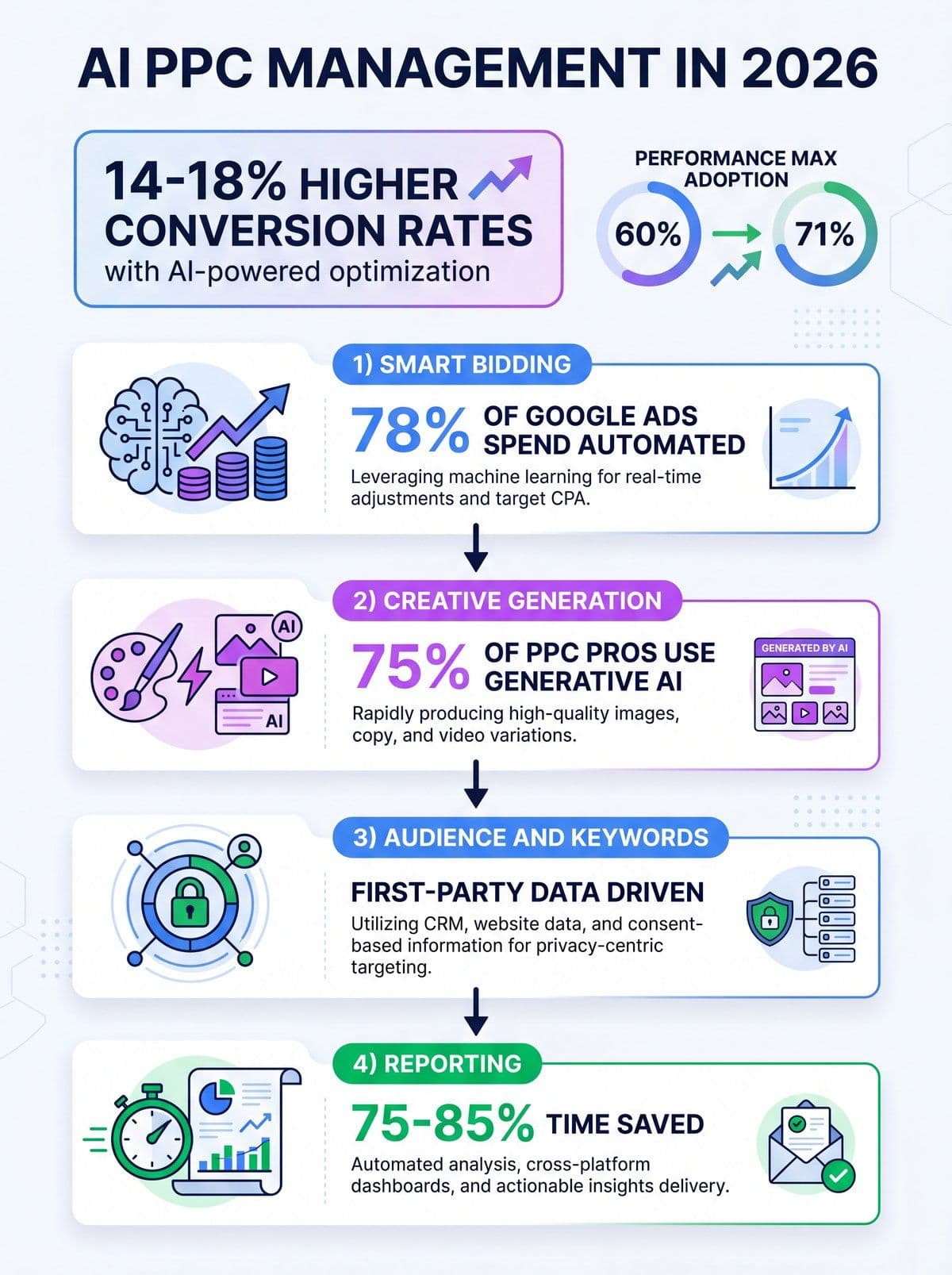
How AI PPC management automates the paid search workflow in 2026.
The Benefits and the Hidden Risks
The upside of AI PPC management is well documented. Brands implementing AI in Search campaigns see 14% to 18% higher conversion rates, and campaigns using AI Max with Smart Bidding Exploration showed an 18% increase in unique converting query categories and a 19% lift in overall conversions. Add the 75% to 85% time savings and the case looks one-sided.
The upside: 14% to 18% higher conversion rates, up to 40% better performance than manual bidding, and 75% to 85% less time spent on routine campaign management.
But the averages hide failure cases. The same automation that delivers strong results can underperform manual management by 30% to 50% when conversion tracking is broken, the account is poorly structured, or creative inputs are thin. Smart Bidding generally needs around 100 conversions per month per campaign to learn well, so low-volume accounts often struggle. And black-box systems make it harder to know why something changed, which is exactly why measurement and attribution rank among marketers’ top frustrations.
The rule of thumb: AI amplifies whatever you give it. Clean conversion data, clear goals, and good creative get amplified into strong results. Dirty data and vague targets get amplified into expensive waste.
A Practical Roadmap to Implement AI PPC Management
You do not need to overhaul everything at once. Use this sequence to adopt AI PPC management without losing control.
Step 1: Fix your measurement first
Before you hand bidding to AI, make sure conversion tracking is accurate and your conversion values reflect real business outcomes. Value-based bidding only works if the values are right. This is the single highest-leverage step, because everything downstream depends on it.
Step 2: Consolidate account structure
AI needs volume to learn. Aim for fewer, more data-rich ad groups, often 3 to 10 tightly themed groups per campaign, each mapped to a distinct intent cluster. Over-segmented accounts starve the algorithm of signal.
Step 3: Feed strong creative and first-party data
Provide high-quality headlines, descriptions, images, and videos, plus clean customer lists and audience signals. The quality of these inputs directly determines the quality of automated output. Treat creative as fuel, not an afterthought.
Step 4: Set guardrails, then let it run
Define your ROAS or CPA targets, brand exclusions, and negative keywords, then give the system the two to three weeks it needs to exit the learning phase. Resist the urge to make daily changes, which resets learning. Review weekly, not hourly.
Step 5: Connect PPC to the rest of your marketing
Paid search does not live in isolation. Connect it to your marketing dashboard, your ROI measurement, and your broader marketing workflow automation so ad performance informs creative, SEO, and budget decisions across the funnel. This is where most teams lose value, because their ads, analytics, and creative live in separate tools that never talk to each other.
Why a Unified Platform Beats a Stack of Point Tools
Here is the structural problem with most AI PPC setups in 2026. Research shows the typical team stitches together two to three tools for full coverage, for example one platform for competitive research, another for execution, and a third for cross-platform reporting. Every handoff between tools is a place where data gets lost, brand consistency slips, and insight dies. You end up with smart automation running on fragmented information.
This is the gap MarqOps was built to close. Instead of bolting an AI PPC tool onto a pile of disconnected software, MarqOps unifies paid advertising, creative production, SEO content, and analytics in one brand-intelligent platform. Its Brand Intelligence DNA means every ad, asset, and report reflects your brand from the start, and the unified dashboard removes the constant tab-switching that fragments most teams’ workflows. One platform replaces seven or more disconnected tools, which is why teams report up to 6x faster content and campaign output.
1 platform, 7+ tools replaced
Paid search, creative, SEO, and analytics from one source of truth
When your AI PPC management draws from the same data and brand rules as your content and analytics, the automation gets smarter and your reporting finally tells one consistent story. If you are still assembling that stack, our guides to building a lean marketing tech stack and choosing the best AI marketing tools in 2026 are good next steps.
Start Free – No Card RequiredSee How MarqOps Works
5 Common AI PPC Management Mistakes to Avoid
Most disappointing AI PPC results trace back to a handful of avoidable errors. Watch for these before you blame the algorithm.
1. Handing over bidding before tracking is clean. If conversions are mismeasured, the AI optimizes toward the wrong outcome and scales the mistake. Fix measurement first, always.
2. Making daily changes that reset learning. Constant tweaks keep campaigns stuck in the learning phase. Set targets, then give the system two to three weeks of stability.
3. Starving the algorithm with over-segmented accounts. Too many thin ad groups split the conversion signal. Consolidate into fewer, data-rich groups so AI has enough volume to learn.
4. Treating creative as an afterthought. Generative AI amplifies your source assets. Weak headlines and images produce weak ads no matter how good the bidding is. Strong creative remains a human responsibility, supported by conversion rate optimization on the landing pages that follow the click.
5. Running PPC in a silo. When ads, analytics, SEO, and creative live in separate tools, the AI never sees the full picture. Connecting paid search to your wider marketing funnel and a single source of truth is what separates the teams that scale from the teams that plateau.
Frequently Asked Questions
What is AI PPC management?
AI PPC management is the use of machine learning and generative AI to run pay-per-click campaigns with minimal manual work. It automates bidding, creative generation, audience targeting, keyword discovery, and reporting, while the marketer sets goals, brand rules, and strategy. Smart Bidding alone now manages about 78% of Google Ads spend.
Does AI PPC management replace PPC managers?
No. AI handles the repetitive, math-heavy execution, but humans still own goals, conversion values, brand voice, offers, audience strategy, and interpretation of results. The role shifts from manual operator to strategist who guides and audits the automation.
How much can AI improve PPC performance?
Brands using AI in Search campaigns see 14% to 18% higher conversion rates, and Smart Bidding often delivers 20% to 40% better performance than manual bidding. However, automation can underperform by 30% to 50% when tracking is broken or inputs are weak, so data quality is essential.
What data do I need for AI PPC to work well?
You need accurate conversion tracking, conversion values that reflect real business outcomes, and clean first-party data such as customer lists. Smart Bidding typically needs around 100 conversions per month per campaign to learn effectively, so low-volume accounts should consolidate structure to build signal.
How does MarqOps help with AI PPC management?
MarqOps unifies paid advertising, creative, SEO, and analytics in one brand-intelligent platform, so your AI PPC management runs from the same clean data and brand rules as the rest of your marketing. That removes the fragmentation of stitching multiple point tools together and replaces seven or more disconnected tools with a single unified dashboard.
Keep following the signal
Related field notes
Marketing
Marketing Automation for Agencies in 2026: What to Automate, What to Keep Human
11 min readMarketing
Brand Asset Management in 2026: How to Run It Without Adding Another Tool
14 min readMarketing Operations