llms.txt in 2026: What It Actually Does for AI Search Visibility (and What It Doesn’t)
llms.txt is everywhere in 2026, but does it help AI search? A data-driven guide to what the file does, how to create one, and where the real value sits.

TL;DR
- llms.txt is a Markdown file at your domain root that gives AI systems a curated map of your most important content, with one-line descriptions for each link.
- Adoption is real but early. An SE Ranking study of 300,000 domains found a 10.13% adoption rate, and companies like Anthropic, Stripe, Zapier, and Cloudflare now publish one.
- It is not an SEO ranking factor. Google confirmed in July 2025 it does not use llms.txt, and studies show major AI crawlers almost never fetch the file.
- The real payoff is developer and agent experience, meaning AI coding tools, MCP servers, and in-product assistants that read your docs, not AI Overviews or ChatGPT citations.
- Ship one if it is cheap to maintain, but treat your content structure, entity consistency, and topical depth as the things that actually earn AI visibility.
Table of Contents
- What is llms.txt?
- How llms.txt actually works
- The state of adoption in 2026
- Does llms.txt help AI search visibility?
- Where llms.txt genuinely adds value
- llms.txt vs robots.txt and sitemaps
- How to create an llms.txt file (step by step)
- A practical 2026 roadmap for marketing teams
- Frequently asked questions
What is llms.txt?
By 2026, most marketing teams have accepted a hard truth: a growing share of your audience never reaches your website through a blue link. They ask ChatGPT, Perplexity, Claude, or Google’s AI Overviews, and they read the answer those systems assemble. That shift is exactly why llms.txt has become one of the most talked-about, and most misunderstood, ideas in search.
llms.txt is a plain Markdown file you publish at the root of your domain, at https://yourdomain.com/llms.txt. Its job is discovery. Instead of leaving an AI system to crawl every thin tag page and stale blog post on your site, the file hands it a curated list of your most important URLs, each with a short human-written description of what lives there. Think of it as a concierge for language models: here is who we are, here is what matters, here is where to look first.
The concept was proposed by Jeremy Howard of Answer.AI in September 2024, and it spread fast because it solves a genuine problem. Large language models work with limited context windows, and raw HTML is bloated with navigation, scripts, and markup that waste that budget. A clean, link-forward Markdown index is far easier for a model to parse than a rendered page. If you have followed our work on GEO vs SEO or answer engine optimization, llms.txt fits neatly into the same conversation about making your content legible to machines, not just people.
The quick definition: llms.txt is a curated, machine-readable table of contents for your website, written in Markdown, designed to help AI systems find and prioritize your best content. It is a proposal and a convention, not an official web standard endorsed by search engines.
How llms.txt actually works
The format is deliberately simple. The specification calls for an H1 with your project or brand name, a blockquote summary that describes the site in a sentence or two, optional prose for extra context, then one or more H2 sections that group curated links. Each link is a standard Markdown bullet: a URL and a short description of the page behind it.
Only one element is strictly required. You must have exactly one H1, and it must be the brand or project name. Without it, the file is invalid and compliant clients will refuse to parse it. Everything else, including the summary and section structure, is strongly recommended but technically optional.
There is also a companion file, llms-full.txt, meant to carry deeper context and longer summaries for long-context retrieval. The pattern most production sites follow is a division of labor: the focused llms.txt handles quick discovery and indexing, while llms-full.txt feeds richer material when a model wants to go deep. Documentation, tutorials, and reference-heavy sites benefit most from publishing both.
A minimal example looks like this:
# Acme Analytics
> Acme Analytics is a marketing intelligence platform that unifies ads, SEO, and creative reporting in one dashboard.
## Core Pages
– [Product overview](https://acme.com/product): What Acme does and who it is for
– [Pricing](https://acme.com/pricing): Plans, limits, and what is included
## Documentation
– [API reference](https://acme.com/docs/api): Endpoints, auth, and rate limits
– [Getting started](https://acme.com/docs/start): Set up your first report in ten minutes
Notice what is missing. No YAML front matter, no JSON header, no metadata block. The spec is strict, and clients will not parse extras. Keep descriptions under roughly 120 characters, keep the whole file comfortably under 10 KB when you can, and never list pages that sit behind a login, because the model will simply hit a wall.
The state of adoption in 2026
Here is where the honest reporting begins, because the headlines and the reality do not always match. Adoption of llms.txt is real, it is growing, and it is still early.
10.13%
of 300,000 domains studied by SE Ranking now publish an llms.txt file
That figure means that after roughly eighteen months of industry conversation, llms.txt sits on about one in ten sites in a large sample. Adoption reportedly grew nearly ninefold year over year, and the list of serious adopters is what gives the movement credibility: Anthropic, Stripe, Zapier, and Cloudflare all publish one. Perhaps the strongest signal of mainstreaming is that Yoast SEO now generates an llms.txt automatically for WordPress sites, which quietly puts the file in front of millions of publishers who never asked for it.
Search engines are indexing these files too. Google had somewhere between 30,000 and 60,000 llms.txt files indexed globally as of October 2025. By spring 2026 that number climbed toward 120,000, with a peak observation near 200,000 in April 2026. So the file is out there, it is being crawled, and it is being counted.
But there is a catch that matters enormously for anyone treating this as a visibility tactic. When one analysis monitored more than 500 million AI bot visits across a 90-day window, only 408 of them targeted /llms.txt directly. That is a rounding error. The crawlers you care about, GPTBot, ClaudeBot, PerplexityBot, OAI-SearchBot, and Google-Extended, overwhelmingly skip the file and crawl your HTML the same way they always have.
Does llms.txt help AI search visibility?
This is the question every marketing director is really asking, so let us answer it plainly: as of 2026, there is no credible evidence that llms.txt improves your citation rate in ChatGPT, Perplexity, Google AI Overviews, or AI Mode.
The clearest signal comes from Google itself. In July 2025, Google’s Gary Illyes confirmed on the record that Google does not support llms.txt and has no plans to. John Mueller went further and compared it to the long-discredited keywords meta tag, a piece of markup that publishers stuffed for years while search engines ignored it entirely. Google Search has also stated explicitly that the file does not affect AI Overviews or AI Mode.
That does not mean AI visibility is out of your control. It means the levers are the ones we have written about repeatedly. Getting cited by AI systems depends on content structure, entity consistency, third-party presence, and genuine topical authority, not on a curated Markdown index sitting at your domain root. If you want to understand the full mechanics of earning references inside generated answers, our guides on LLM SEO and AI visibility lay out what actually moves the needle.
The trap to avoid: Do not publish an llms.txt, cross your fingers, and expect more citations in AI answers. That is the 2026 equivalent of stuffing meta keywords. The file is infrastructure, not a growth lever.
The realistic read is that llms.txt is not yet an SEO play. It is a developer-experience play. And that distinction, far from being a disappointment, is actually where the interesting opportunity lives.
Where llms.txt genuinely adds value
The bots skipping your llms.txt are the search and answer crawlers. The systems that do read it are a different and fast-growing category: AI coding assistants and in-product agents.
Tools like Cursor, Claude Code, GitHub Copilot, and Windsurf increasingly fetch llms.txt when a developer points them at your documentation. MCP servers and agent frameworks use it to orient themselves before pulling deeper context. If your important readers include engineers wiring up your API inside an AI-assisted IDE, a well-built llms.txt measurably improves how those tools understand and use your product. This is agent-to-agent plumbing, and it is only going to matter more as software gets built by humans and agents working side by side.
There is a quieter benefit too. Writing an llms.txt forces you to answer a genuinely useful question: which twenty or thirty pages actually represent your business? Most marketing teams have never made that list explicitly. The exercise of curating it often surfaces orphaned content, redundant pages, and gaps in your content optimization that were invisible before. Even if no crawler ever reads the file, the act of building it sharpens your information architecture.
Bottom line for 2026: build an llms.txt for your developer audience and for your own content clarity. Build your generative engine optimization strategy for everything else.
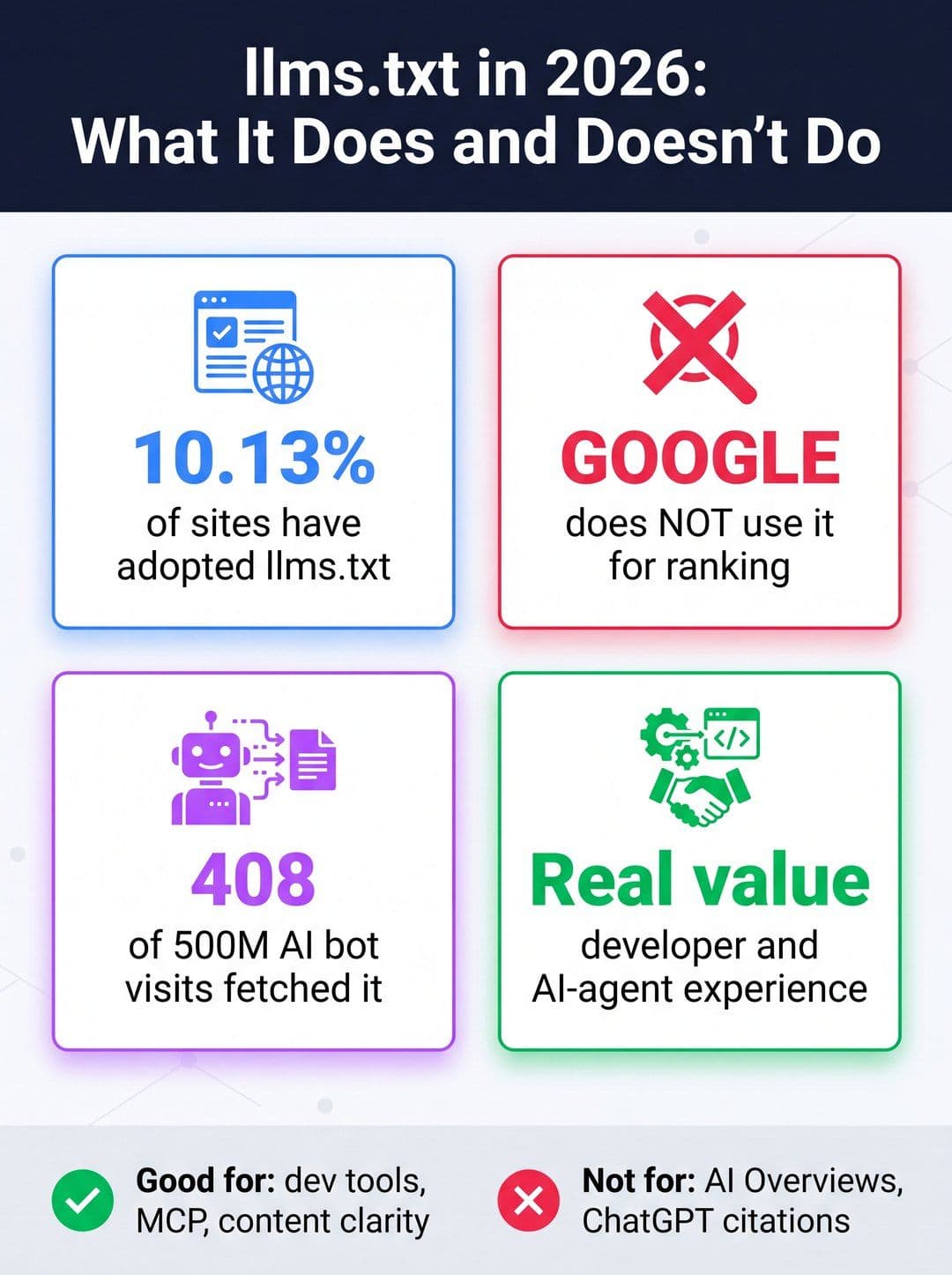
llms.txt in 2026: what it does, what it does not, and where the real value sits.
llms.txt vs robots.txt and sitemaps
A common point of confusion is how llms.txt relates to files you already have. They are cousins, not competitors, and each answers a different question.
| File | Question it answers | Primary audience |
|---|---|---|
| robots.txt | What are you allowed to crawl? | Search and AI crawlers |
| sitemap.xml | What pages exist and when did they change? | Search engine indexers |
| llms.txt | What matters most and what does it mean? | AI models and agents |
robots.txt is about permission and remains the file that actually governs AI crawler access, so if you want to allow or block GPTBot or Google-Extended, that is where the real control sits. A sitemap is an exhaustive machine list of everything. llms.txt is the opposite of exhaustive: it is an editorial choice about what deserves attention. You should keep all three, and you should not expect llms.txt to do the job of the other two.
How to create an llms.txt file (step by step)
If you have decided the developer-experience and content-clarity benefits are worth it, here is a clean way to ship one that follows the spec.
Step 1: Pick your 15 to 30 most important URLs
Resist the urge to list everything. Choose the pages that define who you are and what you sell: product, pricing, core documentation, your best cornerstone articles, and key support resources. This curation is the whole point.
Step 2: Write the required H1 and summary
Start with a single H1 that is your brand name, then a blockquote that describes your business in one or two sentences. Lead the summary with what you do and who you serve, not with adjectives.
Step 3: Group links into H2 sections with descriptions
Organize your links under clear H2 headings like Product, Documentation, or Guides. For each link, write a description under 120 characters that leads with the page’s value, because that sentence is what a model actually reads when deciding whether to surface the URL.
Step 4: Add an optional llms-full.txt for depth
If your site is documentation-heavy, publish a companion llms-full.txt with longer context. Keep the core llms.txt lean for discovery and let the full file carry the depth.
Step 5: Publish at the root and date it
Upload the file so it resolves at https://yourdomain.com/llms.txt. Add a short line like “Last reviewed 2026-04-01” in the body so both humans and crawlers can judge freshness, then put a reminder in your content calendar to refresh it whenever your key pages change.
Maintenance is the hidden cost. An llms.txt that points to renamed or deleted pages is worse than none at all. If you cannot commit to keeping it current, either automate its generation or skip it until you can.
A practical 2026 roadmap for marketing teams
So what should you actually do this quarter? Here is the sequence we recommend to teams weighing llms.txt against everything else on their AI-search to-do list.
First, get your fundamentals right. Your citations in AI answers come from clear content structure, consistent entities, and depth on the topics you want to own. If your topical authority is thin, no root-level file will rescue it. Fix the content first.
Second, monitor where you already appear. You cannot improve what you cannot see. Track how often your brand surfaces across ChatGPT, Claude, Gemini, and Perplexity using dedicated AI search visibility tools, and pair that with ongoing AI brand monitoring so you catch shifts in sentiment and share of answer as they happen. This matters more as zero-click search and AI Overviews absorb more of the journey.
Third, ship an llms.txt if it is cheap. If you have developer-facing docs or you can automate generation, publish one. Treat it as good hygiene and a nice-to-have for agent tooling, not as a growth channel.
This is exactly the kind of coordination problem where fragmentation kills momentum. When your SEO tool, your analytics, your brand monitoring, and your content production all live in separate tabs, keeping an llms.txt current and tying it to real visibility data becomes one more thing that falls through the cracks. This is the gap MarqOps was built to close. By unifying content optimization, SEO operations, analytics, and brand intelligence in one dashboard, MarqOps replaces seven or more disconnected tools with a single system that keeps your AI-visibility work moving instead of stalling between platforms. Its Brand Intelligence DNA means the output stays on-brand from the first draft, and teams ship roughly six times faster because the busywork between tools disappears.
Frequently asked questions
Does llms.txt help my site rank in Google or get cited by ChatGPT?
No. As of 2026, Google has confirmed it does not use llms.txt, and studies show major AI crawlers almost never fetch it. Citations in AI answers come from content quality, structure, entity consistency, and topical authority, not from the file itself.
If it does not help SEO, why would I create one?
The real value is developer and agent experience. AI coding tools like Cursor, Claude Code, and Copilot, plus MCP servers and in-product assistants, read llms.txt to understand your docs. Building one also forces useful clarity about which pages truly represent your business.
What is the difference between llms.txt and llms-full.txt?
llms.txt is a lean, curated index for quick discovery. llms-full.txt is an optional companion that carries deeper context and longer summaries for long-context retrieval. Documentation-heavy sites often publish both, letting the focused file handle indexing and the full file feed depth.
How is llms.txt different from robots.txt?
robots.txt controls what crawlers are allowed to access and remains the file that actually governs AI crawler permissions. llms.txt does not control access at all. It is an editorial map of your most important content, meant for AI models and agents to understand what matters.
How much of the web has adopted llms.txt?
An SE Ranking study of 300,000 domains found a 10.13% adoption rate, roughly one in ten sites, with adopters including Anthropic, Stripe, Zapier, and Cloudflare. Yoast SEO now auto-generates the file for WordPress, so adoption is expected to keep climbing.
Keep following the signal
Related field notes
Marketing
Marketing Automation for Agencies in 2026: What to Automate, What to Keep Human
11 min readMarketing
Brand Asset Management in 2026: How to Run It Without Adding Another Tool
14 min readMarketing Operations