Retail Media Networks in 2026: The Complete Guide for Marketing Teams
US retail media spend hits $69.33B in 2026. Learn how retail media networks work across onsite, offsite, CTV, and in-store, and how AI unifies a fragmented channel.
TL;DR
- Retail media networks (RMNs) let retailers sell ad space across their websites, apps, in-store screens, and connected TV, powered by their own first-party shopper data.
- US retail media ad spend is forecast to hit $69.33 billion in 2026, up roughly 18 percent from $58.79 billion in 2025, with the global market pushing past $165 billion.
- The catch: brands now run an average of 6 retail media networks and expect to manage 11 by the end of 2026, each with its own dashboard, taxonomy, and attribution model.
- The real winners are not the brands spending the most. They are the teams that unify creative, data, and measurement across every network in one place.
- AI-native marketing platforms like MarqOps collapse that fragmentation, generating brand-perfect retail media creative 6x faster and reporting on every network from a single dashboard.
Table of Contents
- What Is a Retail Media Network?
- Why Retail Media Is Exploding in 2026
- The 2026 Retail Media Landscape and Top Networks
- How Retail Media Networks Actually Work
- The Fragmentation Problem Nobody Warned You About
- How AI and Unified Platforms Fix It
- How to Build a Retail Media Strategy in 2026
- Measuring Retail Media ROI
- What Comes Next: Trends to Watch
- Frequently Asked Questions
What Is a Retail Media Network?
A retail media network is the advertising business a retailer builds on top of its own audience. When a brand pays to appear at the top of Amazon search, on a sponsored product tile in the Walmart app, on a digital screen in a Kroger aisle, or on a streaming ad targeted using Target’s purchase data, that brand is buying retail media. The retailer owns the audience, the data, and the placement. The brand rents access to high-intent shoppers at the exact moment they are deciding what to buy.
What makes retail media different from a normal display ad is the data underneath it. RMNs run on first-party data collected directly from logged-in shoppers and loyalty programs. That means a retailer can show you an ad and then prove that the same shopper bought the product, online or in a physical store. In a world where third-party cookies are unreliable and privacy rules keep tightening, that closed-loop measurement is the single most valuable asset in digital advertising right now.
The category has grown so fast that it now sits beside search and social as a core pillar of every serious media plan. The question for marketing teams in 2026 is no longer whether to invest in retail media. It is how to manage it without drowning in dashboards.
Why Retail Media Is Exploding in 2026
The numbers tell the story better than any pitch deck. US advertisers are projected to spend $69.33 billion on retail media in 2026, up from $58.79 billion in 2025, a year-over-year jump of nearly 18 percent. Globally, retail media spend pushes past $165 billion as networks launch in every retail vertical from grocery to pharmacy to home improvement.
$69.33B
Projected US retail media ad spend in 2026, up ~18% year over year
Three forces are driving this. First, intent. Shoppers on a retailer’s site are further down the funnel than almost anywhere else online, so the ads convert. Second, data. Retailers sit on a goldmine of zero-party and first-party data that brands can no longer easily get elsewhere, which makes RMN inventory uniquely targetable and measurable. Third, margin. Advertising is far more profitable than selling groceries, so every retailer with scale is racing to launch a network.
There is a concentration story too. Walmart and Amazon are forecast to absorb more than 89 percent of the incremental retail media dollars spent in 2026. Amazon’s retail media revenue alone is expected to clear $75 billion by 2028, more than $65 billion ahead of the next largest network. That gravity matters for how you allocate budget, but it also means a long tail of smaller networks is fighting hard for the rest, often with better margins and less competition for ad slots.
Retail media is the fastest-growing major ad channel of the decade, but the growth is lopsided. Two players take most of the new money while dozens of smaller networks fragment the rest. Winning means playing both ends without multiplying your workload.
The 2026 Retail Media Landscape and Top Networks
Amazon, Walmart, and Instacart together account for roughly 78 percent of the category, but the list of credible networks now runs deep. Here is how the major players stack up for marketing teams planning spend in 2026.
| Network | Strength | Best For |
|---|---|---|
| Amazon Ads | Scale, search intent, full-funnel inventory | Brands that sell on Amazon or want reach |
| Walmart Connect | Omnichannel, in-store screens, Vizio CTV | CPG and brands needing offline reach |
| Instacart | High-frequency grocery purchase data | Food, beverage, and household brands |
| Target Roundel | Loyal audience, strong offsite extension | Lifestyle, apparel, and home brands |
| Kroger Precision Marketing | Deep grocery loyalty data, in-store media | Grocery and CPG performance campaigns |
Beyond these, networks from Best Buy, The Home Depot, Costco, Albertsons, and even non-retail players in finance and travel are entering the space. The practical takeaway is simple: the number of networks worth testing keeps climbing, and each one you add multiplies the operational load on your team unless you have a way to manage them centrally.
How Retail Media Networks Actually Work
Retail media used to mean sponsored product listings and nothing more. In 2026 it spans four connected surfaces, and understanding each one is the key to building a campaign that works across the full funnel.
1. Onsite media
These are the ads inside the retailer’s own properties: sponsored products, sponsored brands, banner placements, and search results on the website and app. Onsite is the most mature surface, the closest to the purchase, and usually the best place to start because attribution is cleanest.
2. Offsite media
Retailers now activate their first-party data beyond their own walls, targeting their shoppers on social platforms, the open web, and elsewhere using AI-powered programmatic advertising. eMarketer estimates the next $20 billion-plus of retail media growth is moving offsite. This is where retail media starts to overlap with your existing paid search and social programs, which is exactly why coordination matters.
3. Connected TV (CTV)
Retailers are partnering with streaming platforms to extend reach into living rooms while still using shopper data to target and measure. Walmart’s acquisition of Vizio created an addressable CTV inventory source at scale, letting brands run a TV ad and then tie it to actual store and online sales. CTV turns retail media into a true upper-funnel channel without losing the closed-loop measurement that makes RMNs special.
4. In-store media
Roughly 76 percent of purchases still happen in physical stores, so the shelf is the next frontier. Kroger is building shelf-integrated animated content with Barrows, Albertsons launched an 80-store digital display network with Stratacache, and Hy-Vee added more than 10,000 in-store screens across over 400 locations. In-store media closes the gap between the ad and the moment of purchase like nothing else can.
The strategic shift in 2026 is full-funnel. Retail media is no longer just a bottom-of-funnel search tactic. With CTV, offsite, and in-store, a single retailer’s data can power awareness, consideration, and conversion in one measurable loop.
The Fragmentation Problem Nobody Warned You About
Here is the part the growth charts leave out. Every network you add is a separate login, a separate creative spec, a separate audience taxonomy, and a separate attribution model that rarely agrees with the others. Brands today run an average of 6 retail media networks and expect that number to grow to 11 by the end of 2026.
6 to 11
Retail media networks the average brand will manage by the end of 2026
Each network reports conversions differently, counts attribution windows differently, and exports data in its own format. A campaign manager can easily lose a full day a week just exporting spreadsheets, normalizing metrics, and stitching together a picture that is out of date by the time it reaches the CMO. Creative teams hit the same wall: every network demands its own dimensions, character limits, and brand-safety rules, so producing assets for eleven networks means eleven versions of every concept.
This is the same tool-sprawl problem that has plagued marketing for a decade, just with a new label. Platform fragmentation has also exposed the limits of traditional attribution, because no single network sees the full customer journey. The teams that win retail media in 2026 are not the ones with the biggest budgets. They are the ones who solve the operational chaos first.
How AI and Unified Platforms Fix It
The fix is consolidation. Instead of bolting on a point solution for each network, leading teams are moving to AI-powered marketing platforms that unify creative production, campaign management, and reporting across every channel, retail media included. This is the entire reason a platform like MarqOps exists: one system replaces 7-plus disconnected tools so your team stops switching tabs and starts scaling.
AI is already changing the economics. Walmart Connect deployed gen-AI automated creative generation that cut median creative production time by 80 percent. The same shift is available to any brand that adopts AI-native creative automation. With MarqOps, Brand Intelligence DNA produces brand-perfect retail media creative across every network’s specs from the start, so you generate eleven on-spec variations in the time it used to take to build one, roughly 6x faster output without losing brand consistency.
On the data side, a unified dashboard pulls every network’s spend, sales, and ROAS into one view. Instead of reconciling six exports by hand, your team sees normalized marketing analytics in real time, and AI surfaces which networks and creatives are actually driving incremental sales. Pair that with multi-touch attribution and privacy-safe data clean rooms, and you finally get a full-journey view that no single retailer’s walled garden can give you.
The bottleneck in retail media is no longer media buying. It is creative production at scale and measurement across fragmented networks. Both are operations problems, and both are exactly what AI-native platforms are built to solve.
How to Build a Retail Media Strategy in 2026
You do not need to be on every network on day one. A disciplined rollout beats a scattered one. Here is a practical roadmap.
Step 1: Start where your shoppers already buy
Pick the one or two networks where your products already sell well. For most brands that means Amazon plus one omnichannel retailer like Walmart or your strongest category-specific grocer. Prove the model before you expand.
Step 2: Win onsite before you go offsite
Master sponsored products and search on each network first. Onsite has the cleanest attribution, so it is the fastest way to build the case for more budget. Only extend to offsite and CTV once you have a baseline that works.
Step 3: Standardize your creative pipeline
Before you scale to more networks, lock in a creative system that can output every network’s specs automatically. This is where AI dynamic creative optimization pays off, generating and testing variations without your designers rebuilding each one by hand.
Step 4: Unify measurement from day one
Decide up front how you will normalize metrics across networks. If you wait until you are on six networks, you will spend months untangling it. A unified marketing dashboard that ingests every network’s data is the difference between scaling cleanly and scaling into chaos.
Step 5: Coordinate retail media with the rest of your mix
Retail media should not live in a silo. Connect it to your omnichannel strategy so retail media, paid search, social, and email reinforce each other instead of competing for the same shopper.
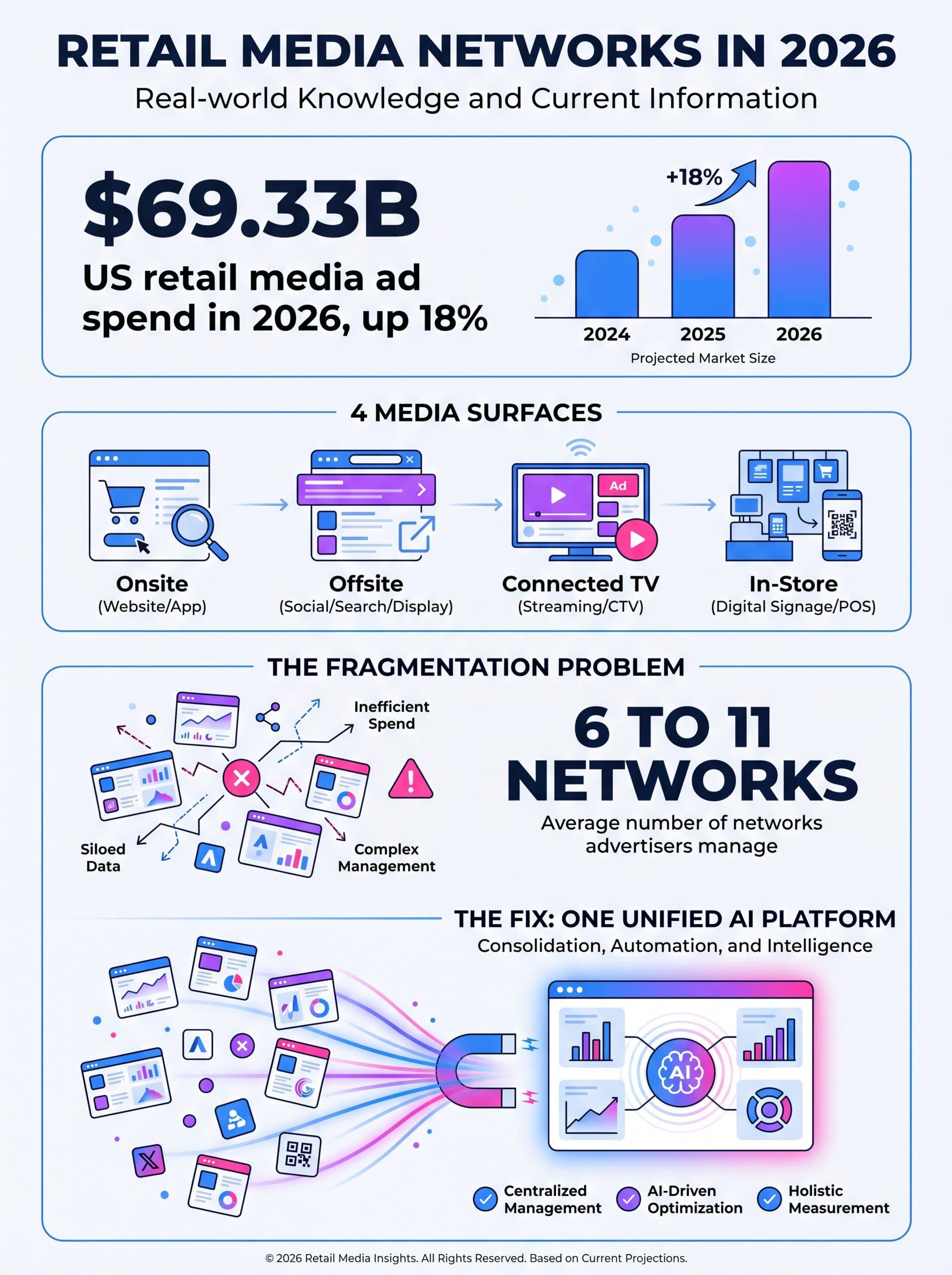
The 2026 retail media landscape at a glance: spend, surfaces, fragmentation, and the path to a unified stack.
Measuring Retail Media ROI
Retail media’s superpower is closed-loop measurement: the network can connect an ad impression to a real purchase. But that power comes with a catch. Each network grades its own homework, using its own attribution window and its own definition of a conversion. Compare a 14-day Amazon view-through to a 7-day Walmart click-through and you are comparing apples to oranges.
To measure retail media honestly, anchor on incrementality rather than raw ROAS. Ask whether a campaign drove sales that would not have happened anyway, not just whether it can claim credit for sales that were already coming. Blend network-reported numbers with your own marketing ROI analysis and, where possible, marketing mix modeling to see the true contribution across channels. AI-driven analytics make this real-time and proactive instead of a quarterly reconciliation exercise, which is the only way to keep up when you are running eleven networks at once.
Rule of thumb: never let a single network’s dashboard be your only source of truth. The retailer is both selling the ads and reporting on them. A neutral, unified measurement layer is what keeps your budget honest.
What Comes Next: Trends to Watch
Three shifts will define the next phase of retail media. First, commerce media. The model is expanding beyond traditional retailers to airlines, banks, delivery apps, and any business with rich first-party purchase data, blurring the line between retail media and the broader ad ecosystem. Second, standardization. Industry bodies are pushing for shared measurement standards so brands can finally compare networks on equal footing, which will reduce some of today’s fragmentation pain. Third, deeper AI. From automated creative to predictive budget allocation, AI agents will increasingly run the day-to-day optimization that humans cannot do across a dozen networks manually.
The direction of travel is clear. Retail media is becoming a full-funnel, omnichannel, AI-operated discipline. The brands that treat it as one more silo will fall behind. The brands that fold it into a unified, AI-native operation will compound their advantage as the channel grows.
Frequently Asked Questions
What is a retail media network in simple terms?
It is the advertising business a retailer runs using its own audience and shopper data. Brands pay to show ads on the retailer’s website, app, in-store screens, or connected TV, reaching customers who are actively shopping. The retailer can then prove which ads led to real purchases.
How big is retail media in 2026?
US retail media ad spend is forecast at $69.33 billion in 2026, up about 18 percent from $58.79 billion in 2025. Globally the market exceeds $165 billion, making it one of the fastest-growing major advertising channels of the decade.
What are the top retail media networks?
Amazon Ads, Walmart Connect, and Instacart dominate, together making up roughly 78 percent of the category. Strong second-tier networks include Target Roundel, Kroger Precision Marketing, and a growing list of grocery, retail, and even non-retail players entering the space.
Why is managing retail media so hard?
Fragmentation. The average brand runs 6 networks today and will run 11 by the end of 2026, each with its own dashboard, creative specs, and attribution model. Without a unified platform, teams waste days normalizing data and rebuilding creative for every network.
How does AI help with retail media?
AI automates the two hardest parts: creative and measurement. It generates brand-perfect, on-spec creative for every network up to 6x faster, and it unifies reporting so you see normalized performance across all networks in real time. Platforms like MarqOps combine both in a single dashboard.
Keep following the signal