YouTube Advertising in 2026: Costs, Formats, and What the AI Now Controls
Connected TV passed 44% of US YouTube watch time and YouTube now holds 12.7% of all US television viewing, which makes YouTube advertising a TV buy that happens to run through Google Ads. This guide covers 2026 cost benchmarks by surface, the six formats worth budget and how they map to screens, what changed with Demand Gen, view-through conversion optimization and the global rollout of Video Campaign Groups, how targeting works now that Customer Match is the most durable signal left, the creative throughput problem that decides everything, and a 90 day operating plan.

YouTube advertising stopped being a video line item some time in the last eighteen months and became a television buy that happens to run through Google Ads. Connected TV now accounts for more than 44% of US YouTube watch time, YouTube holds 12.7% of all US television viewing, and the platform posted $9.88 billion in ad revenue in Q1 2026 alone. The living room, not the phone, is where the money moved.
That shift changed what a YouTube campaign actually is. The manual levers most media buyers learned on, keyword targeting on video, placement lists, bid adjustments by device, have been steadily absorbed into Demand Gen and the automated campaign types around it. What is left for the team is creative supply, first-party audience quality, and measurement that survives view-through delay.
This guide covers what YouTube ads cost in 2026 with real benchmarks, which formats are worth budget, how the campaign types changed this year, why targeting now starts with your own customer list, and the creative throughput problem that decides whether any of it works.
Table of contents
- YouTube is a television channel now
- What YouTube advertising costs in 2026
- YouTube ad formats and where they actually run
- Campaign types after the 2026 consolidation
- Targeting when the third-party signals are gone
- The creative supply problem
- Measuring a channel that converts late
- A 90 day YouTube ads operating plan
- Frequently asked questions
- The bottom line
YouTube is a television channel now
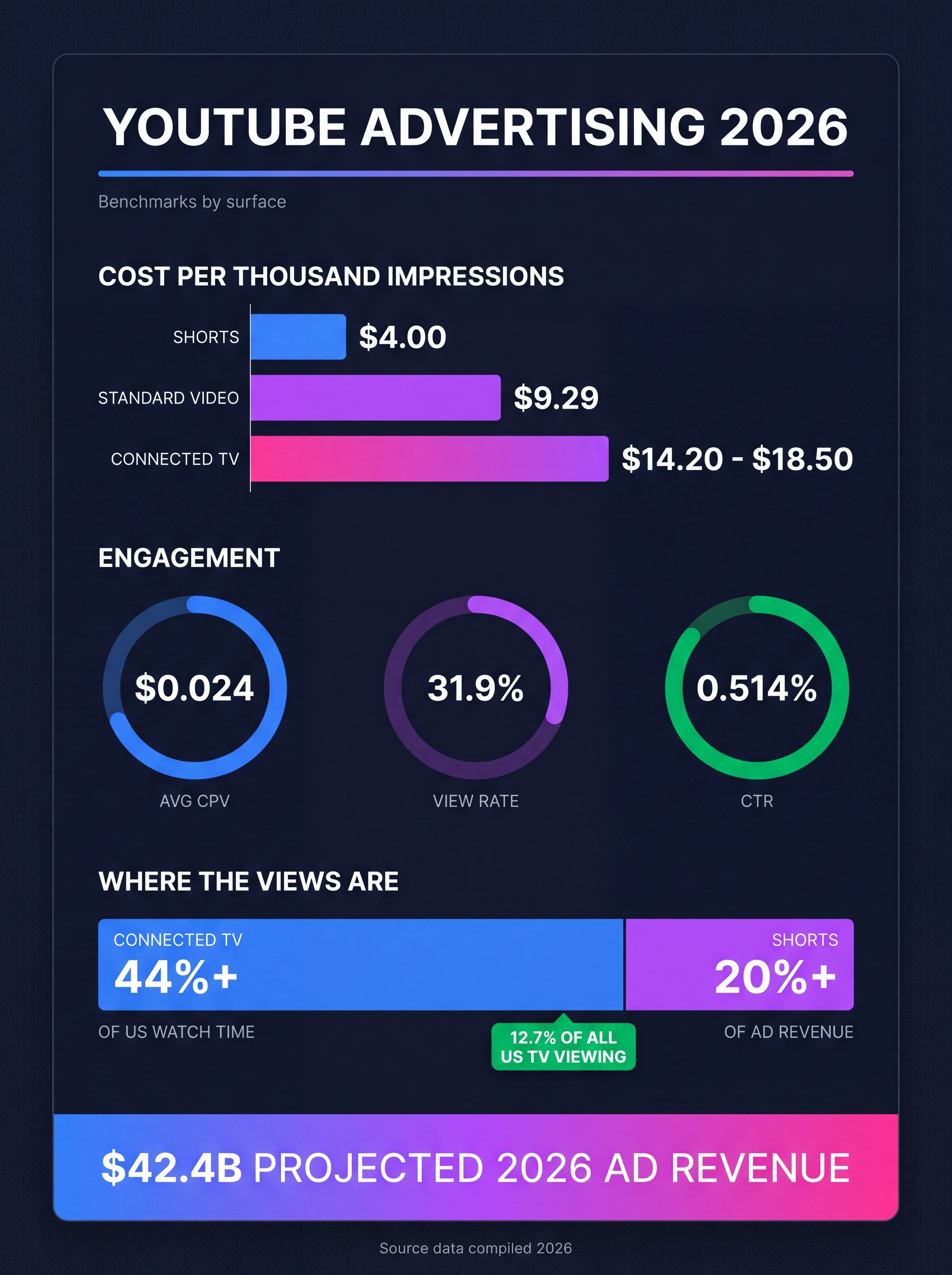
The most consequential fact about YouTube advertising in 2026 has nothing to do with Google Ads settings. It is that the audience moved rooms. Connected TVs account for more than 44% of US YouTube watch time, Americans watch over 200 million hours of YouTube per day on living room screens, and as of December 2025 YouTube commanded 12.7% of total US TV viewing time, ahead of Netflix and Disney+.
Connected TV formats now contribute roughly 34% of YouTube's total ad revenue. At the other end of the platform, Shorts moved from about 15% of ad revenue in 2024 to more than 20% by 2026. Between them, the two surfaces that need purpose-built creative account for over half of where your impressions land.
That matters because most brands still produce one hero video, crop it two ways and call it a multi-format plan. A sixteen by nine asset built for a laptop window looks thin on a 65 inch screen and unusable in a vertical feed. If you have been treating connected TV advertising as a separate budget conversation from YouTube, 2026 is the year those two lines merged whether or not your org chart agrees.
Total platform revenue reflects the shift. YouTube ad revenue reached $11.38 billion in Q4 2025, its largest quarter ever, and $9.88 billion in Q1 2026 against $8.93 billion the year prior. Full year 2026 projections sit near $42.4 billion, with more bullish models running to $46 billion on the strength of AI-optimized bidding, Shorts monetization and retail media integration.
What YouTube advertising costs in 2026
YouTube gets quoted as a cheap channel, and at the impression level it still is. The problem with a single headline number is that the three main surfaces price roughly four times apart from each other.
| Metric | 2026 benchmark | What moves it most |
|---|---|---|
| CPM, standard video | $9.29 average, $5 to $10 typical | Vertical and auction competition |
| CPM, Shorts | $4.00 average | Inventory supply, roughly 57% below standard video |
| CPM, connected TV | $14.20 to $18.50 | Premium living room demand from brand budgets |
| CPV | $0.010 to $0.030, $0.024 Q1 2026 average | Industry, from $0.018 in CPG to $0.058 in legal |
| View rate, in-stream | 31.9% average, above 40% is strong | Hook quality in the first five seconds |
| CTR | 0.514% average | Offer clarity and call to action placement |
| Skip rate | Around 65% at the five second mark | Relevance and creative fatigue |
The industry spread inside cost per view runs more than three times, from $0.018 in consumer packaged goods to $0.058 in legal services across the fourteen verticals commonly tracked. Planning against a cross-industry average will mislead you in either direction depending on which side of that range you sit on.
One practical budgeting note. Because Shorts CPMs sit near $4.00 and connected TV sits near $16.00, the same daily budget buys roughly four times the impressions on one surface as the other. If you let a single campaign optimize freely across surfaces without a frequency plan, delivery will drift toward the cheapest inventory and your reported CPM will look excellent while your reach against the audience you actually wanted stays flat.
YouTube ad formats and where they actually run
There are six formats that matter for most advertisers, and they map to different surfaces rather than different funnel stages.
- Skippable in-stream. The workhorse. Runs before or during videos across desktop, mobile and connected TV. Skippable after five seconds. Charged on 30 seconds viewed, full view on shorter assets, or a click. Assets from 12 seconds to three minutes, with 15 to 30 seconds the practical range.
- Non-skippable in-stream. 15 to 20 seconds depending on region, sold on CPM. Useful for reach guarantees and unavoidable brand messages. Expensive on connected TV and unforgiving of weak creative.
- In-feed video. Appears in search results, watch next and the home feed as a thumbnail plus headline. Charged on click through to watch. The closest thing YouTube has to intent-led placement.
- Shorts ads. Vertical 9:16, running between Shorts in the feed. Cheapest inventory on the platform and the fastest-fatiguing. Needs native, unpolished-looking creative rather than repurposed television spots.
- Bumper ads. Six seconds, non-skippable, CPM priced. Best used as frequency support behind a longer asset rather than as a standalone campaign.
- Masthead. Reserved home feed takeover, sold on a fixed day basis through a Google sales rep. Launch-scale budgets only.
The format decision that costs teams the most money is aspect ratio discipline. Connected TV needs 16:9 with legible on-screen text sized for a viewing distance of ten feet. Shorts needs 9:16 with the first frame carrying the message because sound-off scrolling is the default. Running one asset everywhere means paying premium connected TV CPMs to deliver a letterboxed vertical video that reads as an error.
Campaign types after the 2026 consolidation
Google spent 2025 and 2026 folding video campaign types into fewer, more automated containers. Three changes matter this year.
Demand Gen is now the default for anything below pure awareness. It runs across YouTube in-stream, in-feed, Shorts, Discover and Gmail, and it took over most of what Video Action Campaigns used to do. The March 2026 Demand Gen Drop added Veo-generated video variations from static images, YouTube Creator Partnerships directly inside Google Ads, and optimization toward follow-on views. Google reports that creator partnership boosts on Shorts inventory delivered an average 30% increase in conversion lift while holding CPA efficiency. If you have not revisited Google Demand Gen since its launch, the surface area has roughly doubled.
View-through conversion optimization arrived for Demand Gen. You can now optimize toward view-through conversions rather than only click-driven ones. This is significant for video specifically, where a large share of influence never produces a click. It also means your reported conversion counts will jump when you enable it, so re-baseline your targets before you judge performance.
Video Campaign Groups went global on 13 July 2026. This is the media planning upgrade brand teams have wanted for years: deduplicated reach across campaigns, a frequency band set at group level rather than per campaign, and unified reporting across the group. If you run parallel awareness and consideration campaigns against overlapping audiences, this is the single highest-value setting change available to you right now.
Peak Points, which places ads at algorithmically identified moments of high emotional engagement inside longer content, is being extended to sequential Demand Gen campaigns. Long-form content in the eight to twelve minute range is where it has the most placement opportunity. Treat it as a brand tool rather than a performance one.
The through-line across all three is the same one running through Performance Max and Search: Google keeps trading advertiser control for algorithmic efficiency, and the inputs it still accepts from you are budget, conversion signal quality, audience seeds and creative. Those four inputs are now the entire job. The same logic that governs smart bidding on search applies to video, with the added complication that video creative is far more expensive to produce.
Targeting when the third-party signals are gone
YouTube targeting in 2026 is a first-party data exercise with algorithmic help, not an audience-picking exercise.
Customer Match, where you upload your own email or phone lists, has become the most reliable signal on the platform because it does not depend on third-party cookies at all. Google's affinity and in-market audiences still work for top-of-funnel reach, but their accuracy has thinned as privacy signals degraded, and they now perform best as layering signals on top of first-party seeds rather than as standalone targeting.
Two failure modes are worth naming. The first is over-segmentation. Splitting a modest budget across eight narrow audiences starves each one of the conversion volume the bidding model needs, and the model then defaults to broad delivery anyway. The second is treating audience lists as a set-and-forget asset. A Customer Match list uploaded nine months ago and never refreshed decays into a segment of lapsed customers, and the similar-audience expansion built on top of it inherits that decay.
Retargeting on YouTube remains strong because view events are first-party by definition. Viewers of a specific video, channel subscribers and people who engaged with your Shorts are all addressable without any cookie dependency. Most accounts underuse this and spend their retargeting budget entirely on site visitors.
The creative supply problem
Every structural change above points at the same bottleneck. When targeting and bidding are automated, creative becomes the only meaningful variable, and video creative is the most expensive asset type in marketing.
YouTube advertising benchmarks and surface mix for 2026
The economics changed sharply. AI video tooling has cut per-video production costs by 70% to 90%, with reported drops from roughly $4,500 per finished minute to around $400. Time to produce a 60 second marketing video fell from about 13 days to under half an hour in the tooled workflows, and teams report saving in the region of 34 hours a week previously spent on production and editing.
Adoption followed the economics. Close to 90% of advertisers are using or planning to use generative AI to build video creative in 2026, and buyers project generative AI creative will account for roughly 40% of all video ads this year. Teams running AI-assisted variant generation report 20% to 40% better ROAS than teams limited to two or three traditional creatives, largely because the algorithm has more to choose from.
The risk that comes with that volume is brand drift. Producing forty variants a month is only useful if all forty are recognizably yours. This is the problem MarqOps was built to solve: Brand Intelligence DNA holds your voice, colors, claims and visual rules as a constraint on every generated asset, so scale does not cost you consistency. The alternative is a review bottleneck that quietly caps your output at whatever your brand team can manually approve.
A workable creative cadence looks like this. Ship three to five new concepts per month rather than one. Cut each concept into the five-asset format set described earlier. Retire assets on view rate decay rather than on a calendar. And keep a standing library of proven hooks that new concepts can borrow from, because the first five seconds carries more weight than everything after it combined. If you are still briefing video one asset at a time, creative automation is the process change that unblocks the rest of the channel.
Measuring a channel that converts late
YouTube's measurement problem is structural rather than technical. Video creates demand that surfaces later as branded search, direct traffic or a marketplace purchase, and last-click attribution credits whichever channel closed the session. The result is a channel that consistently under-reports its own contribution in the dashboard everyone looks at.
Three practices fix most of it.
- Enable view-through conversion optimization and report on it separately. Do not blend view-through and click-through conversions into one number, and do not pretend they are equivalent. Report both, and know your own ratio between them.
- Run geo holdout or conversion lift tests at least quarterly. Platform-reported lift figures are directionally useful and structurally optimistic. Incrementality testing is the only way to know what YouTube actually added rather than what it observed.
- Track brand search volume as a leading indicator. A YouTube campaign that is working usually shows up in branded query volume before it shows up in the conversion column. Pair that with a brand tracking baseline so you can separate awareness gains from seasonal noise.
Where multi-touch models are in play, be honest about their limits on video. Most multi-touch attribution implementations require a click to enter the path, which excludes the majority of YouTube exposure by design. That is an argument for using media mix modeling alongside it on any account where video is more than a token share of spend, not an argument for abandoning attribution.
A 90 day YouTube ads operating plan
Days 1 to 30: fix the inputs. Audit conversion tracking end to end, including enhanced conversions. Upload and set a weekly refresh schedule for Customer Match lists. Build the first five-asset format set for two concepts. Set up Video Campaign Groups and define a group-level frequency band. Establish your view rate and CPV baselines by surface, not blended.
Days 31 to 60: buy deliberately. Split budget explicitly across connected TV, standard in-stream and Shorts rather than letting delivery drift to cheap inventory. Launch Demand Gen with view-through conversion optimization enabled and re-baseline targets. Add creator partnership boosts on Shorts inventory. Start a geo holdout on one meaningful market.
Days 61 to 90: scale on evidence. Read the holdout result before you scale spend. Retire assets on view rate decay and replace on a fixed cadence. Expand the concepts that beat baseline into full format sets. Layer in-market audiences on top of the first-party seeds now that the model has conversion volume. Move budget between surfaces based on incremental contribution rather than platform-reported ROAS.
Teams running this alongside Google Search, Meta and TikTok ads usually discover that the operational cost is coordination rather than any single platform. Consolidating creative production, brand rules, campaign reporting and creative analytics into one system is what makes a five-asset-per-concept cadence sustainable instead of aspirational. That consolidation, replacing seven or more disconnected tools with a single brand-aware workflow, is the whole premise behind MarqOps.
Frequently asked questions
How much do YouTube ads cost in 2026?
Standard video CPM averages $9.29, with most advertisers landing between $5 and $10. Shorts inventory averages about $4.00 and connected TV runs $14.20 to $18.50. Average cost per view sits near $0.024, ranging from $0.018 in consumer packaged goods to $0.058 in legal services. Surface mix affects your blended cost more than any bidding decision.
What is the minimum budget for YouTube advertising?
There is no platform minimum, but there is a practical one. Automated bidding needs roughly 30 to 50 conversions per campaign per month to optimize reliably, so work backwards from your cost per acquisition. For most mid-market advertisers that lands somewhere between $3,000 and $10,000 a month per campaign. Spreading less than that across multiple audiences and surfaces will starve the model.
Are YouTube Shorts ads worth running?
Yes, provided you build for the format. Shorts now carry more than 20% of YouTube's ad revenue and CPMs sit around 57% below standard video. The condition is native vertical creative with the message in the first frame, because sound-off scrolling is the default behavior. Repurposed television spots delivered into Shorts inventory underperform badly enough to erase the CPM advantage.
Should I use Demand Gen or a video reach campaign?
Use Demand Gen for anything with a conversion or consideration goal, since it covers in-stream, in-feed, Shorts, Discover and Gmail with conversion optimization including view-through. Use reach-focused video campaigns when the objective is measured reach and frequency against a defined audience. If you run both, put them inside a Video Campaign Group so reach is deduplicated and frequency is capped at group level.
Is a 65% skip rate bad?
No. A 65% skip rate at five seconds is the platform norm, and on skippable in-stream most of those skips cost you nothing because billing requires 30 seconds viewed, a completed view on short assets, or a click. The metric to watch is view rate, where 31.9% is average and above 40% is strong. Compare it against your own historical baseline rather than a public benchmark.
How do I target on YouTube without third-party cookies?
Start with Customer Match using your own email and phone lists, refreshed weekly. Build similar segments from your highest-value cohorts. Use YouTube's own engagement signals for retargeting, since video views, channel subscriptions and Shorts engagement are first-party events. Add affinity and in-market audiences as broadening layers once the campaign has conversion volume, not as your primary targeting.
How much creative do I need for YouTube ads?
Plan on three to five new concepts a month, each cut into roughly five assets: a 15 to 30 second 16:9 hero, three vertical Shorts variants and a six second bumper. Retire assets when view rate decays rather than on a fixed schedule. Accounts with deep variant libraries report 20% to 40% better ROAS than accounts running two or three creatives, because automated delivery has more to test against.
The bottom line
YouTube advertising in 2026 rewards two things and mostly ignores everything else. The first is creative that respects the surface it lands on, which now means building for the living room and the vertical feed rather than cropping one asset to fit both. The second is measurement that accounts for delay, because the channel's real contribution shows up in branded search and holdout tests long before it shows up in a last-click report.
The targeting craft that used to separate good media buyers from average ones has largely been automated away. What replaced it is unglamorous and harder to fake: clean conversion signals, refreshed first-party lists, and enough brand-correct video to keep the algorithm fed. Solve the creative throughput problem and YouTube becomes one of the more predictable channels in the mix. Leave it unsolved and no campaign setting will rescue the account.
Keep following the signal