Brand Tracking in 2026: The Complete Guide to Measuring Brand Health in Real Time
Brand tracking in 2026 blends surveys, share of search, and AI visibility monitoring. Learn the 8 metrics that matter, real costs, and how to build a program that predicts revenue.
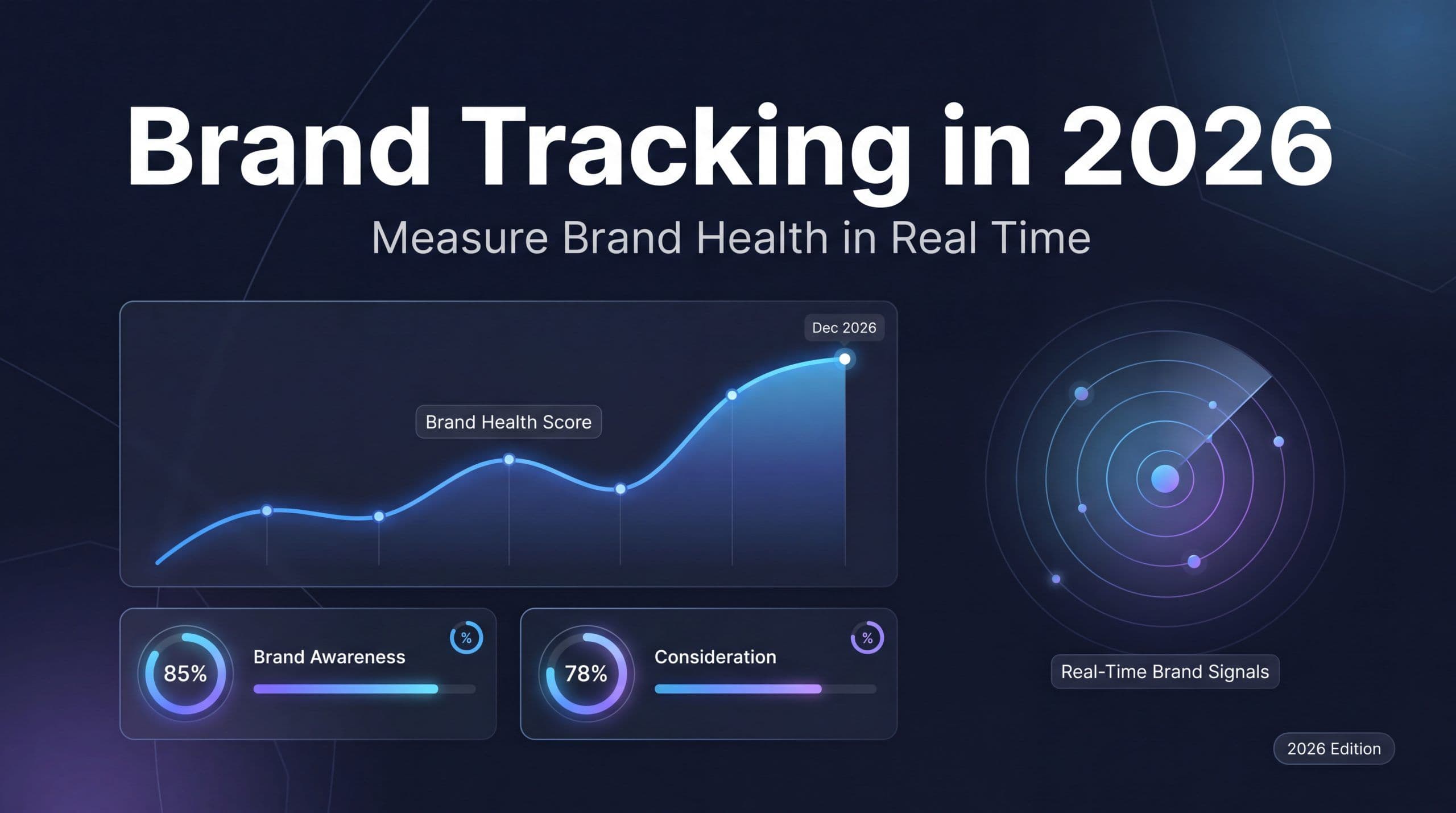
TL;DR
- Brand tracking is the systematic measurement of how your brand’s awareness, perception, and equity change over time. In 2026 it spans surveys, search data, social sentiment, and AI assistant visibility.
- 77% of companies now run some form of brand tracking, reporting an average 7x return, because perception shifts show up in trackers 6-12 months before they show up in revenue.
- The old model (a quarterly survey and a PDF report) is too slow. Modern programs blend always-on signals like share of search and AI mention tracking with periodic survey benchmarks.
- Costs range from $99/month self-serve tools to $200,000+/year enterprise panels. Most mid-market teams land at $4,000-$10,000/year for quarterly tracking plus free search-based signals.
- AI search changes the game: your brand is now “tracked” by ChatGPT, Gemini, and Perplexity whether you measure it or not. If you don’t know what AI says about you, you have a blind spot.
Table of Contents
- What Is Brand Tracking?
- Why Brand Tracking Matters More in 2026
- The 8 Brand Tracking Metrics That Matter
- Traditional vs. Modern Brand Tracking Methods
- AI Brand Tracking: The New Layer Nobody Can Skip
- Share of Search: The Free Leading Indicator
- How to Build a Brand Tracking Program in 6 Steps
- Brand Tracking Tools and What They Cost
- 5 Brand Tracking Mistakes That Waste Budget
- FAQs
What Is Brand Tracking?
Brand tracking is the ongoing, systematic measurement of how people perceive your brand: whether they know it exists, what they associate it with, whether they would consider buying from it, and how those numbers move over time. Unlike a one-off brand study, a tracker repeats the same core measurements at a consistent cadence so you can separate real trends from noise.
That distinction matters because brand perception is a leading indicator. Sales data tells you what happened last quarter. Brand tracking data tells you what is likely to happen two or three quarters from now. Research from Les Binet, one of the most cited effectiveness researchers in marketing, found that shifts in a brand’s share of search precede shifts in market share by 6 to 12 months. Perception moves first, revenue follows.
In practice, brand tracking in 2026 covers two connected disciplines. The first is classic survey-based tracking: asking a representative sample of your category’s buyers structured questions about awareness, consideration, and preference. The second is signal-based tracking: continuously monitoring search volumes, social sentiment, review language, and, increasingly, how visible your brand is inside AI assistants. The strongest programs run both, because each covers the other’s blind spots.
Quick definition: Brand tracking measures perception over time (strategic, longitudinal). Brand monitoring watches mentions in real time (tactical, continuous). You need both, and this guide covers how they fit together.
Why Brand Tracking Matters More in 2026
Three shifts have turned brand tracking from a nice-to-have research line item into core marketing infrastructure.
1. Buyers research where you can’t see them
Gartner projected that traditional search engine volume would fall 25% as discovery shifts toward AI chatbots and assistants. Combine that with the rise of zero-click search, where the majority of Google queries end without a website visit, and a growing share of your buyer’s journey is now invisible to your analytics stack. Brand tracking is how you measure demand that never touches your website.
2. Trust is fragile and skepticism is rising
A Gartner survey of 1,539 US consumers found that 61% frequently question whether the information they use to make decisions is reliable, and 68% frequently wonder whether the content they see is even real. In that environment, brand perception can move fast, in either direction, and quarterly check-ins are often too slow to catch it.
3. The economics finally work for everyone
A decade ago, brand tracking meant a $50,000+ agency retainer, so only enterprises did it. Today, self-serve trackers start at $99/month and search-based signals like share of search cost nothing but analyst time. That’s why adoption has climbed: 77% of companies now conduct brand tracking, and they report an average ROI of 7x. The excuse that tracking is “an enterprise luxury” no longer holds.
6-12 months
How far ahead brand signals like share of search predict market share movement (Les Binet, IPA research)
The 8 Brand Tracking Metrics That Matter
Every credible tracker is built on a consistent set of metrics, measured the same way every wave. These are the eight that earn their place.
1. Unaided awareness
“Which brands come to mind when you think of [category]?” No prompts, no list. This is the hardest metric to move and the most predictive of future buying, because buyers shortlist from memory long before they compare features.
2. Aided awareness
“Which of these brands have you heard of?” with a list shown. The gap between aided and unaided awareness tells you whether you have a recognition problem (people have never heard of you) or a salience problem (they’ve heard of you but forget you exist at the buying moment).
3. Consideration
Of the people who know you, how many would shortlist you? The awareness-to-consideration gap is the single most diagnostic number in a tracker. High awareness with low consideration usually signals a positioning or reputation issue, not a reach issue.
4. Preference
When forced to choose among brands they’d consider, which one wins? This is where competitive dynamics show up first.
5. Brand associations
What attributes do buyers attach to your brand, and are they the ones you’re paying media dollars to build? If your campaigns say “premium” and your tracker says “cheap,” your brand voice and media plan are working against each other.
6. Purchase intent
Stated likelihood to buy within a defined window. Directionally useful, especially when trended against actual sales.
7. NPS / loyalty
Satisfaction and advocacy among existing customers. This is a lagging indicator of experience, but a leading indicator of word of mouth, which feeds back into unaided awareness.
8. Share of search / AI visibility
The behavioral check on everything above. Survey answers are what people say; search volume and AI assistant mentions are what people actually do. When stated awareness rises but your share of search is flat, believe the search data.
Traditional vs. Modern Brand Tracking Methods
The methodology debate in 2026 isn’t surveys versus signals. It’s about the cadence and cost structure that fits your category. Here’s how the approaches compare.
| Approach | Cadence | Typical cost | Best for |
|---|---|---|---|
| Agency tracker | Quarterly or biannual | $25,000-$75,000/year | Enterprises needing custom methodology and analyst support |
| Enterprise panel (e.g., YouGov BrandIndex) | Daily | $50,000-$200,000+/year | Big consumer brands tracking 16+ metrics across markets |
| Self-serve tracker (Tracksuit, Latana, Attest) | Monthly or continuous | From $99/month | Startups and mid-market brands starting their first tracker |
| AI-moderated qual studies | Quarterly | $4,000-$10,000/year | Teams that need the “why” behind perception shifts |
| Search + social + AI signals | Always-on | Free to low cost | Everyone, as the real-time layer between survey waves |
The pattern among sophisticated teams is a two-layer stack: an always-on signal layer (search, social, AI mentions) for early warning, plus a periodic survey layer for stable benchmarks that leadership and finance will trust. Signals tell you something changed this week. Surveys tell you what it means and whether it’s real.
AI Brand Tracking: The New Layer Nobody Can Skip
Here’s the uncomfortable truth of 2026: ChatGPT, Gemini, Claude, and Perplexity are already running a brand tracker on you. Every time a buyer asks “what’s the best [your category] tool,” an AI model retrieves, weighs, and summarizes your brand’s reputation. The only question is whether you’re measuring what it says.
AI visibility tracking measures how generative engines cite, mention, recommend, or misrepresent your brand. The core metrics are citation frequency (how often you appear in answers for category queries), share of voice across LLMs (your mentions relative to competitors), sentiment and framing (recommended, neutral, or warned against), and hallucination instances (factually wrong claims about your product or pricing).
This layer matters because AI answers compress the consideration phase. A buyer who asks an assistant for a shortlist may never see your ads, your homepage, or your G2 profile. If you’re absent from the answer, you were never in the running. We’ve covered the tooling landscape in depth in our guide to AI search visibility tools and the strategic playbook in AI brand monitoring.
Practical starting point: Once a month, run your top 10 category questions through ChatGPT, Gemini, and Perplexity. Log whether your brand appears, how it’s framed, and who appears instead. That simple spreadsheet is a functioning AI brand tracker, and it costs you an hour.
Treat corrections like an SEO program: fix the sources AI models cite (review sites, comparison pages, Wikipedia, your own structured content), and your representation in answers follows. This is the same discipline as generative engine optimization, applied to brand reputation instead of content rankings.
Share of Search: The Free Leading Indicator
If you adopt only one behavioral brand metric this year, make it share of search: your brand’s search volume divided by total search volume for all brands in your category. It’s free to calculate from Google Trends or keyword tools, updates continuously, and has unusually strong evidence behind it.
Les Binet’s research across automotive, energy, and mobile phone categories found share of search correlates with market share and leads it, with movements predicting market share shifts 6 to 12 months ahead. Follow-up work by James Hankins across 30 case studies spanning 12 categories and 7 countries found share of search explained roughly 83% of a brand’s market share. And a Google/Tracksuit study confirmed the upstream driver: for brands around 30% awareness, each 5-point gain in awareness generated roughly a 5-point gain in share of search.
The workflow is simple: measure monthly, trend against your two or three nearest competitors, and treat sustained divergence between your survey numbers and your search numbers as a signal to investigate, not a rounding error. We’ve published a full methodology in our share of search guide.
How to Build a Brand Tracking Program in 6 Steps
Step 1: Define the category and audience precisely
“Marketing leaders at US B2B SaaS companies with 50-500 employees” is trackable. “Business decision makers” is not. Your category definition determines your competitive set, your survey sample, and your share of search denominator, so get it in writing first.
Step 2: Pick 5-8 core metrics and freeze them
Choose from the list above, then leave the question wording untouched wave after wave. Trend integrity is the entire value of a tracker; every “small improvement” to a question resets your baseline to zero.
Step 3: Set a cadence that matches your category’s speed
Quarterly surveys are the standard for most active markets. Add the always-on layer (share of search, social sentiment, AI visibility checks) at weekly or monthly granularity so you’re never more than a few weeks from detecting a shift.
Step 4: Benchmark three ways
Compare against your own history (are we improving?), direct competitors (are we winning?), and category leaders (how far is the ceiling?). A number without a benchmark is trivia.
Step 5: Wire results into decisions, not decks
A tracker earns its budget when it changes media allocation, messaging, or creative strategy. Route the data into the same marketing dashboard your team already uses for performance metrics, so brand and demand are read side by side. Pair it with marketing mix modeling and you can connect perception shifts to revenue outcomes.
Step 6: Close the loop with brand governance
Tracking tells you where perception drifted. Fixing it requires consistent execution: aligned messaging, consistent visual identity, and brand-safe content at every touchpoint. That’s a brand management discipline, and it’s where most programs quietly fail, because insight without enforcement changes nothing.
This last step is where unified platforms earn their keep. MarqOps, for example, bakes brand governance into execution with Brand Intelligence DNA: every asset, post, and page the platform generates is checked against your brand’s voice, visual identity, and messaging rules from the start. Instead of discovering drift in next quarter’s tracker, you prevent it at the point of creation, across content, ads, and SEO, from one dashboard instead of 7+ disconnected tools.
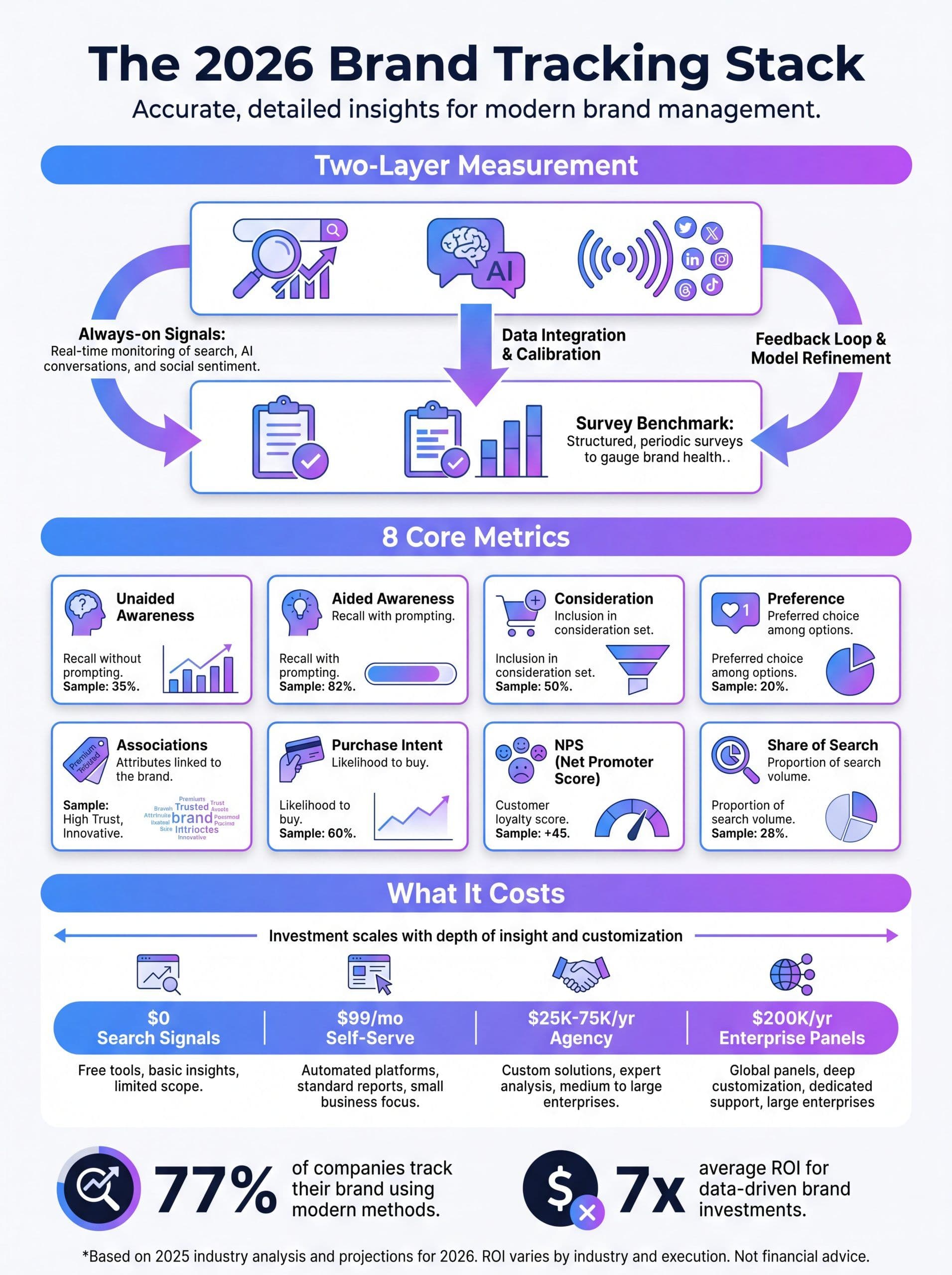
The 2026 brand tracking stack: always-on signals plus periodic survey benchmarks.
Brand Tracking Tools and What They Cost
Budget expectations, based on current market pricing:
Free tier: Google Trends for share of search, manual AI assistant audits, and Google Search Console brand query volume. Enough for any team to start this week.
$99-$500/month: Self-serve survey trackers like Tracksuit and Latana run continuous awareness and consideration measurement against a defined audience. This tier has done the most to democratize tracking.
$4,000-$10,000/year: Quarterly AI-moderated qualitative studies that explain the “why” behind quantitative shifts. A sensible line item for any brand spending $2M+ annually on marketing.
$25,000-$75,000/year: Traditional agency trackers with custom methodology, larger samples, and analyst interpretation.
$50,000-$200,000+/year: Enterprise panels like YouGov BrandIndex, which tracks 16 brand health metrics daily against a panel of 30+ million registered members.
Whatever tier you choose, insist on three things: a stable methodology, exportable data you can pipe into your own marketing analytics stack, and competitive benchmarking in the same dataset.
5 Brand Tracking Mistakes That Waste Budget
1. Changing questions between waves
Every wording tweak breaks your trend line. Lock the core questions and add new ones separately.
2. Tracking without a decision owner
If no one is accountable for acting on the data, the tracker becomes a quarterly PDF nobody opens. Assign an owner who presents implications, not just numbers.
3. Surveying only your customers
Your customers already like you. Brand tracking’s value is measuring the category buyers who don’t buy from you yet, because that’s where growth lives.
4. Ignoring the AI layer
If your tracker has no view of how AI assistants describe your brand, you’re blind to the fastest-growing influence on buyer perception. Start with the manual monthly audit described above.
5. Treating brand and performance data as separate worlds
Brand metrics live in a research tool, performance metrics live in ad platforms, and nobody joins them. Unify them in one view so you can see, for example, whether rising unaided awareness is lowering your paid search CPCs. Teams using MarqOps get this join for free, because analytics, ads, SEO, and brand signals already share one unified dashboard, which is how content teams ship 6x faster without losing brand consistency along the way.
Frequently Asked Questions
What is brand tracking?
Brand tracking is the systematic, repeated measurement of how a target audience perceives a brand over time, covering metrics like aided and unaided awareness, consideration, preference, associations, and purchase intent. Modern programs combine periodic surveys with always-on behavioral signals such as share of search, social sentiment, and AI assistant visibility.
How often should you run brand tracking surveys?
Quarterly is the standard cadence for most active markets, with biannual acceptable in slow-moving categories. Brands running major campaigns benefit from monthly or continuous measurement. Between survey waves, always-on signals like share of search and social sentiment provide weekly early-warning coverage at little to no cost.
How much does brand tracking cost?
Self-serve tools start around $99/month, AI-moderated quarterly studies run $4,000-$10,000/year, traditional agency trackers cost $25,000-$75,000/year, and enterprise daily panels like YouGov BrandIndex range from $50,000 to $200,000+ per year. Search-based signals like share of search can be measured for free.
What metrics should a brand tracker include?
The core set is unaided awareness, aided awareness, consideration, preference, brand associations, purchase intent, and NPS, plus at least one behavioral metric such as share of search or AI visibility. Keep the list to 5-8 metrics measured identically every wave so trends stay comparable.
How is AI changing brand tracking?
AI changes brand tracking in two ways. First, AI assistants like ChatGPT, Gemini, and Perplexity now shape buyer perception directly, so programs must track how these engines mention, recommend, or misrepresent the brand. Second, AI-moderated research and always-on signal analysis have cut tracking costs dramatically, replacing static quarterly PDFs with real-time perception intelligence.
Track the Brand Signals That Predict Revenue
Brand tracking in 2026 is no longer a choice between an expensive survey program and flying blind. The playbook is clear: pick a tight set of metrics, freeze the methodology, layer free behavioral signals like share of search on top, audit what AI assistants say about you monthly, and connect all of it to the dashboard where you already make spend decisions. Perception data leads revenue data by two to four quarters. The brands that read those signals early are the ones that show up in next year’s market share numbers.
Keep following the signal
Related field notes
Marketing
Marketing Automation for Agencies in 2026: What to Automate, What to Keep Human
11 min readMarketing
Brand Asset Management in 2026: How to Run It Without Adding Another Tool
14 min readMarketing Operations