Performance Max vs Search Campaigns in 2026: When to Run Each (and Why the Best Accounts Run Both)
How Performance Max and Search campaigns compare in 2026, where PMax cannibalizes Search, when to use each, and how to build a hybrid setup that lifts ROAS.
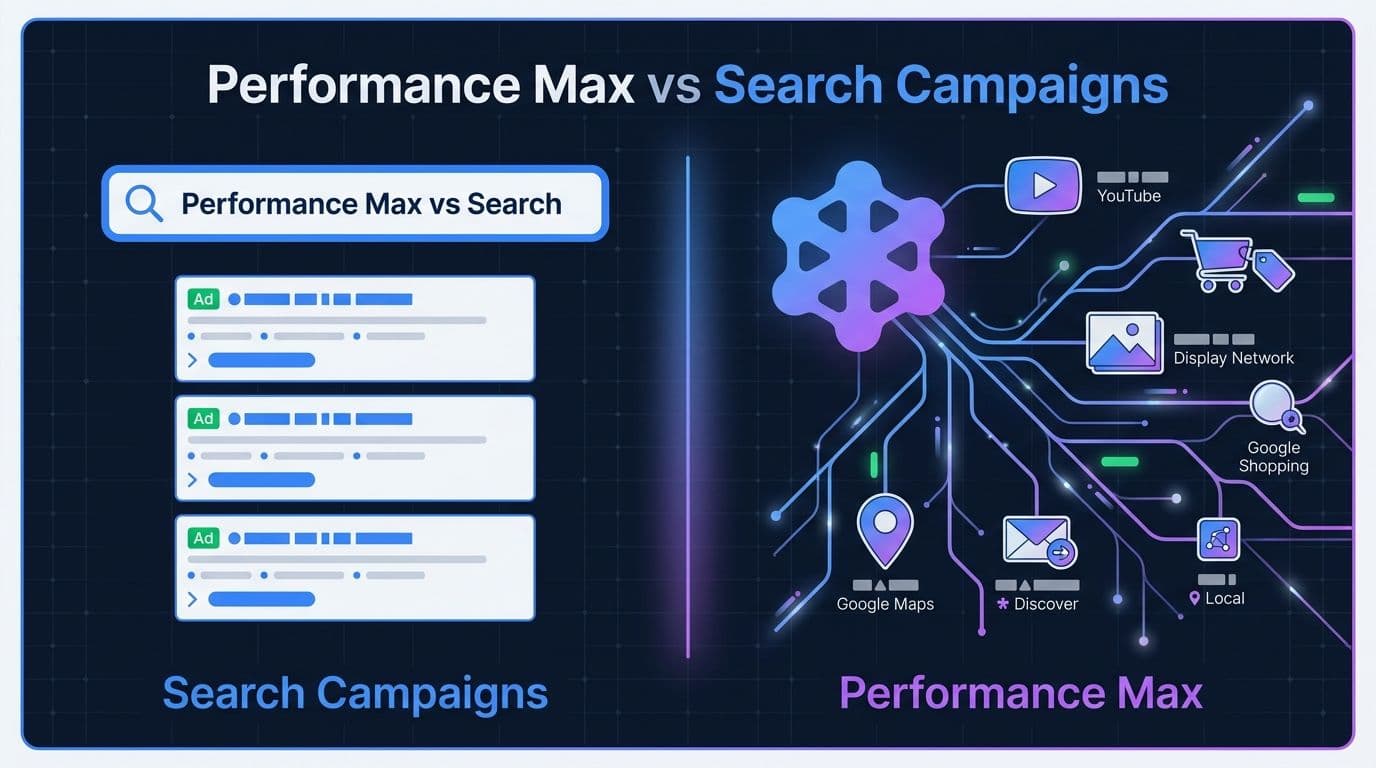
Performance Max keeps expanding its reach across Google’s ad inventory, and Search campaigns keep defending their transparency and control. If you run both without a plan, they quietly compete for the same clicks and the same budget. This guide breaks down how each campaign type actually works in 2026, where the overlap hurts you, and how to build a hybrid setup that gets the reach of PMax without letting it cannibalize your best-performing Search terms.
TL;DR
- Search campaigns win on control and intent: you choose keywords, see search terms, and own the query. Best for high-intent, brand, and bottom-funnel demand.
- Performance Max wins on reach and automation: one campaign serves Search, Shopping, YouTube, Display, Discover, Gmail, and Maps, with Google’s AI deciding channel, audience, and bid.
- The two overlap more than most teams realize. An Optmyzr study of 503 accounts found 91.45% had keyword overlap between Search and PMax, and brand cannibalization can leak 10 to 25% of budget when exclusions are not set.
- The highest-performing accounts in 2026 run both, with clear guardrails: brand and top converters in Search, discovery and scale in PMax. Hybrid setups show a 20 to 35% ROAS lift over single-campaign approaches.
- Winning at either now depends on feeding better inputs (creative, audience signals, conversion data), not micromanaging bids. That is the operations problem MarqOps is built to solve.
Table of Contents
- What Search campaigns actually do in 2026
- What Performance Max actually does in 2026
- Performance Max vs Search: head-to-head comparison
- The cannibalization problem no one warns you about
- When to run Search campaigns
- When to run Performance Max
- The hybrid playbook: running both without the overlap tax
- Common mistakes to avoid with both campaign types
- Why this is really an operations problem
- Frequently asked questions
What Search Campaigns Actually Do in 2026
A Search campaign shows text ads on the Google search results page in response to specific queries. You (or your automated bidding strategy) decide which keywords to target, write the responsive search ads, and control match types and negatives. The defining trait is intent: someone types a query, and you respond to it. That makes Search the most transparent and controllable format Google offers.
In 2026, Search is more automated than it used to be. Smart Bidding sets auction-time bids, and Google’s AI Max layer expands keyword matching and generates asset variations. But the core promise holds: you still see the exact search terms that triggered your ads, you still choose your keywords, and you still own the branded and high-intent queries that convert best. If you want to understand how AI now reshapes match types and assets inside Search, read our guide to AI for Google Ads and the deeper dive on AI Max for Google Ads.
The Search advantage in one line: when you know exactly what a customer is searching for, Search lets you own that moment with a controllable, measurable ad. Nothing else on Google gives you that level of query-level precision.
What Performance Max Actually Does in 2026
Performance Max (PMax) is a goal-based campaign that runs across every Google channel from a single setup: Search, Shopping, YouTube, Display, Discover, Gmail, and Maps. You provide the inputs, and Google’s AI makes three decisions at once for every impression: which channel to serve on, which user to show it to, and how much to bid. Instead of managing keywords, you manage inputs.
Those inputs live inside asset groups, which are the building blocks of PMax. Think of an asset group as an ad group for the AI era: each one holds a set of creative assets, audience signals, and (for retail) a product feed segment. Google recommends loading at least 10 to 15 headlines, 5 descriptions, 10 or more images in multiple formats, and 3 to 5 videos per asset group. Internal tests consistently show manually produced videos outperforming auto-generated ones by 25 to 40%, so creative volume and quality matter more than ever.
45%
of Google Ads conversions are now attributed to Performance Max, and 73% of accounts run at least one PMax campaign
2026 brought meaningful transparency upgrades to PMax that change this comparison. Google added channel-level performance and budget reporting, search terms reporting, campaign-level negative keywords, asset group-level reporting, audience exclusions, and improved placement controls. Smart Bidding Exploration, which lets the algorithm bid on unproven queries within a ROAS tolerance range, went globally available for all feed-free PMax campaigns on June 15, 2026. Google also added Waze inventory for store-goal campaigns. In short, PMax is still automation-first, but you finally have more levers to steer it. For the full build-out mechanics, see our complete Performance Max campaigns guide.
Performance Max vs Search: Head-to-Head Comparison
The two campaign types are not really competitors so much as different tools for different jobs. Here is how they stack up on the dimensions that matter most to a marketing team in 2026.
| Dimension | Search Campaigns | Performance Max |
|---|---|---|
| Reach | Google Search and Search partners only | All Google channels from one campaign |
| Control | High: keywords, match types, negatives | Moderate: inputs, signals, exclusions |
| Transparency | Full search-term visibility | Improved in 2026, still partial by channel |
| Best for intent | Bottom-funnel, brand, known demand | Discovery, scale, new demand |
| Creative load | Text-first, lighter | Heavy: images, video, feeds required |
| Reported ROAS | Clean, query-attributable | 2.57x to 4.6x typical, but can be flattered by brand |
Notice the last row. PMax often shows a higher reported ROAS, but part of that number can come from branded and existing-customer traffic it absorbs from your other campaigns. That is where the real risk lives.
The Cannibalization Problem No One Warns You About
Here is the pattern nearly every account audit uncovers in 2026: PMax reports a gorgeous 7x ROAS, but blended Google performance is flat or declining, and your brand search impression share is quietly eroding. What happened? PMax has a tendency to scoop up branded and high-intent queries, serve an ad, and claim the conversion as its own. The headline number looks great while the underlying account gets less efficient.
The data is stark. An Optmyzr study from March 2026 found that 91.45% of 503 analyzed accounts had keyword overlap between Search and PMax, and 56.29% of nearly 5,800 Search campaigns showed the same overlap. PMax frequently cannibalizes search keywords even when they are set to exact match.
When brand exclusions are not configured, the leak typically runs 10 to 25% of campaign budget. That is budget you are paying premium PMax rates for on traffic that would have converted through cheaper branded Search anyway. The fix is not to abandon one campaign type. It is to give each a clear lane so they stop bidding against each other. Diagnosing this accurately requires clean cross-campaign measurement, which is exactly the kind of blind spot a unified analytics view is meant to catch. Our guides on multi-touch attribution and AI marketing analytics go deeper on measuring blended performance instead of trusting a single campaign’s self-reported ROAS.
When to Run Search Campaigns
Lead with Search when control and intent matter more than raw reach. Specifically, Search should be your primary or protected channel when:
- You are defending brand terms. Branded queries are your cheapest, highest-converting traffic. Keep them in a dedicated Search campaign so you control the message and the cost, and so PMax cannot inflate its ROAS by claiming them.
- You have clear, high-intent keywords. When demand already exists and you know the exact queries, Search lets you own those moments precisely.
- You need search-term transparency. For regulated industries, B2B, or any account where you must justify every dollar, the query-level reporting in Search is non-negotiable.
- Your budget is tight. Search concentrates spend on known winners rather than exploring across seven channels, which usually means faster, more predictable returns.
Pair Search with a disciplined Smart Bidding strategy so the automation optimizes bids while you keep control of the keywords themselves.
When to Run Performance Max
Lean into PMax when your goal is scale, discovery, and cross-channel coverage. It shines when:
- You are an ecommerce advertiser with a strong product feed. PMax plus a healthy Merchant Center feed is one of the most reliable ways to scale Shopping-style performance across every surface.
- You want to find new demand. PMax excels at surfacing customers who were not searching for you yet, using YouTube, Discover, and Display to build the top of the funnel.
- You have the creative to feed it. PMax rewards volume and quality of assets. If you can produce strong images and video at scale, it will use them. If you cannot, performance suffers. This is where dynamic creative optimization and creative analytics earn their keep.
- You want to consolidate management. Running one goal-based campaign instead of six channel-specific ones reduces operational overhead, as long as you steer it with the new 2026 controls.
For the broader context on how automated, cross-channel buying is evolving, see our guides on AI advertising and AI programmatic advertising.
The Hybrid Playbook: Running Both Without the Overlap Tax
The best-performing Google Ads accounts in 2026 almost never choose one or the other. They run both and referee the overlap. Hybrid setups that combine PMax reach with Search control show a 20 to 35% ROAS lift over single-campaign approaches. Here is how to build one that behaves.
1. Give brand terms exclusively to Search
Run your brand queries through a dedicated Search campaign, then use account-level negative keywords and PMax brand exclusions to block those terms from PMax entirely. This single move recaptures most of that 10 to 25% budget leak and cleans up your reported numbers.
2. Build a comprehensive negative keyword list before launch
Preventing waste is far easier than clawing it back. Use PMax’s 2026 campaign-level negative keywords plus account-level negatives to fence off brand, irrelevant, and already-converting queries. Then let PMax explore everything else.
3. Protect your top converters in Search
Identify your highest-converting non-brand keywords and run them in Search too. You want your known winners handled with keyword-level control, and PMax hunting for the unknowns around them.
4. Manage PMax at the asset group level, weekly
With channel reporting, search terms reporting, and asset group reporting now available, passive PMax management leaves money on the table. Review channel performance weekly, refresh underperforming assets, and add negatives as new search terms surface.
5. Measure blended, not siloed
Never judge PMax on its self-reported ROAS alone. Track blended Google performance, brand impression share, and incremental conversions across both campaign types. If PMax ROAS climbs while blended efficiency falls, you have a cannibalization problem hiding in plain sight.
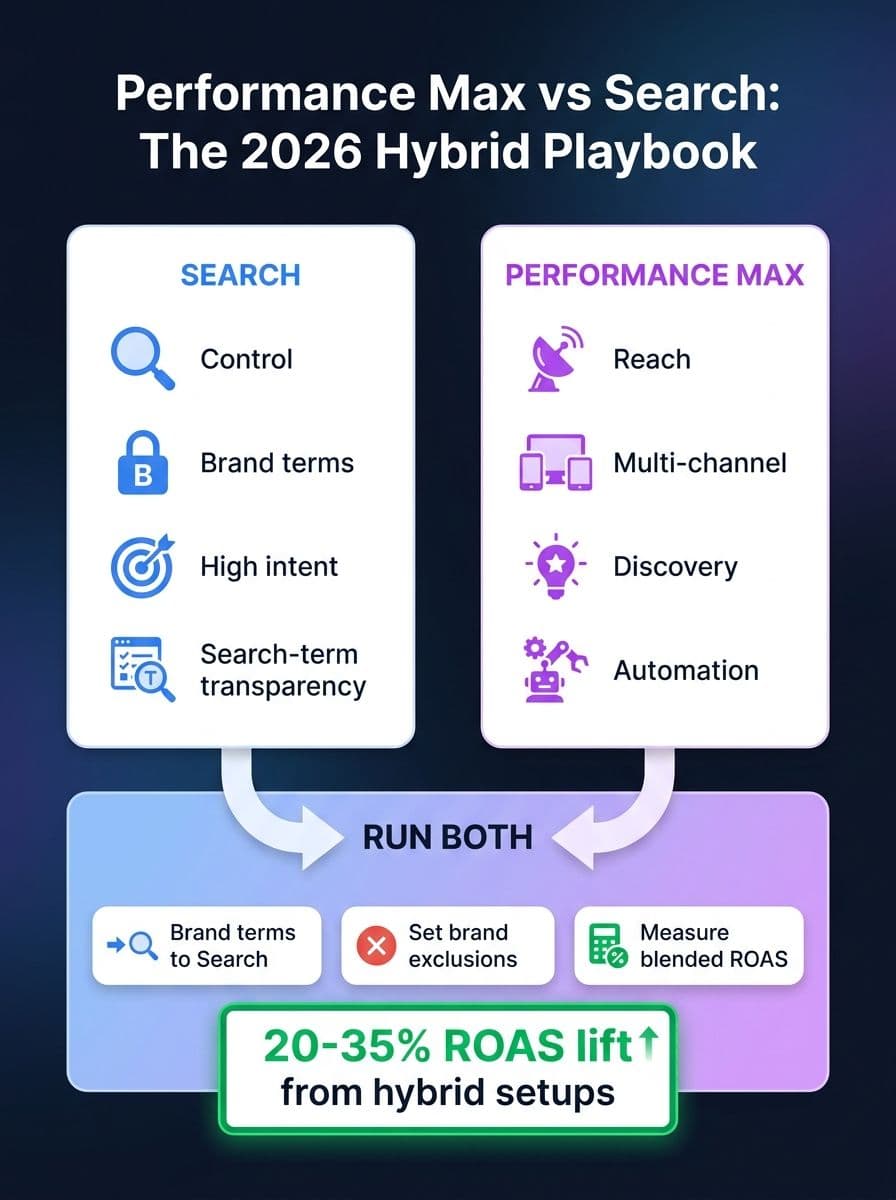
The 2026 hybrid playbook: which campaign type owns which job, and how to prevent overlap.
Common Mistakes to Avoid With Both Campaign Types
Even experienced teams fall into the same traps in 2026. Watch for these before they cost you a quarter of results.
- Trusting PMax ROAS at face value. A single campaign’s self-reported return tells you nothing about incrementality. Always compare it against blended account performance and brand impression share.
- Launching PMax with thin creative. A handful of headlines and no video starves the algorithm. Load the full recommended asset volume per group and refresh it on a schedule.
- Skipping brand exclusions. This is the number one cause of the 10 to 25% budget leak. Set them on day one, not after the audit.
- Treating PMax as set-and-forget. The 2026 reporting upgrades exist so you can steer. Ignoring channel and search terms data means ignoring your biggest optimization lever.
- Running Search with no negative keyword discipline. Broad and phrase match plus Smart Bidding can drift into irrelevant queries fast. A living negative list keeps spend on intent.
A useful mental model: Search is a scalpel, Performance Max is a net. Use the scalpel where you know exactly what you are cutting, and cast the net where you want to catch demand you cannot see yet. Teams that internalize that division of labor tend to stop asking which campaign type to run and start asking how to feed both better. That reframing, from bid management to input quality and measurement, is the same shift driving the broader move toward agentic PPC management.
Why This Is Really an Operations Problem
Step back and the pattern is clear. Winning at Search or PMax in 2026 no longer comes down to manual bid tweaks. It comes down to the quality of your inputs: creative volume, audience signals, feed health, negative keyword hygiene, and honest cross-campaign measurement. Google’s AI handles the auction. Your job is to feed it well and referee the overlap. That is an operations challenge, and it is exactly where fragmented tool stacks break down.
Most teams manage creative in one tool, analytics in another, ad platforms in a third, and try to reconcile blended performance in a spreadsheet. That fragmentation is what lets cannibalization go unnoticed for months. MarqOps replaces 7 or more disconnected marketing tools with one brand-intelligent system, so your creative production, ad management, and analytics live in a single unified dashboard. Its Brand Intelligence DNA keeps every asset on-brand from the start, teams ship creative up to 6x faster, and blended performance is visible in one place instead of scattered across tabs. When you can see PMax and Search side by side against real incremental results, the cannibalization trap stops being invisible. If you are moving toward automated, agentic ad management, our overviews of AI PPC management and AI marketing ROI show where this is all heading.
Frequently Asked Questions
Is Performance Max better than Search campaigns?
Neither is universally better. Search wins on control, transparency, and high-intent or brand traffic. Performance Max wins on reach, automation, and discovering new demand across every Google channel. In 2026, the strongest accounts run both with clear guardrails rather than picking one.
Does Performance Max cannibalize my Search campaigns?
It can. A March 2026 Optmyzr study found 91.45% of analyzed accounts had keyword overlap between Search and PMax, and unmanaged cannibalization can leak 10 to 25% of budget. Prevent it by running brand terms exclusively in Search, applying account-level negatives, and setting PMax brand exclusions.
Should I run both Performance Max and Search at the same time?
Yes, for most accounts. Hybrid setups that combine PMax reach with Search control show a 20 to 35% ROAS lift over single-campaign approaches. The key is giving each type a distinct lane so they stop bidding against each other.
What is a good ROAS for Performance Max in 2026?
Typical reported ROAS ranges from about 2.57x to 4.6x depending on vertical and configuration, though platform-reported figures can run higher. Treat any single-campaign ROAS with caution and judge PMax on blended, incremental performance rather than its self-reported number.
What changed in Performance Max in 2026?
Google added channel-level performance and budget reporting, search terms reporting, campaign-level negative keywords, asset group reporting, audience exclusions, and better placement controls. Smart Bidding Exploration went globally available for feed-free PMax campaigns on June 15, 2026, and Waze inventory was added for store-goal campaigns.
Stop guessing which campaign is really working
MarqOps unifies your creative, ad management, and analytics into one brand-intelligent dashboard so cannibalization has nowhere to hide.
Keep following the signal
Related field notes
Marketing
Brand Asset Management in 2026: How to Run It Without Adding Another Tool
14 min readMarketing Operations
Marketing Project Management Software in 2026: How to Choose Without Adding Tool #122
11 min readMarketing Analytics