Brand Guidelines Template (2026): The AI-Ready Framework Every Marketing Team Needs
A complete brand guidelines template for 2026. The 12 essential sections, AI content rules, real brand examples, and a free framework you can copy.
TL;DR
- A modern brand guidelines template is no longer a static PDF. It is the operating system that keeps humans, agencies, and AI tools producing brand-perfect work at scale.
- Brands with strict consistency see up to a 23 percent revenue uplift, yet nearly half of teams admit publishing off-brand content multiple times a year.
- The 12 essential sections in 2026: brand story, logo, color, typography, voice and tone, imagery, motion, accessibility, social media, AI content rules, do and don’t examples, and a one-page summary.
- You can build a usable rulebook in four weeks. The hard part is keeping it alive across every channel, vendor, and AI prompt.
- MarqOps replaces a stack of disconnected brand tools with a single Brand Intelligence DNA layer that every AI agent reads before it writes, designs, or launches a campaign.
What Is a Brand Guidelines Template? (And What Are Brand Guidelines, Exactly?)
A brand guidelines template is a structured document that defines exactly how your brand looks, sounds, and behaves across every touchpoint. Logo rules, color palettes, type systems, voice, tone, do and don’t examples, and now AI content protocols all live in one place. The result gives designers, writers, agencies, and AI tools a single source of truth so the brand stays recognizable whether it shows up in a Google ad, an investor deck, or a chatbot reply.
If you are wondering what are brand guidelines in the first place, think of them as the rulebook that keeps everyone on the same page. The template is the reusable structure of that rulebook. You fill it in once for your specific brand, then update it as your team, channels, and AI workflows evolve.
Quick definition: A brand guidelines template (sometimes called a brand style guide template or brand book) is the reusable framework you fill in for your specific brand. The result is a living rulebook that humans and AI systems both read before they create anything.
Table of Contents
- Why a Brand Guidelines Template Matters in 2026
- The 12 Essential Sections of a Modern Brand Guidelines Template
- How to Make Brand Guidelines (Step-by-Step)
- Brand Guidelines Examples From Top Companies
- AI-Ready Brand Guidelines: The New Section Every Template Needs
- Brand Guidelines Template vs. Brand Style Guide
- How AI Turns Your Brand Guidelines Into Living Infrastructure
- A Free Brand Guidelines Template Framework You Can Copy
- Common Mistakes to Avoid
- FAQs
Why a Brand Guidelines Template Matters in 2026
Three things changed at the same time, and together they made the brand guidelines template much more important than it used to be.
One, marketing fragmented. A typical mid-sized marketing team now uses 10 to 20 different tools for design, content, ads, analytics, and asset storage. Eighty-five percent of marketers say their team spends more than half its time fixing issues instead of creating campaigns. Most of those issues trace back to assets and copy that drifted out of brand alignment somewhere along the chain.
Two, AI started producing a huge share of the output. Generative tools now write ad copy, design banners, draft social posts, and personalize emails. Without explicit brand rules in machine-readable form, AI produces content that is technically fine but feels like it came from a different company. A generic AI-written LinkedIn post can erase years of careful brand building in a single afternoon.
Three, the audience got better at spotting inconsistency. A 2026 Ipsos brand recall study tracking 9,200 consumers found that brands with strict visual and tonal consistency had unaided recognition rates 79.6 percent higher than inconsistent ones. Buyers can sense when a brand is drifting, and they trust drifting brands less.
23.4%
Average revenue uplift for brands with strict consistency (Lucidpress, 2026)
The takeaway is simple. A modern brand rulebook is not a design exercise anymore. It is an operations document. It exists so that every human, every agency, and every AI agent can produce work that is on-brand the first time, without a manager rewriting it at 11 p.m. If you want to see how this connects to the broader marketing stack, our guide to marketing operations covers the full picture.
The 12 Essential Sections of a Modern Brand Guidelines Template
Use this structure as your starting brand guidelines sample. Every brand will customize the depth of each section, but all 12 belong in any 2026 rulebook.
1. Brand Story and Mission
Two to three paragraphs covering your purpose, your audience, and what you stand for. This is the section AI tools and new hires read first to calibrate everything else. Skip the corporate filler. State what you do and why it matters.
2. Logo System
Primary logo, secondary marks, monogram, clearspace rules, minimum size, and forbidden treatments. Include exports in SVG, PNG, and EPS so that whoever needs the logo never recreates it from a screenshot.
3. Color Palette
Primary, secondary, and accent colors with HEX, RGB, CMYK, and Pantone values. Add WCAG contrast pairings and a dedicated dark mode palette. Most templates from 2019 are missing this and it shows in modern apps.
4. Typography
Primary typeface, secondary typeface, web fallbacks, weight hierarchy, and pairing rules. Include a one-glance type scale (H1 through caption) so writers and developers reach for the same sizes.
5. Voice and Tone
How you sound when you are confident, when you apologize, when you celebrate, and when you sell. Include three to five tone sliders (formal vs. casual, serious vs. playful) with example sentences. This is the section your AI copywriting tool needs more than any other.
6. Imagery and Photography
Subject, composition, lighting, and post-processing rules. Include 10 to 15 approved reference images so AI image tools have a visual anchor.
7. Iconography and Illustration
Stroke weight, fill rules, corner radius, and style references. Without this section, every AI illustration request comes back in a different style and your decks look like a Frankenstein mood board.
8. Motion and Animation
This is the new one. Define easing curves, transition durations, and approved micro-interactions. Motion is now as important as static visual identity for screen-first products. Our guide to AI graphic design generators goes deeper on how motion shows up in modern creative pipelines.
9. Accessibility Standards
Minimum contrast ratios, font sizes, alt text guidance, and inclusive language rules. This is no longer optional. Many enterprise buyers now require WCAG 2.2 AA compliance in vendor contracts.
10. Social Media and Channel Adaptations
Profile image specs, banner dimensions, post templates per platform, and channel-specific tone shifts. The same brand should sound slightly different on LinkedIn than on TikTok, and your guidelines should say how.
11. AI Content Rules
This section did not exist in most templates two years ago. Cover what AI can and cannot generate without human review, the prompts to avoid, the disclosure rules, and the human approval checkpoints. We expand on this in the dedicated section below.
12. Do and Don’t Examples
Side-by-side visual examples are the single highest-leverage part of any brand guidelines template. People copy patterns faster than they read rules. Include at least three do-and-don’t pairs per major section.
Pro tip: Build a one-page brand guidelines template summary as a companion document. New hires, freelancers, and agency partners will reach for the one-pager 90 percent of the time. The full document exists for the 10 percent of edge cases.
How to Make Brand Guidelines (Step-by-Step)
Most teams overthink this. You do not need a six-month brand sprint. Here is a four-week plan that works for both early-stage startups and established brands going through a refresh. The same approach applies whether you are building a brand style guide or a full brand book.
Week 1: Audit What You Already Have
Pull together every recent ad, deck, blog post, email, and social asset. Sort them into “feels right” and “feels off.” The patterns inside the “feels right” pile are your real brand, even if the official guidelines say something else.
Week 2: Lock the Visual System
Finalize logo, color, typography, and imagery. Get sign-off from the smallest decision-making group possible. Two people moving fast beats a 12-person committee moving never.
Week 3: Write the Voice and Tone
Draft 20 example sentences across emails, ads, support replies, and social posts. Mark each one as on-brand or off-brand. Reverse-engineer the rules from the examples. This is faster than writing rules from scratch.
Week 4: Add AI Rules and Roll Out
Define AI prompts, escalation rules, and approval workflows. Then publish the document somewhere everyone can find it in 10 seconds. A 50-page PDF buried inside a forgotten folder might as well not exist.
Reality check: The first version should ship in four weeks, not four months. You will rewrite half of it within the first quarter as real usage exposes gaps. That is normal and good.
Brand Guidelines Examples From Top Companies
The fastest way to build a great rulebook is to study public ones. Here are seven brand guidelines examples worth saving as reference.
Nike publishes one of the cleanest brand systems on the web. Their guidelines focus on energy, motion, and bold contrast. The “Just Do It” voice rules are short, declarative, and easy to copy.
Spotify shows how a digital-native brand handles motion, dark mode, and dynamic color extraction from album art. Their guide is a great example of brand guidelines that anticipate AI personalization.
Starbucks is the textbook example of detailed visual identity rules paired with strict logo treatment. Their public creative expression guide is short enough to read in one sitting and detailed enough to actually use.
Walmart demonstrates how a giant retailer maintains consistency across thousands of stores, suppliers, and partner brands. Their guidelines are a masterclass in scale.
Netflix uses a famously sparse brand system focused on a single iconic logotype, a tight color palette, and a strong typographic voice. It works because the rules are followed without exception.
Target publishes detailed creative manifesto pages that mix brand purpose with practical asset rules. Their voice guidelines read like a personality profile, not a corporate document.
Amazon has separate brand guideline systems for Amazon, AWS, Alexa, and Prime. Studying how they keep all four distinct yet related is a useful exercise if you manage a multi-brand portfolio.
What every one of these brand guidelines examples has in common is that the rules are short, the visuals are dominant, and the document is updated. The worst brand guidelines are usually the longest.
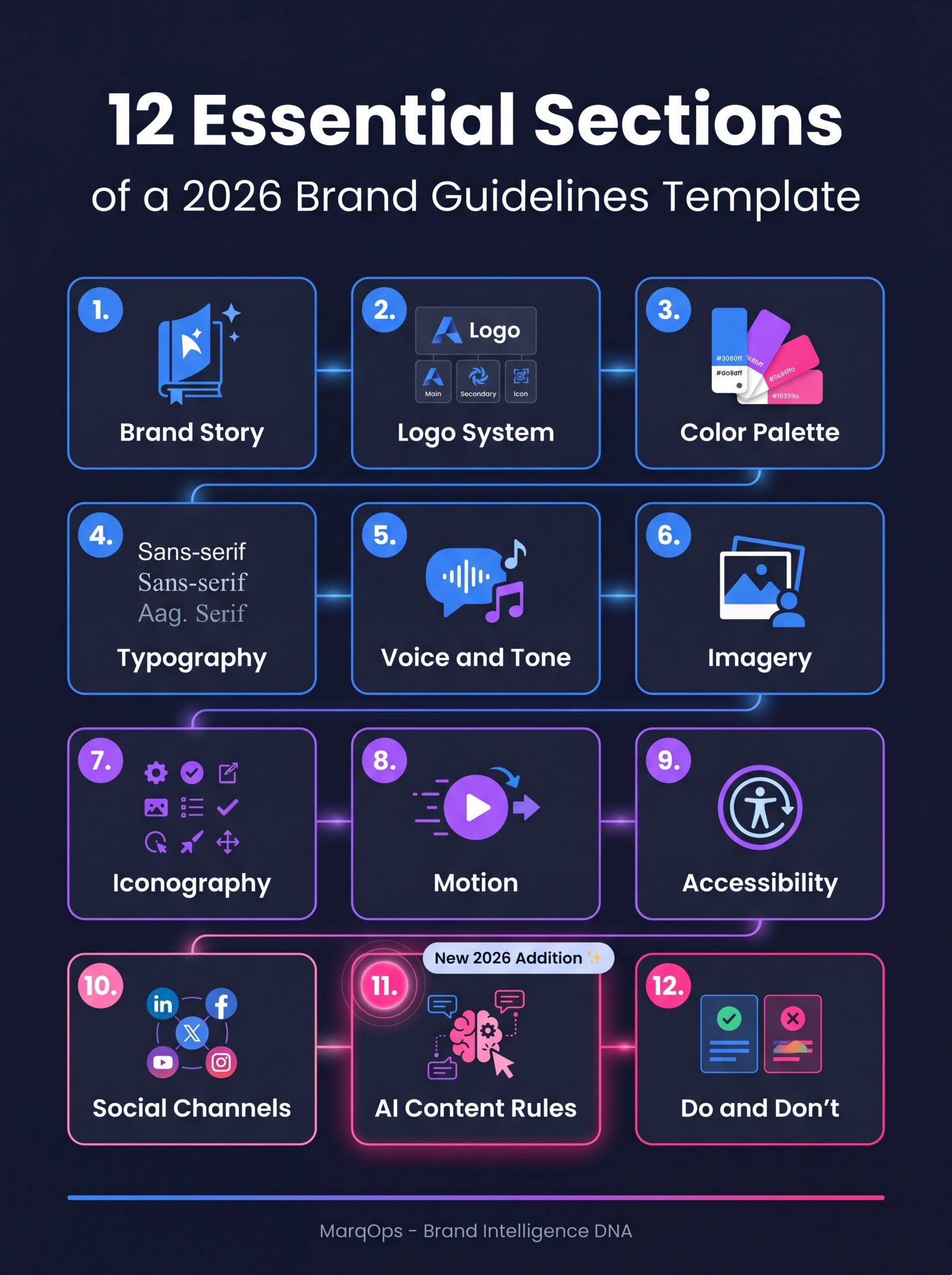
The 12 sections that belong in a modern brand guidelines template
AI-Ready Brand Guidelines: The New Section Every Template Needs
If you only update one thing in your existing rulebook this quarter, make it this section. AI tools now generate a huge share of marketing output. Without rules, every model produces something that is technically usable and tonally wrong.
An AI content rules section should cover six things.
1. What AI can produce without human review. Examples: first drafts, internal reports, ad variants, image background removal. Anything routine and low-risk.
2. What AI can never produce without human review. Examples: customer-facing apologies, legal copy, medical or financial claims, anything attributed to a named executive.
3. Approved prompt patterns. The exact opening prompt structure that loads brand voice, audience, and tone before the model writes a single word. We cover prompt patterns in depth in our AI content strategy guide.
4. Forbidden words and phrases. Every brand has a small list. Common ones include “leverage” as a verb, “synergy,” and the em dash. List yours so AI tools learn to avoid them.
5. Disclosure rules. When and how to disclose AI involvement to customers, regulators, and partners. The EU AI Act, FINRA, and FDA all have specific requirements depending on industry. Build the rule once and reuse it.
6. Approval workflows. The exact path content takes from prompt to publish. Who reviews what, in what order, and what triggers an escalation. This is where most teams get stuck because the workflow exists in someone’s head, not in the template. Our deep dive on AI agents for marketing shows how modern teams automate this layer.
The teams that get this right end up with brand guidelines that are not just human-readable but machine-readable. That is the unlock for the next section.
Brand Guidelines Template vs. Brand Style Guide: What’s the Difference?
The terms get used interchangeably, but they are not the same.
A brand style guide template is usually narrower. It focuses on visual rules: logo, color, typography, and layout. Designers reach for it when they are building a deck or a website.
A full brand rulebook is broader. It includes the visual system plus voice, tone, brand story, audience, channel rules, AI policy, and approval workflows. It aligns marketing, sales, product, support, and any external partner.
Most modern teams need both. The style guide is the visual reference, often a one-page brand style guide for fast lookup. The full rulebook is the underlying operating manual. If you are starting from zero, build the rulebook first and extract the style guide from it. Doing it the other way around tends to leave the strategic sections empty.
How AI Turns Your Brand Guidelines Into Living Infrastructure
Here is where everything changes. A static document, even a great one, has one weakness. People do not read it. They start, they skim, they get back to the deadline. The result is the same drift the rulebook was supposed to prevent.
The fix is to make the rules machine-readable and to put them in front of every tool that creates content. This is what Adobe, Aprimo, and other enterprise platforms call brand intelligence. It is also the core idea behind MarqOps’ Brand Intelligence DNA.
The model is simple. Your rules get encoded once into a structured format that includes voice, tone, visual standards, do and don’t examples, AI prompts, and approval workflows. Then every AI agent and creative tool reads that DNA before it produces anything. A blog draft, a Google ad, a Performance Max asset, a social caption, and an email all start from the same brand foundation. The output is on-brand the first time, and the team spends 6x less time on rewrites.
This is also where consolidation pays off. Most marketing teams duplicate brand assets across a design tool, a content platform, an ad manager, an analytics suite, and a DAM. Every duplicate is a chance for drift. A unified system that replaces seven or more disconnected tools removes those failure points by design. Our guide to marketing intelligence platforms walks through how this looks in practice.
What changes when rules become infrastructure: L’Oréal reported a 40 percent reduction in campaign setup time after deploying a custom marketing operating system that integrates brand assets and AI workflows. The underlying rules were the same. What changed was how they were distributed and enforced.
A Free Brand Guidelines Template Framework You Can Copy
Here is the structure to copy into your own document tool. This is the same framework MarqOps uses internally before encoding a client’s brand into Brand Intelligence DNA. You can also reference the publicly available WCAG 2.2 accessibility guidelines when filling in your accessibility section.
Section 1: Brand foundation covers mission, vision, values, target audience personas, and competitive positioning. Two to three pages.
Section 2: Visual identity covers logo system, color palette with HEX and dark mode, typography with full type scale, iconography, illustration, photography, and motion. Eight to 12 pages.
Section 3: Voice and messaging covers brand voice, tone sliders, vocabulary, forbidden phrases, messaging pillars, and elevator pitches. Four to six pages.
Section 4: Channel-specific rules covers website, email, paid ads, organic social, sales decks, and customer support. Two to three pages per channel.
Section 5: AI and content governance covers AI prompt patterns, what AI can and cannot generate without review, disclosure rules, and approval workflows. Three to five pages.
Section 6: Asset library and operations covers where assets live, how to request new ones, version control, and a single-page summary. Two to three pages plus links.
That is it. Forty-five pages or so for the full template, plus a one-page summary that does the heavy lifting. The point is not to write a thick document. The point is to define rules that hold up across every channel and every AI agent that touches your brand.
Common Mistakes to Avoid When Building Your Brand Guidelines Template
Treating it as a one-time project. Rules need quarterly reviews. Voice shifts, channels change, AI tools evolve, and standards that made sense in 2024 are now blocking your team in 2026.
Writing rules without examples. Every rule should have a do-and-don’t pair. Without examples, people interpret rules differently and the brand drifts.
Hiding the document. If new hires cannot find your rulebook within five minutes of starting, it does not exist. Pin it in Slack, Notion, or whatever tool the team actually uses.
Skipping the AI section. This is the most common 2026 mistake. Rulebooks that do not address AI explicitly leave every prompt to chance, and the brand drifts faster than ever.
Letting the document get too long. Aim for 40 to 50 pages plus a one-page summary. Anything longer becomes a reference nobody reads.
Forgetting to share with vendors and agencies. External partners often produce more brand assets than internal teams. They need the same rulebook, in the same format, with the same updates.
FAQs About Brand Guidelines Templates
What is a brand guidelines template?
A brand guidelines template is a reusable document structure that defines how a brand looks, sounds, and behaves across every channel. It typically covers logo, color, typography, voice, tone, imagery, motion, accessibility, social, and AI content rules. You fill it in once for your specific brand, then use it as the source of truth for every team and tool.
What should a brand guidelines template include in 2026?
Twelve sections cover the essentials: brand story, logo system, color palette with dark mode, typography, voice and tone, imagery, iconography and illustration, motion, accessibility, social media adaptations, AI content rules, and do-and-don’t examples. The AI rules section is the newest and most important addition.
How long should a brand guidelines template be?
Forty to 50 pages for the full document is enough for most brands, plus a separate one-page brand guidelines template summary that team members reach for daily. Documents over 80 pages tend to go unused.
What is the difference between a brand guidelines template and a brand style guide template?
A brand style guide template focuses on visual rules like logo, color, typography, and layout. A brand guidelines template is broader and includes the visual system plus voice, tone, brand story, channel rules, AI policy, and approval workflows. Most teams need both.
How do you use a brand guidelines template with AI tools?
The most effective approach is to encode the brand guidelines into a structured, machine-readable format that AI agents read before generating anything. Platforms like MarqOps call this Brand Intelligence DNA. The template stops being a static PDF and starts acting as a system prompt that loads voice, tone, and rules into every AI workflow automatically.
Where can I find free brand guidelines template examples?
Public brand guidelines from Nike, Spotify, Starbucks, Netflix, Walmart, Target, and Amazon are some of the best free brand guidelines examples to study. Canva, Figma, and Notion all offer free template structures you can fill in. The framework in this guide is also a free brand guidelines template you can copy directly.
How often should brand guidelines be updated?
Quarterly for fast-moving brands and at minimum every six months for established ones. The AI rules section often needs more frequent updates as new tools and regulations appear. Treat the brand guidelines template as living infrastructure, not a finished document.
Bringing It All Together
A brand guidelines template in 2026 is not a design artifact. It is the operations layer that lets humans, agencies, and AI agents produce brand-perfect work at scale. Get the 12 sections right, keep the document short, ship it in four weeks, and put it in front of every tool that creates content.
If you want to skip the part where you have to manually push your rules into a dozen disconnected tools, MarqOps replaces that stack with a single platform. Brand Intelligence DNA encodes your rulebook once and lets every AI agent inside the platform produce content, ads, SEO posts, and creative that match your brand from the first draft. Teams ship 6x faster, see one unified dashboard, and stop fixing off-brand work at midnight.
Sources: Lucidpress 2026 Brand Consistency Study, Deloitte Global Marketing Effectiveness Study 2026, Ipsos Global Brand Registry 2026 recall study, Adobe Brand Intelligence, Aprimo brand management research, Cloud Campaign AI brand guidelines guide.
Keep following the signal