Creative Brief Template: 9 Sections, a Copyable Format, and Examples (2026)
A copyable creative brief template with nine sections, a filled-in example, and variations for ad, video, content, and design briefs, plus what poor briefs cost.
Table of Contents
- What Is a Creative Brief?
- Why Brief Quality Decides the Budget
- The Nine Sections Every Creative Brief Needs
- Creative Brief Template You Can Copy
- A Filled-In Example: Paid Social Launch
- Adapting the Template: Ad, Video, Content, and Design Briefs
- Six Brief Mistakes That Trigger Rework
- Using AI to Write and Check Briefs
- Putting the Brief Into Your Workflow
- Frequently Asked Questions
Most late campaigns trace back to the same moment: someone received a request that said "make us a launch video" and nothing else. Three days and two rounds of feedback later, the team discovers the audience was wrong, the deadline was a guess, and the budget had a ceiling nobody mentioned. A good creative brief template prevents that moment by forcing the answers to appear before the work starts.
This guide gives you a copyable nine-section template, a filled-in example, and variations for ad, video, content, and design briefs. It also covers the research on what bad briefs cost, the mistakes that cause rework, and where AI helps. If your briefs feed a larger process, our guides to creative operations and marketing operations show where the brief sits in the wider system.
What Is a Creative Brief?
A creative brief is a short document that aligns everyone who touches a creative project on its purpose, audience, message, deliverables, and constraints. It is written by the person who owns the business problem (a marketer, product owner, or account lead) and handed to the people who will solve it creatively (designers, writers, video producers, or an agency).
Zapier's guide describes the standard brief as one to three pages, with one to three objectives, and the WARC best practice guide adds that a good brief is concise, clear, consistent, and creative. The point is not paperwork. The point is that a brief translates strategy into something a creative person can act on without a meeting.
A brief is also different from a content brief, which gives a writer SEO targets and an outline, and from a creative strategy, which sets direction across many projects. The brief is the project-level contract between strategy and production.
Why Brief Quality Decides the Budget
The strongest public data on this comes from The BetterBriefs Project, a global study run with Flood + Partners and premiered at the IPA's EffWorks Global event in 2021. It surveyed more than 1,700 marketers and agency staff across over 70 countries. The results are self-reported, so treat the percentages as a measure of how practitioners feel, but the pattern is hard to ignore.
- Perception gap: 80% of marketers believed they write good briefs. Only 10% of agencies agreed.
- Strategic clarity: 78% of marketers said their briefs give clear strategic direction. Only 5% of agencies said the same.
- Language: 83% of marketers called their briefs clear and concise. Only 7% of agencies did.
- Rework: 69% of marketers and 73% of agencies agreed that rebriefs happen too often.
- Importance: 90% of marketers and 92% of agencies described the brief as valuable yet neglected.
A follow-up effort from the same group, The BetterIdeas Project, extended the concern to idea evaluation and creative decision-making. Its announcement cited WARC's projection of roughly US$1.07 trillion in global advertising spend for 2025 and applied the one-third waste estimate to argue that around US$350 billion could be affected. That figure is an extrapolation, not an audit, but it shows why agencies and brands keep returning to the brief.
Production pressure makes this worse. Superside's May 2026 analysis, citing Breakpoint research, reports that about 80% of creative leaders see higher request volume than last year and four in five teams operate at or beyond capacity. When capacity is tight, vague briefs turn directly into extra revision rounds. For the downstream view, see how creative analytics can show which briefs produced assets that performed.
The Nine Sections Every Creative Brief Needs
Different sources list five to twelve sections. Nine covers nearly every marketing project without turning the brief into a questionnaire. Each section answers one question the creative team would otherwise have to ask.
1. Project overview
Two or three sentences on what the project is, why it exists now, and how it connects to a campaign or business goal. Include the trigger: a product launch, a seasonal window, a competitor move, or a performance gap. Context is what lets a designer or writer make good judgment calls.
2. Objective
State one to three objectives, ideally measurable. "Increase awareness" gives nobody anything to aim at. "Lift email signups 15% over three months" does. If you cannot name the metric, you are not ready to brief. Our guide to marketing KPIs can help you pick one that connects to revenue.
3. Target audience
Go beyond demographics. Describe what the audience wants, what frustrates them, what they believe about your category, and where they will see the work. If you have an ideal customer profile or segments, reference them by name and link to the source.
4. Single-minded message
The one thing the audience should remember. Write it as a sentence a person could repeat. Add a short proof point and the tone you want (for example, confident and plain, not hype). If your team has documented voice rules, point to them. The AI brand voice guide covers how to turn tone into rules a team can apply.
5. Deliverables and specs
List the exact assets: formats, dimensions, durations, file types, languages, and channels. Add accessibility needs, legal disclaimers, and platform requirements. A missing spec is a guaranteed revision round.
6. Mandatories and constraints
Logos, claims, disclaimers, competitor restrictions, regulated language, and anything that must or must not appear. This is where brand compliance expectations belong, in the brief rather than discovered at review.
7. Timeline and budget
Working-back dates for kickoff, first draft, feedback window, final approval, and launch. State the budget or the cap on each deliverable. Hidden budget limits waste the most creative effort of any omission.
8. References and inspiration
Two to four examples of what to emulate and one to avoid, with a sentence on why each works. Include relevant brand guidelines, past top performers, and links to approved assets.
9. Stakeholders, approvals, and success measures
Name the requester, the contributors, and the single final approver. State how many review rounds are expected and who reviews what. Add how success will be measured and when. This section prevents the late arrival of a new decision-maker with new opinions.
Creative Brief Template You Can Copy
Paste this into your doc tool, intake form, or project system. Keep the prompts as helper text and delete anything that does not apply, but do not skip sections.
| Section | What to write | Example prompt |
|---|---|---|
| Project name and owner | Short title, requester, date, version | Q1 Webinar Series Launch / Dana K. / v1 |
| Overview | Why this project, why now, link to campaign goal | We are launching a webinar series to feed Q1 pipeline. |
| Objective(s) | 1 to 3 measurable outcomes | 1,200 registrations; 35% attendance; 120 sales-qualified leads. |
| Audience | Who, what they want, what blocks them, where they will see it | Marketing ops managers at 200 to 2,000 person companies. |
| Single-minded message | One sentence plus one proof point and tone | Fewer tools, faster launches. Proof: 3 case metrics. Tone: direct. |
| Deliverables and specs | Asset list, sizes, formats, channels, languages | 5 LinkedIn images 1200x627; 1 landing hero; 3 email headers. |
| Mandatories and limits | Legal, claims, logo rules, do-nots | Include webinar disclaimer; no competitor names. |
| Timeline and budget | Key dates and cost cap | Draft Jan 12; final Jan 19; launch Jan 22; $6,000 cap. |
| References | 2 to 4 examples and 1 to avoid, with why | Last year's Q3 series (strong CTR); avoid stock-photo style. |
| Approvals and success | Final approver, review rounds, measures, review date | Approver: VP Marketing. 2 rounds. Review KPIs Feb 15. |
A Filled-In Example: Paid Social Launch
Here is a compact example of how the template reads when the details are real. It is a fictional B2B software company, written to show the level of specificity that avoids rework.
- Overview: Launching a reporting feature to existing customers in March. Adoption of the old dashboard is 22%, and support tickets about reports are the top category.
- Objective: 30% of active accounts try the new reports within 60 days. Secondary: reduce report-related tickets by 20%.
- Audience: Account managers at agencies, time-poor, tired of exporting spreadsheets. They see ads in the app and on LinkedIn.
- Message: "Client reports in two clicks." Proof: average build time dropped from 40 minutes to 4 (internal data, cite as such). Tone: practical, no hype.
- Deliverables: 4 static ads at 1080x1080 and 1200x628, 2 fifteen-second vertical videos with captions, in English and Spanish.
- Mandatories: Product name in first frame; no "best" claims; screenshot must show current UI.
- Timeline and budget: Concepts Feb 3, drafts Feb 10, final Feb 17, live Mar 1. $4,500 production cap.
- Approvals: Product marketing lead is final approver. Legal reviews claims only. Two rounds.
Notice the brief names the number behind the objective, the context that justifies it, and who decides. That is the difference between a brief and a wish list. If this reporting scenario sounds familiar, our client reporting framework explains what to include in the product that the ads promote.
Adapting the Template: Ad, Video, Content, and Design Briefs
The nine sections stay the same. What changes is the detail inside the deliverables, message, and references sections.
| Brief type | Add or emphasize | Common omission |
|---|---|---|
| Ad creative brief | Platform and placement specs, offer, call to action, hook options, test hypothesis, variants wanted | No testing plan, so winners are not learned from |
| Video brief | Length, aspect ratios, script or beats, voiceover or on-screen text, music, captions, talent and location | Missing captions and cutdown versions |
| Content brief | Search intent, focus keyword, outline, sources, internal links, word count | Writer never told the audience stage |
| Design brief | Usage context, brand assets, layout constraints, file formats, print or digital | Source files and font licenses not provided |
| Campaign brief | Channel mix, flighting, budget split, measurement plan | Individual asset briefs not linked back to it |
For ad work, add a test hypothesis to the brief itself: "We believe the price-led hook will beat the speed-led hook for agency account managers." This turns every launch into a learning loop, which pairs naturally with AI A/B testing and dynamic creative optimization. If you produce many variants, a creative automation workflow can generate sizes and languages from one approved master.
Six Brief Mistakes That Trigger Rework
- Describing the output, not the problem. "We need a video" is not a brief. State the audience action you want and let the creative team propose the format.
- Too many objectives. If everything is a priority, nothing is. Cap objectives at three and rank them.
- A message that is really a list. A single-minded message fits in one sentence. Move extra points to supporting proof.
- Hidden constraints. Budget caps, legal limits, and brand rules revealed at review guarantee a redo. Put them on page one.
- No named approver. Without one final decision-maker, feedback arrives from everyone and contradicts itself.
- No success measure. If nobody defines what good looks like, taste becomes the only judge and revision rounds multiply.
Many of these failures live in handoffs, not in writing skill. Teams that treat the brief as a living part of their content supply chain tend to fix the intake form once and benefit on every project afterward.
Using AI to Write and Check Briefs
AI is useful at both ends of the brief: drafting and checking. Superside's May 2026 article describes AI expanding a short description into a draft covering goals, deliverables, audiences, messaging, channels, references, metrics, and timelines, and pulling context from scattered guidelines, folders, and chat tools. The same article is vendor content, and it names real limits: generic tools are not trained on your brand, they forget past decisions, and they stop at the brief without carrying context into production.
A practical split looks like this:
- Let AI draft: turn rough notes, a kickoff transcript, or a Slack thread into a first-pass brief using your template.
- Let AI check: flag missing sections, vague objectives ("increase awareness"), unmeasurable goals, or specs that conflict with your brand rules before the brief is sent.
- Let AI connect: attach the right brand guidelines, past top-performing assets, and approved claims to the brief automatically.
- Keep people on strategy: the audience insight, the single-minded message, and the final approval stay human.
This is where a unified platform helps. MarqOps stores your Brand Intelligence DNA (voice, visual rules, claims, and past approvals) alongside creative, SEO, and ad workflows, so a brief can reference the same source of truth the production step uses. It is built around the idea that one platform can replace seven or more disconnected tools and deliver content up to 6x faster. For a deeper look at governing AI in these workflows, read our AI agent governance framework.
Putting the Brief Into Your Workflow
A template only helps if people use it. Four habits make it stick:
- Make the template the intake form. Required fields in your project tool prevent half-filled requests. Our marketing project management software guide covers tools that support this.
- Hold a 15-minute brief review. The requester and the lead creative read it together and ask what is unclear before work begins. This is cheap insurance against a rebrief.
- Version the brief, not the thread. When scope changes, update the brief and notify the team. Feedback buried in chat is how decisions get lost.
- Close the loop. After launch, add results to the brief and store it with the assets. Over time you build a library of what worked, which feeds brand asset management and future workflow automation.
Typeface's May 2026 survey, cited in our creative operations guide, found 88% of leaders said teams can make content quickly and approval is the real bottleneck, while only 20% had standardized, documented workflows. A shared brief template is one of the lowest-cost steps toward that documented workflow.
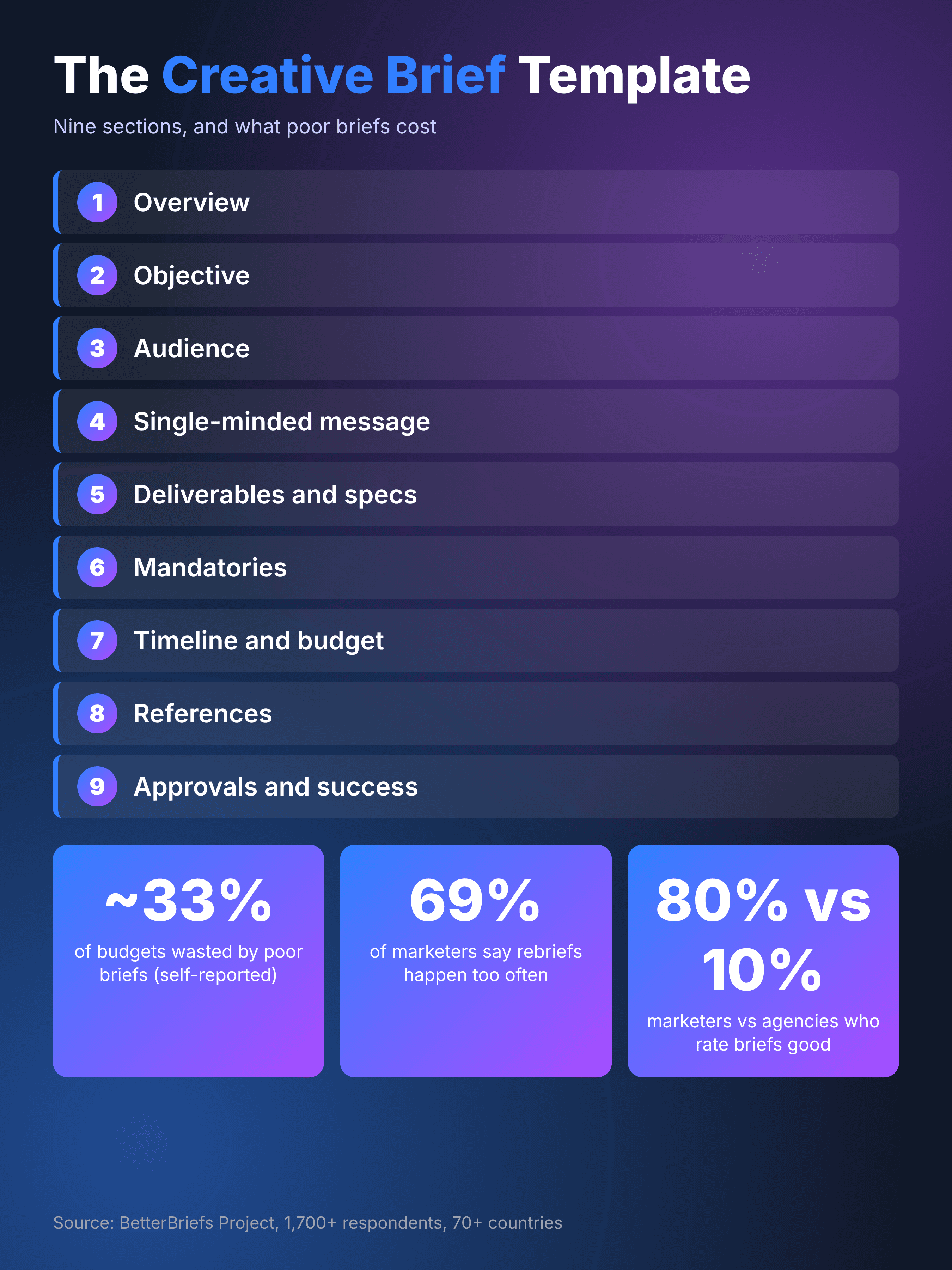
The nine-section creative brief template and what poor briefs cost, based on BetterBriefs Project data.
Whether you adopt this template as written or adapt it, the principle is the same: spend twenty minutes up front so your creative team spends days on the right problem. If you want the brief, the brand rules, and the production workflow in one place, you can try MarqOps free and see it in action.
Frequently Asked Questions
What is a creative brief template?
A creative brief template is a reusable document with set sections (overview, objectives, audience, message, deliverables, constraints, timeline, references, and approvals) that a requester fills in before a creative project starts. It keeps requests consistent and makes sure nothing critical is missing.
What should be included in a creative brief?
At minimum: the project background, one to three measurable objectives, the target audience, a single-minded message, deliverables with specs, mandatories and constraints, timeline and budget, references, and the named approver with success measures.
How long should a creative brief be?
One to two pages for most marketing projects, and three at most for complex campaigns. Length is not the goal. If a creative person can produce a strong first draft from the page without a meeting, it is long enough.
Who writes the creative brief?
The person who owns the business problem writes it, usually a marketer, product owner, or account lead. The creative lead should review it before work starts and push back on gaps. Writing it alone and sending it over the wall is how rebriefs happen.
Can AI write a creative brief?
AI can draft a brief from rough notes and check one for missing or vague sections, which saves time. It cannot supply your audience insight or decide your key message, and it should not invent proof points. Treat the AI draft as a starting point that a person edits and owns.
Keep following the signal