Ideal Customer Profile (ICP) in 2026: The Complete Guide to Building, Scoring, and Activating a Living ICP
Build a data-driven ideal customer profile in 2026: the four data layers, a 7-step framework, scoring rubrics, and how to keep your ICP a living, AI-driven model.
TL;DR
- An ideal customer profile (ICP) is a data-backed description of the companies that buy fastest, stay longest, and deliver the most value. It is built from your closed-won data, not your wish list.
- The payoff is large and well documented: companies with a clearly defined ICP report up to 68% higher win rates, 15 to 30% shorter sales cycles, and acquisition costs roughly 50% lower on in-profile deals.
- Despite that, around 68% of B2B companies still have not clearly defined their ICP, which makes a disciplined profile one of the cheapest competitive advantages available in 2026.
- A usable ICP layers four data types: firmographics, technographics, intent and behavior, and verified contact data. Each layer is then weighted into a scoring rubric that sorts accounts into A, B, and C tiers.
- In 2026 the winning move is to treat your ICP as a living model that refreshes on real signals, not a slide that gathers dust. MarqOps unifies that signal data so your profile updates itself instead of going stale.
Table of Contents
- What Is an Ideal Customer Profile?
- Why Your ICP Decides Your Revenue Math
- ICP vs Buyer Persona vs Segmentation
- The Four Data Layers of a Modern ICP
- How to Build Your ICP: A 7-Step Framework
- Building an ICP Scoring Rubric
- From Static Document to Living, AI-Driven ICP
- Common ICP Mistakes to Avoid
- How to Activate Your ICP Across Marketing
- Frequently Asked Questions
What Is an Ideal Customer Profile?
An ideal customer profile is a structured, data-backed description of the type of company that gets the most value from your product and gives the most value back in return. In B2B, that means the organizations that close quickly, expand over time, churn rarely, and cost the least to support. Your ICP is the filter that narrows a universe of millions of companies down to the few thousand actually worth pursuing.
The key word is data-backed. A strong profile is built from your best existing customers, not your dream logos. You pull your closed-won deals, tag each with the attributes that describe the account, and look for the patterns that repeat among your healthiest relationships. In practice, 70 to 80% of your wins will share just three to five common traits. Those traits are your ICP. Everything else is noise.
This is different from how most teams operate. Many marketing organizations still target broadly, then wonder why conversion stalls and customer acquisition cost creeps up. A precise ICP fixes that at the source by aligning every downstream motion, from demand generation to lead scoring, against the same definition of a great-fit account.
Quick definition: An ICP describes the ideal company to sell to. A buyer persona describes the ideal person inside that company. You need both, but they answer different questions, and confusing them is the single most common profiling error.
Why Your ICP Decides Your Revenue Math
An ICP is not a branding exercise. It is a revenue lever, and the numbers behind it are striking. Companies with a clearly defined ICP report up to 68% higher win rates than those without one. McKinsey benchmarks put it differently but in the same direction: organizations with well-defined ICPs see roughly 40% higher close rates and twice the revenue growth rate.
~50%
lower acquisition cost on in-profile deals versus out-of-profile deals
The efficiency story is just as compelling as the growth story. Teams that build ICP discipline into their go-to-market motion see a 30 to 50% lift in sales conversion, and in-profile deals cost roughly half as much to acquire as out-of-profile ones. When sales and marketing share one clear ICP, the gains compound: research links that alignment to 36% higher customer retention, 38% higher win rates, and a 208% boost in marketing-attributed revenue.
There is also a documentation effect. Around 71% of companies that exceed their revenue and lead goals have a documented ICP, and teams with a documented, scored profile report 20 to 40% higher win rates and 15 to 30% shorter sales cycles than teams working from gut feel. The discipline of writing it down and scoring against it is doing real work.
Here is the opportunity hiding in plain sight: roughly 68% of B2B companies have still not clearly defined their ICP. In a market where everyone has access to the same AI tools and the same contact databases, a sharp, well-maintained profile is one of the few advantages your competitors are leaving on the table. It also feeds directly into how you measure success, which is why ICP work pairs so naturally with pipeline marketing and revenue-based reporting.
ICP vs Buyer Persona vs Segmentation
These three terms get used interchangeably, and that confusion quietly wrecks targeting. They are complementary layers, not competing ideas.
Your ICP works at the company level. It answers “which organizations should we pursue?” using firmographics, technographics, and account-level behavior. Your buyer persona works at the human level. It answers “which two or three people inside those companies do we talk to, and what do we say?” using job roles, goals, and pain points. Your segmentation is how you then group and prioritize within the ICP for campaign delivery.
The clean way to think about it: the ICP narrows millions of companies down to a few thousand worth pursuing, the personas tell your reps which humans to reach inside each one, and segmentation decides the order and the message. An ICP without personas is half a strategy, because you know where to aim but not what to say. Personas without an ICP are the other half missing, because you have great messaging pointed at the wrong companies. For the human-level layer, our guide to AI customer segmentation goes deeper on grouping and activation.
| Dimension | Ideal Customer Profile | Buyer Persona |
|---|---|---|
| Focus | The company | The individual |
| Question answered | Who do we target? | Who do we talk to, and how? |
| Core data | Firmographics, technographics, account behavior | Role, goals, pain points, buying behavior |
| Primary use | Account selection and ABM targeting | Messaging, content, and nurture |
The Four Data Layers of a Modern ICP
A profile that actually drives action is built from four layers of data. Skip a layer and your targeting gets blurry.
1. Firmographics: who the company is
These are the company-level basics: industry and niche, employee count, annual revenue range, growth stage, and geography. Firmographics are table stakes. They get you in the right neighborhood, but every competitor has access to the same fields, so they rarely make your targeting sharp on their own.
2. Technographics: what the company runs
This is where targeting gets precise. Knowing a prospect runs Salesforce and Outreach tells you more about buying readiness than knowing they are a 200-person SaaS company. Technographic signals reveal integration fit, budget maturity, and competitive displacement opportunities that firmographics simply cannot.
3. Intent and behavior: what they are doing now
Static fit data tells you who could buy. Intent data tells you who is likely to buy soon. Funding rounds, hiring surges in relevant departments, technology changes, content consumption, and competitor research all flag accounts that may be in a buying window right now. This layer is what turns a list into a priority queue, and it is the heart of any modern intent data strategy.
4. Verified contact data: how to reach the buyer
None of the above matters if you cannot reach a real human. Roughly 25 to 30% of B2B contact data goes stale every year, so verification and enrichment have to be continuous rather than a one-time project. This layer is also where your ICP connects to your first-party data strategy and your customer data platform.
The compounding effect: firmographics alone might get you a 10% reply rate. Layer technographics, live intent, and verified contacts on top, and the same outreach can convert several times higher, because you are reaching the right company, at the right moment, through the right person.
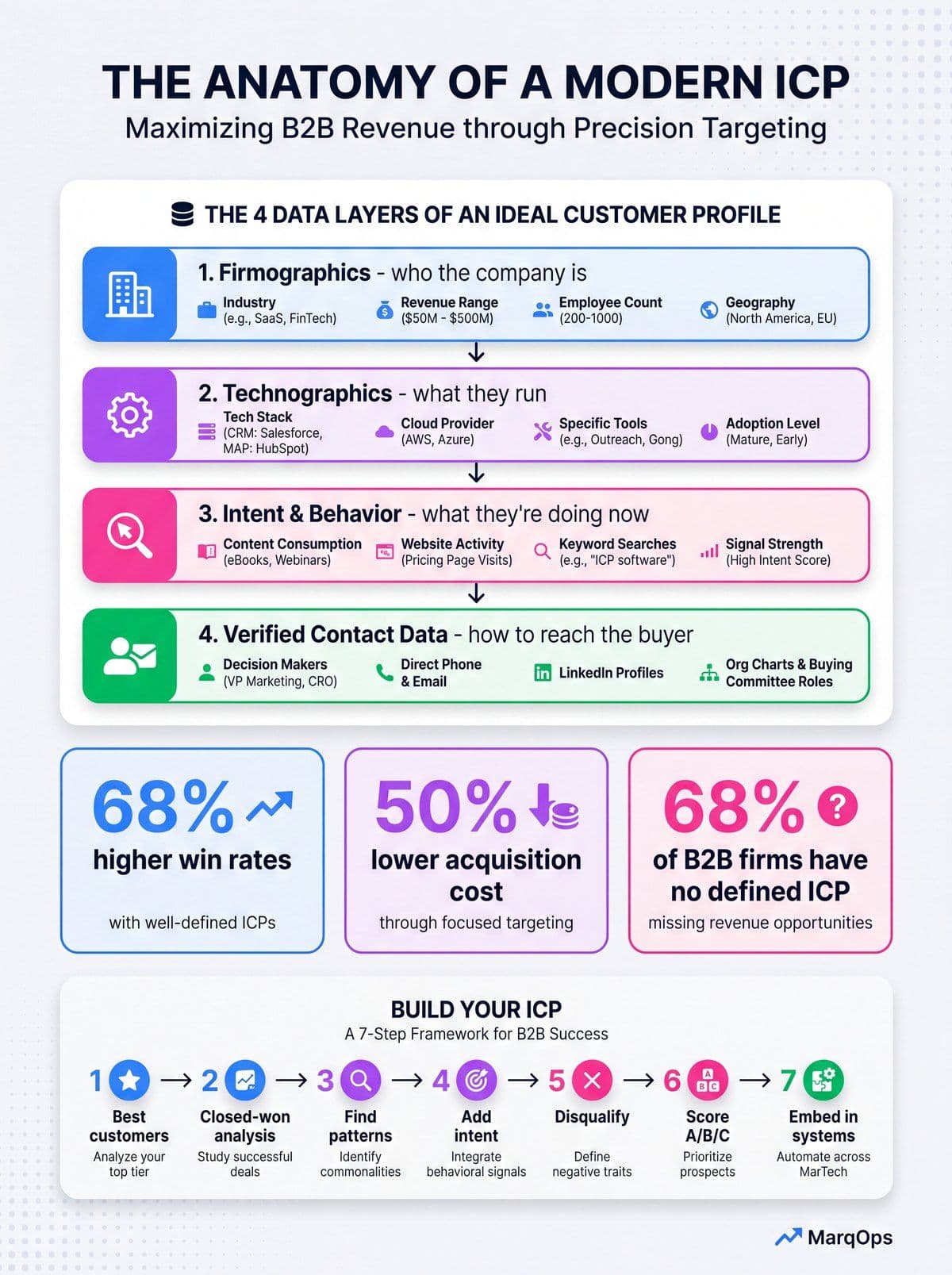
The four data layers and the 7-step framework for building a living ICP in 2026.
How to Build Your ICP: A 7-Step Framework
Building an ICP is a structured process, not a brainstorm. Here is the sequence that consistently produces a profile your whole revenue team will actually use.
Step 1: Start with your best customers, not your biggest
Pull a list of your 20 to 30 best accounts. Define “best” by what matters to your business: highest net revenue retention, fastest close, most expansions, lowest support burden. Resist the urge to list your most impressive logos. Impressive and ideal are not the same thing.
Step 2: Analyze 50 to 100 closed-won deals
Go to the data, not your assumptions. Pull your closed-won deals from the last 12 months and tag each with firmographic and technographic attributes: industry, employee count, revenue range, tech stack, and geography. This raw tagging is the foundation everything else rests on.
Step 3: Find the patterns
Look for clusters. You will almost always discover that 70 to 80% of your wins share three to five traits. Maybe it is “Series B to D SaaS companies between 100 and 500 employees that run HubSpot.” Those repeating traits are the spine of your ICP.
Step 4: Layer in intent and behavior
Now enrich your fit profile with the signals that indicate timing. Which behaviors preceded your fastest deals? A leadership hire, a funding event, a technology migration? Add those to the profile so it captures not just who to target but when.
Step 5: Build disqualification criteria
An ICP is as much about who to exclude as who to include. Identify the deal characteristics that consistently predict churn, slow cycles, or low lifetime value, and treat them as disqualification signals. This is where pairing your ICP with customer churn prediction pays off, because your worst-fit accounts often share a fingerprint.
Step 6: Codify it into a scoring rubric
Translate the traits into a weighted scoring model, which we break down in the next section. The point is to make “fit” a number, not an opinion.
Step 7: Embed it in your systems
An ICP that lives in a slide deck is already dead. Embed the traits into CRM fields, scoring models, and campaign targeting so the definition shapes daily decisions. This is the step where most teams lose the value, and where a unified platform matters most. MarqOps writes your ICP directly into the same place your analytics, ads, and content operations live, so the definition is enforced everywhere rather than forgotten in a folder.
Building an ICP Scoring Rubric
A scoring rubric turns your ICP from a description into a decision engine. You assign point values to each attribute, score every account against them, and sort accounts into tiers that determine how much effort they receive.
A simple, effective structure looks like this:
| Tier | Score | What it means | Go-to-market action |
|---|---|---|---|
| A | 80 to 100 | Strong fit plus active intent | Full ABM, sales-led, fast follow |
| B | 50 to 79 | Good fit, low or no intent yet | Nurture, scaled plays, watch signals |
| C | Below 50 | Weak fit or disqualifying traits | Self-serve or deprioritize |
Weight your attributes by how strongly they predicted your past wins. If industry and tech stack were the heaviest signals in your closed-won analysis, give them the most points. Then connect the score to your funnel so A-tier accounts get routed instantly. This is the bridge between your ICP and a healthy marketing funnel, and it is the input that makes account-based marketing economical instead of a money pit.
From Static Document to Living, AI-Driven ICP
The biggest shift in 2026 is that ICPs are no longer static documents. Traditional profiles relied on demographic fields that someone updated once a year, if that. AI-powered go-to-market systems layer behavioral and technographic signals on top and keep the profile current automatically, learning from new data, predicting buying windows, and guiding action in real time.
This matters because profiles decay. If you have not revisited your ICP in the last six months, it is stale, and teams that refresh quarterly outperform teams refreshing annually by 20 to 35% on the conversion from marketing-qualified to closed-won. A living ICP closes that gap by design.
Static vs living: a static ICP says “target tech companies in North America.” A living ICP says “this specific company just hired a VP of Sales, added a competing tool, and visited your pricing page twice this week, and it scores 91.” One is a description. The other is a decision.
The practical barrier is that the signals needed to keep an ICP alive are scattered across your CRM, product analytics, ad platforms, intent providers, and web behavior. Stitching them together is exactly the problem MarqOps was built to solve. Instead of bolting together seven or more disconnected tools, MarqOps unifies the data in one dashboard, so your ICP updates itself from live signals rather than from a quarterly meeting. Its Brand Intelligence DNA also keeps the messaging you build for each ICP tier consistent across every channel, which is what lets teams ship campaigns up to 6x faster without losing brand voice. For the wider context, see our guide to AI customer data platforms.
Common ICP Mistakes to Avoid
Most failed ICPs fail in predictable ways. Watch for these.
Treating it like a wish list. The number one mistake is building an ICP around who you want to sell to instead of who actually buys, succeeds, and stays. Aspiration is not data. Start from closed-won reality.
Casting too wide a net. An overly broad profile is the same as no profile. If your ICP describes half the market, it cannot help anyone prioritize. Narrow it until it is genuinely selective.
Relying on firmographics alone. Industry and headcount are not enough in 2026. Without technographics, behavioral signals, and intent data, you are targeting on the least differentiating layer.
Letting it go stale. An ICP that never changes despite a shifting market is a liability. If your most recent cohort’s six-month churn has climbed three or more points above your trailing average, that is a signal you are acquiring customers outside your ICP, and the profile needs a refresh.
Building it in a silo. If marketing writes the ICP and sales never sees it, alignment evaporates. The whole revenue point of an ICP is a shared definition, which is why it sits at the center of strong revenue operations.
How to Activate Your ICP Across Marketing
A profile only earns its keep when it drives action. Here is where a well-built ICP changes day-to-day marketing.
Targeting and media. Use ICP tiers to build audiences and allocate budget, so your paid spend concentrates on A-tier accounts instead of spraying the whole market.
Content and messaging. Map content to the pain points of each ICP tier and its personas, then let your AI marketing strategy scale that messaging across channels without diluting it.
Routing and prioritization. Feed ICP scores into your CRM so high-fit, high-intent accounts are routed to sales immediately while lower-fit accounts go to scaled nurture.
Reporting. Measure pipeline and revenue by ICP tier. When you can show that A-tier accounts convert several times better than C-tier, budget conversations get a lot easier.
Defining your ICP is the strategy. Keeping it alive and acting on it across every channel is the execution, and that is where most teams stall because the data lives in too many places. MarqOps brings analytics, ads, SEO, and creative into one brand-intelligent system so your ideal customer profile stays current and drives every campaign from a single source of truth.
Frequently Asked Questions
How do you define an ideal customer profile?
Start with your 20 to 30 best existing customers and 50 to 100 closed-won deals, tag each with firmographic, technographic, intent, and contact data, then find the three to five traits that 70 to 80% of your best accounts share. Codify those traits into a scoring rubric. The result is your ICP, built from real buying data rather than assumptions.
What is the difference between an ICP and a buyer persona?
An ICP describes the ideal company to target, using firmographics, technographics, and account behavior. A buyer persona describes the ideal individual inside that company, using role, goals, and pain points. The ICP tells you which companies to pursue, the persona tells you which people to talk to and how. You need both.
How often should you update your ICP?
Review it at least quarterly. Profiles decay because markets shift and contact data goes stale at 25 to 30% per year. Teams that refresh quarterly outperform those refreshing annually by 20 to 35% on the conversion from marketing-qualified lead to closed-won, so treat your ICP as a living model rather than a one-time document.
Does a defined ICP actually improve results?
Yes, and the data is consistent. Companies with a clearly defined ICP report up to 68% higher win rates, 15 to 30% shorter sales cycles, and roughly 50% lower acquisition cost on in-profile deals. Despite that, about 68% of B2B companies have not clearly defined their ICP, which makes the discipline a rare and cheap competitive edge.
How does AI improve the ideal customer profile?
AI turns a static profile into a living one. It continuously layers behavioral, technographic, and intent signals on top of firmographic data, scores accounts against your rubric in real time, and flags companies entering a buying window. A unified platform like MarqOps consolidates those scattered signals into one dashboard so your ICP updates itself instead of going stale between quarterly reviews.
Keep following the signal