Podcast Advertising in 2026: Costs, Formats, and What Actually Converts
US podcast ad revenue hit $2.86 billion and YouTube now leads podcast listening. A data-backed 2026 guide to podcast advertising costs, formats, targeting, and measurement.
Podcast advertising has a credibility problem that has nothing to do with whether it works. It works. The problem is that the channel is described almost entirely by the people selling it, in language borrowed from 2018, while the thing being sold has quietly changed underneath. The inventory is increasingly video. The delivery is almost entirely dynamic. The targeting is contextual and machine-driven. And the most-used podcast platform in the United States is no longer a podcast app at all.
If your media plan still treats podcasts as a niche audio experiment funded out of the brand budget, the numbers below will be uncomfortable. US podcast ad revenue reached $2.862 billion in 2025 and grew 17.6% year over year, faster than digital audio as a whole. That is a channel with a decade of compounding behind it, not a test line item.
Table of contents
- Podcast advertising in 2026: the numbers that matter
- The video shift changes what you are actually buying
- Ad formats: host-read, produced, and dynamically inserted
- What podcast advertising costs in 2026
- Targeting: from show lists to episode-level signals
- Measurement and attribution without the guesswork
- Brand safety and suitability in audio
- Creative: what converts, and where AI actually helps
- A 90-day podcast advertising playbook
- Frequently asked questions
- The bottom line
Podcast advertising in 2026: the numbers that matter
The IAB and PwC Internet Advertising Revenue Report, published in April 2026, is the closest thing the channel has to an audited figure. It put US podcast advertising at $2.862 billion for 2025, up 17.6% year over year. That extends a run that started at $105.7 million in 2015, and it beat the broader digital audio category, which grew 10.2% to $8.4 billion.
Two caveats matter more than the headline. First, growth has decelerated from the 72% spike in 2021 and the 26% gain in 2022. Double-digit expansion in four of the past five years is a mature growth channel, not a land grab. Second, digital audio's share of total internet advertising revenue has been stuck at 2.8% since 2022. Podcast dollars are growing, but faster formats are growing faster. Digital video grew 25.4% last year and social grew 32.6%, against 13.9% for internet advertising overall.
That flat share number is the strategic tell. Podcast advertising is not losing, but it is not compounding its position against video and social either. The reason, and the opportunity, is that the IAB figure reflects the traditional audio-only definition of a podcast. The report says so explicitly, and flags that the definition is expanding as video becomes the leading channel for podcast consumption. A meaningful and growing slice of what advertisers experience as podcast spend is being classified as video.
Deloitte's forecast reads the combined market differently and projects global podcast ad revenue, including video podcasts, at roughly $5 billion in 2026, up nearly 20% year over year. When you see wildly different market-size numbers quoted in vendor decks, this definitional split is almost always the cause. Ask which definition a number uses before you build a plan on it.
The video shift changes what you are actually buying
Edison Research's 2026 data is the part that should reset planning assumptions. Monthly podcast consumption in the US reached an all-time high of 58%, and YouTube is now the most-used platform for podcast consumption at around 40% of listeners, ahead of Spotify at 24% and Apple Podcasts at 12%. Among weekly podcast consumers naming a primary service, YouTube took 39% against Spotify's 20% and Apple's 11%. More than a billion people watch podcasts on YouTube every month, and podcast content contributed to YouTube accounting for roughly 12.5% of all US streaming time as of January 2026.
On the supply side, about 71% of US podcast creators now produce video versions of their shows, and the top 200 US podcasts largely publish full-video episodes as primary distribution. The format has stopped being audio with a webcam attached.
This has a practical consequence that trips up a lot of media plans. YouTube does not support traditional dynamic ad insertion the way Spotify and the audio hosting platforms do. Buying "podcast advertising" on YouTube means either the YouTube ads auction, which is a video buy governed by video mechanics, or a direct sponsorship deal negotiated with the individual creator. Those are two different budgets, two different approval paths, and two different measurement stacks. If you are already running YouTube advertising as a separate line, you may be double-counting reach against the same shows you are buying on audio networks.
The overlap with connected TV advertising is also becoming real, as video podcasts increasingly get consumed on living room screens. Planning audio, video podcast, and CTV in separate silos produces frequency you did not intend and cannot see.
Ad formats: host-read, produced, and dynamically inserted
Three variables define any podcast ad buy, and conflating them is the most common source of confused expectations. The first is who reads it. The second is where it sits in the episode. The third is how it gets delivered.
Host-read ads are voiced by the show's host, usually from a brief rather than a locked script. They carry the host's credibility and they are the reason podcast advertising outperforms its CPM. Producer-read or announcer-read spots are professionally voiced but not endorsed. Brand-produced spots are fully produced audio, closest to a radio commercial, and the weakest performer on recall unless the creative is genuinely good.
Placement splits into pre-roll, which runs before content and gets the highest completion, mid-roll, which sits inside the episode and commands the highest price because listeners are committed, and post-roll, which is cheapest and least effective.
Delivery is where most of the modern change lives. Baked-in ads are embedded permanently in the audio file, so they run forever, including in back-catalogue downloads years later. Dynamic ad insertion places the ad at serve time, which means you can target, cap frequency, rotate creative, and stop a campaign that is not working. Dynamic insertion now accounts for roughly 90% of podcast ad revenue by delivery method, and it is what makes podcast buying resemble the rest of your programmatic advertising stack rather than a print insertion order.
| Format | Typical CPM | Ad recall | Best used for |
|---|---|---|---|
| Host-read, top 100 show | $60 to $120 | 60% to 70% | Category entry, brand launches, high consideration products |
| Host-read, mid-tier show | $25 to $50 | 60% to 70% | The efficiency sweet spot for most direct response programs |
| Pre-recorded, network buy | $15 to $30 | Mid range | Scaling reach after host-read has proven the offer |
| Programmatic dynamic insertion | $12 to $25 | 24% to 31% | Frequency, retargeting, always-on efficiency floor |
The performance gap is the whole argument. Magellan AI's Q1 2026 benchmark put host-read response at 2.45% against 1.93% for programmatic. A host-read spot at triple the CPM delivering 27% better response is not automatically the better buy. Run the arithmetic against your own customer acquisition cost rather than accepting either side's framing.
What podcast advertising costs in 2026
Podcast pricing is quoted on CPM, calculated against downloads or impressions rather than confirmed listens, which is the first thing to interrogate. A show quoting 50,000 downloads per episode at a $30 CPM is asking $1,500 per placement. Whether those downloads represent 50,000 humans who heard your mid-roll is a separate question, and the answer depends on the measurement standard the host adheres to.
Beyond format, four factors move price. Genre matters most: business, technology, finance, and true crime command premiums because the audiences are valuable or enormous. Audience size works inversely to CPM at the extremes, with small niche shows sometimes charging more per thousand than mid-size shows because the audience is so precisely qualified. Exclusivity and term lift price, particularly category exclusivity. Seasonality is sharper than most buyers expect, with Q4 inventory in premium shows frequently sold out by August.
A realistic entry budget for a testable host-read program is $15,000 to $30,000 across four to six shows over eight to twelve weeks. Below roughly $10,000 you can buy placements, but you cannot generate enough signal to learn anything, which means you will conclude the channel does not work when what actually happened is that you did not measure it. That is the same failure mode that makes people give up on incrementality testing after one underpowered read.
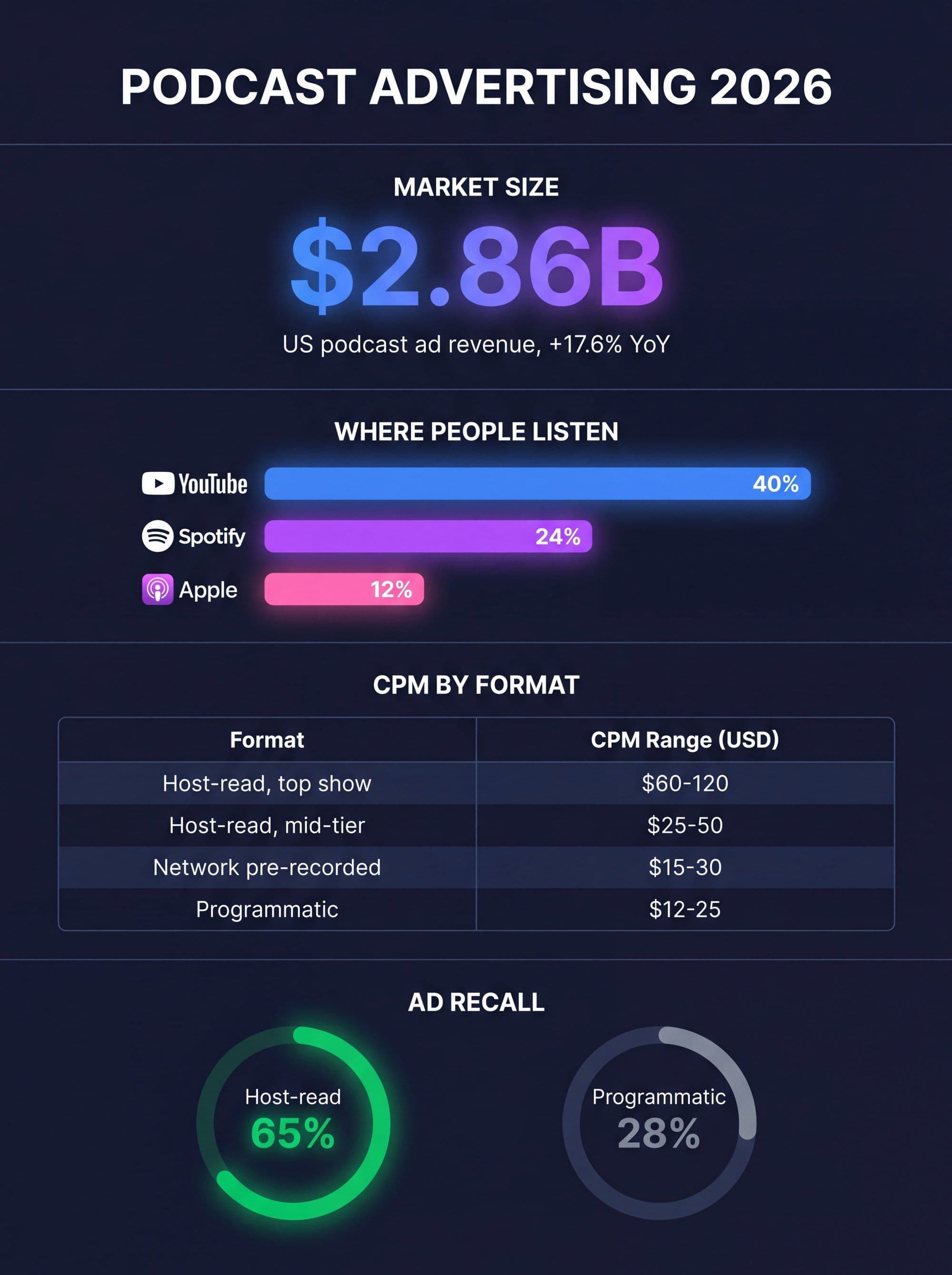
Podcast advertising in 2026: market size, platform share, CPM benchmarks, and format performance at a glance.
Targeting: from show lists to episode-level signals
The old model was a spreadsheet of shows whose audience demographics looked roughly like your buyer. It was media planning by proxy, and it wasted a lot of money on shows that fit the demographic but not the moment.
Dynamic insertion made real targeting possible, and AI made it precise. Platforms now run semantic analysis over episode-level transcripts, converting what a specific episode is actually about into targeting signals. Contextual signals now account for roughly 60% of all targeting dimensions on major audio ad platforms, which is a remarkable reversal for a channel that spent a decade apologizing for its lack of data.
The privacy story is the underrated part. Contextual targeting in audio does not depend on cross-site identifiers, so it degrades gracefully as third-party signal continues to erode. Audio is arguably better positioned for a privacy-constrained world than most display inventory, provided you pair it with a solid first-party data foundation for the conversion side.
Practical targeting layers worth specifying on any modern buy:
- Contextual and episode-level. Target episodes discussing topics adjacent to your category, not just shows in your category. A general business show doing an episode on hiring is better inventory for an HR product than a niche HR show with a tenth of the audience.
- Genre and show tier. Blend premium anchor shows for credibility with mid-tail inventory for efficiency.
- Geographic and device. Standard, but worth setting explicitly rather than leaving at default.
- Frequency capping. The single most neglected setting. Uncapped dynamic insertion produces genuinely irritating repetition, and irritation is a measurable brand cost.
- Retargeting and sequencing. Serve a different message to listeners already exposed, the same discipline you would apply in omnichannel campaigns.
Measurement and attribution without the guesswork
Podcast measurement used to mean a vanity URL and hope. It is considerably better now, though no single method is sufficient alone.
Pixel-based attribution is the current backbone. The ad platform records exposure, then matches subsequent site activity, letting you see conversions from listeners who never typed a promo code. It is IP-based matching rather than deterministic identity, so treat it as directional and expect it to overclaim somewhat.
Promo codes and vanity URLs undercount badly, often capturing a fraction of true conversions, because most people who hear an ad search your brand name later. Their real value is as a consistent relative signal across shows, not as a total.
Brand lift studies with test and control design answer the questions performance data cannot, and they are the right instrument for upper-funnel objectives. Incrementality tests, usually geo-based holdouts, are the strongest evidence available and the only method that survives a serious finance review.
Search behaviour is a useful free signal. A working podcast campaign shows up as a lift in branded search volume and direct traffic that correlates with flight dates. Tracking share of search alongside podcast flights costs nothing and often provides earlier evidence than the attribution platform does.
For teams already running multi-touch attribution, podcast is the channel that most exposes its limits. Audio generates no click, so a last-touch model will credit the branded search that followed the ad. Feeding podcast exposure into marketing mix modelling is the more honest treatment, and increasingly the standard among advertisers spending seven figures in the channel.
Brand safety and suitability in audio
Audio was historically opaque to brand safety tooling for a simple reason: you cannot scan speech the way you scan a web page. That excuse expired. Episode-level transcription is now standard on major platforms, and pre-bid suitability decisions run against the actual transcript before the impression is served.
This flips the framing from avoidance to selection. Rather than blocking a list of banned terms, which in audio produces absurd false positives, you positively select episodes whose content matches your message. The same transcript infrastructure that powers contextual targeting powers suitability, which is why the two capabilities arrived together.
Host-read advertising carries a distinct risk that no transcript can screen: the host is a person, and people say things. Category exclusivity clauses, approval rights over the read, and a defined exit provision belong in every host-read contract. Ongoing AI brand monitoring across audio and video mentions is the practical safeguard once a program scales past a handful of shows.
Creative: what converts, and where AI actually helps
Roughly 81% of podcast listeners report taking action based on ads they hear. That number gets quoted constantly and it is only useful if you understand what drives it: the ad did not feel like an interruption.
What consistently works in podcast creative:
- A single idea. Sixty seconds of audio holds one message. Three features and a promo code is a wasted spot.
- Specificity over adjectives. "Cuts your monthly close from nine days to three" beats "streamlines financial operations" every time.
- A brief, not a script, for host-reads. Give the host the proof points, the required disclosure, and the offer, then let them use their own language. Locked scripts destroy the exact quality you paid a premium for.
- A memorable, sayable destination. If the listener is driving, they need to recall it twenty minutes later. Short domains beat deep URLs and complicated codes.
- Front-loaded brand mention. Name the brand in the first ten seconds and again at the end. Skippers who heard only the opening should still know who you are.
The AI layer has become genuinely useful here, mostly on the production side. Synthetic voice generation has improved to the point where text-to-speech is difficult to distinguish from a recorded read for straightforward announcer-style copy, and the AI voice segment is growing fast, from $1.57 billion in 2025 to a projected $2.04 billion in 2026. The practical win is not replacing voice talent. It is that you can produce twelve variants of a spot, test them, and swap seasonal messaging without booking a studio, which turns audio creative into something you can actually iterate on the way you iterate dynamic creative in display.
The honest limit: for campaigns that depend on emotion or storytelling, human reads still outperform, and host endorsement cannot be synthesized at all. Use synthetic voice for volume, versioning, and testing. Use humans where the performance depends on being believed. Feeding the results back into creative analytics is what turns a set of one-off spots into a compounding asset.
A 90-day podcast advertising playbook
Days 1 to 15: baseline and shortlist. Record current branded search volume, direct traffic, and blended acquisition cost so you have a pre-flight baseline. Build a shortlist of fifteen to twenty shows using contextual relevance rather than demographic proxy. For each, establish the audio-versus-YouTube consumption split before you assume an audio buy covers the audience.
Days 16 to 30: instrument first, buy second. Install the attribution pixel and confirm it fires. Set up a unique landing page or promo code per show, not per campaign, so you can compare. Define what success looks like numerically before any money is committed, because a defined threshold prevents the post-hoc rationalization that keeps bad buys alive.
Days 31 to 60: run the first flight. Buy four to six shows, host-read where the offer needs credibility, with a programmatic layer underneath for frequency. Insist on at least three insertions per show. A single insertion tests nothing, because podcast response builds with repetition as the host's endorsement accumulates weight.
Days 61 to 90: read, cut, and scale. Compare shows on cost per acquisition using pixel data, cross-checked against branded search lift. Cut the bottom third without sentiment. Double the spend on the top two. Then design a geo holdout for the next quarter to establish true incrementality, because at this point pixel data can tell you which show is best but not whether the channel is additive.
This is the specific gap MarqOps was built to close. Rather than stitching together separate tools for creative production, campaign analytics, SEO signal, and paid media reporting, one platform replaces the seven or more disconnected systems most teams are reconciling by hand, with Brand Intelligence DNA keeping the creative output on-brand across every variant you test.
Frequently asked questions
How much does podcast advertising cost?
Podcast advertising is priced on CPM. In 2026, expect $25 to $40 for host-read placements on individual shows, $60 to $120 on top 100 titles, $15 to $30 for pre-recorded network buys, and $12 to $25 for programmatic dynamic ad insertion. A show with 50,000 downloads per episode at a $30 CPM charges about $1,500 per placement. A credible test program starts around $15,000 to $30,000 across four to six shows.
Is podcast advertising effective compared with other channels?
On recall it outperforms most digital formats. Host-read podcast ads generate 60% to 70% ad recall against 24% to 31% for programmatic audio spots, and roughly 81% of listeners report taking action based on podcast ads. The tradeoff is measurement latency, since audio produces no click, so effectiveness shows up in branded search lift and incrementality tests rather than immediate attribution.
Should I buy podcast ads on YouTube or on audio platforms?
Increasingly both, because they reach different segments of the same show's audience. YouTube is now the most-used podcast platform in the US at around 40% of listeners. But YouTube does not support traditional dynamic ad insertion, so buying there means the YouTube ads auction or a direct creator sponsorship, while audio platforms offer dynamic insertion, contextual targeting, and frequency capping. Check the consumption split for your specific target shows before assuming an audio-only buy covers the audience.
What is dynamic ad insertion and why does it matter?
Dynamic ad insertion places the ad into the episode at the moment it is downloaded rather than baking it permanently into the audio file. It allows targeting, frequency capping, creative rotation, and stopping a campaign mid-flight, and it monetizes back-catalogue episodes that keep accumulating downloads. Dynamic insertion now carries roughly 90% of podcast ad revenue by delivery method, which is what makes podcast buying behave like programmatic rather than like a print insertion order.
How do I measure podcast advertising ROI?
Use pixel-based attribution to compare shows against each other, since it captures conversions from listeners who never used a promo code. Use promo codes and vanity URLs as a consistent relative signal, not as a total, because they undercount significantly. Then validate the channel as a whole with a geo-based incrementality test or by feeding podcast exposure into marketing mix modelling. Track branded search volume against flight dates as an early free indicator.
The bottom line
Podcast advertising in 2026 is a mature channel that most media plans still describe inaccurately. The revenue is real and growing at 17.6%. The measurement problem is largely solved for optimization and adequately solved for validation. The targeting is contextual, privacy-durable, and precise enough to compete with the rest of the programmatic stack.
The genuine change is the video shift. When YouTube is the most-used podcast platform and seven in ten creators publish video, a buy structured purely as audio is a partial buy described as a complete one. Fix that first. Then instrument before you spend, insist on repeat insertions, and hold the channel to an incrementality standard rather than a last-touch one.
Do those four things and podcast stops being the line item that gets defended every planning cycle and starts being the one that gets protected.
Keep following the signal