Omnichannel Marketing in 2026: The AI-Powered Guide to Connected Customer Journeys That Actually Convert
The complete 2026 guide to omnichannel marketing: how it differs from multichannel, the 4-layer AI-native stack (unified data, orchestration, execution, measurement), a 7-step strategy, real examples from Disney, Starbucks, Sephora, and Nike, plus how to measure it right.
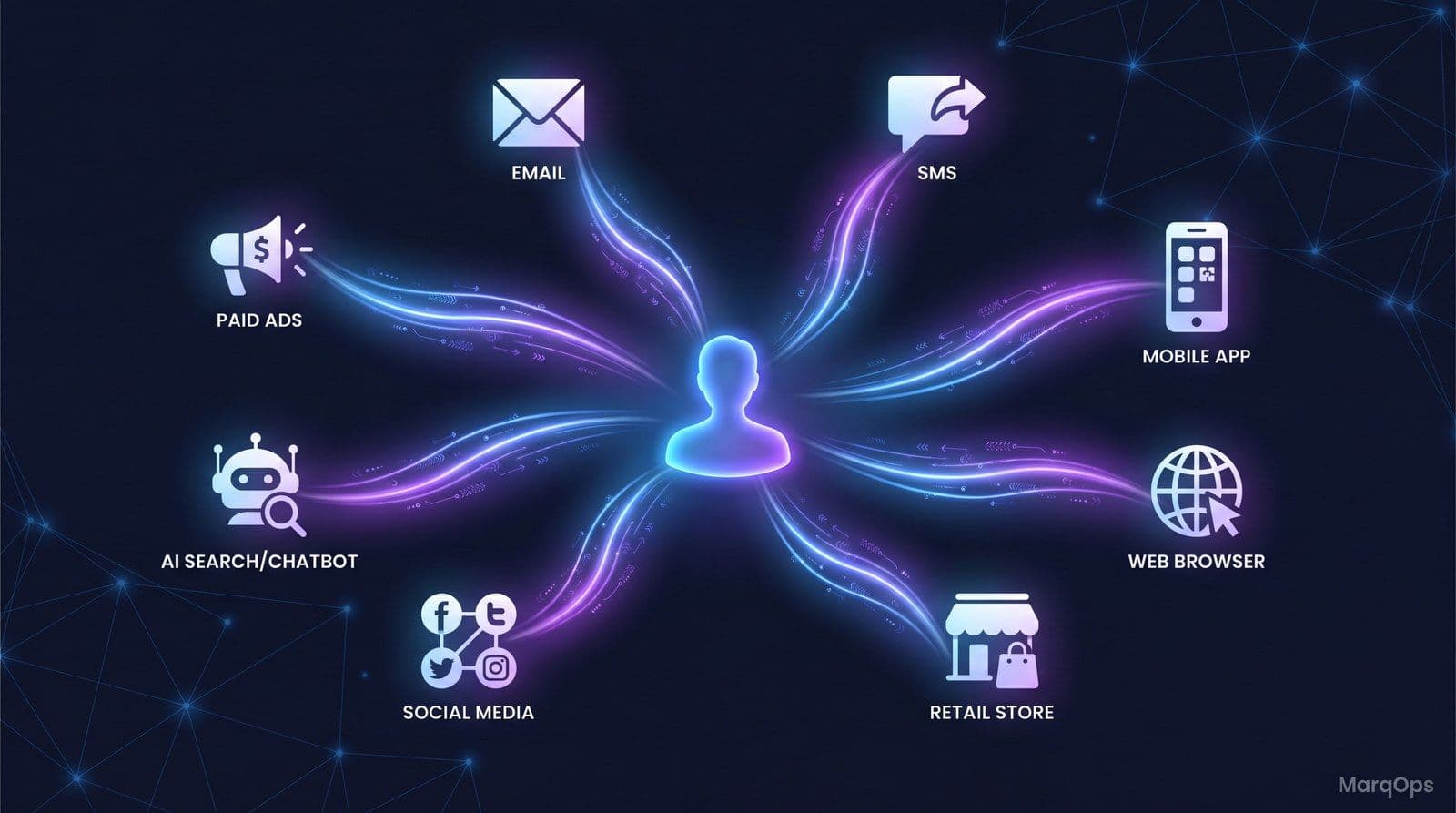
Omnichannel Marketing in 2026: The AI-Powered Guide to Connected Customer Journeys That Actually Convert
Last updated: May 30, 2026 | 13 min read | By MarqOps
TL;DR
- Omnichannel marketing in 2026 is no longer “be everywhere” – it is “show up as one brand, with one memory, across every touchpoint a buyer chooses.”
- Companies with strong omnichannel strategies retain 89% of customers vs 33% for weak performers, and omnichannel buyers spend up to 10% more online than single-channel shoppers.
- 78% of companies now use AI in at least one function to enable omnichannel experiences, and 92% plan to grow AI budgets over the next three years.
- The 2026 stack has four layers: unified customer data (CDP or unified profile), AI orchestration agents, channel execution, and a single analytics view across paid, owned, and earned.
- The biggest failure mode is not technology – it is fragmented tools. Marketing teams running 7+ disconnected platforms cannot deliver one brand voice, one customer view, or one report.
- MarqOps unifies brand DNA, content production, paid media, SEO, and analytics in one AI-native platform – the backbone that makes omnichannel actually work at speed.
Table of Contents
- What Is Omnichannel Marketing in 2026?
- Omnichannel vs Multichannel Marketing: The Real Difference
- Why Omnichannel Matters More Than Ever in 2026
- Omnichannel Marketing Statistics That Should Reshape Your 2026 Plan
- The 2026 Omnichannel Marketing Stack: 4 Layers
- How to Build an Omnichannel Marketing Strategy (7 Steps)
- The AI Role: Agents, Personalization, and Real-Time Orchestration
- Omnichannel Marketing Examples From Brands Doing It Right
- Best Omnichannel Marketing Tools and Platforms in 2026
- 7 Omnichannel Mistakes That Quietly Kill Customer Experience
- How to Measure Omnichannel Marketing the Right Way
- Why MarqOps Is the Operating System for AI-Native Omnichannel
- FAQs
What Is Omnichannel Marketing in 2026?
Omnichannel marketing is the practice of designing every customer interaction so that data, messaging, and brand experience flow seamlessly across every channel a buyer touches. Email, SMS, paid ads, your website, mobile app, in-store, support chat, and now AI search results like ChatGPT and Perplexity – all share the same customer context and the same brand voice.
The 2026 definition has shifted in one important way. It is no longer enough to “be everywhere.” Buyers expect every channel to remember what they did on the last one. If a shopper abandons a cart on mobile, the email two hours later should reference that exact product, the in-store associate should see it on their tablet, and the retargeting ad should not pretend the interaction never happened.
That requires three things working together: a unified customer data layer, AI that can decide the next best action in real time, and channel execution that does not break when scale increases. Most marketing teams have the third. Almost none have the first two stitched into one operating system. That is the gap MarqOps was built to close.
Quick definition: Omnichannel marketing in 2026 is the orchestration of every brand touchpoint – online, offline, and AI-mediated – on top of a single source of customer truth, using AI agents to decide what to deliver, where, and when.
Omnichannel vs Multichannel Marketing: The Real Difference
These two terms get used interchangeably, and that confusion costs marketing teams real money. Here is the cleanest way to think about it.
Multichannel marketing uses many channels, but each channel runs its own playbook. The email team owns email. The paid team owns paid. The store team owns the floor. The same customer gets a “WELCOME10” email, an unrelated retargeting ad, and an in-store cashier with no idea they ever visited the website. Reach is wide, context is shallow.
Omnichannel marketing uses the same channels, but every channel reads from and writes to the same customer profile in real time. The email knows what the ad showed. The ad knows what the store associate said. The store associate knows what the cart looked like. The customer feels like the brand is one person with one memory, not seven departments arguing about who owns the relationship.
The shift from multichannel to omnichannel is less about adding channels and more about adding connective tissue. The brands that win in 2026 are not the ones with the most channels – they are the ones whose channels actually talk to each other.
Multichannel vs Omnichannel at a Glance
| Dimension | Multichannel | Omnichannel |
|---|---|---|
| Center of gravity | Channel | Customer |
| Data flow | Siloed per channel | Unified customer profile |
| Messaging | Channel-specific, often inconsistent | Consistent brand voice, contextual content |
| Personalization | Segment-level | 1:1, real-time, AI-driven |
| Measurement | Last-click per channel | Cross-channel attribution and incrementality |
| Customer experience | Repetitive or contradictory | Seamless and continuous |
Why Omnichannel Matters More Than Ever in 2026
Three forces are turning omnichannel from a nice-to-have into a survival skill.
First, buyer behavior fragmented further. B2B buyers now use an average of ten touchpoints across their journey, and 42% use more than eleven before they buy. Consumers move between mobile, desktop, app, store, voice assistant, and AI search in a single afternoon. If your brand shows up differently in each place, you are not one brand to them – you are seven inconsistent strangers.
Second, AI search rewired discovery. A growing slice of category searches now starts inside ChatGPT, Claude, Perplexity, or Google’s AI Overviews. Your brand either gets cited in those answers or it does not exist for that buyer. Omnichannel now has to include the AI surface, which is why answer engine optimization and AI search visibility tools are now part of the channel mix.
Third, expectations cracked the patience window. 85% of customers expect a seamless experience across all retail channels, and 71% expect personalization across every one of them. The gap between expectation and reality is the new churn driver. Companies with strong omnichannel strategies retain 89% of their customers. Weak performers retain just 33%.
89% vs 33%
Customer retention for strong vs weak omnichannel performers
Omnichannel Marketing Statistics That Should Reshape Your 2026 Plan
Here are the numbers worth pinning above your desk this year.
- 2.5x marketing ROI. Companies with unified customer data see a 2.5x lift in marketing ROI from omnichannel campaigns.
- 287% higher purchase rates. Marketers using three or more coordinated channels achieve 287% higher purchase rates than single-channel campaigns.
- $892.4 billion. Multichannel e-commerce sales are projected to hit $892.4 billion in 2026, up 15% year over year.
- 78% AI adoption. 78% of companies use AI in at least one function to enable omnichannel experiences.
- 92% AI budget growth. 92% of firms plan to increase AI budgets over the next three years, with omnichannel personalization and orchestration as top use cases.
- 362% ROI from CDPs. 79% of companies using customer data platforms see ROI within 12 months, with average returns near 362%.
- 10x mobile dominance. Mobile already drives 57% of global e-commerce sales and is projected to hit 62% by 2027.
- 75% of B2B buyers expect a seamless, personalized experience across channels, on par with what they get as consumers.
The pattern is simple. The brands that connect their data, channels, and content together are not just performing slightly better – they are pulling away from everyone else.
The 2026 Omnichannel Marketing Stack: 4 Layers That Have to Work as One
Most omnichannel stacks fail at the seams. Each layer is good in isolation, but the handoffs between them leak data, time, and budget. Here is what a working 2026 stack looks like.
Layer 1: Unified Customer Data
This is the foundation. A customer data platform or a unified profile inside your marketing platform ingests first-party data from web, app, CRM, support, point-of-sale, and ad platforms, then resolves it into one identity per real human. Without this layer, personalization is theater. With it, every other layer gets sharper.
Layer 2: AI Orchestration and Decisioning
This is the brain. AI agents watch signals across channels and decide the next best action in real time – send the email now, hold the SMS for two hours, swap the ad creative, surface a different product on the homepage. Modern customer journey orchestration platforms make these calls in milliseconds, not in next week’s sprint.
Layer 3: Channel Execution
This is where the work shows up – email, SMS, push, paid ads, web, app, in-store displays, support chat, and AI search citations. The job of this layer is to execute the orchestrator’s decisions cleanly, with brand-perfect creative and copy.
Layer 4: Measurement and Feedback
This is the truth layer. A unified marketing dashboard shows performance across every channel and feeds results back into the orchestration layer so the AI gets smarter every week. Multi-touch attribution and marketing mix modeling tell you what actually drove revenue.
When these four layers run on four different vendors, you have an integration project, not a marketing engine. When they run as one system, you have omnichannel.
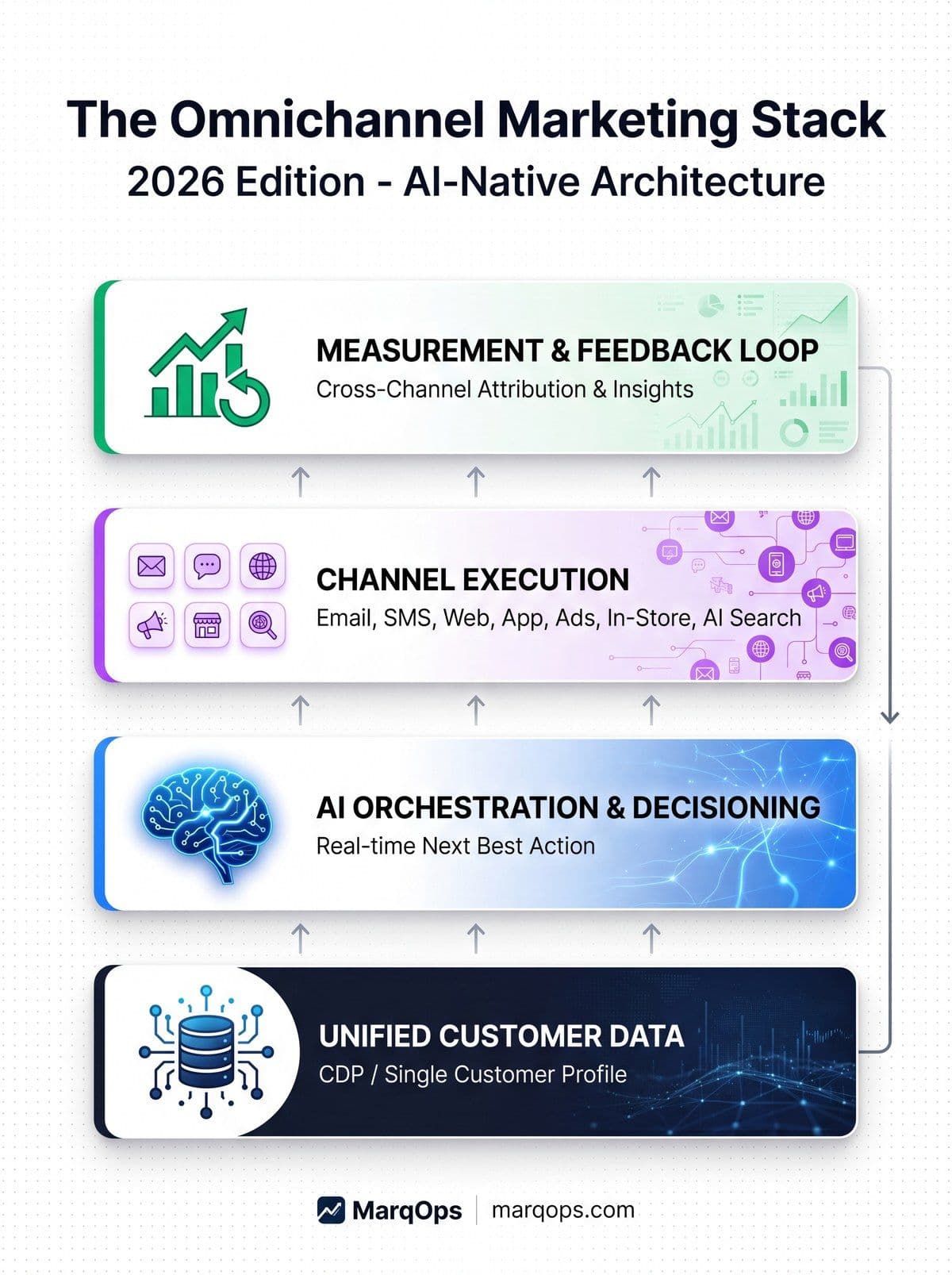
The 4-layer omnichannel stack that powers modern AI-native marketing teams
How to Build an Omnichannel Marketing Strategy (7 Steps)
Skip the 50-page transformation slide deck. Here is the practical version that actually ships.
Step 1: Pick 2 to 3 High-Impact Journeys
Do not try to orchestrate everything at once. The brands winning in 2026 connect only the data needed to power two or three flagship journeys – new customer onboarding, cart recovery, and reactivation are the usual starters. Discipline outperforms ambition every time.
Step 2: Audit Your Channels and Data Sources
List every channel you touch – email, SMS, app, web, paid social, search, in-store, support. For each one, write down where the data goes when a customer takes an action. If the answer is “nowhere useful,” you have your first integration target.
Step 3: Define the Single Source of Customer Truth
Decide where the unified profile lives. It might be a standalone CDP, your CRM, or a unified marketing platform. The choice matters less than picking one and committing. Every channel should read from and write to this profile.
Step 4: Map the Journey, Then the Triggers
For each priority journey, map the steps the customer takes and the events that should trigger the next message. Use the AI marketing funnel view to align stages, signals, and the AI-mediated next action.
Step 5: Standardize Brand Voice and Creative
Omnichannel breaks the moment two channels speak in two different voices. Document your brand voice, build a brand DNA profile your AI tools can reference, and make sure every piece of creative passes through the same brand guardrails before it ships.
Step 6: Layer in AI Decisioning
Once the data layer and brand layer are in place, plug in AI to make the live decisions – which channel, which message, which moment. This is where AI agents earn their budget. Start with one high-volume use case like abandoned cart, prove the lift, then expand.
Step 7: Measure Across Channels, Not Within Them
Replace channel-by-channel reporting with one cross-channel view. AI marketing ROI only shows up when you can see the full picture – the SMS that quietly closed the deal the ad opened.
The AI Role: Agents, Personalization, and Real-Time Orchestration
AI is not a feature you add to omnichannel. In 2026 it is the layer that makes omnichannel actually work at scale.
Personalization at population scale. AI generates and selects content variations per customer in real time. Instead of three email templates per segment, you ship one orchestrated experience with hundreds of micro-variations driven by behavior, context, and intent. AI personalization at this scale is impossible by hand.
Real-time decisioning. AI agents continuously evaluate signals – opens, clicks, in-store scans, support tickets – and update the next best action. A customer who just walked into a store should not get the “we miss you” email queued up an hour ago. AI can suppress, swap, and reroute in milliseconds.
Predictive orchestration. Models forecast what each customer is likely to do next, then bias channel choice and message timing accordingly. High-propensity buyers get a lighter touch. At-risk accounts get earlier intervention, surfaced through customer churn prediction models tied directly into the orchestration layer.
Creative production at speed. AI shrinks the production cycle from weeks to hours. Marketing teams using AI for creative automation ship 6 to 10 times more variations without growing headcount, which makes per-channel and per-segment personalization affordable for the first time.
Cross-channel measurement. AI handles the messy job of stitching events across channels and attributing revenue without resorting to last-click theater.
Omnichannel Marketing Examples From Brands Doing It Right
Theory is easy. Here are four brands whose omnichannel work is the gold standard in 2026, and what every marketing team can borrow.
Disney
The MagicBand turned a wristband into the connective tissue for a Disney vacation. Hotel key, park ticket, FastPass, payment method, and photo ID, all linked to one profile that knows the rides you rode and the meals you ordered. The lesson: identify one piece of “identity hardware” – physical or digital – that follows the customer everywhere, and route everything through it.
Starbucks
The Starbucks app, loyalty program, payment system, and point-of-sale share a single customer wallet that updates in real time across any store, in any country. The lesson: real time is the bar. If the loyalty balance updates tomorrow, customers feel like the experience is fake. If it updates the moment they tap, they trust the system.
Sephora
The Beauty Insider program ties in-store purchases, online orders, wishlist saves, and tutorial views into one profile. Store associates open a tablet and see exactly what the shopper has been eyeing online. The lesson: omnichannel does not mean replacing humans with screens. It means giving humans better screens so they can show up smarter.
Nike
Nike’s app, website, retail stores, and connected products all share the same membership graph, which means the running shoes you bought online unlock a personalized training plan in the app and a customized in-store experience the next time you walk in. The lesson: connected products are not gadgets – they are channels.
Best Omnichannel Marketing Tools and Platforms in 2026
The omnichannel tooling landscape splits into four buckets in 2026. Most companies end up with one platform from each, which is exactly why integration becomes the bottleneck.
- Customer data platforms (CDPs). Segment, Treasure Data, mParticle, Bloomreach, Lytics. Job: build the unified customer profile.
- Marketing automation and engagement platforms. HubSpot, Salesforce Marketing Cloud with Data Cloud and Agentforce, Adobe, Braze, Klaviyo, Iterable, Customer.io. Job: execute email, SMS, push, and lifecycle journeys.
- Journey orchestration platforms. Insider, Optimove, Bloomreach Engagement. Job: decide the next best action across channels in real time.
- Analytics and attribution. Amplitude, Mixpanel, Google Analytics 4, plus dedicated MMM and incrementality tools. Job: prove what worked.
That is a lot of seats, a lot of contracts, and a lot of integration debt. The 2026 alternative is to consolidate as many of these layers as possible into one AI-native platform. See our breakdown of the modern marketing tech stack and the best marketing automation tools in 2026 for the full comparison.
Buyer tip: Before you sign another tool, write down the seven things you want to be true about your customer experience in twelve months. Then ask each vendor to show you – live – which of those seven their product actually delivers without a six-month implementation. Most cannot.
7 Omnichannel Mistakes That Quietly Kill Customer Experience
These are the failure patterns we see most often when marketing teams try to upgrade from multichannel.
- Buying channels instead of connecting them. Adding TikTok, WhatsApp, and push notifications without unifying data just makes the silos louder.
- Treating personalization as a banner test. Real personalization happens at the journey level, not in a hero swap.
- Letting brand voice drift channel by channel. When email sounds corporate, social sounds chaotic, and SMS sounds robotic, customers feel the seams.
- Measuring per channel. Last-click reporting punishes the channels that built the relationship and rewards the ones that closed it.
- Ignoring AI search as a channel. If your brand is not cited in ChatGPT, Claude, or Perplexity answers, you have an invisible hole in your funnel.
- Over-rotating on automation, under-rotating on humans. Omnichannel works when human teams are armed with better context. It fails when humans get cut out entirely.
- Running 7+ tools that do not talk. Tool sprawl is the single biggest predictor of omnichannel failure. One platform replacing seven is not a luxury – it is the operational requirement.
How to Measure Omnichannel Marketing the Right Way
Omnichannel measurement breaks when you ask the wrong question. Stop asking “which channel converted this customer.” Start asking “which sequence of touchpoints turned this person into revenue, and how do we make more of that sequence happen.”
The 2026 measurement stack has three components that work together.
Multi-touch attribution. Algorithmic attribution that gives credit across the full journey, not just the last click. Pair with our multi-touch attribution guide for the model selection logic.
Marketing mix modeling (MMM). Statistical modeling that quantifies channel contribution at the portfolio level, including offline and brand spend. This is how you defend budget when boards get nervous.
Incrementality testing. Holdout tests that prove whether a channel actually caused incremental revenue or just took credit for it. The cleanest signal in the measurement toolbox.
Run all three. The triangulation between them is what turns omnichannel reporting from a debate into a decision.
Why MarqOps Is the Operating System for AI-Native Omnichannel
Most omnichannel projects fail for one reason: the marketing team is asked to deliver one customer experience while running on seven disconnected tools, three CSV exports, and four agency relationships. The math does not work.
MarqOps was built to collapse that complexity into one AI-native platform. The brand DNA you train once becomes the guardrail every output respects – email, ad copy, landing page, SEO content, social post. The unified dashboard makes it possible to see paid, owned, and earned performance in one view instead of bouncing between tabs. AI agents handle the repetitive production work so your team focuses on strategy, journey design, and the creative bets only humans should make.
What that looks like in practice:
- One platform replaces 7+ disconnected tools – creative production, SEO content, paid media, analytics, brand intelligence, and ad ops, in one place.
- Brand Intelligence DNA means every piece of output – in every channel – sounds like you, not like generic AI.
- 6x faster content production across email, ads, landing pages, and SEO, which makes per-channel personalization affordable.
- Unified analytics dashboard connecting paid, organic, and creative performance so you can finally answer “what is working” without four tabs and a spreadsheet.
- Multi-model AI pipeline picks the best AI model per task, so you are not locked into one vendor’s strengths or weaknesses.
If your omnichannel program is stuck because the tooling fights you, the fix is not another tool. It is fewer, better-connected ones.
Start Free – No Card RequiredSee How MarqOps Works
FAQs: Omnichannel Marketing in 2026
What is omnichannel marketing in simple terms?
Omnichannel marketing means every channel a customer touches – website, email, app, store, support, ads, AI search – shares the same customer context and delivers a consistent brand experience. The customer feels like the brand has one memory across every interaction.
What is the difference between omnichannel and multichannel marketing?
Multichannel marketing uses many channels, but each one runs independently with its own data and messaging. Omnichannel marketing uses the same channels, but they all share one customer profile and coordinate in real time. The shift from multichannel to omnichannel is less about adding channels and more about connecting them.
What are the four pillars of omnichannel marketing?
Unified customer data, AI orchestration and decisioning, channel execution, and cross-channel measurement. When all four work as one system, omnichannel actually delivers on its promise. When they live in four different vendors, it becomes an integration project that never ships.
How does AI improve omnichannel marketing?
AI handles four jobs that humans cannot do at scale: real-time personalization per customer, real-time decisioning across channels, predictive orchestration based on next-likely behavior, and cross-channel attribution that stitches messy signals into one story. 78% of companies now use AI in at least one omnichannel function.
What is the best omnichannel marketing platform in 2026?
There is no single best platform – it depends on your data maturity, your channel mix, and how much consolidation you can absorb. Salesforce Marketing Cloud with Data Cloud, HubSpot with Breeze, Insider, Adobe, Klaviyo, and Bloomreach are common enterprise choices. For teams that want to compress the stack and remove integration debt, an AI-native platform like MarqOps replaces creative production, SEO, paid media ops, and analytics in one place.
How do you measure omnichannel marketing success?
Use three measurement layers together. Multi-touch attribution to credit the full journey, marketing mix modeling for portfolio-level decisions, and incrementality testing to prove what actually drove revenue. Track unified KPIs like customer lifetime value, retention rate, and cross-channel engagement rather than channel-level vanity metrics.
What are good examples of omnichannel marketing?
Disney’s MagicBand, Starbucks Rewards, Sephora’s Beauty Insider, and Nike’s membership graph are the canonical examples. All four share the same pattern: one identity, one profile, one set of preferences, available in every channel the brand owns.
Do B2B companies need omnichannel marketing?
Yes, more than ever. B2B buyers use an average of ten touchpoints across their journey, and 75% expect a consumer-grade experience across every one. Omnichannel for B2B usually centers on website, email, paid social, sales outreach, content, events, and now AI search visibility.
Final Word
Omnichannel in 2026 is not about being on more channels. It is about being one brand on every channel – with one memory, one voice, and one decisioning layer that uses AI to make the right call in the moment. The tooling exists. The data is already in your systems. What stops most teams is the gap between seven disconnected tools and one unified operating system.
That is the gap MarqOps closes. If you are ready to consolidate your stack, sharpen your brand voice across every channel, and let AI agents handle the busywork so your team can focus on the strategy, the door is open.