Marketing Attribution Software in 2026: The Buyer's Guide for a Stack That Won't Stop Growing
Marketing teams run 121 tools on average and still can't prove ROI. Here is what to check before buying attribution software in 2026, including the AI traffic gap most buyer's guides miss.

Table of Contents
- Why "Just Buy Attribution Software" Doesn't Fix the Real Problem
- The 121-Tool Stack Is the Real Reason Attribution Feels Broken
- What to Actually Evaluate When Buying Attribution Software
- The Blind Spot No Buyer's Guide Mentions: AI Referral Traffic
- Standalone Tool or a Data Layer That Already Sees Everything
- A Practical Checklist Before You Sign
- Frequently Asked Questions
- The Bottom Line
Why "Just Buy Attribution Software" Doesn't Fix the Real Problem
Every marketing team eventually hits the same wall. Leadership wants a clean answer to "what's working," and the honest answer is scattered across a Google Ads dashboard, a GA4 property, a CRM, an email platform, and three spreadsheets somebody built during a fire drill last quarter. So the team goes shopping for marketing attribution software, expecting it to be the fix.
It rarely is, and not because the tools are bad. Attribution software solves the modeling problem: which touchpoint gets credit when a lead converts. It does not solve the data problem underneath it, which is that most marketing teams are trying to stitch together more systems than any one attribution tool was built to ingest cleanly. Only 32% of marketers say they measure ROI across both traditional and digital media, and just 28% describe their measurement system as solid. Buying a fourteenth tool to fix a thirteen-tool problem is how you end up with a fifteenth tool next year.
This guide covers what actually matters when you're evaluating marketing attribution software in 2026: the buying criteria that separate a real fit from a feature checklist, the pricing bands to expect, and the AI-traffic blind spot that almost every other comparison article on this topic quietly ignores.
The 121-Tool Stack Is the Real Reason Attribution Feels Broken
The martech stack has grown faster than most teams' ability to manage it. The average marketing team now runs about 121 tools, up from 91 in 2022 and just 24 in 2014. B2B SaaS teams run closer to 184. That growth outpaced budgets, headcount, and, most relevantly here, the number of clean integration points any single attribution platform can realistically maintain.
The knock-on effects show up directly in attribution accuracy. Only 33% of purchased martech capabilities actually get used, and an estimated 60% of martech spend fails to translate into measurable business value. Tool tenure is also collapsing: the average tool now lasts 18.4 months before a team replaces it, down from 27.1 months in 2022, and 34.6% of tools got swapped out in the last 12 months alone. Attribution software plugged into a stack that unstable inherits broken pipes on both ends: source systems that change their data schema without warning, and destination systems (your CRM, your BI tool) that were configured for whatever you were running last year.
This is also why marketing tech stack consolidation and attribution buying decisions are really the same decision wearing two different names. Companies that consolidated into a more unified architecture reported 20 to 31% lower costs, not because any single tool got cheaper, but because they stopped paying to connect and reconcile so many of them.
The same sprawl shows up whenever teams try to build client or campaign reports. We've covered the reporting side of this directly in our guides to marketing reporting software and PPC reporting: the pattern is identical. A team buys a specialized tool to fix one symptom (reporting, or attribution, or dashboards), and the underlying data fragmentation just moves one layer over, waiting to break the next tool in line.
What to Actually Evaluate When Buying Attribution Software
Strip away the marketing pages and most attribution platforms compete on the same handful of capabilities. Use this as your baseline scorecard, not the vendor's own feature list.
| Evaluation area | What to check |
|---|---|
| Attribution models | First-touch, linear, time-decay, and true data-driven modeling, not just a rules-based approximation labeled "AI." |
| Channel and data ingestion | Native connectors across paid, organic, email, social, and offline, plus real API access when a connector doesn't exist yet. |
| Identity and cross-device tracking | Identity stitching across sessions and devices without leaning entirely on third-party cookies, which are already unreliable. |
| Revenue mapping | Direct ties from touchpoint to CRM pipeline stage and closed revenue, not just last-touch conversion counts. |
| Total cost of ownership | Implementation time, training, and the ongoing cost of maintaining integrations, not just the license line item. |
| AI traffic visibility | Whether the platform has a defined method for AI referral and answer-engine traffic. Most 2026 buying guides skip this entirely, which is exactly the problem covered next. |
On pricing, expect a wide range: starter attribution plans run $100 to $500 a month, professional tiers $500 to $1,500, and enterprise deployments $1,500 and up, with individual point tools ranging from free to $200-plus monthly depending on event volume. None of that includes the analyst time it takes to keep the connections healthy, which is the cost most teams underbudget.
Attribution data only matters if the rest of your stack can use it
A common mistake in this evaluation is treating attribution software as an end point rather than an input. The whole reason to model touchpoints correctly is so that data can feed something downstream: a forecast, a budget reallocation, a client report. If your marketing analytics stack can't consume the attribution output cleanly, or your predictive forecasting models are still running on last-touch data because nobody connected the new attribution tool to them, you've bought better math without a better decision process. Ask vendors specifically how their output plugs into forecasting and BI, not just whether it has a dashboard.
This is also where a marketing intelligence platform approach tends to outperform a standalone attribution tool over time: the attribution layer, the forecasting layer, and the reporting layer are built to read from the same data, so nothing gets stranded in a tool that only talks to itself.
The Blind Spot No Buyer's Guide Mentions: AI Referral Traffic
Here is the part that almost every 2026 attribution software comparison leaves out entirely, and it is the single biggest reason a shiny new tool won't fix your reporting the way you expect.
That single measurement gap distorts almost every number an attribution platform reports. Direct traffic looks artificially strong. Organic looks artificially weak, because AI answer engines are absorbing clicks that used to land as organic search and returning zero attribution credit for them. And the traffic hiding inside that gap is not low-value: AI-referred visitors convert at 10.21%, against 2.46% for non-AI traffic, a 4.1x premium. You are underreporting your best-converting channel and calling it "Direct."
The scale of the miss is why 89% of brands say they cannot properly attribute AI referral traffic today, and 41% of agencies report new, unresolved challenges measuring ROI specifically because of it. If your evaluation checklist for attribution software doesn't include a direct question about how the vendor identifies AI-assistant and answer-engine sessions, you're buying a tool that will confidently misreport a growing share of your funnel. This is the same measurement gap we dug into from the reporting side in our framework for client reporting, and it applies just as much when you're the one buying the tool, not just presenting the numbers from it.
If you want the deeper mechanics of how touchpoints get weighted once the data is clean, that's covered separately in our multi-touch attribution guide. This piece is about the layer before that: making sure the data going into any model is actually complete.
Where this shows up first: Google Ads
Paid search is usually where the gap gets noticed first, because it's the channel teams scrutinize most closely. If your Google Ads conversion tracking hasn't been audited since AI-assistant referrals started showing up in meaningful volume, there's a good chance some of what your reports credit to "Direct" or "unassigned" actually started with an AI answer engine sending someone straight to a landing page you paid to build. Attribution software can't fix that at the modeling layer if the conversion data feeding it was already misclassified at the source.
Standalone Attribution Tool, or a Data Layer That Already Sees Everything
There are two honest paths here, and the right one depends on how much of your stack is already fragmented.
Path one: add a dedicated attribution tool. This makes sense when your ad platforms, CRM, and analytics are already reasonably clean and you mainly need better modeling on top of good data. In that case, a focused point solution can be the fastest route to a working answer.
Path two: fix the data layer first. This is the right call when attribution is one symptom of a broader problem: your SEO content, paid ads, creative production, and analytics all live in separate systems that don't talk to each other, so every reporting question turns into a manual reconciliation project. Adding attribution software number fifteen to that stack gives you another dashboard, not fewer discrepancies.
The budget pressure behind this decision is real and getting worse. 56% of CMOs say they don't have sufficient budget to deliver on their 2026 strategy, and proving ROI remains a top-cited priority industry-wide even as AI spending climbs, with CMOs now allocating an average of 15.3% of marketing budget to AI initiatives. That pressure makes the case for consolidation harder to ignore: teams that unified their stack rather than layering on another tool reported 20 to 31% lower total costs, and unification is also the only way to close the AI-traffic gap described above, since a tool that only sees one slice of your funnel can't fix a blind spot that spans your whole funnel.
This is the gap MarqOps was built to close. Instead of asking you to license, configure, and reconcile a separate attribution point solution on top of your ad platform, your SEO tools, and your creative pipeline, MarqOps unifies analytics, ads, SEO, and creative production in one platform, replacing 7-plus disconnected tools with a single system that already has your full-funnel data in one place, including the AI-referral traffic most attribution tools still can't see.
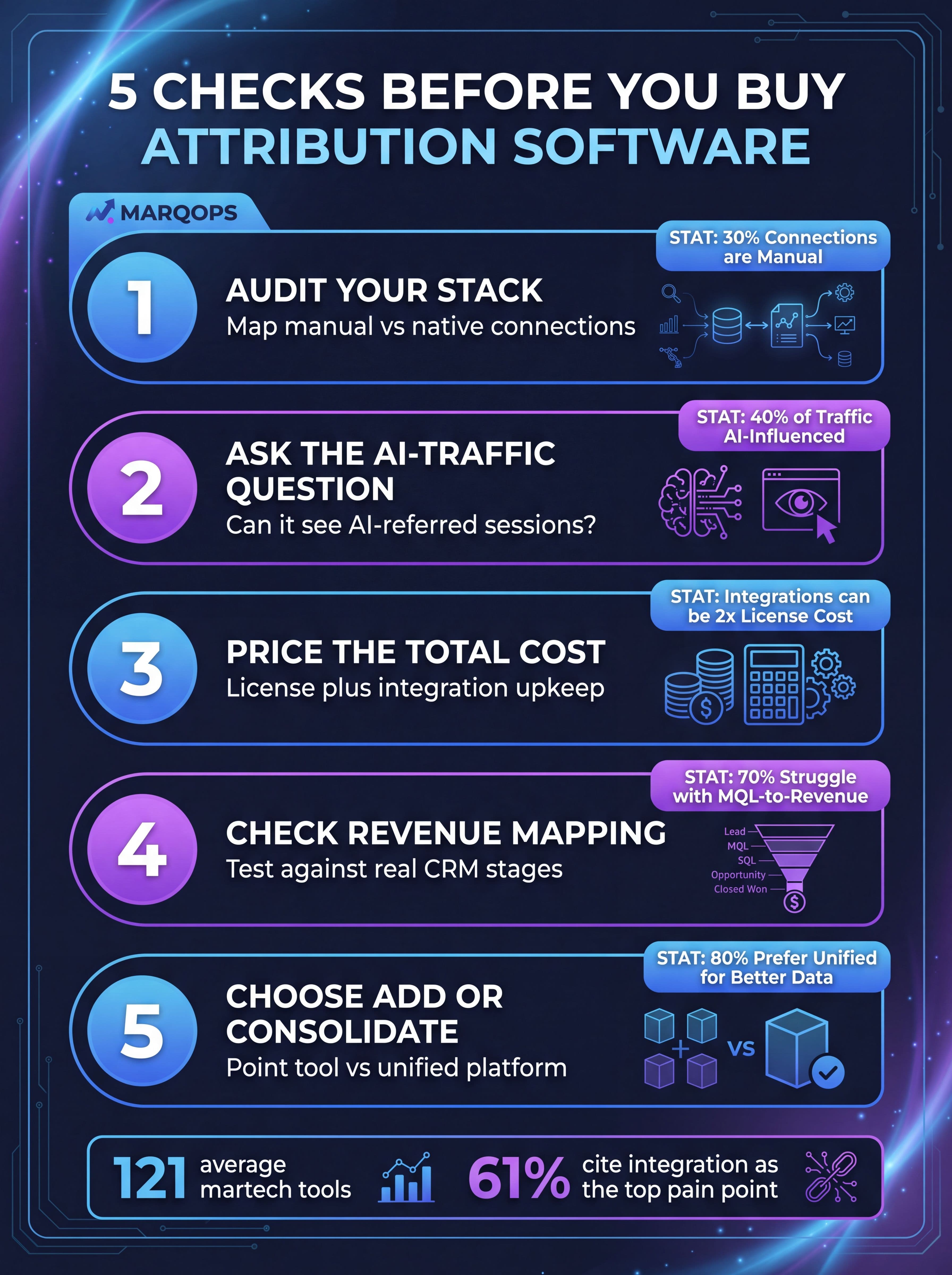
The five checks worth running before you sign an attribution software contract in 2026.
A Practical Checklist Before You Sign
1. Audit what's already broken before you shop
List every system your current reporting pulls from and mark which connections are manual versus native. If more than half are manual, the problem is bigger than modeling, and a point-solution attribution tool will only patch part of it.
2. Ask the AI-traffic question directly
Ask every vendor, in writing, how their platform identifies and credits AI-assistant and answer-engine referrals. If the answer is "GA4 handles that," it doesn't, at least not completely, since GA4's own AI Assistant channel only catches sessions that still carry a referrer header.
3. Price the total cost, not the license
Add implementation time, training, and the ongoing headcount needed to maintain integrations to whatever number is on the pricing page. A $500-a-month tool that needs ten analyst hours a month to keep working is not a $500-a-month tool.
4. Check revenue mapping against your actual CRM stages
Demo the platform against your real pipeline stages, not a generic demo account. Attribution that stops at "conversion" and doesn't map to your specific deal stages will not satisfy a CFO asking for proof of ROI.
5. Decide consolidation versus addition on purpose
Make the point-solution-versus-unified-platform decision explicitly, with the 121-tool stack statistic and your own integration count in front of you, rather than defaulting to "add one more tool" because that's the familiar move.
Frequently Asked Questions
What is marketing attribution software?
Marketing attribution software tracks a customer's touchpoints across channels, such as paid search, social, email, and organic, and applies a model (first-touch, linear, time-decay, or data-driven) to assign credit for a conversion. It typically connects to your ad platforms, website analytics, and CRM to tie those touchpoints to actual revenue.
How much does marketing attribution software cost?
Starter plans typically run $100 to $500 a month, professional tiers $500 to $1,500, and enterprise deployments $1,500 or more, based on event or ad spend volume. Factor in implementation and ongoing integration maintenance on top of the license, since that is where the real cost usually shows up.
Does GA4 count as attribution software?
GA4 offers basic data-driven attribution, but it is not a dedicated attribution platform. It also has a well-documented gap with AI-referred traffic: roughly 70% of AI-assistant sessions arrive without a referrer header and land in the Direct bucket instead of being credited to the source that actually sent them.
How do I track AI referral traffic in my attribution setup?
Start by auditing how much of your "Direct" traffic segment shows landing-page and engagement patterns typical of assistant-referred visits, then ask any attribution vendor you're evaluating exactly how their platform identifies and credits that traffic. Very few point solutions have a complete answer today, which is why this should be a standing question in every 2026 vendor evaluation.
Multi-touch attribution vs. marketing mix modeling: which do I need?
Multi-touch attribution works best when you have strong digital tracking and want touchpoint-level credit within a customer journey. Marketing mix modeling works better when a large share of spend is offline or privacy signals are too degraded for reliable tracking. Many teams now run both, which is itself a reason to consolidate the underlying data rather than manage two more disconnected systems. For a deeper walkthrough of touchpoint-level modeling specifically, see our multi-touch attribution guide.
The Bottom Line
Marketing attribution software can absolutely make your reporting better, but only if you're solving the right problem. If your stack is already reasonably unified, a focused attribution tool with strong modeling and clean CRM revenue mapping is a legitimate upgrade. If you're running anywhere near the industry-average 121 tools and spending more time reconciling data than acting on it, the fix isn't tool number fifteen. It's a platform, like MarqOps, that already unifies your analytics, ads, SEO, and creative production, so attribution isn't one more disconnected system to maintain, it's a byproduct of data that was never fragmented in the first place. That also happens to be the only realistic way to close the AI-referral gap that every standalone attribution tool on the market is currently missing.
For more on getting your reporting stack in order before you shop for point solutions, see our guides on building a lean, AI-powered martech stack, unifying your marketing dashboard, and proving marketing ROI with AI-powered measurement.
Keep following the signal