SEO Agents in 2026: The Complete Guide to AI Agents That Run Your Search Strategy
What SEO agents are, how the agentic loop works, 7 real use cases, the best tools in 2026, and a 6-step roadmap to deploy AI agents for SEO without losing brand control.
TL;DR
- An SEO agent is an AI system that plans, executes, and iterates on search strategy autonomously – researching keywords, writing briefs, optimizing content, monitoring rankings, and flagging decay without waiting for prompts.
- The shift is urgent: 25% of Google searches now trigger AI Overviews, 68% of US searches end without a click, and only 14% of marketers even track their AI search visibility.
- Teams using agentic SEO workflows report average time savings of 66.8% per task, cutting content production from 9-14 hours per post to under an hour.
- SEO agents are not “set and forget.” Analysts expect over 40% of agentic AI projects to fail by 2027 due to weak oversight, so human-in-the-loop guardrails are non-negotiable.
- The winning setup in 2026: agents handle research, drafting, optimization, and monitoring; humans own strategy, brand voice, and final approval.
Table of Contents
- What Is an SEO Agent?
- SEO Agent vs SEO Tools vs SEO Automation
- How SEO Agents Work: The Agentic Loop
- 7 Things SEO Agents Can Do Today
- Why SEO Agents Matter in 2026: The Numbers
- The SEO Agent Landscape in 2026
- How to Implement an SEO Agent: A 6-Step Roadmap
- Risks, Limitations, and Guardrails
- FAQs
Introduction
Search changed faster in the last 18 months than in the previous decade. AI Overviews now appear on roughly a quarter of Google searches, 68% of US searches end without a single click, and Google’s AI Mode has crossed 100 million users. Meanwhile, the average marketing team is still running SEO the way it did in 2021: one specialist, a stack of disconnected tools, and a backlog of briefs nobody has time to write.
That gap is exactly what the SEO agent exists to close. Instead of a tool that waits for you to type a keyword, an SEO agent works more like a junior search team that never sleeps: it researches opportunities, builds briefs, drafts and optimizes content, publishes to your CMS, watches rankings across both Google and AI engines, and tells you when something needs attention. If you have already explored SEO automation or experimented with AI SEO tools, agents are the logical next step: the difference between automating a task and delegating an outcome.
This guide covers what SEO agents actually are, how they work under the hood, what they can (and cannot) do today, the tools worth evaluating, and a practical roadmap for rolling one out without losing control of your brand or your rankings.
What Is an SEO Agent?
An SEO agent is an AI system that autonomously plans, executes, and iterates on search engine optimization work. Unlike a traditional tool that performs one function when you ask it to, an agent is goal-driven: you give it an objective (“grow organic traffic for this product line” or “keep our money pages ranking in the top 3”), and it decides which tasks to run, in what order, and when to loop back and adjust.
In practice, a well-configured SEO agent can analyze the top 20 SERP results for a target query, identify the entities and content gaps that top-ranking pages cover, build a brief with target keywords and structural recommendations, draft the article against that brief, optimize it for both Google ranking signals and AI citation patterns, publish it to your CMS with correct schema markup, and then monitor performance across traditional search and AI engines, flagging decay before it costs you rankings.
Key distinction: AI writing tools respond to prompts. SEO agents pursue goals. The agent decides what to do next based on live data, which is why it can catch a ranking drop at 2am and have a refreshed draft waiting for review by morning.
The concept sits inside the broader shift toward agentic marketing, where autonomous systems handle execution across channels while humans set direction. SEO happens to be one of the best-suited disciplines for agents because so much of the work is data-driven, repetitive, and continuous.
SEO Agent vs SEO Tools vs SEO Automation
These three terms get used interchangeably, but they describe different levels of autonomy. Here is the cleanest way to separate them:
| Dimension | SEO Tool | SEO Automation | SEO Agent |
|---|---|---|---|
| Trigger | You click a button | A schedule or rule fires | The agent decides based on goals and live data |
| Scope | One task (e.g., keyword lookup) | One workflow (e.g., weekly rank report) | An outcome (e.g., grow organic traffic) |
| Adaptation | None | Only what the rule anticipates | Re-plans when SERPs, rankings, or data change |
| Human role | Operator | Rule designer | Strategist and approver |
Most teams already live in the first two columns. If you have built rule-based workflows like the ones covered in our guide to marketing workflow automation, you have the operational muscle to graduate to agents. The difference is that agents close the loop: they observe results and change their own behavior.
How SEO Agents Work: The Agentic Loop
Under the hood, virtually every SEO agent runs a version of the same loop: perceive, plan, act, evaluate. Applied to search, that loop breaks into six stages.
Stage 1: Opportunity Discovery
The agent continuously scans keyword data, SERP movements, competitor publishing activity, and your own analytics to surface opportunities. This goes deeper than a monthly keyword export: agents classify intent, cluster related queries, and score opportunities against your existing content, similar to what we describe in our guide to AI keyword research tools, but running continuously instead of on demand.
Stage 2: SERP and Competitor Analysis
For each target query, the agent pulls the live SERP, analyzes what the top 10-20 results cover, extracts the entities and subtopics they share, and identifies gaps. It also checks which results get cited in AI Overviews and answer engines, because ranking surfaces now extend well beyond ten blue links.
Stage 3: Brief and Draft Generation
The agent turns that analysis into a structured brief (target keyword, secondary keywords, heading structure, entities to cover, internal links to include) and then drafts against it. Strong systems enforce brand voice at this stage rather than bolting it on afterward.
Stage 4: Optimization for Google and AI Search
Drafts get scored and revised for both classic ranking signals and AI citation patterns: entity coverage, structural clarity, citation-friendly formatting, and schema markup. These signals overlap heavily, which is why one optimization pass can serve Google, AI Overviews, ChatGPT, and Perplexity simultaneously. Our guide to AI content optimization covers these overlapping signals in depth.
Stage 5: Publishing and Technical Execution
Agents plug directly into CMS platforms, so approved content ships with correct metadata, internal links, and structured data instead of sitting in a handoff queue. Some agents also handle technical fixes: broken internal links, missing alt text, orphaned pages, and redirect chains.
Stage 6: Monitoring and Self-Correction
This is the stage that separates agents from everything else. The agent tracks rankings, AI citations, traffic, and conversions, then feeds what it learns back into stage 1. When a page starts decaying, the agent flags it (or drafts a refresh) before the drop shows up in your quarterly report. Pair this with the measurement approaches in our AI search visibility tools guide and you get closed-loop coverage across every surface where your brand can appear.
7 Things SEO Agents Can Do Today
Marketing teams are past the proof-of-concept phase. Here are the use cases delivering real results in 2026:
1. Continuous keyword and topic discovery
Agents monitor search demand shifts and surface new opportunities weekly, scored by volume, difficulty, and fit with your existing content clusters.
2. Automated content briefs
Instead of a strategist spending 2-3 hours per brief, the agent generates SERP-informed briefs and a human approves or adjusts them in minutes.
3. Draft-to-publish content production
Content teams that previously spent 9-14 hours producing a single optimized post now ship comparable work in 30-60 minutes with agentic workflows handling research, drafting, and optimization while editors focus on judgment calls.
4. Content decay detection and refresh
The agent watches every published URL, spots ranking and traffic decay early, and queues refresh drafts with updated stats, entities, and internal links.
5. Technical SEO housekeeping
Broken links, missing schema, slow pages, crawl anomalies: agents detect and either fix or ticket these issues continuously instead of waiting for a quarterly audit.
6. AI search and citation optimization
Agents track whether your brand gets cited in AI Overviews, ChatGPT, and Perplexity, and optimize content formatting to win those citations. This matters more every quarter: being cited in an AI Overview lifts organic CTR by roughly 35%. For the strategy behind this, see our guides to LLM SEO and answer engine optimization.
7. Internal linking at scale
Agents map your site’s topical architecture and insert contextually relevant internal links across hundreds of pages, a task that is borderline impossible to do manually and pairs naturally with programmatic SEO builds.
Why SEO Agents Matter in 2026: The Numbers
The case for SEO agents rests on two converging trends: search is fragmenting across AI surfaces faster than humans can keep up, and agentic workflows have matured enough to trust with real work.
25.1%
of Google searches now trigger AI Overviews (Q1 2026), up from roughly 16% in late 202568%
of US Google searches ended without a click in early 2026, rising to 83% when an AI Overview is present66.8%
average time savings when an AI agent completes a task versus doing it manually
The adoption data tells the same story from the other side: 90.3% of marketing organizations already use AI agents somewhere in their stack, and organizations leading in agentic AI report roughly five times the revenue gains of laggards. Meanwhile, AI-referred traffic converts 42% better than non-AI traffic in commercial categories, yet only 14% of marketers even track their AI search visibility.
The opportunity gap in one sentence: search behavior has already moved to AI surfaces, most competitors are not watching those surfaces, and SEO agents are the most practical way to cover them all without tripling headcount.
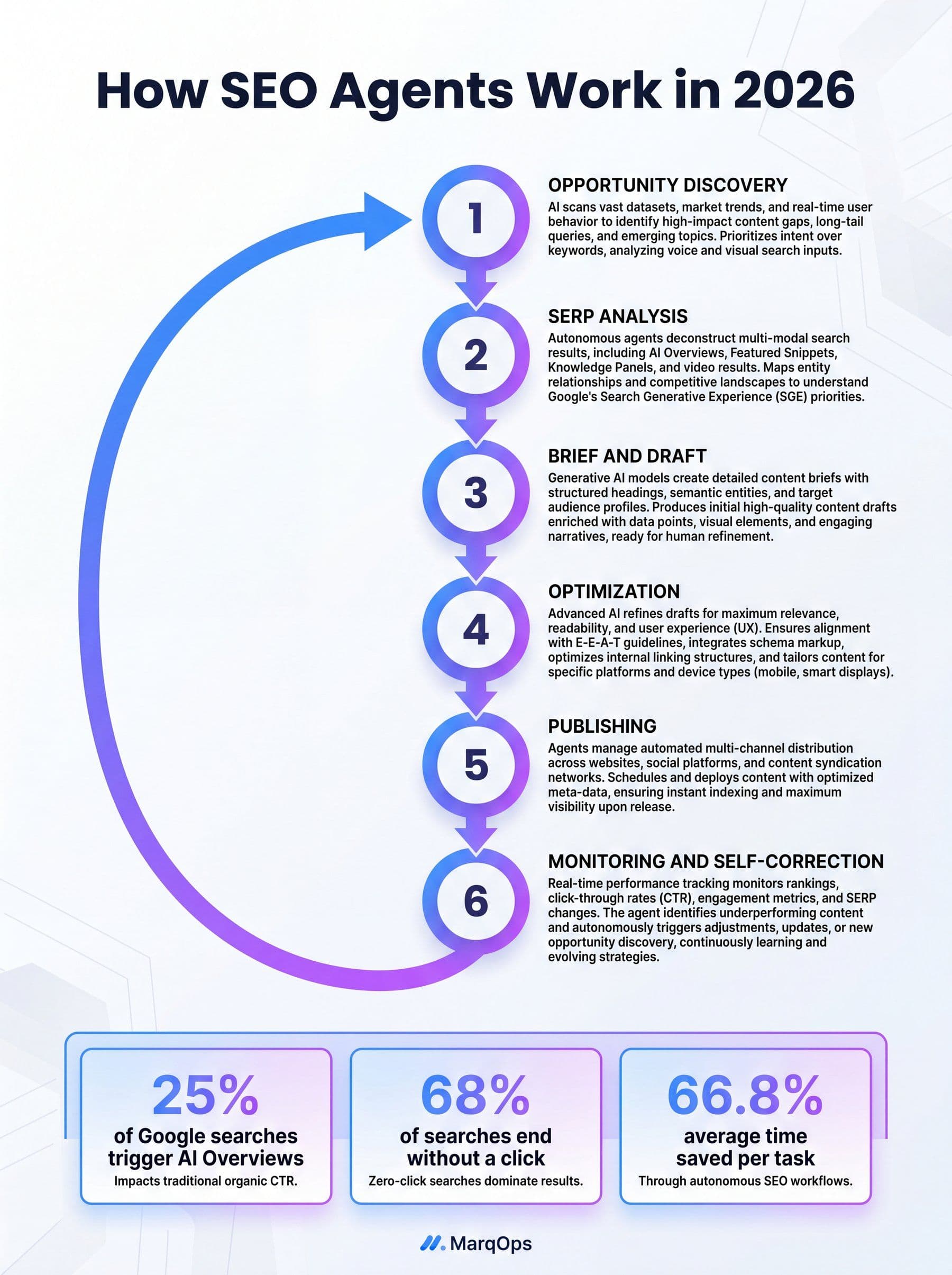
The SEO agent loop: six stages from discovery to self-correction, and the 2026 numbers driving adoption.
The SEO Agent Landscape in 2026
The market splits into three groups: dedicated SEO agents, SEO platforms adding agentic features, and general agent builders you can configure for SEO. Here is how the notable options compare:
| Tool | Category | Agentic strength | Best for |
|---|---|---|---|
| Frase | Dedicated SEO agent | Covers all six pipeline stages, including decay monitoring | Small teams wanting full-pipeline coverage (~$49/mo) |
| Nightwatch | Rank tracking + AI visibility | Agentic monitoring across Google, Bing, and AI engines | Agencies needing white-label reporting |
| Surfer SEO | Content optimization | Strong on-page scoring; partial pipeline automation | Teams whose bottleneck is content quality (~$99/mo+) |
| Ahrefs | SEO platform | Brand Radar tracks 286M+ monthly prompts across AI engines | Data depth and link intelligence ($129/mo+, Brand Radar extra) |
| Relevance AI / Lyzr | Agent builders | Fully custom agents with your own tools and guardrails | Technical teams building bespoke workflows |
| MarqOps | Unified marketing OS | SEO agents plus creative, ads, and analytics in one brand-aware system | Teams consolidating 7+ tools into one platform |
One pattern worth noting: point solutions create a new version of the old problem. An SEO agent that does not know your brand voice, your ad performance, or your content calendar will optimize in a vacuum. That is why platforms like MarqOps build SEO agents on top of a Brand Intelligence DNA layer, so every brief, draft, and optimization decision inherits your voice, terminology, and positioning from the start instead of requiring a separate review pass for brand alignment. It is the same unified-stack argument we make in our guide to AI agents for marketing.
How to Implement an SEO Agent: A 6-Step Roadmap
Step 1: Audit your current SEO workflow
Map every recurring SEO task, who does it, and how long it takes. Score each for volume, repetitiveness, and risk. High-volume, low-risk tasks (keyword research, briefs, decay monitoring) are your first agent candidates.
Step 2: Codify your brand and quality standards
Agents amplify whatever standards you give them, including bad ones. Document voice, terminology, banned claims, and quality criteria before the agent writes a word. If your brand guidelines live in someone’s head, fix that first.
Step 3: Start with one closed-loop use case
Pick a single workflow, run it agent-assisted for 2-4 weeks, and measure time saved and quality delta against your manual baseline. Content refresh is a great starter: bounded scope, measurable outcome, low blast radius.
Step 4: Define approval gates
Decide what the agent can do autonomously (research, drafts, internal reports) versus what requires sign-off (publishing, deleting, redirects, anything customer-facing). Write these as explicit action thresholds, not vibes.
Step 5: Wire in measurement across all search surfaces
Track classic rankings and traffic alongside AI citations and AI-referred conversions. If you only measure Google positions, your agent will optimize for a shrinking slice of discovery. Our GEO vs SEO guide explains how to weight the two.
Step 6: Expand scope as trust builds
Once the agent hits quality benchmarks consistently, widen its autonomy: more content clusters, technical fixes, then cross-channel coordination with your broader AI workflow automation. Autonomy is earned in stages, not granted on day one.
Risks, Limitations, and Guardrails
The honest counterweight to the hype: analysts project that over 40% of agentic AI projects will fail by 2027, mostly due to inadequate risk controls rather than model capability. SEO agents have specific failure modes you should design against.
Failure at scale. An agent that makes a small error once is annoying. An agent that makes the same small error across 500 pages is a site-wide incident. Cap batch sizes and require review on bulk changes.
Brand drift. Generic agents converge on generic output. Without enforced brand context, agent-written content reads like everyone else’s agent-written content, which is increasingly a ranking and citation liability as engines reward distinctive, experience-backed content.
Optimizing the wrong target. Agents chase whatever metric you give them. Point one at “publish more content” and you will get more content, not more revenue. Tie agent goals to pipeline and conversions, not output volume.
Governance gaps. Only about a quarter of organizations have full visibility into what their AI agents are doing. Log every agent action, review the logs, and keep a human owner accountable for each agent.
The working rule: humans set brand direction, guardrails, and priorities; agents execute the repetitive, technical, and time-sensitive work. Teams that invert this (agents deciding strategy, humans doing grunt work) are the ones that end up in the 40% failure statistic.
This is also where platform choice matters. Running your SEO agent inside a unified system like MarqOps means brand rules, approval workflows, and performance data live in one dashboard instead of being stitched across seven tools, which closes most of the governance gaps that sink standalone agent deployments and helps teams ship brand-perfect content up to 6x faster.
FAQs
What is an SEO agent?
An SEO agent is an AI system that autonomously plans and executes search optimization work: keyword research, SERP analysis, content briefs, drafting, on-page optimization, publishing, and rank monitoring. Unlike prompt-based AI tools, agents pursue goals continuously and adjust their own actions based on live results.
Will SEO agents replace SEO specialists?
No. Agents replace the repetitive execution layer (research, drafts, monitoring, technical housekeeping), which typically saves 60-70% of task time. Humans remain essential for strategy, brand voice, quality judgment, and approval gates. The specialist role shifts from doing tasks to directing and auditing agents.
How much does an SEO agent cost?
Dedicated SEO agents start around $49-99 per month for small teams. Enterprise SEO platforms with agentic features and AI visibility tracking run $129-700+ per month. Custom-built agents on frameworks like Relevance AI or Lyzr vary with usage. Unified platforms bundle SEO agents with creative, ads, and analytics, which usually costs less than stacking point solutions.
Do SEO agents work for AI search engines like ChatGPT and Perplexity?
Yes, and this is one of their biggest advantages. Modern SEO agents optimize for entity coverage, structural clarity, and citation-friendly formatting, which are the signals AI engines use when choosing sources to cite. They also monitor whether your brand appears in AI Overviews, ChatGPT, Gemini, and Perplexity answers, a surface only 14% of marketers currently track.
How do I keep an SEO agent on-brand?
Codify your brand voice, terminology, and banned claims into the agent’s context before it produces anything, and enforce approval gates on customer-facing output. Platforms with a built-in brand intelligence layer, like MarqOps with its Brand Intelligence DNA, inherit these rules automatically so every draft starts brand-aligned instead of requiring a separate compliance pass.
The Bottom Line
SEO in 2026 is a continuous, multi-surface discipline that no human team can fully cover manually. AI Overviews, answer engines, and classic rankings all reward the same fundamentals (entity-rich, well-structured, genuinely useful content), but they demand a cadence of research, production, and monitoring that only agents can sustain.
Start small, keep humans on strategy and approvals, measure across every search surface, and give your agent real brand context. Teams that get this right are already shipping 6x faster and covering ranking surfaces their competitors have not noticed yet.
Keep following the signal