Best AI Keyword Research Tools in 2026: 11 Platforms Modern Marketing Teams Trust
The 11 best AI keyword research tools for 2026, plus the five capabilities that matter and a tested stack template for solo marketers through enterprise teams.
TL;DR
- AI keyword research tools have moved from simple suggestion engines to intent-mapping, SERP-aware platforms that cluster topics, predict AI Overview triggers, and surface zero-volume queries that still convert.
- By Q1 2026, 25.11% of Google searches trigger an AI Overview and organic CTR for those queries dropped 61%, so picking tools that show AI Mode and ChatGPT visibility now matters as much as raw search volume.
- Between 65% and 85% of ChatGPT prompts have no matching keyword in legacy databases, which is why semantic clustering and prompt tracking features are the new must-have, not a nice-to-have.
- The best stack pairs a discovery engine (Semrush or Ahrefs) with a clustering and intent layer (Surfer, Clearscope, Junia AI) and a brand visibility tracker (Ahrefs Brand Radar, Semrush AI SEO Toolkit).
- MarqOps wraps keyword research, content generation, SEO scoring, and analytics into one Brand Intelligence DNA workspace, so your team stops paying for seven tools that barely talk to each other.
Why AI Keyword Research Tools Are the New Center of Gravity for SEO
Keyword research used to be the easiest part of SEO. You typed a seed term into a tool, downloaded a CSV, sorted by volume, and shipped a content brief. That model is dead. By the start of 2026, an analysis of 21.9 million Google searches showed 25.11% triggering an AI Overview, and organic click-through rate for those queries fell from 1.76% to 0.61%, a drop of 61%. Some categories see AI Overviews on nearly half of all queries. The exact-match phrase you ranked for last quarter may now produce a generative answer block that summarizes your page above the fold, and the user never clicks.
That is forcing a reset on how teams pick keywords, and which tools they use to find them. Modern AI SEO tools have stopped optimizing only for blue-link rankings and started optimizing for citations inside AI Mode, ChatGPT, Gemini, and Perplexity. The right keyword research tool today does five things that legacy platforms cannot: it maps semantic intent, clusters keywords into topical authority groups, surfaces zero-volume queries that LLMs still surface, predicts AI Overview triggers, and shows whether your brand is mentioned in generative answers.
65 to 85%
of ChatGPT prompts have no matching keyword in legacy SEO databases
That single statistic, surfaced from Semrush’s own LLM dataset, is the most important data point in keyword research right now. It explains why teams are bolting AI-native tools onto their existing stacks, and why the lines between keyword research, content optimization, and brand monitoring have all collapsed into the same workflow.
What Changed: From Search Volume to Search Behavior
For two decades, SEO ran on three numbers per keyword: monthly search volume, keyword difficulty, and cost per click. Pick the easy ones with the highest volume, write a 1,800-word post, ship. That math broke for three reasons.
First, search behavior moved off the keyword. Users now type fragments, prompts, and conversational questions into AI assistants. The same person who once searched “best CRM for B2B” now opens ChatGPT and asks, “I run a 12-person sales team selling to mid-market manufacturing companies, what CRM should I use and why.” That sentence does not exist in any keyword database, but it absolutely exists in the buying funnel, and the answer the AI gives shapes the shortlist. Tools that index only Google’s keyword universe miss it entirely.
Second, zero-click search became the default outcome. About 60% of searches in traditional engines now end without a click, because the AI Overview, featured snippet, or knowledge panel answers the question on the page. That means a “winning” keyword no longer guarantees traffic. It guarantees brand exposure if you happen to be cited, and nothing if you are not. Brands that earn citations in AI Overviews see 35% more organic clicks and 91% more paid clicks across the rest of their site, which is why visibility tracking has become inseparable from keyword research.
Third, the unit of optimization moved from the keyword to the topic cluster. Modern AI keyword research tools no longer hand you a flat list. They group hundreds of related queries into semantically coherent clusters, recommend a pillar page plus supporting articles, and tell you which intent each cluster serves. This is the same shift our team covered in detail in our AI content strategy guide, and it is now the baseline expectation for any SEO platform.
The 11 Best AI Keyword Research Tools in 2026
The list below is organized by primary use case rather than ranked head-to-head, because no team uses just one tool anymore. Mix and match based on your priorities, budget, and the size of your content engine. Each tool’s standout AI feature is called out so you can spot the one that closes a gap in your current workflow.
1. Semrush: Best All-in-One AI Discovery Platform
Semrush is the gold standard for breadth. Its Keyword Magic Tool now indexes 27.9 billion keywords across 142 locations, with 3.8 billion in the United States alone, and pairs that data with an AI clustering engine that automatically groups thousands of related terms into topic buckets. The 2026 release added the AI SEO Toolkit, which surfaces a visibility overview for ChatGPT, Google AI Overviews, AI Mode, and Perplexity in one panel, plus Prompt Tracking for following a custom set of generative queries with daily updates.
Where Semrush wins: enterprise teams who need keyword discovery, competitive intelligence, content briefs, and AI visibility tracking inside the same suite. Where it loses: pricing climbs fast above the entry tier, and the interface still feels like a stack of tools rather than a unified workflow.
2. Ahrefs: Best for Backlink-Aware Keyword Research
Ahrefs edges Semrush on raw scale, indexing 28.7 billion keywords across 217 locations, and its Keyword Explorer pairs every metric with a unique Traffic Potential score that estimates the actual organic traffic a top-ranked page receives, not just theoretical volume. The big 2026 addition is Brand Radar, which tracks brand mentions across 271 million prompts spanning AI Mode, ChatGPT, AI Overviews, Copilot, Gemini, and Perplexity.
Where Ahrefs wins: backlink-driven SEO teams who care about competitor link profiles as much as keywords, plus anyone tracking brand presence in generative engines. Where it loses: content optimization features still trail Surfer and Clearscope, and the data exports are less generous than Semrush’s at comparable price points.
3. Surfer SEO: Best for Keyword-to-Content Briefing
Surfer is not a discovery tool. It is the layer you put on top of Semrush or Ahrefs to turn a keyword list into a writeable brief. Its Content Editor scores drafts in real time against the top-ranking pages for a target keyword, recommending word count, heading structure, semantic terms, and natural language placements. The 2026 update added an Intent Optimization mode that flags whether your draft matches the dominant SERP intent (informational, transactional, navigational, or generative-answer-friendly), and rewrites sections that drift.
Pair Surfer with strong keyword discovery and you have the workflow that most modern content teams now run. We break down the full content stack in our AI copywriting tool guide.
4. SE Ranking: Best for Keyword Research Connected to AI Visibility Tracking
SE Ranking runs keyword research off a 5.5-billion-keyword database across 188 country databases, returning difficulty, volume, CPC, competition, and search intent for any term and expanding a seed into related, long-tail, and question-based ideas. You can also isolate the keywords that trigger any of 35+ SERP features, including AI Overviews, to see which queries are likely to produce a generative answer before you commit a brief.
The AI-answer side lives in SE Visible, SE Ranking's dedicated AI search visibility platform. It tracks brand mentions, links, and citations across ChatGPT, Gemini, Perplexity, Google AI Overviews, and AI Mode, with prompt-level analysis. You can see which prompts surface your brand versus a competitor's, which sources those answers cite, and how the framing moves over time.
Where SE Ranking wins: agencies and mid-market teams that want keyword discovery and AI-answer visibility as two purpose-built tools rather than one crowded dashboard. Where it loses: keyword data is Google-only, and the deepest LLM analysis sits in SE Visible, not the core SEO platform.
5. Junia AI: Best Free AI Keyword Research for Long-Tail Intent
Junia AI is one of the few free tools that actually delivers something legacy databases cannot. Type a seed keyword and the tool returns long-tail variations, search intent labels, People-Also-Ask style questions, and a content cluster recommendation that maps each keyword to the right page type (blog, landing page, comparison page, local service page). It is built for solo marketers and small teams who cannot justify a four-figure annual seat on Semrush yet still need intent-aware research.
6. AnswerSocrates: Best for “People Also Ask” Mining
AnswerSocrates is a free, Google-autocomplete and PAA-driven tool that surfaces hundreds of low-competition long-tail questions for any seed term. It is especially strong for content teams writing for an FAQ-rich format or trying to capture featured snippets. Long-tail keywords typically convert 2.5x better than head terms, and AnswerSocrates is one of the cheapest ways to find them at scale.
7. KeywordTool.io: Best for Cross-Platform Autocomplete Research
KeywordTool.io generates up to 750 keywords per seed term across Google, YouTube, Amazon, eBay, Bing, and the App Store. Each platform has its own autocomplete logic and audience intent, so the tool is a goldmine for ecommerce, video, and app-focused teams who need to research keywords outside the Google bubble. The free tier is usable for ad-hoc research, and the paid tier unlocks search volume and CPC data.
8. Clearscope: Best Premium Content Optimization Layer
Clearscope is the high-end alternative to Surfer for enterprise content teams. Its strength is the precision of its semantic relevance scoring, which most agency content directors trust more than any other tool. Pair it with Ahrefs for discovery and you get the cleanest enterprise SEO workflow money can buy. The trade-off is price: Clearscope’s entry tier starts at a level that prices out small teams.
9. Ubersuggest: Best Budget All-in-One
Ubersuggest has quietly become a credible enterprise alternative at a fraction of competitor pricing. The 2026 version generates thousands of keyword suggestions from a single seed, ships content gap analysis and backlink data, and added an AI content suggestion module trained on top-ranking pages. It will not match Semrush on data depth, but for teams under $5K monthly tool budgets, it is the strongest value pick on the market.
10. Google Keyword Planner: Still Free, Still Essential
Google’s own Keyword Planner is not strictly an AI tool, but it remains the closest thing to ground truth for paid search volume and competition data, drawn directly from advertiser bid signals. Use it as the validation layer when a third-party tool gives you a number that looks too good to be true. Free with any Google Ads account.
11. MarqOps: Best Unified Keyword-to-Content-to-Analytics Workspace
The pattern across the ten tools above is clear. Each one does one thing well, and modern marketing teams end up paying for five to seven of them, then duct-taping the outputs together with spreadsheets and zaps. MarqOps was built to collapse that stack. The platform pairs keyword discovery with semantic clustering, AI content generation, brand-DNA-aware scoring, paid search insights, and unified analytics in one workspace. One platform replaces seven plus disconnected marketing tools, and brand-perfect output ships from the start because every asset runs through the same Brand Intelligence DNA layer. We expand on the full architecture in our marketing intelligence platform guide.
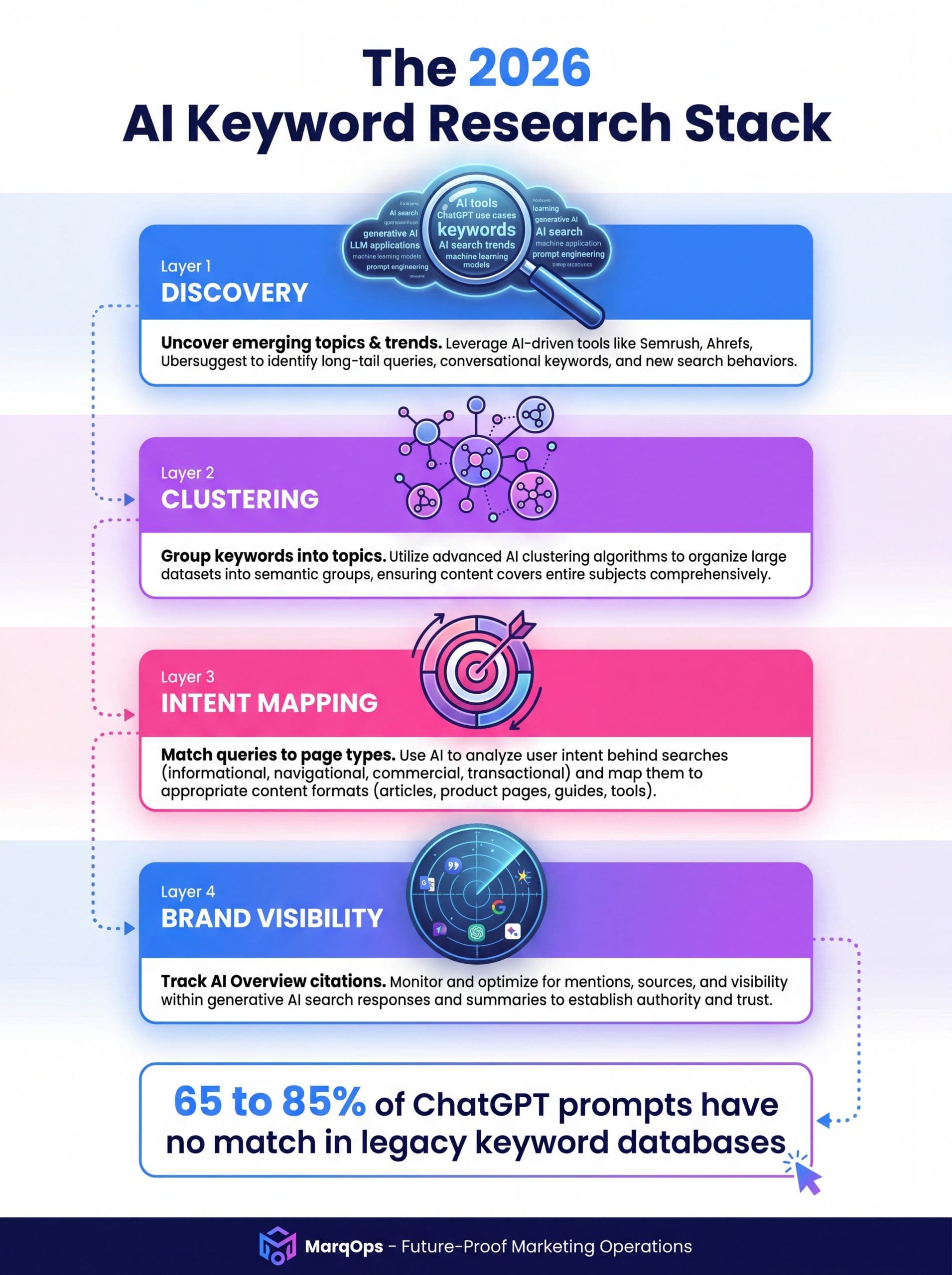
The four layers of the modern AI keyword research stack: discovery, clustering, intent, and brand visibility.
The Five Capabilities That Separate AI Keyword Tools From Legacy Platforms
If you are evaluating tools, do not get distracted by the marketing pages. Every vendor now claims to be AI-powered. Score them against these five capabilities instead, because this is what actually moves the needle on SEO and AI search performance.
1. Semantic Intent Mapping
The tool should label every keyword by intent (informational, navigational, transactional, commercial, or generative-answer) and explain which content format wins for that intent. If it just gives you a flat list of phrases, it is a 2018 product with a chatbot bolted on. The strongest tools also flag whether a query is likely to trigger an AI Overview or AI Mode response, which changes the optimization play from “rank for the term” to “earn the citation.”
2. Semantic Clustering at Scale
Modern tools take 5,000 raw keywords and cluster them into 80 to 120 topical groups, each with a recommended pillar page and supporting articles. This is the foundation of programmatic SEO and it is impossible to do manually for any site beyond a few hundred URLs. If your tool cannot cluster, you cannot scale.
3. AI Search Visibility Tracking
You need to see whether your brand and your competitors show up inside ChatGPT, Gemini, Perplexity, AI Mode, and Google AI Overviews for the prompts that matter to your buyers. Wikipedia is the most-cited source in ChatGPT at 7.8% of citations, followed by Reddit at 1.8%, Forbes at 1.1%, and G2 at 1.1%. If a buyer-defining prompt cites your competitor and not you, the keyword research tool should surface it the next morning.
4. Zero-Volume Keyword Discovery
Between 65% and 85% of ChatGPT prompts have no match in legacy keyword databases. That entire universe of long-tail, conversational, and emerging queries is invisible to volume-first tools. The new generation pulls from forum data, prompt corpora, and LLM training-set proxies to find queries that never show in Google Trends. Teams that capture these queries early own the answer when the AI starts citing.
5. Direct Integration With Content Production
The fastest content engines no longer have a handoff between research and writing. The keyword tool generates the brief, the brief flows into the writing surface, the draft is scored against the brief in real time, and the final asset publishes with structured data baked in. Anything that requires a CSV export and a manual paste is too slow for the volume modern marketing teams ship.
The shift in plain English: Keyword research used to be a research step. In 2026 it is a continuous signal that drives content production, analytics, and brand strategy. Pick tools that treat it that way.
How to Build Your AI Keyword Research Stack: A Practical Roadmap
The right number of tools depends on team size and content velocity. Here is a tested template you can adapt the same week.
Solo Marketer or Founder (1 Content Asset Per Week)
Stack: Junia AI free tier for long-tail discovery, AnswerSocrates for question mining, Google Keyword Planner for volume validation, and one paid tool (Ubersuggest at the entry tier or Semrush’s lowest plan) for monthly competitive snapshots. Total monthly spend stays under $200 and the workflow scales to roughly four pieces of content per month before the seams show.
Small Marketing Team (4 to 8 Assets Per Week)
Stack: Semrush as the discovery and clustering engine, Surfer SEO as the writing surface, AnswerSocrates as the long-tail layer, and a brand visibility tool (Ahrefs Brand Radar or Semrush’s AI SEO Toolkit) for monthly tracking. Add one analytics layer to close the loop on what content actually drives pipeline. Most teams in this band overpay for redundant features across tools, which is why we cover martech budget optimization in our marketing tech stack guide.
Mid-Market or Agency (15+ Assets Per Week, Multi-Brand)
Stack at this volume gets unwieldy fast. Most teams run Ahrefs and Semrush together (yes, both, because each has data the other lacks), Surfer or Clearscope for writing, a brand visibility tracker, a separate analytics platform, and a workflow tool to coordinate it all. Tool cost is typically $4,000 to $9,000 per month, and the bigger problem is the operational tax of moving data between systems.
This is the band where MarqOps replaces the most line items. By unifying keyword research, clustering, AI content production, scoring, paid integration, and analytics under one Brand Intelligence DNA model, mid-market teams typically cut tool spend by 40 to 60% and ship content 6x faster because the handoffs disappear. Compare the workflow side by side with the legacy stack covered in our AI in marketing automation guide.
Enterprise (Multiple Properties, 50+ Assets Per Week)
Enterprise stacks need API access, role-based permissions, and per-property data segmentation. Semrush Enterprise and Ahrefs Enterprise are the two best foundations. Pair with Clearscope for writing governance, a custom prompt-tracking layer, and a unified martech intelligence platform. Plan for a dedicated SEO operations role to manage the data flows, or pick a unified platform that absorbs that role into the product.
Common Mistakes Marketing Teams Still Make in 2026
Even with better tools, the same five mistakes show up in nearly every audit our team runs.
Optimizing for high-volume head terms first. Head terms now trigger AI Overviews and have collapsing CTR. Long-tail and intent-rich queries are where the conversion happens. The Junia and AnswerSocrates tier of the stack matters more than the Semrush tier for early-stage content programs.
Ignoring zero-volume queries. If a tool says volume is zero, it might still drive traffic from AI engines that index that exact phrasing. Treat zero-volume as a signal of opportunity in the right context, not a reason to skip.
Treating clustering as optional. Without clusters, you end up with cannibalization, thin pages, and a sitemap that no AI engine can confidently summarize. The clustering output should be the source of truth for the editorial calendar, not a downstream artifact.
Not tracking AI search visibility. If you are not measuring whether ChatGPT and Gemini cite your brand for the queries you care about, you are flying blind on the channel that increasingly mediates buyer research. This is the gap that generative engine optimization services were built to close.
Letting research and writing drift apart. The longer the gap between brief and draft, the more the brief gets ignored. Tools that score the draft against the brief in real time are the only ones that close that loop reliably.
The 2026 reality: Content quality and search intent are now the #1 active SEO strategy, named by 54% of practitioners. Tools that help you nail intent are worth more than tools that help you find another long-tail variation.
Where Keyword Research Is Heading: The Next 18 Months
Three changes are already underway that will reshape the category by mid-2027.
First, prompt research will become a first-class workflow alongside keyword research. Tools that index real prompts (not just queries) will own the upstream signal. Expect Semrush, Ahrefs, and a handful of new entrants to publish prompt-volume datasets in the next year.
Second, agentic keyword research will arrive. Instead of you operating a tool, an agent will continuously monitor your site, your competitors, and the AI engines, and propose clusters and briefs without being asked. This is already partly true inside AI agents for marketing, and the keyword-research-specific layer is the next obvious build.
Third, the line between SEO, ad copy, social copy, and email subject lines will dissolve. The same intent-mapped phrase will inform a search ad, a TikTok hook, a podcast title, and an email preheader, with one platform writing all four. Marketing teams running fragmented stacks will not be able to keep up with teams running unified ones.
Frequently Asked Questions
What is the best AI keyword research tool for small businesses?
For most small businesses, the strongest free entry point is Junia AI for intent-aware long-tail discovery, paired with AnswerSocrates for question mining and Google Keyword Planner for volume validation. When you outgrow the free tier, Ubersuggest’s entry plan is the best paid value before you need Semrush or Ahrefs.
Are AI keyword research tools accurate compared to Google Keyword Planner?
For paid search volume, Google Keyword Planner remains the closest to ground truth because it draws on advertiser bid data. AI tools like Semrush and Ahrefs use modeled data that can vary 15 to 30% from Planner numbers. The right move is to use AI tools for discovery and clustering and validate the top targets in Keyword Planner before you commit budget.
How do I research keywords for AI Overviews and ChatGPT?
Start with prompt-style queries rather than short head terms. Tools like Semrush’s AI SEO Toolkit and Ahrefs Brand Radar track which prompts cite which brands across ChatGPT, Gemini, Perplexity, and AI Mode. Pair that with content depth (long, structured, citation-rich pages) because content depth is the strongest predictor of AI citations, ahead of traditional metrics like backlinks.
Do I still need keyword research if AI Overviews answer most queries?
Yes, more than ever. AI engines synthesize answers from a curated set of cited sources, and getting cited requires that you publish content that maps cleanly to high-intent queries. Keyword research is now the way you decide which questions are worth answering, which clusters to build authority around, and which brand mentions to pursue. The tool changed; the discipline did not.
How does MarqOps replace multiple AI keyword research tools?
MarqOps unifies keyword discovery, semantic clustering, AI content generation, brand-aware scoring, paid search insights, and analytics into one Brand Intelligence DNA workspace. Teams that previously paid for Semrush, Surfer, a brand visibility tool, an analytics layer, and a workflow tool typically cut their stack to one platform, ship content 6x faster, and produce on-brand assets from the first draft. Start free with no card required and see the workflow in action.
Ready to Replace 7 Tools With One Brand-Intelligent Platform?
You can keep paying for separate keyword research, content optimization, brand monitoring, paid search, and analytics tools, or you can run all of it through a single Brand Intelligence DNA workspace built for modern marketing teams. MarqOps gives you AI keyword discovery, semantic clustering, brand-perfect content output, and unified analytics from day one. No card required to start.
Keep following the signal