Keyword Cannibalization: How to Tell a Real Problem From a False Alarm
When Ahrefs hand-reviewed 80 of its own 9,700 multiple-ranking keywords, exactly one needed fixing. Most cannibalization flags are diversification doing its job. Here is the four-test Search Console diagnosis that separates real same-intent overlap from a false alarm, the four fixes ranked by reversibility, and the measurement habit that stops a failed merge from being reported as a win.

Contents
- What keyword cannibalization actually is
- The data that should change your default
- The two signatures: swapping versus stable
- A four-test diagnosis in Search Console
- What AI Overviews change about the calculation
- Four fixes, ranked by how easily you can undo them
- Measuring the fix honestly
- Preventing the next one with a keyword map
- Five ways a cleanup goes wrong
- Where MarqOps fits
- Frequently asked questions
- The bottom line
What keyword cannibalization actually is
Keyword cannibalization is when two or more pages on your site compete for the same query with the same intent, and the competition costs you something. That last clause is the part most definitions skip, and it is the reason so many cleanup projects end with less traffic than they started with.
The common version of the definition is simpler and wrong: if two of your URLs show up for one keyword, you have a problem. That framing turns a diagnostic question into an alarm, and it scales badly. Run a site with a few thousand indexed pages through any cannibalization report and you will get hundreds of flags. Act on all of them and you will spend a quarter merging pages that were doing fine.
The useful distinction is between overlap and duplication. Overlap is two pages touching the same topic from different angles, a definition post and a product page, a category and a buying guide. Duplication is two pages trying to be the same answer for the same searcher. Only the second one is cannibalization, and only the second one is worth surgery.
The data that should change your default
Ahrefs ran the most honest version of this audit on its own site and published the result. Their domain had roughly 9,700 keywords where more than one ahrefs.com URL ranked. Classic SEO theory says every one of those is a defect. So an analyst spent a day reviewing a random sample of 80 of them in detail.
One case out of eighty needed action. If that ratio held across the full set, roughly 120 of those 9,700 flags were real and about 9,580 were the search engine deciding that two of their pages were both worth showing.
Two secondary findings from the same study are worth carrying into your own audit. The median keyword difficulty of the multiple-ranking keywords was 64, against 37 for keywords where only one page ranked. Ranking twice was more common on harder terms, not easier ones, which is the opposite of what the dilution theory predicts. And median search volume was almost identical between the two groups, 50 against 40, so volume tells you nothing about whether a keyword is at risk.
The practical consequence is a change in burden of proof. The default assumption should be that a multiple ranking is fine until you can point at evidence that it is not. Tools that surface these cases are doing useful work by narrowing your search space. They are not doing the diagnosis, and treating their output as a to-do list is how teams end up deleting pages that were earning clicks.
The two signatures: swapping versus stable
There is a visual tell that separates the two situations, and it takes about thirty seconds per keyword once you know what you are looking at. Pull the position history for the query and look at what the two URLs do over time.
Swapping. One URL ranks, then drops out and is replaced by the other, then they trade back. The line looks like a relay race. This is the real thing. The search engine cannot decide which page answers the query, it shows one at a time, and every handover resets whatever momentum the previous page had. Ahrefs' own example was a set of case study posts that kept displacing each other, where each newly published one knocked the previous one out of the results.
Stable side by side. Both URLs hold positions simultaneously, for months, without trading. This is diversification. It usually happens because the two pages serve genuinely different intents on a mixed-intent query. A glossary definition holding a featured snippet while a tool landing page sits at position four is not a conflict. It is two intents being served, and merging them forces you to pick one group of searchers to disappoint.
| Signal | Cannibalization | Diversification |
|---|---|---|
| Position history | URLs trade places repeatedly | Both hold position for months |
| Search intent | Same intent, same format | Different intent or different content type |
| Title and H1 | Near-identical phrasing | Clearly different promises |
| Combined clicks over time | Flat or declining despite added pages | Higher than either page alone |
| Correct action | Consolidate or re-target | Leave it, and strengthen internal links |
One structural constraint is worth knowing before you interpret any of this. Google's site diversity behaviour generally limits a single domain to about two results in the top set for a query, with exceptions when relevance is unusually strong. So a third page entering the fight for a term you already own twice is genuinely competing for a slot, while the first two often are not competing with each other at all.
A four-test diagnosis in Search Console
You do not need a paid tool for the diagnosis, and using one for the detection step does not remove the need for these four tests. Everything below runs on Search Console data you already have.
Test one: confirm both URLs actually receive impressions. Open Performance, then Search results. Add a query filter for the exact term, set the date range to the last six or twelve months, then switch to the Pages tab. If only one URL appears, there is nothing to fix regardless of what a crawler told you. If two or more appear, note the click and impression split. Search Console holds 16 months of data, so use the window rather than a 28 day default that hides trading behaviour entirely.
Test two: check the movement, not the snapshot. Compare two adjacent six month windows for the same filtered query. If URL A carried most impressions in the earlier window and URL B carries most in the later one while the total stayed flat, you are looking at a handover. If both held roughly proportional shares across both windows and the total grew, you are looking at diversification.
Test three: read the intent, not the keyword. Open both pages side by side and answer one question for each: what does the searcher want to do next after landing here. Learn a definition, compare options, run a tool, buy, get support. Two pages answering the same next action are duplicates. Two pages answering different next actions are a funnel. This test catches the cases the other three miss, and it is the one no tool can run for you.
Test four: check whether the total is actually suffering. Sum clicks across all competing URLs for the query cluster and chart that total over 16 months. Real cannibalization shows up as a total that stalls or declines while page count rises. If the combined number is climbing, the pages are additive whatever the report says.
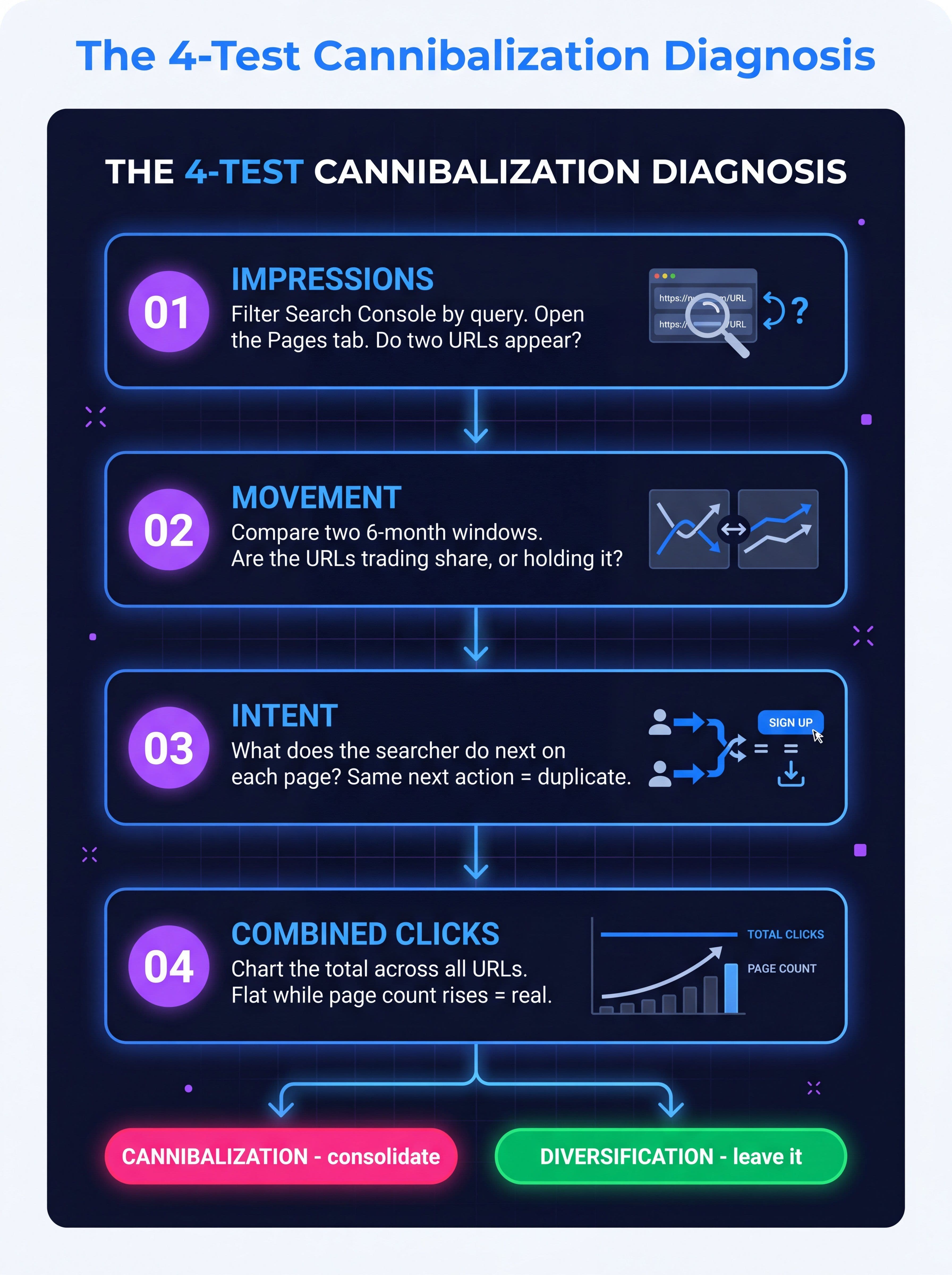
The four-test sequence, and what each outcome means for the fix you should choose.
What AI Overviews change about the calculation
The economics shifted in a way that cuts both directions, and neither direction is the one most cleanup advice assumes.
On one side, a second listing is worth less than it used to be. Ahrefs' May 2026 update, built on 300,000 keywords using December 2025 data, found the average click-through rate for top-ranking pages on queries with an AI Overview running 58% below equivalent positions without one, up from 34.5% in the previous version of the same study eight months earlier. When the whole results page delivers fewer clicks, the marginal value of holding two slots instead of one shrinks with it. Our breakdowns of AI Overviews and zero-click search go through what that does to the rest of the forecast.
On the other side, generative results are drawn from passages rather than from whole-page rankings. Two pages covering the same ground in slightly different language are two chances to have a passage selected, which is not how classic ranking worked. That argues for keeping distinct, well-structured coverage rather than compressing everything into one very long page, and it makes the entity-level clarity of each page matter more than its keyword density.
Both effects point at the same conclusion. Consolidate for intent overlap, not for tidiness. If two pages genuinely answer the same question, merging still wins. If they answer adjacent questions in a topic cluster, the AI search era rewards keeping them separate and connected, which is the argument for building topical authority through coverage rather than through page count reduction. Tracking whether your pages are actually being cited is a separate discipline, covered in our piece on AI visibility.
Four fixes, ranked by how easily you can undo them
Most guides open with consolidation. Start at the other end of the list and work down, because reversibility is the property that matters when your diagnosis might be wrong.
1. Internal linking, fully reversible. Point the weaker page's internal links at the stronger one using consistent anchor text, and clean up any site-wide navigation or footer links pointing the wrong way. This clarifies your preference without destroying anything. On a genuine near-tie it is often enough on its own, and if nothing improves in six weeks you have lost nothing.
2. Re-targeting, mostly reversible. Keep both pages and rewrite one against a distinct intent. Change the title, the H1, the introduction and the internal anchor text so the promise is different, then let the query set separate. This is the right call when both pages have earned links or conversions and neither is disposable. It takes longer to show up than a merge and it does not put anything at risk.
3. Canonicalisation, reversible but easy to get wrong. Point one URL's canonical tag at the other while keeping both accessible. Google treats canonicals as a hint rather than an instruction, so this works when the pages really are near-duplicates and silently does nothing when they are not. It is worth reserving for pagination, parameter variants and genuine duplicates rather than for editorial overlap.
4. Merge and redirect, hard to reverse. Combine the useful sections into one page and 301 the retired URLs to it. This is the strongest fix and the only one with a real downside. Google evaluates whether the redirect target is a relevant replacement, and a 301 pointing at a page it judges insufficiently related gets treated as a soft 404, which means the redirect passes nothing and the old URL's equity is gone. Redirect to the closest matching page, never to a generic hub, and never to the homepage.
Whichever fix you choose, repoint every internal link that referenced the retired URL. Leaving them to resolve through the redirect works, technically, and it is also the step most often skipped, which leaves a trail of hops that dilutes exactly the signal you were trying to concentrate. A technical SEO audit pass after any merge is the cheapest way to catch what got missed.
Measuring the fix honestly
Here is where most cannibalization case studies quietly fail, including some of the ones you will find celebrating dramatic gains.
After a merge, the natural thing to chart is the survivor page against its own history. It almost always goes up. It absorbed content, it absorbed links, and it now receives redirected traffic. That chart is not evidence of anything, because it excludes the URLs you retired.
Three more measurement habits are worth building in. Give it eight to twelve weeks before judging, because Google needs to recrawl and reprocess the redirect and the interim numbers are noise. Watch the query set, not just the volume, since a merge that holds clicks steady while shedding your highest-intent commercial queries has cost you money the traffic number will never show. And record the pre-merge baseline somewhere durable before you touch anything, because Search Console will happily show you the after and you will be reconstructing the before from memory.
If you report this work to a client, classify it the same way you would any other claim. "Combined organic clicks across the four merged URLs rose 22% over the twelve weeks following consolidation" is a verified statement with a source behind it. "The merge caused the increase" is not, because a seasonal shift or an unrelated algorithm update could produce the same chart. The distinction is the whole discipline behind defensible client reporting, and it applies to cleanup work as much as it does to growth work.
Preventing the next one with a keyword map
Cannibalization is a symptom of publishing without a map. The prevention is one spreadsheet and one rule: every URL owns one primary query and one intent, and nothing new gets briefed without checking the map first.
A workable map has five columns. URL, primary query, secondary queries, intent, and current status. Before commissioning any new page, search the map for the primary query. If a page already owns it, the decision is to update that page rather than to write a new one, and that decision should be the default rather than the exception.
Grouping matters as much as the map itself. Building the query set into intent-based groups first, which is the job keyword clustering does, prevents the situation where two writers are handed near-identical briefs three months apart. A recurring content audit then catches the drift that accumulates anyway, because titles get rewritten and pages wander off their assigned intent without anyone noticing.
Two situations deserve extra care. Programmatic pages generated from a template are the fastest way to create thousands of near-identical intent targets at once, so the differentiation rules need to be set before the first batch ships rather than audited after, a point we go through in detail on programmatic SEO. And anything you model in an SEO forecast should be reconciled against the map, because a forecast that assumes a new page will rank for a term an existing page already owns is double-counting the same demand.
Five ways a cleanup goes wrong
Treating the tool output as the diagnosis. Detection reports find overlap. They cannot see intent, and intent is the variable that decides the fix. Every flag needs the four tests before it earns an action.
Merging pages that were serving different searchers. The definition post and the product page were not fighting. They were covering a mixed-intent query from both sides, and now you have one page that does neither job well.
Redirecting everything to one hub. Convenient, and it is the fastest way to trigger the soft 404 treatment. One-to-one intent mapping is more work and it is the only version that reliably preserves anything.
Judging the result on the survivor alone. Covered above and worth repeating, because it is the error that makes bad consolidations look good and therefore causes them to be repeated.
Fixing the pages and not the process. Without a keyword map and a brief-time check against it, you will be running the same audit in nine months against a fresh set of duplicates.
Where MarqOps fits
MarqOps is built around one idea: the claim a client reads should be traceable to the source data behind it, and a human should approve it before it ships. Cannibalization work is a good stress test of that idea, because it is an area where the standard reporting makes it unusually easy to show a win that did not happen.
Analytics Ops connects Search Console and GA4 so the query and page data behind a diagnosis comes from the account rather than from a screenshot, and lets you ask a plain-language question with the source view one click away. SEO Ops carries the same trail from research through brief to published content, which is where the keyword map stops being a spreadsheet someone forgets to open and becomes part of the workflow that produces the brief. Verified reporting then runs each material claim through a review that marks it verified, needs context, or unsupported, and holds the unsupported ones back. "Combined clicks across the merged cluster rose 22%" passes that review. "The merge caused the increase" gets flagged for context, which is the correct outcome.
MarqOps sits above whatever dashboard you already use rather than replacing it. Plans start at $19 per month on a seven day trial with no credit card. If you want to see the mechanics first, the interactive sample report shows evidence receipts on a live example and verified client reporting walks through the claim review flow. For the technical inputs, the free SEO and Core Web Vitals audit and the free SEO audit checklist are both open.
Frequently asked questions
What is keyword cannibalization?
Keyword cannibalization is when two or more pages on the same site compete for the same query with the same search intent, and the competition reduces the site's overall performance for that query. The defining symptom is pages trading positions over time rather than holding them simultaneously. Two pages ranking side by side for a mixed-intent query is diversification, not cannibalization, and does not need fixing.
How do I check for keyword cannibalization for free?
Use Google Search Console. Open Performance, then Search results, add a filter for the query, set the range to six or twelve months, and open the Pages tab. Multiple URLs receiving impressions for the same query is the starting signal. Then compare two adjacent six month windows to see whether the URLs are trading share, and read both pages to check whether they serve the same next action for the searcher.
Is ranking twice for the same keyword bad?
Usually not. When Ahrefs hand-reviewed a sample of 80 keywords from the roughly 9,700 multiple-ranking cases on its own domain, only one required action. Two stable listings for a query typically means the search engine judged both pages worth showing. The cases that need attention are the ones where the pages swap positions rather than hold them, or where combined clicks are flat while page count rises.
Should I merge pages or 301 redirect them?
Merging and redirecting are two halves of the same fix: move the useful content onto the survivor, then 301 the retired URL to it. Redirect to the closest matching page rather than to a category or the homepage, because Google evaluates whether the target is a genuine replacement and treats redirects to insufficiently related pages as soft 404s. Try internal linking or re-targeting first, since both are reversible and a redirect is not.
How long does it take to see results after fixing cannibalization?
Allow eight to twelve weeks before drawing conclusions. Google has to recrawl the retired URLs, process the redirects and reassess the survivor, and the interim data is unreliable. Internal linking changes tend to surface faster than merges. Whatever the timeline, benchmark against the combined performance of all URLs involved rather than against the survivor's own history.
Does keyword cannibalization affect AI Overviews and AI search?
It changes the trade-off rather than removing it. Generative results select passages rather than whole pages, so distinct well-structured pages on adjacent subtopics can each be citable, which argues against compressing a cluster into one long page. At the same time, Ahrefs measured click-through rates on AI Overview queries running 58% below equivalent positions without one, so a second listing is worth less than it was. Consolidate for genuine intent overlap and keep the rest separate and internally linked.
The bottom line
Keyword cannibalization is real, and it is far rarer than the reports flagging it suggest. The failure mode in 2026 is not ignoring it. It is running a detection tool, treating every result as a defect, and merging pages that were each earning clicks from different searchers.
Change the burden of proof. A multiple ranking is fine until the position history shows trading, the intents match, and the combined click total is flat or falling. When all three line up, fix it, starting with the reversible options and reaching for a redirect last. Then measure the cluster rather than the survivor, and write down what you can prove separately from what you can only suggest.
That last habit is the one that carries beyond this particular audit. Most SEO work produces a chart that can be framed as a win. The teams that keep clients through a flat budget year are the ones whose charts can be reconstructed six months later by someone who was not in the room.
Keep following the signal
Related field notes
Marketing Operations
Marketing Project Management Software in 2026: How to Choose Without Adding Tool #122
11 min readMarketing Analytics
Marketing Attribution Software in 2026: The Buyer's Guide for a Stack That Won't Stop Growing
11 min readMarketing Operations