Google Ads Optimization in 2026: The Cadence, Checklist, and What to Let AI Handle
A practical Google Ads optimization system for 2026: a daily to quarterly cadence, which optimization score recommendations to trust, and how AI Max and journey-aware bidding change the work.
Table of Contents
- What Google Ads Optimization Means in 2026
- What Unoptimized Accounts Actually Cost
- Optimization Score: What to Accept and What to Ignore
- The Four-Layer Optimization Cadence
- The Seven Levers That Move Results
- 2026 Changes That Rewrite the Playbook
- Google Ads Optimization Checklist
- Where AI Tools Help (and Where They Do Not)
- Frequently Asked Questions
Most Google Ads accounts do not fail in one dramatic moment. They leak. A broad match keyword picks up irrelevant queries for six weeks, a conversion action double counts form fills, a Performance Max asset group runs the same tired image since spring, and nobody notices because the dashboard total still looks fine. Google Ads optimization is the discipline of finding those leaks on a schedule, fixing the ones that matter, and leaving the automation alone when it is doing its job.
This guide lays out a practical system: what to check daily, weekly, monthly, and quarterly, which recommendations to trust, and how the 2026 product changes (AI Max, journey-aware bidding, Performance Max transparency) change the work. If you need a one-time diagnostic first, start with our Google Ads audit checklist, then use this guide to keep the account healthy afterward.
What Google Ads Optimization Means in 2026
Google Ads optimization is the ongoing process of improving campaign results (conversions, revenue, cost per acquisition, or return on ad spend) by adjusting the inputs Google's systems use: conversion data, bidding goals, budgets, targeting signals, creative, and landing pages. An audit is a snapshot. Optimization is the recurring routine that follows it.
The job has changed shape. Five years ago, optimization meant manual bid adjustments by device, hour, and keyword. Today, Smart Bidding sets bids at auction time using signals no human can see, and Google said at Google Marketing Live 2026 that advertisers using AI Max or Performance Max see 15% more conversions at a similar ROAS. Vidhya Srinivasan, Google's VP of Ads and Commerce, put the shift bluntly: "You can't choose keywords anymore" for the new AI Search ad formats.
That does not make optimization obsolete. It moves your effort upstream. When the machine controls the bid, your leverage comes from three places:
- What the system optimizes toward. Conversion actions, values, and goals. Feed it bad data and it will efficiently buy the wrong outcome.
- What the system is allowed to do. Negative keywords, brand exclusions, budget caps, target settings, and landing page rules.
- What the system has to work with. Ad copy, images, video, product feeds, and landing pages. In an automated auction, creative is the biggest remaining differentiator.
What Unoptimized Accounts Actually Cost
The clearest recent data on account neglect comes from WordStream's Google Ads waste study, published in February 2026. It analyzed 251,236 assessments from its free Performance Grader, covering 15,666 unique accounts across more than 23 industries between January and November 2025.
That is more than a third of a typical budget. The other findings point straight at basic hygiene rather than sophisticated strategy:
- 29% of accounts recorded zero conversions over 90 days while still averaging around 12,667 impressions a month. Some of that is real underperformance; much of it is broken or missing conversion tracking.
- 25% of accounts had never added a negative keyword. Accounts with at least one negative averaged a 13% conversion rate, compared with 4.6% for accounts with none.
- Even among accounts spending over $10,000 a month, 4% recorded zero conversions.
Meanwhile, the benchmark bar keeps rising. WordStream's 2026 benchmarks, drawn from 13,474 US search campaigns between April 2025 and March 2026, put the median CTR at 6.64%, CPC at $5.42, conversion rate at 8.18%, and cost per lead at $66.69. Cost per lead fell for the first time in five years, and conversion rates rose in 87% of industries. In other words, competitors are getting better at this. Standing still is falling behind.
Optimization Score: What to Accept and What to Ignore
Optimization score is Google's 0 to 100% estimate of how well an account is set up to perform. It sits on the Recommendations page, updates in real time, and each recommendation shows how many points it would add. Both applying and dismissing a recommendation raise the score, which tells you something important: the score measures whether you have reviewed Google's suggestions, not whether your account makes money.
Optmyzr reports that in a 2024 study of more than 17,000 accounts, those scoring above 70% earned substantially higher returns than those below. That is correlation, and well-run accounts tend to keep their recommendations tidy for the same reasons they run well. Chasing 100% is not the goal. Use this sorting rule instead:
| Recommendation type | Default action | Why |
|---|---|---|
| Fix broken final URLs, disapproved ads, conflicting negatives | Accept | Pure hygiene. No strategic downside. |
| Add sitelinks, callouts, images, and other assets | Accept, with your own copy | More assets usually lift CTR. Write them to brand standards rather than letting Google auto-generate. |
| Remove redundant or duplicate keywords | Review | Usually fine, but check the keyword is not doing deliberate routing work. |
| Switch to broad match, add AI Max, raise budget | Test, do not accept blindly | These expand reach and spend. Run them as experiments with a clear success metric. |
| Change bid strategy or raise/lower targets | Decide yourself | Google does not know your margins, lead quality, or cash position. |
One setting deserves a specific check: auto-applied recommendations. Google lets you apply categories of recommendations automatically, and experiment results can be promoted by default. Open the Recommendations page, review the auto-apply settings, and turn off anything that touches keywords, match types, bidding, or budgets. Keep auto-apply, if you use it at all, for low-risk asset and hygiene items.
The Four-Layer Optimization Cadence
The most common optimization mistake is not a wrong decision. It is the wrong frequency. Change bid targets every two days and Smart Bidding never exits its learning period. Review search terms once a quarter and you pay for three months of junk queries. A tiered cadence matches each check to how fast its signal changes.
Daily (10 minutes): Catch anomalies
- Spend pacing against budget, with alerts for spend spikes or drops beyond 30% of the trailing average.
- Conversion volume sanity check. A sudden drop to zero is almost always a tracking break, not a market shift.
- Disapproved ads, policy flags, and billing issues.
Do not change bids or targets on daily data. Daily checks exist to catch breakage, not to optimize.
Weekly (45 to 60 minutes): Clean inputs
- Search terms review across Search, AI Max, and Performance Max. Add irrelevant queries as negative keywords and promote converting queries into exact or phrase match where useful.
- Asset performance. Replace low-rated headlines, descriptions, and images. Keep a pipeline of fresh creative so swaps are fast.
- Landing page check on the top five spend destinations: load speed, form function, and message match.
Monthly (2 to 3 hours): Reallocate and tune
- Shift budget from campaigns that are capped by target to ones limited by budget with headroom.
- Adjust tCPA or tROAS targets in steps of 10 to 15%, no more, and only after at least two to three conversion cycles of data.
- Compare campaign types side by side. Our guide to Performance Max vs Search campaigns covers when each earns its share.
- Launch or close one structured experiment, such as a new bid strategy, landing page, or AI Max opt-in.
Quarterly (half a day): Rebuild the foundation
- Audit conversion actions, values, and primary versus secondary goals.
- Review account structure: consolidate thin campaigns so each has enough conversion volume for Smart Bidding.
- Re-validate measurement with an incrementality test or geo holdout on your biggest campaign.
- Refresh audience signals and Customer Match lists built from your first-party data.
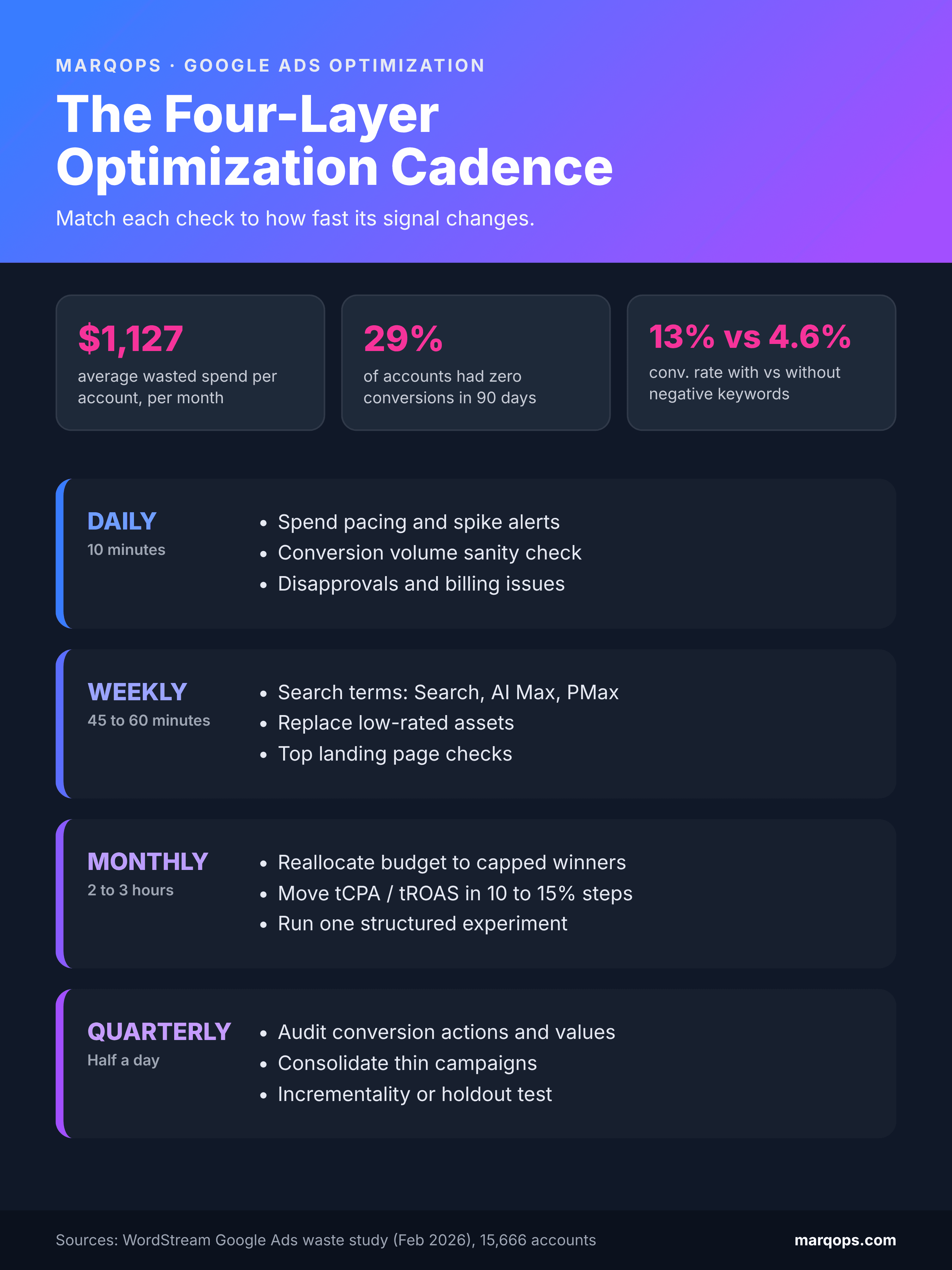
The four-layer Google Ads optimization cadence: match each check to how fast its signal changes.
The Seven Levers That Move Results
Within that cadence, these are the levers that consistently produce the biggest gains, roughly in order of impact for most accounts.
1. Conversion data quality
Every automated bid is only as good as the conversion signal behind it. Count unique leads rather than every page load, assign values that reflect real business worth, and import offline conversions (qualified leads, closed deals) so the system learns which clicks turn into revenue. Enhanced conversions and consent mode keep the signal intact as cookies fade.
2. Bid strategy fit
Match the strategy to the data you have. Maximize Conversions works for building volume; tCPA and tROAS need steady conversion flow to stay stable. For lead generation with long sales cycles, Google's new journey-aware bidding (more on it below) is designed to learn from the full set of conversion goals, not just the one you bid on.
3. Query control
Broad match and AI Max widen your reach. Negative keyword lists, brand exclusions, and URL rules keep that reach relevant. The WordStream data above shows how much a basic negative list matters: accounts with negatives converted at nearly three times the rate of accounts without them.
4. Creative volume and quality
Responsive search ads, Performance Max asset groups, and Demand Gen all mix and match assets. More strong, distinct options give the system more combinations to test. This is where most teams are bottlenecked, because producing on-brand headlines, images, and videos at the pace automation consumes them is hard. Our guides on creative analytics and dynamic creative optimization cover how to measure what is working.
5. Landing page experience
Ad relevance gets the click; the page earns the conversion. Message match between query, ad, and headline, fast mobile load times, and short forms move conversion rate more than most bid changes. Landing page experience also feeds into Quality Score, which affects what you pay per click.
6. Budget allocation
Campaigns limited by budget while hitting target are the cheapest growth in the account. Campaigns that spend fully but miss target need a tighter target, better creative, or less budget. Review the split monthly, not daily.
7. Account structure
Fewer, better-funded campaigns usually beat many thin ones under automated bidding, because each campaign needs enough conversions to learn. Split campaigns only when goals, margins, or budgets genuinely differ.
2026 Changes That Rewrite the Playbook
Several product changes from the past 18 months directly affect how you run Google Ads optimization. Here is what changed and what to do about each.
Dynamic Search Ads become AI Max in September 2026
Google announced at Google Marketing Live 2026 that Dynamic Search Ads will automatically upgrade to AI Max for Search in September 2026. Google cited a 24% ROAS increase for Lufthansa Group and, for IKEA, a 65% lift in non-branded clicks. Advertisers also reported AI Max routing specific product queries to generic landing pages, a job DSA handled reliably. Action: before the switch, review URL inclusion and exclusion rules and watch landing page reports closely for the first month. Our AI Max guide walks through the settings.
Journey-aware bidding and Smart Bidding Exploration
On May 7, 2026, Google introduced journey-aware bidding in beta for tCPA Search campaigns. It learns from all your conversion goals, not only the ones you bid toward, which suits B2B and lead generation funnels with multiple steps. Google also expanded Smart Bidding Exploration to tROAS Performance Max and Shopping, reporting that Search campaigns using it see 27% more unique converting users on average. Demand-led budget pacing, which shifts spend toward high-demand days, is rolling out to Search and Shopping. Action: make sure your secondary conversion actions are accurate, because the bidder now reads them.
Performance Max is no longer a black box
Through 2025, Google rolled out search terms reporting across all Performance Max campaigns, channel-level performance reporting, campaign-level negative keyword lists (up to 5,000 keywords per list), a doubled limit of 50 search themes per asset group, and demographic and device controls. Action: add PMax to your weekly search terms review, and use channel reporting to see whether spend is flowing to Search, YouTube, Display, or Maps. Our Performance Max guide covers setup in depth.
Ask Advisor and conversational optimization
Google merged Ads Advisor, Analytics Advisor, and the upcoming Merchant Center agent into one Gemini-based interface called Ask Advisor, in beta for English-language accounts. It can diagnose and propose changes conversationally. Treat it like the optimization score: a fast way to surface issues, with a human approving anything that changes spend.
Google Ads Optimization Checklist
Copy this into your team's task tracker and assign an owner to each line.
- Primary conversion actions count unique, business-relevant outcomes, with values assigned.
- Offline or CRM conversions are imported at least weekly for lead generation accounts.
- Auto-apply recommendations are off for bidding, budgets, keywords, and match types.
- Search terms reviewed weekly across Search, AI Max, and Performance Max.
- Account-level negative keyword list maintained and shared across campaigns.
- Every responsive search ad has at least 8 to 10 distinct headlines, and every asset group has fresh images and video.
- Low-rated assets replaced every two to four weeks.
- Bid targets changed no more than once every two weeks, in steps of 15% or less.
- Budget-limited campaigns hitting target reviewed for more budget each month.
- One structured experiment running at all times.
- URL rules and landing page reports checked ahead of the September 2026 DSA to AI Max upgrade.
- Quarterly incrementality or holdout test on the largest campaign.
For reporting this work to stakeholders, our PPC reporting guide separates what you can prove from what you can only show.
Where AI Tools Help (and Where They Do Not)
Google's own AI handles the auction. The work that still eats a paid media team's week sits around it: pulling reports across platforms, spotting anomalies, writing and resizing creative variations, and keeping every asset on brand. That is where third-party AI earns its place.
- Anomaly detection and alerts. Automated monitoring for spend spikes, conversion drops, and disapprovals turns the daily check into a glance at exceptions.
- Creative production. Generating headline and image variations quickly keeps asset groups fresh. The risk is off-brand output, so brand rules need to be built into the generator, not checked afterward.
- Unified reporting. Google Ads, Meta, LinkedIn, GA4, and the CRM rarely agree. A single marketing dashboard makes budget calls faster and less political.
This is the problem MarqOps was built around. Instead of juggling a reporting tool, a creative tool, a brand checker, and an ads manager, MarqOps puts Google Ads management, AI creative, SEO, and analytics in one platform, so one platform replaces 7+ disconnected marketing tools. Its Brand Intelligence DNA keeps every generated headline and image on brand from the first draft, which matters when you are refreshing assets every few weeks, and teams produce content up to 6x faster. For a broader view of automation in paid search, see our guides to AI PPC management and AI for Google Ads.
What AI should not do is set your business goals. Target CPA, acceptable lead quality, brand safety lines, and how much risk to take on new campaign types are judgment calls. Keep those with a person who owns the outcome.
Frequently Asked Questions
What is Google Ads optimization?
Google Ads optimization is the ongoing process of improving campaign results by adjusting conversion tracking, bidding goals, budgets, targeting controls, creative, and landing pages. In 2026 most bids are set by Smart Bidding, so optimization focuses on the quality of the data, guardrails, and creative you give Google's AI, reviewed on a regular daily, weekly, monthly, and quarterly cadence.
What is a good optimization score in Google Ads?
Many practitioners treat 70% or higher as healthy, but the score is not a performance metric. Dismissing a recommendation raises it just as applying one does. Aim for a score where every remaining recommendation has been consciously reviewed, and judge the account on conversions, CPA, and ROAS instead.
How often should I optimize my Google Ads campaigns?
Check for anomalies daily, review search terms and assets weekly, adjust budgets and bid targets monthly, and rebuild structure and measurement quarterly. Avoid changing bid targets more than once every two weeks, because frequent changes keep Smart Bidding in its learning period.
Why are my Google Ads not performing well?
The most common causes are broken or inflated conversion tracking, irrelevant search queries with no negative keywords, stale creative, slow or mismatched landing pages, and campaigns split too thinly for Smart Bidding to learn. WordStream found 29% of accounts recorded zero conversions over 90 days, which usually points to tracking or targeting rather than the market.
Should I turn on auto-apply recommendations?
Only for low-risk categories such as adding assets or fixing hygiene issues. Keep auto-apply off for anything that changes keywords, match types, bid strategies, or budgets, and review experiment results manually before they are promoted. Those decisions depend on margins and lead quality that Google cannot see.
Google Ads optimization rewards consistency more than cleverness. Put the cadence on the calendar, protect your conversion data, keep fresh creative flowing, and let the automation do the auction work it does well.
Keep following the signal