White Label SEO Reports: The 2026 Agency Playbook
White label SEO reports in 2026 need more than a logo swap. What belongs in the report, how to source every claim, build versus buy, and honest pricing benchmarks for agencies reselling SEO.

Search "white label SEO reports" and you get thirty product pages promising the same thing: upload your logo, pick your colors, send a PDF that looks like you made it. All of that is real and all of it is table stakes. None of it explains why a client reads the report, forwards it to their CFO, and renews.
The reason agencies buy white label reporting is not vanity. It is margin. If you resell SEO through a partner, the report is the only part of the engagement the client ever touches. It is the product. And in 2026 that product has to do something reports did not have to do five years ago: prove that the sentences in it are true.
This is a practical guide to building white label SEO reports that hold up. What goes in them, how to source the claims, what to charge, and where the common builds break down.
Contents
- What a white label SEO report actually is
- The economics: why agencies bother
- The trust problem nobody puts on the feature list
- What belongs in the report
- Sorting claims: verified, needs context, unsupported
- Build versus buy in 2026
- Building one in five steps
- Pricing and packaging
- Mistakes that get reports ignored
- Where MarqOps fits
- Frequently asked questions
- The bottom line
What a white label SEO report actually is
A white label SEO report is a performance document delivered under your agency's brand, built from data and often from work that came from somewhere else. Three things usually get relabeled: the tooling that produced the numbers, the fulfillment partner that did the work, and the template that arranges it all on a page.
Two adjacent terms get confused with it constantly, so it is worth separating them.
White label SEO services means an outside team performs the work and you resell it. The global market for that was valued at roughly $1.68 billion in 2025 and is projected to reach about $2.88 billion by 2032, growing near 8.1% annually. White label SEO reporting is narrower: the presentation layer on top of whoever did the work, including your own team. You can run every campaign in house and still need white label reporting, because the data still arrives from Google, from Search Console, from a rank tracker, and from a crawler, each with its own branding.
The economics: why agencies bother
Reporting is the most reliably underpriced activity in agency work. Nobody bills for it directly, everybody does it monthly, and the hours are real.
The estimates vary by source and by how much strategic commentary is included, which tells you something in itself. AgencyAnalytics' 2026 benchmarks report, drawn from 494 agency professionals, puts the average client reporting process near 8.2 hours per client per month. Other industry counts land between 4 and 12 hours per client per cycle, and a Databox survey across 450 agencies found teams spending 12 to 15 hours a week on report preparation overall.
Run that against a portfolio. Fifteen clients at even six hours each is ninety hours a month, or most of a full time salary, spent assembling documents that generate no revenue on their own.
The other half of the economics is retention, and it is the part agencies systematically underrate. SEO retainers churn at roughly 38% annually and PPC at roughly 49%, which are brutal numbers when you have paid to acquire each account. Reporting sits close to the middle of that. One 2026 analysis found agencies using AI assisted narrative reporting saw about 9% annual churn among clients who engaged with those reports, against 31% among clients who did not open them. Correlation rather than proof, but the direction is consistent with what agency leaders say: 80% name strong relationships as the top retention factor and 69% name communication.
A report that nobody reads is not neutral. It is a monthly reminder that the client cannot tell what they are paying for. If you are also tracking the acquisition side, our breakdown of customer acquisition cost is worth putting next to these churn figures, because the two numbers together decide whether a portfolio compounds or leaks.
The trust problem nobody puts on the feature list
Here is what changed in 2026. Report commentary is increasingly drafted by AI, and AI drafts state things confidently whether or not the data supports them.
This stopped being hypothetical this year. In June 2026 KPMG withdrew a report on agentic AI after multiple organizations disputed its claims about their deployments and GPTZero documented widespread citation problems. In May, GPTZero found most citations in an EY Canada report were fabricated. Deloitte Australia partially refunded a government report after AI generated errors, including references to academic papers that do not exist. These are firms whose entire product is credibility.
Marketers already sense the risk. Survey work in 2026 found just 1% of marketers express complete trust in AI output. The problem is that low trust plus high adoption produces the worst possible workflow: an AI writes the narrative, a busy account manager skims it, and the client receives a claim nobody actually checked.
The specific failure mode in SEO reporting is causal overreach. "Our technical fixes drove a 34% increase in organic traffic" is a sentence an AI will happily write from a traffic chart and a task list. The chart shows traffic went up. The task list shows fixes shipped. Neither shows causation, and if the client's competitor also gained traffic that month because a seasonal query spiked, you have staked your credibility on something a five minute check would have disproven.
What belongs in the report
Most white label SEO reports are too long and say too little, because they default to dumping every metric a connector exposes. A report earns attention by answering four questions in order: what happened, why, what it means for the business, and what happens next.
| Section | What it answers | Primary source |
|---|---|---|
| Executive summary | What changed and what we are doing about it | Written by a human, sourced from everything below |
| Organic visibility | Clicks, impressions, average position by query group | Search Console |
| Rankings | Movement on tracked commercial terms | Rank tracker |
| Traffic and engagement | Sessions, engaged sessions, landing page performance | GA4 |
| Conversions and pipeline | Goal completions, assisted conversions, revenue where available | GA4 plus CRM |
| Technical health | Crawl errors, index coverage, Core Web Vitals | Search Console, crawler, CrUX |
| Content and links shipped | What the retainer actually produced | Your project tracker |
| AI and answer engine visibility | Citations and mentions in AI answers | GEO tracking tools |
| Next 30 days | The specific next actions and why | Written by a human |
That last row on AI visibility is the newest and the one most templates still lack. It is also the fastest growing line item a white label partner can offer in 2026, precisely because supply has not caught up with demand. If you are adding it, start with our guides to AI visibility and answer engine optimization, and check where a client currently stands with the free LLM mention checker.
For the technical health section, do not paste a crawler export. Pull the handful of findings that changed and tie each to an owner. Our technical SEO audit checklist covers what is worth flagging, and the 40 point free SEO audit checklist works well as the once a quarter deep pass that feeds the monthly summary.
Sorting claims: verified, needs context, unsupported
This is the part that separates a report that survives a CFO conversation from one that does not, and it costs nothing to adopt.
Before a report goes out, take every material claim in the narrative and sort it into one of three buckets.
Verified. The claim restates something the source data directly shows. "Organic clicks rose from 4,210 to 5,680 month over month" is verified if Search Console says so. Attach the source and the date range, and move on.
Needs context. The claim is defensible but incomplete without a qualifier. "Rankings improved across our target cluster" is fine if you also note that two of the fourteen tracked terms fell, or that the improvement coincided with a competitor deindexing a category page. Correlation is present, causation is not established, and saying so out loud builds more credibility than glossing over it.
Unsupported. The claim asserts something the data cannot show. Causal language is the usual culprit, followed by revenue attribution that the tracking setup was never capable of proving. These should not ship. Either gather the evidence or rewrite the sentence.
Running this sort takes about ten minutes on a monthly report once you have the habit. It also changes how the team writes, because people stop drafting sentences they know will get flagged. If your attribution model is the weak link in the unsupported bucket, our multi touch attribution guide and the piece on incrementality testing cover how to earn the causal claims rather than assert them.
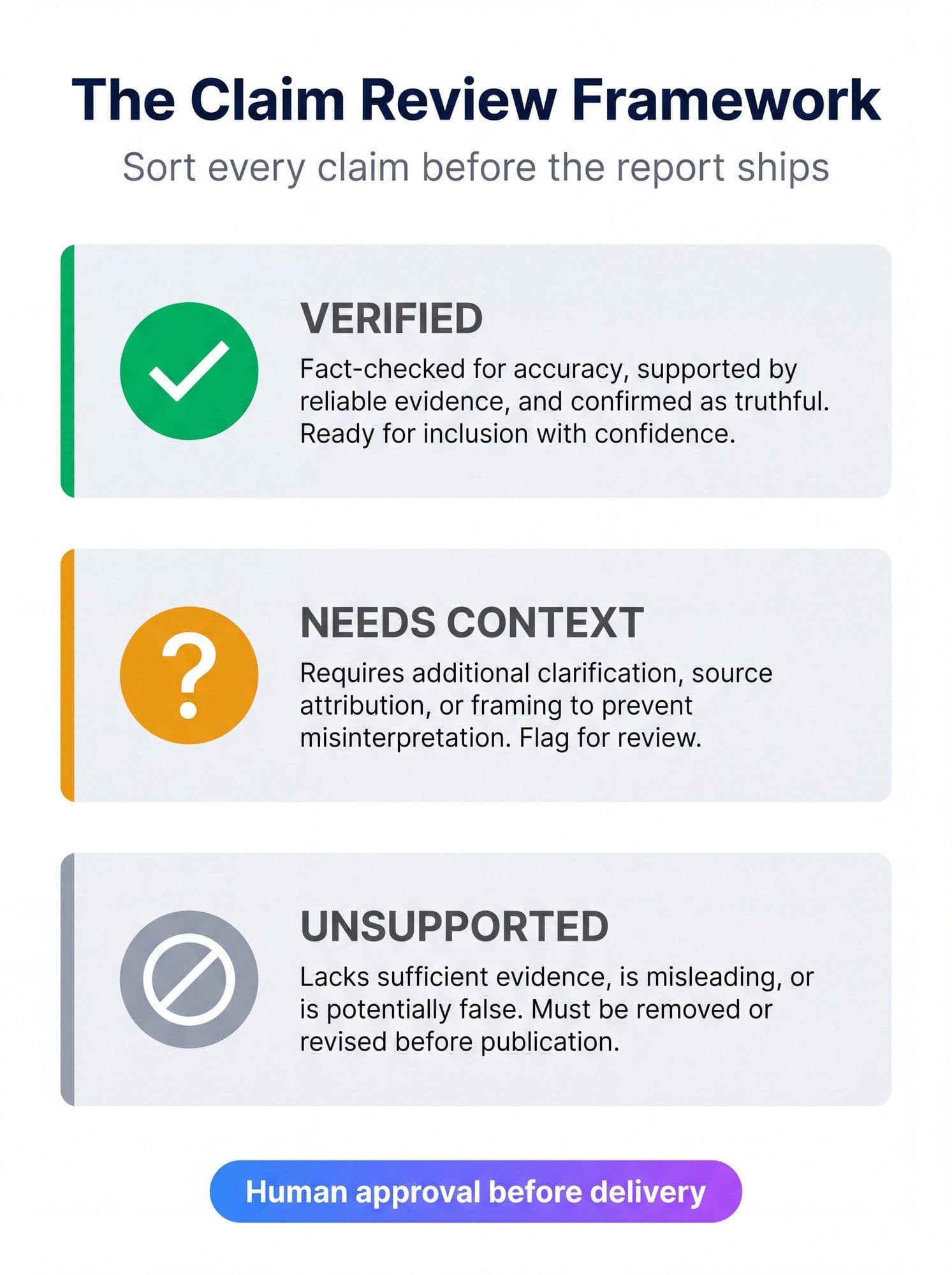
Every material claim in a client report sorts into one of three tiers before it ships.
Build versus buy in 2026
There are three viable paths and the right one depends almost entirely on client count and how much of your time is billable.
| Approach | Real cost | Best for | Where it breaks |
|---|---|---|---|
| Looker Studio templates | Free platform, plus connector fees and your build time | Technical teams under 10 clients with custom needs | Maintenance. Every connector change is your problem |
| Dedicated reporting tool | Roughly $60 to $400 a month by client count | Agencies running 10 to 50 clients on repeatable templates | Narrative is still manual, and dashboards go unopened |
| Evidence layer on top of your data | Subscription, sits above your existing dashboard | Teams whose bottleneck is the write up, not the charts | Requires connecting sources rather than pasting screenshots |
Looker Studio deserves a fair hearing because it is free and it genuinely white labels: a report level logo appears on every page automatically, theme colors take a few minutes, and connectors exist for GA4, Search Console, and most SEO platforms. The limitation is operational rather than technical. You build and maintain everything, connector costs accumulate, and the tool assumes a person with time to configure it. It is the right answer for a data capable team that wants to own a template forever. It is the wrong answer if you are trying to buy your time back.
Dedicated reporting tools solve the assembly problem well. AgencyAnalytics leads adoption at roughly 35% of surveyed agencies, followed by Looker Studio near 28% and Databox near 15%. What none of them solve is the sentence at the top of page one, which is the only part most clients read. We compared the broader category in the round up of agency marketing ops platforms, and the marketing reporting software breakdown goes deeper on individual tools.
Building one in five steps
1. Connect the sources, do not export them. Screenshots and CSV pastes are where reporting time disappears and where numbers drift out of sync. Connect Search Console, GA4, and Google Ads once per client and let the report pull. Anything you paste manually you will have to re verify manually.
2. Standardize one template across the portfolio. Per client bespoke layouts feel attentive and cost you the ability to automate. Build one structure, allow a client specific section at the end, and hold the line. This is the same argument as any other marketing workflow automation decision: variance is what makes work unautomatable.
3. Define the metric set before the first report, with the client. Agree on which five to eight numbers define success and write them into the scope. Reports fail when the client is grading you on a metric you were not optimizing for. Our guide to marketing KPIs is a reasonable starting menu.
4. Draft the narrative from the data, then run the claim sort. Let AI assemble the first pass so a human is editing rather than staring at a blank page. Then apply the verified, needs context, unsupported buckets from above. Ten minutes here is the difference between a report that survives scrutiny and a KPMG situation at agency scale.
5. Ship on a fixed cadence and make it easy to open. Most agencies in 2026 pair a lightweight weekly or biweekly async update, usually a dashboard link, with a full monthly report. Sixty three percent now do something along those lines. The monthly document should open in a browser without a download.
Pricing and packaging
If you are reselling white label SEO alongside the reporting, the 2026 benchmarks are reasonably well established. Wholesale rates run roughly $300 to $900 a month for local SEO, $900 to $2,500 for mid market accounts, and $2,500 to $6,000 or more for ecommerce and enterprise scopes. Agencies typically resell at two to three times wholesale, landing in a 45% to 65% gross margin band.
| Tier | Typical wholesale | Typical retail | Reporting depth |
|---|---|---|---|
| Local | $300 to $900 / mo | $600 to $900 / mo | Monthly PDF, local pack and GBP focus |
| Growth | $900 to $2,500 / mo | $1,200 to $1,800 / mo | Monthly report plus live dashboard link |
| Premium | $2,500 to $6,000+ / mo | $2,200 / mo and up | Weekly async updates, monthly narrative, quarterly strategy |
Two pricing notes that matter more than the table. First, do not itemize reporting as a line item. The moment it appears as a cost the client will ask you to remove it, and you will still have to do it. Price it into the retainer as part of the deliverable. Second, reporting depth is a legitimate tier differentiator. Weekly updates and a quarterly strategy session are worth real money and are far cheaper to deliver than more link building.
Mistakes that get reports ignored
Leading with rankings. Rankings are an input. Clients care about traffic, leads, and revenue. Put rankings on page three as supporting evidence for a business outcome, not on page one as the outcome itself.
Sending a dashboard instead of a report. A live dashboard is a reference tool. It answers questions the client already knows to ask. A report tells them what to ask about. Dashboards that go unopened are the leading indicator of a client who is about to leave.
Reporting only the good months. Skipping or softening a bad month destroys more trust than the bad month does. Name the decline, explain the cause, state the correction. Clients who have seen you report honestly on a loss will believe you on a win.
Branding the PDF but not the plumbing. Check the file metadata, the footer, the email sender domain, and the share link. Vendor names leak through all four.
Letting the narrative outrun the data. Covered above, and worth restating because it is the failure with the highest cost. One unsupported causal claim that a client's analyst disproves will color how they read every report you send afterward.
Ignoring the paid side. Most SEO clients also run ads, and a report that stops at organic misses half the picture. If you are folding paid into the same document, the Google Ads audit framework and the marketing dashboard guide cover what belongs alongside the organic sections.
Where MarqOps fits
MarqOps was built around the claim sorting problem specifically. It sits above whatever dashboard you already use as an evidence layer: connect Search Console, GA4, Google Ads, or upload a CSV, and every material claim in the report is traced to a source and held for human approval before it reaches a client. Claims come back marked verified, needs context, or unsupported, with a source receipt attached to each. Unsupported claims are blocked from delivery rather than quietly shipped.
Around that sit the other three modules the same team usually needs: SEO Ops for research through publish ready content, Analytics Ops for plain language questions against connected data, and Ad Ops for traffic light campaign risk and search term review. White label portfolio reports are on the Agency plan at $49 a month.
You do not have to take that on faith. The interactive sample report shows the evidence receipts on a real document, and there is a seven day trial with no card required.
See verified reporting in action
Frequently asked questions
What is a white label SEO report?
It is an SEO performance report delivered under your agency's brand rather than the brand of the tool or partner that produced the data. Your logo, your colors, your domain on the share link, with no vendor identifiers in the footer, the file metadata, or the sending address.
Is white label SEO reporting the same as white label SEO services?
No. White label services means an outside team does the SEO work and you resell it. White label reporting is only the presentation layer, and you need it whether the work is outsourced or done in house, because the underlying data still arrives branded by Google and your tool stack.
How often should agencies send SEO reports?
A monthly narrative report is the standard, and about 63% of agencies now pair it with a lighter weekly or biweekly async update, usually a dashboard link. Weekly full reports create noise, because most SEO signals do not move meaningfully inside seven days.
Can you build white label SEO reports in Looker Studio for free?
Yes. Looker Studio costs nothing, supports a report level logo that appears on every page, and connects to GA4 and Search Console natively. The cost shows up as your build and maintenance time plus paid connectors for third party SEO tools, so it suits technical teams with a small client count better than agencies scaling past ten accounts.
How much time does client reporting take?
AgencyAnalytics' 2026 benchmarks put the average near 8.2 hours per client per month, and other industry estimates range from 4 to 12 hours per client per reporting cycle depending on channel count and how much strategic commentary is included. Connected data sources and a standard template remove most of the assembly time but not the narrative time.
Is it safe to let AI write the client narrative?
It is safe as a first draft and unsafe as a final one. Several major consulting firms had reports pulled or refunded in 2026 over fabricated citations and unsupported claims. Ground the draft in your connected first party data, sort every material claim into verified, needs context, or unsupported, and require human approval before delivery.
Should white label SEO reports include AI search visibility?
Increasingly yes. Clients are asking whether they appear in ChatGPT, Gemini, and Perplexity answers, and generative engine optimization is one of the least supplied services a white label partner can offer in 2026. Add citation and mention tracking as its own section rather than burying it in organic traffic.
The bottom line
White label SEO reporting is sold as a branding feature and bought as a time saver, but what it actually decides is whether a client believes you. The logo takes five minutes. The connected data sources take an afternoon. The part that separates agencies with 12% churn from agencies with 45% is whether the sentences at the top of page one are things you can prove.
Pick a template and hold it. Connect the sources instead of exporting them. Sort every claim before it ships. Then price the reporting into the retainer where it belongs, because the report is not overhead. For most SEO engagements, it is the product.
Keep following the signal